

He listened. Then he smiled.
“There’s a ride tomorrow,”
He said. “The Medicine Wheel Run.
Five hundred miles through the Black Hills. No breaks except for gas. It’s kind of a Sturgis legend now.”
“And you think I should do it?”
“These treatments won’t make you young again,” he said, “but they’ll dull the pain.
The rest is up to the stubborn bastard I used to ride with.”
The next morning, I rolled up to the start line. Five hundred riders were there, most young, most full of bravado. Razor and a few club members were already there and were surprised to see me.
The first hundred miles were smooth.
The second hundred took focus. By mile three hundred, bikes were breaking down, and riders were tapping out. My body ached, but the pain wasn’t the hardest part—it was the test of will.
At mile four hundred, I passed Razor.
His bike sat on the side of the road, engine steaming. I nodded as I rode past.
When I finally pulled into the finish line, I was barely upright. My legs shook.
My spine screamed. But I had done it.
Later that night, as the sun dropped behind the hills, Razor found me at the campsite.
“We had another club meeting,” he said. “We voted.
Unanimously. Your patch stays. For life.”
I stared into the fire.
“Why the change of heart?”
“Because today, you reminded us what this is really about,” he said. “Not speed. Not age.
Heart. Brotherhood. Earning your place.”
The next morning, five hundred bikers gathered for the legacy ride.
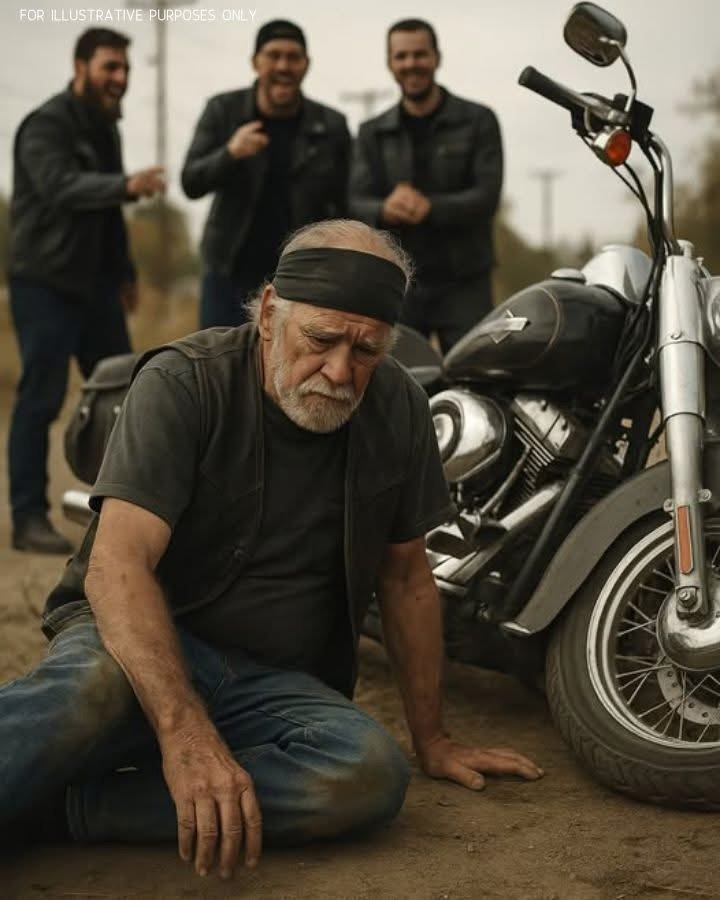
At the front, one old man on a Heritage Softail, his jacket faded with time, carrying fifty years of road stories.
They could’ve passed me. They didn’t.
And me? I still ride.
Slower now, and not as far. My knees ache when it’s cold, and I take more breaks. But every time I throw my leg over the seat, I ride for every brother I’ve lost.
For the road that shaped me. And for a brotherhood that still lives, so long as we remember what it stands for.