

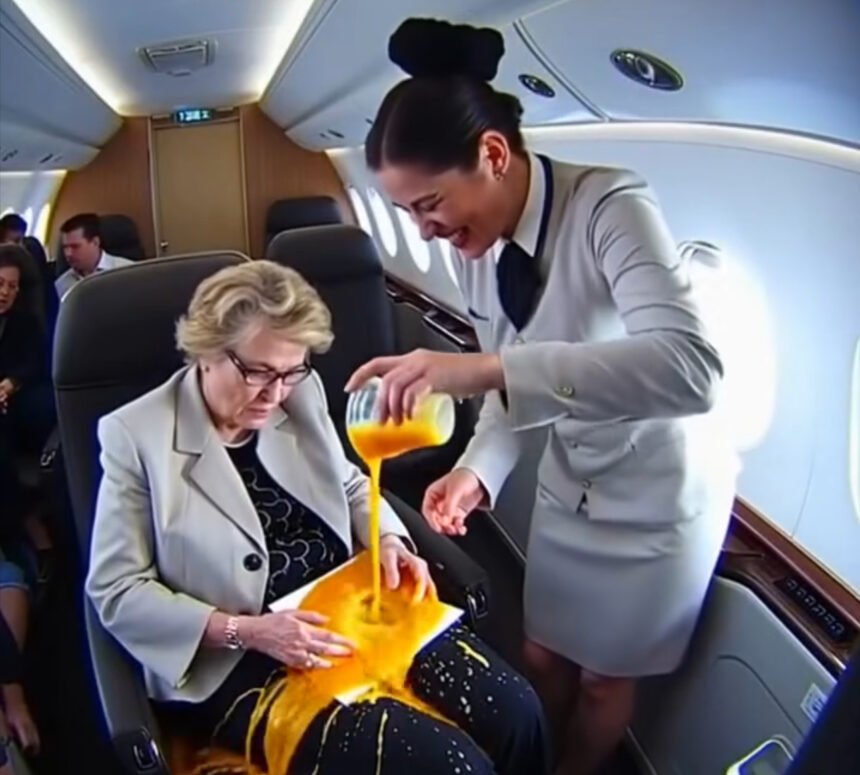
Management saw her glowing performance reviews—reviews she’d carefully cultivated by charming supervisors while terrorizing anyone below her in the hierarchy. She ruled her cabin like a fiefdom, and she’d grown accustomed to passengers who treated her like royalty, tipping generously and praising her service. The few who dared to make demands or, worse, complaints, learned quickly that Victoria Hale did not forget, and Victoria Hale did not forgive.
When she heard the call button from 3A, she felt a flicker of irritation. They hadn’t even pushed back from the gate yet. What could this woman possibly need that couldn’t wait?
She grabbed a small plastic cup, filled it halfway with lukewarm orange juice from the galley cart, and approached with her professional smile firmly in place. “Full beverage service will begin after we reach cruising altitude,” she said, her voice carrying just enough edge to make it clear this wasn’t a negotiation. She placed the orange juice on Eleanor’s tray table with a deliberate clink.
Eleanor looked up from her documents. “I asked for water, please.”
The “please” hung in the air, polite but firm. A few passengers glanced over, sensing something in the exchange.
Victoria’s smile tightened. She hated being corrected, especially by passengers who thought their first-class tickets bought them the right to make demands. “The beverage you’ve been provided is perfectly adequate until service begins.”
“I’m sure it is,” Eleanor replied, her voice still calm.
“But I asked for water. Just water. It shouldn’t be difficult.”
Something in Eleanor’s tone—that unruffled certainty, that complete lack of intimidation—struck a nerve.
Victoria felt her carefully maintained composure crack slightly. This woman wasn’t backing down, wasn’t apologizing, wasn’t showing the deference Victoria had come to expect. “Ma’am, I’ve already explained our policy—”
“And I’ve already explained what I need,” Eleanor interrupted gently.
“A glass of water. That’s all.”
The other first-class passengers were definitely watching now. Victoria felt her face flush.
This woman was making her look bad, making her look like she couldn’t handle a simple request, making her look… common. Victoria reached for the orange juice cup, and with a movement that appeared accidental but was anything but, she tilted it forward. Orange juice splashed across Eleanor’s lap, soaking her expensive suit, the binder of federal documents, and the leather briefcase at her feet.
Gasps rippled through the cabin. “Oh my goodness,” Victoria said, her voice dripping with false concern. “I’m so terribly sorry.
How clumsy of me.” She grabbed a handful of cocktail napkins—thin, useless things—and tossed them onto the spreading mess. “You really shouldn’t have been holding your tray table in that position.”
Eleanor looked down at her ruined suit, at the sticky liquid seeping into documents marked “FAA CONFIDENTIAL,” at the orange juice pooling in her lap. Then she looked up at Victoria with an expression so calm it was almost frightening.
“I need to speak with your captain,” Eleanor said quietly. “Immediately.”
Victoria actually laughed—a short, dismissive sound. “You can file a complaint with customer service when we land.
I’ll even provide you with the form myself.” She turned to walk away, already dismissing the incident, already planning how she’d report this difficult passenger to her supervisor. That was her first mistake. Her final, career-ending mistake.
The Badge
“I said immediately,” Eleanor repeated, her voice unchanged but somehow carrying more weight. She pressed the call button again, holding it down. Victoria spun around, irritation flashing openly across her face now.
“Ma’am, I’ve already told you—”
Eleanor reached into her handbag—a simple leather bag that looked like it could belong to anyone’s grandmother—and pulled out a badge holder. She flipped it open with practiced ease. The badge gleamed in the cabin lighting: Federal Aviation Administration.
The credentials identified her as Eleanor Vance, Senior Aviation Safety Consultant, with authorization codes that would mean nothing to most people but everything to anyone in the industry. The color drained from Victoria’s face. “My name is Eleanor Vance,” she said, her voice now carrying unmistakable authority.
“I am a federal aviation safety consultant. You haven’t just spilled juice on a passenger. You’ve damaged federal property, interfered with an official conducting safety oversight, and demonstrated conduct that raises serious questions about crew professionalism on this aircraft.”
The cabin had gone completely silent.
Every passenger was frozen, watching the scene unfold. A businessman in 2B had his phone half-raised, clearly unsure if he should be recording this. “I… that was an accident,” Victoria stammered, but her voice lacked conviction.
“I didn’t mean—”
“I need to speak with your captain,” Eleanor repeated. “Not in five minutes. Not after takeoff.
Now.”
A younger flight attendant, a woman named Sarah who’d been working in the galley, appeared at Victoria’s elbow. She’d seen the entire exchange. She’d watched Victoria deliberately tilt that cup.
She’d witnessed countless other small cruelties from Victoria over the months they’d worked together. And now, seeing that badge, seeing Victoria’s mask finally slip, she found a courage she didn’t know she possessed. “Captain Morrison needs to know what happened,” Sarah said quietly, but loud enough for nearby passengers to hear.
“All of what happened.”
Victoria shot her a look of pure venom, but Sarah had already moved past her toward the cockpit. The Captain
Captain James Morrison had been flying commercial aircraft for twenty-three years. He’d handled engine failures, severe weather, medical emergencies, and difficult passengers.
But when his junior flight attendant knocked on the cockpit door with unusual urgency, he knew something was different. “Captain, we have a situation in first class. You need to come back.
Right now.”
The tone in Sarah’s voice made him unbuckle immediately. When he stepped into the first-class cabin, he saw the scene: an elegant older woman standing in the aisle, her expensive suit soaked with orange juice, holding an FAA consultant’s badge. His senior flight attendant, Victoria—usually so composed, so professional—looking pale and cornered.
And a cabin full of passengers watching with expressions ranging from shock to fascination. “Captain Morrison,” Eleanor said, extending her hand. “I’m Eleanor Vance, FAA senior safety consultant.
I need to speak with you about an incident that just occurred.”
Morrison’s stomach dropped. He recognized that name. Eleanor Vance was a legend in aviation circles—the inspector who’d grounded three major carriers in the 1990s after discovering systematic maintenance fraud, the woman who’d rewritten safety protocols after that commuter plane crash in Colorado, the consultant airlines both respected and feared.
And she was standing in his first-class cabin, soaked in orange juice, holding credentials that gave her terrifying authority. “Of course, Ms. Vance,” he said, his mind already racing through protocols.
“If you’d like to come to the flight deck—”
“Here is fine,” Eleanor said. “This needs to be documented with witnesses present.”
She began to explain, her voice measured and precise, exactly what had happened. The refused water.
The dismissive response. The deliberately spilled juice. The damaged federal documents.
Victoria tried to interrupt, tried to frame it as an accident, tried to use her usual charm to spin the narrative. But her voice wavered. Her hands shook.
And when Morrison turned to Sarah, the junior flight attendant, her answer was clear and unwavering. “I saw the whole thing, Captain. She poured it on purpose.
Ms. Vance asked for water three times. Victoria refused and then deliberately spilled the juice.”
A murmur ran through the cabin.
Other passengers began nodding, corroborating the account. Morrison’s jaw tightened. “Ms.
Vance, I sincerely apologize. This is completely unacceptable. We’ll—”
“Captain Morrison,” Eleanor interrupted, “I’m going to be clear about something.
Under my authority as an FAA safety consultant, and given the serious nature of this incident—which demonstrates a fundamental breakdown in crew professionalism and judgment—I am officially recommending that this aircraft be grounded for a complete crew review before departure.”
A collective groan of dismay rippled through the first-class cabin. A ground delay meant hours of waiting, missed connections, ruined plans. But Morrison knew he had no choice.
When an FAA consultant made a formal recommendation, especially one with Eleanor Vance’s credentials and reputation, you complied. Immediately. “Understood,” he said.
“I’ll notify ground operations and the tower.”
The massive aircraft, already cleared for takeoff, began its slow, humiliating taxi back to the gate. The Investigation
The jet bridge was crowded when the aircraft door finally opened. Airport security.
Airline management. And two officials from the FAA’s regional office, summoned by an urgent call from Captain Morrison. Eleanor walked off the aircraft first, still wearing her juice-soaked suit, carrying her damaged briefcase and ruined documents.
Victoria followed, flanked by a supervisor, her face ashen. What happened next unfolded with the mechanical efficiency of a federal investigation. Eleanor provided her statement in a private office, clinical and precise.
She described the incident in detail, noting not just Victoria’s actions but her demeanor, her language, her pattern of dismissiveness. She mentioned the junior flight attendant’s courage in speaking up, and she referenced concerns she’d already identified in her pre-visit audit of the airline’s incident reports. “This wasn’t an isolated incident of bad judgment,” Eleanor said to the FAA regional supervisor.
“This was a symptom of a deeper cultural problem. And when I return to my office, my report will reflect that.”
Sarah, the junior flight attendant, was interviewed separately. She was terrified—certain she’d just destroyed her own career by speaking up against Victoria, who had connections throughout the airline.
But the investigators were gentle, encouraging, and when she told them everything she’d witnessed over the months—not just this incident, but others—they listened with grave attention. Other passengers were interviewed. Their accounts were consistent: Victoria had been dismissive, had refused a simple request, and had deliberately spilled the juice.
And then investigators began pulling Victoria’s file. What they found was revealing. Years of glowing performance reviews that seemed at odds with a pattern of passenger complaints that had been quietly dismissed or buried.
Reports from junior crew members about her intimidation tactics, reports that had somehow never made it up the management chain. Expense reports that showed unusually expensive “uniform maintenance” and “professional development” that looked more like personal shopping trips. Victoria had been protected for years by supervisors who either feared her connections or valued her carefully cultivated image over the reality of her conduct.
But federal investigators don’t care about airline politics. They care about safety, about professionalism, about the integrity of the aviation system. By the end of the day, Victoria Hale had been terminated.
Not suspended pending investigation. Not reassigned. Terminated, effective immediately, for gross misconduct.
Her flight attendant credentials were revoked. Her name was flagged in industry databases. Her career in aviation was over.
The Ripple Effect
But the consequences didn’t stop with Victoria. Eleanor’s formal report, filed three days later, was devastating. It documented not just the orange juice incident, but a pattern of systematic failures in oversight, accountability, and crew management.
She noted that Victoria’s behavior had been enabled by supervisors who prioritized image over substance, by a culture that rewarded intimidation over professionalism, by systems that made it nearly impossible for junior employees to report problems without fear of retaliation. The report triggered a broader investigation by the FAA into the airline’s management practices. Within weeks, three supervisors who had protected Victoria and dismissed complaints were fired.
The airline’s vice president of customer experience was forced to resign. The entire flight attendant training program was put under federal review. The airline faced a choice: fight the findings and risk their operating certificate, or embrace comprehensive reforms.
They chose reforms. New policies were implemented requiring all passenger complaints to be investigated by independent third parties. Anonymous reporting systems were established for crew members.
Customer service training was completely overhauled, with an emphasis on respect and professionalism over image management. Senior flight attendants were required to undergo additional training in crew leadership and conflict resolution. And throughout all of this, Sarah—the junior flight attendant who had found the courage to speak the truth—became an unlikely hero.
Instead of being punished for challenging a senior colleague, she was promoted. Her integrity was held up as an example. She became involved in redesigning the training program, ensuring that new flight attendants learned that speaking up wasn’t just acceptable—it was required.
The reforms were expensive, disruptive, and painful. But they worked. Six Months Later
Victoria sat behind the counter of a generic airport coffee shop, watching planes taxi past the enormous windows.
She wore a polyester uniform in teal and brown, a name tag that said “Vicki,” and an expression of permanent bitterness. Every day she watched her former colleagues walk past in their crisp uniforms, rolling their designer luggage, heading to destinations she would never visit again. Some recognized her.
Most didn’t. A few offered sympathetic looks that felt more like pity than compassion. She’d tried to find work at other airlines.
Her resume, once impressive, was now radioactive. The moment hiring managers saw her employment history—terminated for cause, flagged in multiple industry databases—the interviews ended. No airline would touch her.
No aviation company wanted the liability. She’d applied for corporate jobs, retail positions, anything that would let her escape the daily humiliation of working in the airport where she’d once reigned. But her work history had a conspicuous gap she couldn’t explain, and her interview skills—once so polished when she was in a position of power—faltered when she was the supplicant.
So she made lattes. She heated croissants. She smiled at customers who didn’t recognize her and took orders from people who would have begged for her approval six months ago.
The irony was excruciating. She’d built her entire identity around being untouchable, powerful, the woman everyone feared and admired. And it had all collapsed because she couldn’t be bothered to get a glass of water.
One afternoon, a passenger in an expensive suit ordered a cappuccino. As Victoria made the drink, she heard the woman on her phone: “No, I’m telling you, flying has actually gotten better. The crew on my last flight was incredible—professional, attentive, just genuinely kind.
It’s like they completely changed their culture.”
Victoria handed over the cappuccino, her hands steady but her jaw clenched. The passenger didn’t even look at her. Eleanor’s Flight
Six months after the incident, Eleanor boarded another flight on the same airline.
This time, she wasn’t conducting an audit or investigation. She was simply traveling to visit her daughter and new grandson. She settled into seat 3A—the same seat where everything had started—and opened a book.
The flight attendant, a young man with an earnest smile and confident manner, approached almost immediately. “Good afternoon, ma’am,” he said warmly. “Can I get you anything before we take off?
Water, juice, anything at all?”
Eleanor looked up at him. His name tag read “Marcus.” His uniform was impeccable but his demeanor was relaxed, genuine, unforced. This wasn’t someone performing customer service.
This was someone who actually cared. “Water would be lovely, thank you.”
“Still or sparkling?”
“Still is perfect.”
He returned less than a minute later with a proper glass—not plastic—filled with ice water and a slice of lemon. “Here you are.
And if you need anything else during the flight, anything at all, please don’t hesitate to ask.”
Eleanor accepted the water with a genuine smile. “Thank you. That’s very kind.”
As Marcus moved to attend to other passengers, Eleanor noticed something else.
The crew interacted with warmth and respect—toward passengers, yes, but also toward each other. There was no tension, no hierarchy of fear, no sense that anyone was performing for surveillance cameras or worried about arbitrary punishment. This was what change looked like.
Later in the flight, as Eleanor was reading, she noticed Marcus helping an elderly passenger with mobility issues reach the restroom. He was patient, gentle, completely unhurried despite the line forming behind them. When a businessman complained about the wait, Marcus apologized sincerely but didn’t rush the elderly woman.
The dignity of one passenger wasn’t sacrificed for the convenience of another. Eleanor thought about Victoria, about the culture she’d represented, about the arrogance that had seemed so powerful until it collided with accountability. She thought about Sarah, the young flight attendant whose courage had catalyzed everything.
She thought about all the small, daily interactions that happened on thousands of flights, and how they reflected either respect or contempt, either humanity or hierarchy. As the plane began its descent, Marcus stopped by her seat again. “Was everything satisfactory today, Ms.
Vance?”
She looked at him in surprise. “You know who I am?”
He smiled. “Your name was on the manifest, and… well, your story has become part of our training.
In a good way. You helped us become better. Thank you for that.”
Eleanor felt unexpected emotion tighten her throat.
“You’re welcome. But really, I just asked for water.”
“Maybe,” Marcus said. “But you also refused to accept being treated with anything less than basic human respect.
That mattered. That changed things.”
After he walked away, Eleanor sat quietly, looking out the window as the plane descended through clouds. She hadn’t set out to transform an airline or end someone’s career.
She’d just wanted water. Just wanted to be treated with basic courtesy. Just refused to accept humiliation as the price of air travel.
But sometimes the smallest acts of standing up for yourself create the largest ripples of change. The Lessons
The story of Eleanor Vance and the spilled orange juice became legend in aviation circles. It was taught in training programs as a case study in the importance of professionalism.
It was discussed in management seminars as an example of how toxic cultures can collapse when finally confronted with accountability. It was whispered among flight crews as a reminder that passengers aren’t always who they seem, and that basic respect isn’t just good customer service—it’s a fundamental requirement. For Sarah, now a senior flight attendant herself, the lesson was about courage.
She mentored new crew members with the message that speaking up wasn’t career suicide—it was career defining. That integrity mattered more than hierarchy. That the passengers depending on them deserved crews who could trust each other enough to tell the truth.
For the airline’s management, the lesson was expensive but necessary. Creating a culture of fear and image management over substance had seemed profitable—right until the moment it cost them millions in reforms, lost revenue from grounded flights, and damaged reputation. Building a culture of genuine respect was harder, but it proved more sustainable.
For the traveling public, the changes were subtle but meaningful. Requests were met with genuine care rather than dismissive efficiency. Complaints were taken seriously rather than buried.
The experience of flying felt less like navigating a hierarchy and more like being served by professionals who actually cared about their work. And for Victoria, working her shifts at the coffee shop, watching the planes she would never board again, the lesson was the cruelest of all: that power built on intimidation is hollow, that reputations built on fear can collapse in moments, and that one act of petty cruelty can cost you everything you’ve spent years building. On slow days, when the coffee shop was quiet and the afternoon sun slanted through those enormous airport windows, Victoria sometimes thought about that moment.
If she’d just gotten the water. If she’d just swallowed her pride and treated one passenger with basic decency. If she’d realized that the woman in 3A wasn’t someone to be dismissed but someone to be respected—not because of her credentials, but simply because she was human.
But those were thoughts that came too late, after everything had already been lost. The Grandmother and the Grandson
Two years after the incident, Eleanor sat in her daughter’s living room, holding her grandson—now a rambunctious toddler—and telling him a simplified version of the story. “So you see, sweetie, sometimes the most important thing you can do is ask for what you need, and not accept being treated badly.
Even if you’re not powerful, even if you’re scared, even if everyone around you says to just let it go.”
Her daughter, bringing tea from the kitchen, smiled. “Mom, he’s two. He has no idea what you’re talking about.”
“Maybe not now,” Eleanor said, tickling her grandson until he giggled.
“But someday he will. Someday he’ll be in a situation where someone tries to make him feel small, and I want him to remember that he doesn’t have to accept it.”
“Is that what you were thinking when she spilled that juice? That you were teaching a lesson?”
Eleanor considered this.
“No. I was thinking I was very annoyed that my suit was ruined and that I’d asked for something simple three times. The lesson came later, when I realized I had the power to actually do something about it.”
“Do you ever regret it?” her daughter asked.
“That woman lost everything. Her entire career, gone.”
Eleanor looked out the window, thinking. “I regret that it was necessary.
I regret that she put herself in that position. I regret that the airline had created a culture where her behavior was not just tolerated but rewarded. But do I regret holding her accountable?
No. Because it wasn’t just about me. It was about every passenger she’d dismissed, every junior crew member she’d bullied, every person who had been made to feel small because she needed to feel powerful.”
She adjusted her grandson on her lap.
“Besides, I didn’t end her career. She did that herself. I just refused to pretend it hadn’t happened.”
Her daughter nodded, understanding.
She’d heard the stories over the years of her mother’s work with the FAA—the crashes investigated, the lives saved through boring regulatory changes, the constant balance between enforcement and education. Her mother had never been cruel, but she’d also never been willing to look away from problems just because solving them was uncomfortable. “You know what the real victory was?” Eleanor continued.
“Not that one person got fired. It’s that now, thousands of crew members go to work in an environment where they’re taught that respect matters. Where they can speak up without fear.
Where passengers are treated like human beings rather than inconveniences. That’s worth more than any individual punishment.”
Her grandson, bored with the adult conversation, squirmed off her lap to find his toys. Eleanor watched him toddle away, this small person who would grow up in a world slightly changed by what had happened in seat 3A.
The Final Flight
Five years after the incident, Eleanor took her last consulting flight. She was fully retiring now—no more audits, no more investigations, no more anonymous evaluations. She was going to spend her time with family, with her garden, with books she’d meant to read for years.
She boarded the plane with a sense of closure. The crew greeted her warmly. The captain, recognizing her name on the manifest, came back to personally thank her for her years of service to aviation safety.
The flight attendants treated every passenger with genuine care. As they reached cruising altitude and beverage service began, Eleanor requested water. The flight attendant brought it immediately, with a smile, in a proper glass.
Such a small thing. Such a simple courtesy. And yet it represented everything she’d fought for over three decades—the idea that people deserved to be treated with dignity, that systems should protect the vulnerable rather than empower the cruel, that accountability wasn’t punishment but necessity.
She drank her water and looked out the window at the clouds below, thinking about all the flights she’d taken, all the investigations she’d conducted, all the small battles that had added up to meaningful change. One spilled drink had changed an airline. But really, it wasn’t the drink that mattered.
It was the refusal to accept being diminished. It was the courage of a junior flight attendant who told the truth. It was the willingness of an institution to actually reform rather than defend the indefensible.
Eleanor closed her eyes as the plane flew on, carrying her toward retirement and rest, leaving behind an industry just a little bit better than she’d found it. And somewhere, in an airport coffee shop, Victoria made another latte for another passenger who didn’t recognize her, watching planes fly to destinations she would never reach, living daily with the consequences of the moment she’d decided that power was more important than decency. The glass of water should have been nothing more than a simple request.
But it became the moment that proved that respect matters, that accountability has teeth, and that sometimes, the most powerful act of all is simply refusing to be treated as less than human. In the end, that’s what changed everything. Nobody Attended My Son’s Birthday.
Days Later, Dad Texted: ‘Need $2,200 For Your Brother’s Graduation.’ I Sent $1 With ‘Best Wishes.’ Then Changed The Locks. THEN COPS CAME
Family Ignored My Son’s Birthday Party Then Demanded $2,200 for Brother’s Graduation; I Sent $1…
Three days after my five-year-old blew out candles without a single grandparent in sight, my phone lit up: “$2,200 for Tyler’s graduation venue and catering. Send by Friday.” Not a request—a command.
I stared at the text, looked at my son’s new bike leaning by the door, and did the math they never do. I opened my banking app, typed $1, wrote “Best wishes.” Send. That should’ve been the end.
Instead, it was the beginning. When my father arrived the next day with that old “emergency” key, he met a new deadbolt—and a new me. The lock didn’t turn.
His face did. “Open the door.” I left the chain on. “It’s my house.” He reminded me he’d co-signed three years ago.
I reminded him I’d refinanced last month. Deed, mortgage, title—my name only. What followed was the family group chat version of a fire alarm: words like “respect,” “family first,” and “grow up” hurled at me because I wouldn’t bankroll a party after they’d ghosted a child’s birthday.
Then they showed up en masse on my porch—Mom, Dad, both siblings—insisting on a “talk.” I asked them to leave my property. Dad threatened to call the police. “For what?” I asked.
“Trespass works both ways.”
He called. I waited. While the cruiser rolled in, I laid out receipts on my coffee table: certified deed (post-refi), messages confirming they’d attend the party, timestamped photos of a little boy checking the window, and the text demanding $2,200—contrasted with years of “help” they somehow only extend to my brother.
Officer knocked. I stepped outside, closed the door behind me, and handed over the paperwork. My father tried a new story about “concern” and “access to our grandson.” The officer asked a simpler question: “Are you on the deed?” He wasn’t.
“Any court-ordered grandparent visitation?” There wasn’t. She turned to me: “Do you want them to leave?” I did. That should’ve been the end, too.
But the next escalation was worse—and
“You need to help your brother. Family comes first, Mariana.”
I stared at my phone, reading the text message from my father for the third time. The audacity was breathtaking.
My hands trembled as I sat at my kitchen table in Milwaukee, Wisconsin, trying to process what he was asking: $2,200 for my brother’s graduation party. Not a request—a demand. My name is Mariana, and I’m twenty‑nine years old.
I work as a dental hygienist at a busy practice downtown, and I’m a single mother to the most wonderful five‑year‑old boy named Lucas. His father left before he was born—and honestly, that was probably for the best. What wasn’t for the best was my own family’s treatment of us over the years.
I looked across the room at Lucas, who was building a tower with his blocks on the living‑room floor. His dark curls bounced as he concentrated, tongue poking out slightly the way kids do when they’re focused. He had no idea what had happened just three days ago.
Or maybe he did, and he was just better at hiding his hurt than I gave him credit for. Three days ago was Lucas’s fifth birthday party. I had sent invitations to my parents, my brother Tyler, and my younger sister Bethany six weeks in advance.
I called to confirm. I texted reminders. I even offered to pick them up if transportation was an issue—though they all lived within twenty minutes of my house.
The party was supposed to start at two in the afternoon. I had rented a bounce house, ordered a custom superhero cake that cost me a week’s worth of groceries, and invited Lucas’s friends from preschool. I decorated the backyard myself, staying up until midnight the night before, stringing lights and hanging banners.
Lucas kept asking when Grandpa and Grandma were coming. When Uncle Tyler would arrive—he wanted to show them his new bicycle, the one I’d saved for months to buy. Every car that passed, he’d run to the window, pressing his little hands against the glass.
“Are they here, Mama?”
My heart broke a little more each time I had to say, “Not yet.”
By three o’clock, all his friends had arrived. The bounce house was full of squealing children, but my family? Nothing.
Not a call, not a text—complete silence. I called my mother—straight to voicemail. I called my father—same thing.
Tyler didn’t even have his read receipts on, so I couldn’t tell if he’d seen my messages. Bethany, who was twenty‑three and still lived at home with our parents, sent a brief text around four. “Sorry, something came up.”
“Something came up.” That was it.
No explanation. No apology to Lucas. Just those three words.
I smiled through the party, took photos, helped Lucas blow out his candles. But inside, I was dying. Watching him glance at the door every few minutes, hope fading from his eyes each time, was torture.
When the last guest left and I was cleaning up wrapping paper and cake crumbs, Lucas came up to me. His voice was so small. “Mama, did I do something wrong?
Is that why they didn’t come?”
I pulled him into my arms, fighting tears. “No, baby. You didn’t do anything wrong.
Not a single thing.”
But sitting here now, reading my father’s text demanding money for Tyler’s graduation party, I realized something. This wasn’t the first time. It wasn’t even the second time.
This was a pattern. And I had been too blind—or too hopeful, or too desperate for their approval—to see it clearly. Last year, they had also skipped Lucas’s fourth birthday.
My mother claimed she had a headache. My father said he had to work. Tyler didn’t respond at all.
But two weeks later, when Tyler needed money for car repairs, my father called me directly, expecting me to contribute $300 because “that’s what family does.” I had paid it like an idiot. I had paid it. The year before that, they came to Lucas’s third birthday party, but left after twenty minutes because Bethany wanted to go shopping.
They hadn’t even watched him blow out the candles. I looked at my father’s text again. The message was clinical, transactional.
“Tyler’s graduation party is next month. We need $2,200 to cover the venue and catering. Your mother and I are contributing $1,500.
You and Bethany should split the rest. Send $2,200 by Friday.”
The math didn’t even make sense. If they were contributing $1,500 and Bethany and I were splitting the rest, why would I owe $2,200?
But that was typical of my father. Numbers were whatever he needed them to be to get what he wanted. I thought about my savings account—the one I had been building for Lucas’s future, for emergencies, for the security we didn’t have.
$2,200 would wipe out nearly a third of it for a party for my brother—the same brother who couldn’t be bothered to show up for my son’s birthday. Something hardened in my chest. A decision—forming, sharp and clear.
I had spent my entire adult life trying to be the good daughter—the reliable one, the one who showed up and paid up and never complained. Where had it gotten me? Sitting alone at my kitchen table while my son asked if he’d done something wrong.
I opened my banking app and stared at the screen for a long moment. Then I typed in the amount: $1. In the memo line, I wrote, “Best wishes.” I hit send before I could second‑guess myself.
The confirmation screen glowed on my phone. Payment sent: $1. My heart pounded.
I had never defied my father like this. Never. Growing up, he ruled our household with an iron fist disguised as disappointed silence.
He didn’t yell often, but his quiet disapproval could crush you. My mother enabled every bit of it—always siding with him, always making excuses. I grew up in a house where Tyler could do no wrong, and Bethany was the baby who needed protecting.
I was the middle child—the reliable one, the one who didn’t need attention because I could handle things myself. Parentification—I learned later in therapy—the term for when you turn a child into an adult too early. When I was twelve and Tyler was nine, I was the one making sure he had his homework done and his lunch packed.
When Bethany was born, I was fourteen. And suddenly, I had a third shift: making bottles, changing diapers, walking the floors at night when she cried so my parents could sleep. “Mariana’s so responsible,” people would say, and my parents would beam with pride.
What they meant was, “Mariana’s so useful.”
I learned not to ask for help. When I wanted to go to the homecoming dance in high school, my mother said we couldn’t afford the dress. But three months later, Tyler got a brand‑new gaming console for his birthday.
When I graduated high school, we had cake at home. When Tyler graduated two years ago, they threw him a party at a restaurant and invited fifty people. The pattern was so clear now, looking back.
But when you’re living it—when it’s all you know—you think maybe this is just how families work. Maybe you’re asking for too much. Maybe you’re being selfish.
Getting pregnant with Lucas at twenty‑three had been unplanned. His father, a guy I’d dated for four months, disappeared when I told him. My parents’ reaction was predictable: disappointment wrapped in “we’ll support you” statements that never quite materialized into actual support.
They didn’t come to any of my prenatal appointments. Didn’t help me set up the nursery. When I went into labor two weeks early and called my mother in a panic, she said she couldn’t come to the hospital because she had plans with Bethany.
I had Lucas alone. Well, not entirely alone—a wonderful nurse named Patricia held my hand through the worst of it—but no family. No one who was supposed to love me unconditionally.
After Lucas was born, things got slightly better. My parents would visit occasionally, bring small gifts. They liked showing pictures of their grandson to their friends.
But the deeper issues remained. Every family gathering was structured around what Tyler needed, what Bethany wanted. Lucas and I were afterthoughts.
When Lucas was eighteen months old, my car broke down. I called my father because I didn’t know what else to do. The repair estimate was $800—money I didn’t have.
He lectured me for twenty minutes about financial responsibility before finally agreeing to lend me the money. Lend, not give. I paid him back in full within six months, even though it meant eating rice and beans for weeks.
Two years later, Tyler totaled his car driving drunk. My father paid for the replacement vehicle outright—$12,000—just like that. Tyler never paid him back.
When I asked my mother about the double standard, she said, “Tyler’s going through a hard time. He needs our support.” And apparently, I didn’t. I had tried to talk to them about it once—about a year ago.
I sat them down and explained how their favoritism hurt, how I felt invisible, how Lucas deserved grandparents who showed up for him. My father listened with his arms crossed, face impassive. When I finished, he said, “You’ve always been too sensitive, Mariana.
We treat all our children the same.” My mother nodded along. “You’re imagining things. We love you all equally.”
Gaslighting—another therapy term I learned later.
After that conversation, I stopped trying to fix things. I maintained basic contact, sent obligatory birthday cards, showed up to holiday dinners, but I stopped expecting anything. Stopped hoping they’d suddenly see Lucas and me as worth their time and energy.
Still, some stupid part of me had hoped they’d come to his birthday party. I had explicitly told them how much it meant to Lucas—how he talked about it for weeks, how excited he was to show them his new tricks on the monkey bars. They couldn’t even send a text until four hours after the party started.
Now, sitting in my kitchen with that $1 payment confirmation on my screen, I felt something shift. Not just anger—though there was plenty of that—something colder, more calculated. I had been playing by their rules my entire life, and it had gotten me nowhere.
Maybe it was time to make my own rules. My phone buzzed. A text from my father.
“Mariana, I don’t see the full payment. There must be a mistake with your bank. Please resend $2,200.”
I almost laughed.
There was no mistake—but he couldn’t even conceive of the possibility that I had sent exactly what I meant to send. I didn’t respond. Instead, I opened my contacts and scrolled to a number I’d saved six months ago but never called—a real‑estate attorney named Gregory, who had helped my coworker with a property dispute.
Because there was something my parents didn’t know—something I had been quietly working on since Lucas’s fourth birthday party, when they first showed me exactly how little we mattered. The house I lived in—the one I’d been making payments on for three years—wasn’t just in my name. Legally, it had been jointly owned by my father and me.
He’d co‑signed the mortgage when I was twenty‑six, just after Lucas was born, supposedly to help me qualify for better rates. At the time, I’d been grateful—naive. I didn’t realize it was another form of control.
Six months ago, after that conversation where they told me I was too sensitive, I’d started researching my options. I learned that I could refinance the house in my name alone if I could prove sufficient income and creditworthiness. It would cost money I didn’t have easily available, but I’d been saving—cutting every possible expense.
Three months ago, I’d met with Gregory. He reviewed my finances and told me it was possible—difficult, but possible. Two months ago, I’d started the refinancing process.
I’d told no one, not even my closest friend, Destiny. This was my secret—my safety net, my escape route. And one month ago, the paperwork had gone through.
The house was mine—solely, completely mine. My father’s name was off the deed, off the mortgage, off everything. He just didn’t know it yet.
I had been waiting for the right moment to tell him. Or maybe I’d been waiting to see if he’d give me a reason to tell him. He just had.
I texted Destiny. “Are you free tonight? Need to talk.”
She replied within seconds.
“Always. Come over after you put Lucas to bed. Wine is already breathing.”
Destiny had been my friend since college.
We’d met in a biology class, bonded over terrible cafeteria coffee, and somehow stayed close through all the chaos of our twenties. She was the only person who really understood my family situation because she’d witnessed enough of it firsthand. She’d been at Lucas’s birthday party three days ago.
She’d seen him waiting by the window. She’d helped me hold it together when I wanted to fall apart. That evening, after I’d given Lucas his bath and read him two stories and promised him that yes, we could go to the park tomorrow, I drove the fifteen minutes to Destiny’s apartment.
She opened the door before I could knock—two glasses of wine already poured. “Okay,” she said, pulling me inside. “What happened?
You have that look.”
“What look?”
“The ‘I’m about to do something either brilliant or crazy’ look.”
“Maybe both.”
I sat on her couch and told her everything—the text from my father, the $1 payment, the house refinancing she didn’t even know about. When I finished, she was staring at me with wide eyes. “You already took him off the deed?
When?”
“Last month. I’ve been sitting on it—waiting to see if they’d actually show up for Lucas this year. They didn’t.
And now my father wants $2,000 for Tyler’s party like nothing happened.”
Destiny took a long drink of wine. “What are you going to do?”
“I don’t know yet. But I’m done.
I’m done being the one who bends. Done being the one who pays up and shows up while getting nothing in return.”
“They’re going to lose their minds when they find out about the house.”
“I know.”
“Your father especially. He uses that co‑signature as leverage, doesn’t he?”
She was right.
Every time I’d pushed back on something over the past three years, my father would make some comment about “the house we helped you get” or “the financial support we provided.” It was his trump card—his reminder that I owed them. Except I didn’t. Not anymore.
“I’m thinking about changing the locks,” I said quietly. Destiny set down her wineglass. “Do you think they’d actually show up and try to use a key?”
“My father has a spare key.
He insisted on it when he co‑signed. Said it was for emergencies—but he’s used it before. Twice that I know of.
Once he let himself in while Lucas and I were at the grocery store because he wanted to ‘check my water heater.’ Didn’t ask permission—just did it.”
“That’s not okay.”
“I know. I didn’t fight it because I thought it would cause a huge argument and I was trying to keep the peace. But there’s no peace anymore.
There’s just me—being used.”
Destiny reached over and squeezed my hand. “Change the locks. Tomorrow.
I’ll come with you to the hardware store. We’ll make a day of it.”
I felt tears prick my eyes. “Thank you.”
“For what?”
“For not telling me I’m overreacting.
For not saying ‘they’re still my family and I should forgive them.’”
“Mariana, they ghosted a five‑year‑old’s birthday party— their own grandson—and now they want money from you. No. Absolutely not.
You don’t owe them forgiveness. You don’t owe them anything.”
We talked for another hour. She helped me think through the practical steps.
Change the locks. Document everything—every text, every missed event, every broken promise. Prepare for backlash—because there would be backlash.
My father didn’t handle defiance well. The next morning—Saturday—Destiny picked me up at nine. Lucas was at a playdate with his best friend from preschool—a standing weekend arrangement that gave me a few hours to handle adult tasks.
We went to the hardware store and bought new deadbolts for both the front and back doors. The guy at the counter—an older man with kind eyes—showed us how to install them. “Easy enough,” he said.
“Anyone can do it with a screwdriver in about twenty minutes.”
Back at home, I changed both locks. The physical act of removing my father’s key from the equation felt symbolic. Every turn of the screwdriver was a small revolution.
When I finished, I stood on my front porch and looked at the new brass deadbolt. My house. My locks.
My rules. My phone buzzed with another text from my father. “Mariana, it’s been two days.
I need that money transferred by tomorrow or we can’t confirm the venue for Tyler’s party. Stop playing games.”
Playing games—as if my entire life wasn’t a game to them. One where the rules kept changing to benefit everyone but me.
I texted back: “I sent what I could afford. Best wishes to Tyler.”
Three dots appeared immediately, showing he was typing. They disappeared.
Appeared again. This happened four times before his response finally came through. “What you sent was insulting.
Your brother deserves better than your petty behavior. We’ll discuss this in person. I’ll be by your house tomorrow at noon.”
My heart rate spiked.
Tomorrow was Sunday. Lucas would be home. I didn’t want him to witness whatever confrontation was coming.
I texted Destiny. “My father is coming here tomorrow at noon. Can Lucas stay with you for a few hours?”
Her response was immediate.
“Absolutely. Bring him over at 11:00. We’ll make cookies.”
I made another decision right then.
I called Gregory, the real‑estate attorney. He answered on the third ring. “Hi, Gregory.
It’s Mariana. We spoke a few months ago about the house refinancing.”
“Of course. Is everything all right with the paperwork?”
“The paperwork is fine.
But I think I’m going to need legal documentation proving the house is solely in my name now—something official I can show someone if needed. Can you help with that?”
There was a pause. “Is someone disputing your ownership?”
“Not yet, but they might try.
And I want to be prepared.”
“I can have certified copies of the deed and mortgage documents ready by Monday morning. I’ll also draft a letter summarizing the ownership transfer, if you think that would help.”
“That would be perfect. Thank you.”
After I hung up, I sat in my quiet house and let myself feel the fear—because I was scared.
Terrified, actually. I was challenging my father’s authority for the first time in my life, and I knew he wouldn’t take it well. But I was also exhausted.
Exhausted from trying to earn love that should have been freely given. Exhausted from watching my son’s face fall every time my family chose not to show up. Exhausted from being the designated family doormat.
Something my therapist had said once came back to me: “You can’t control how other people treat you. You can only control how you respond.” I was responding. Finally.
That night, I lay in bed and thought about what would happen tomorrow. My father would show up expecting to lecture me, expecting me to cave and transfer the money like I always did. He’d probably threaten to use his key if I didn’t answer the door quickly enough.
Except he wouldn’t have a key that worked anymore. And the house he thought gave him power over me was no longer his to claim. I didn’t sleep much.
Every time I closed my eyes, I imagined the confrontation—his anger, my mother’s tears, the accusations of being ungrateful, selfish, a bad daughter. But then I’d think of Lucas asking if he’d done something wrong, and the fear would transform into something harder: determination. Sunday morning, I took Lucas to Destiny’s apartment.
I packed his favorite toys, some snacks, and told him he got to have a special cookie‑making day with Auntie Destiny. “Why can’t you stay, Mama?” he asked. “I have some boring grown‑up stuff to handle at home, but I’ll pick you up in a few hours and we’ll get ice cream, okay?”
His face lit up.
“Okay!”
Destiny gave me a hug at the door. “You’ve got this. Call me if you need backup.”
“I will.”
I drove home with my hands shaking slightly on the steering wheel.
At 11:45, I made sure all the curtains were closed. I didn’t want my father seeing inside. Didn’t want him to think he had any right to my space.
At exactly noon, I heard a car pull into my driveway. Through the peephole, I watched my father get out—my mother in the passenger seat, staying put. Typical.
She’d let him handle the confrontation, then claim later she had tried to keep the peace. He walked up to my front door with the confidence of someone who expected to be obeyed. I watched him knock—counted to ten—knocked again, harder.
Then I watched him reach into his pocket and pull out a key. I watched through the peephole as my father inserted the key into the lock. He turned it once, twice.
His face registered confusion when the lock didn’t budge. He tried again, jiggling the key more forcefully. Nothing.
He stepped back, examined the key as if it had somehow transformed into the wrong one, then tried the lock again. I could see the exact moment realization hit. His jaw clenched.
His face darkened. He pounded on the door. “Mariana, open this door right now.”
I took a deep breath and opened it, leaving the chain lock engaged so only a few inches of space showed between us.
“Hi, Dad.”
His eyes went to the chain, then back to me. “What’s going on? My key doesn’t work.”
“I changed the locks.”
Silence.
Complete, stunned silence. I watched him process this information—watched his expression shift from confusion to anger. “You changed the locks to your house without telling me?”
“It’s my house.
I can change the locks whenever I want.”
His face was turning red now. “I co‑signed that mortgage. I have a right to access.”
“You co‑signed the original mortgage three years ago.
I refinanced last month. Your name isn’t on anything anymore, so no—you don’t have a right to access.”
I had never seen my father look quite so shocked. His mouth opened and closed like he couldn’t find words.
Behind him, I could see my mother getting out of the car now, clearly sensing something was wrong. “You refinanced?” he finally managed. “When?
Why wasn’t I informed?”
“I wasn’t required to inform you. It’s my property.”
“Mariana, what has gotten into you? First you send an insulting dollar to your brother.
Now you’re changing locks and going behind my back with legal matters.”
“I didn’t go behind your back. I handled my own business. There’s a difference.”
My mother reached the porch.
“What’s happening, Gary? Why are you shouting?”
“Your daughter has apparently lost her mind. She changed the locks and refinanced the house without telling us.”
My mother’s eyes widened.
She looked at me with an expression I couldn’t quite read. “Mariana, honey, why would you do that?”
“Because it’s my house and I wanted new locks.”
“But your father has always had a key for emergencies.”
“There won’t be any emergencies that require him to let himself into my home unannounced.”
My father’s voice rose. “This is about the money, isn’t it?
You’re throwing a tantrum because I asked you to contribute to your brother’s graduation party.”
“You didn’t ask—you demanded. And you demanded it three days after you all skipped Lucas’s birthday party without even a phone call.”
“We explained that your mother had a migraine.”
“And Tyler? Bethany?
What were their excuses?”
My mother jumped in. “Bethany had a work thing, and Tyler was busy with finals.”
“Finals ended two weeks before Lucas’s party. I know because Tyler posted about being done with school all over social media.”
My father stepped closer to the door and I instinctively stepped back—even though the chain held.
“You’re being incredibly selfish right now. Your brother’s graduation is a major milestone. The party is important to him.”
“And my son’s fifth birthday wasn’t important?”
“That’s different.
Lucas is a child. He doesn’t understand these things yet.”
The words hung in the air like poison. My hands trembled with rage.
“Get off my property.”
My father’s eyes narrowed. “Excuse me?”
“You heard me. This is my house, my property, and I’m asking you to leave.”
“Mariana, let’s just calm down and talk about this,” my mother said—her voice taking on that placating tone I knew so well.
“We’re family. We don’t need to be so hostile.”
“You’re right. We are family—which is why you should have shown up for your grandson’s birthday.
Which is why you should have called to apologize instead of demanding money from me three days later.”
“We’re asking for help with a family celebration,” my father said. “That’s what families do. They help each other.”
“Then where was my help when Lucas was born?
Where was my help when my car broke down and you made me pay back every penny? Where was my help when I was working double shifts just to afford diapers—and you bought Tyler a $12,000 car?”
My mother flinched. “We’ve always treated you all fairly.”
“That’s a lie—and you know it.”
My father’s face was pure fury now.
“How dare you speak to your mother that way? We raised you better than this.”
“Did you? Because from where I’m standing, you raised me to accept scraps while Tyler and Bethany got everything.
You raised me to be useful—not loved.”
“That’s not true,” my mother said—her voice cracking. “We love all our children equally.”
“Then prove it. Send me copies of every check you’ve written to Tyler over the past five years—every car payment you’ve covered for him, every credit‑card bill you’ve paid for Bethany.
Let’s add it all up and see if it equals what you’ve given me.”
Silence. Neither of them said a word. “That’s what I thought.”
I started to close the door.
My father slammed his hand against it. “If you don’t open this door right now and have a civil conversation, there will be consequences.”
“What consequences? You can’t threaten me with the house anymore.
You have no power here.”
“We’re your parents. We have every right to expect respect and support from our daughter.”
“And I had every right to expect my parents to show up for their grandson’s birthday. Guess we’re both disappointed.”
I closed the door, locked the deadbolt, engaged the chain.
Through the wood, I could hear my father shouting. “This isn’t over, Mariana. You can’t treat family this way.”
I walked to the kitchen, my whole body shaking.
I poured myself a glass of water and tried to steady my breathing. Outside, I could hear my mother trying to calm my father down—their voices gradually fading as they presumably returned to their car. My phone started ringing.
My father. I declined the call. It rang again—declined.
A text came through. “You’re making a huge mistake. We’re going to fix this whether you like it or not.”
What did that mean?
I stared at the message, feeling uneasy. My father wasn’t someone who made empty threats. Another text—this time from Tyler.
“What the hell is your problem? Dad just called me freaking out. You changed the locks on the house he helped you buy?
That’s messed up.”
I typed back: “The house I bought, that I pay for. That’s now entirely in my name. And maybe if you’d shown up for Lucas’s birthday, we wouldn’t be here.”
Tyler: “Lucas is a kid.
He’ll have plenty of birthdays. My graduation only happens once.”
The audacity was staggering. I didn’t respond.
Within seconds, my phone rang again. Tyler. This time I let it go to voicemail.
Then Bethany called. I declined that too. A group text appeared—one that included my parents, Tyler, Bethany, and me.
My father had started it. “Family meeting tonight at 6:00 at our house. Mariana, you need to be there.
This behavior stops now.”
I stared at the message. The presumption that I would just show up—that I would fall in line like always—made my blood boil. I typed one word.
“No.”
My father: “This isn’t optional.”
Me: “I’m an adult. It’s absolutely optional—and I’m declining.”
Tyler: “Come on, Mariana. Stop being dramatic.”
Bethany: “We just want to talk.
Why are you being so difficult?”
My mother: “Please, honey, let’s work this out as a family.”
I turned my phone on silent and set it face down on the counter. I couldn’t deal with this anymore. Not right now.
I called Destiny. “Can I pick up Lucas in an hour instead of now? I need a minute.”
“Take all the time you need.
He’s having a blast. We’re on cookie number three.”
“Thank you. I’ll explain everything when I get there.”
I sat at my kitchen table and let myself cry.
Not sad tears—angry tears, frustrated tears, relieved tears—all mixed together into a confusing mess of emotion. I had just stood up to my father for the first time in my life. I had set a boundary and enforced it.
But instead of feeling triumphant, I felt terrified—because I knew this wasn’t over. My father’s text had promised consequences, and he always followed through on his threats. What scared me most was that I didn’t know what those consequences might be.
An hour later, I drove to Destiny’s apartment to pick up Lucas. He came running to the door with chocolate on his face and a huge smile. “Mama, we made so many cookies and Auntie Destiny let me put extra chocolate chips!”
I scooped him up, breathing in his little‑kid smell of sugar and soap.
“That sounds amazing, buddy.”
Destiny pulled me aside while Lucas gathered his toys. “How did it go?”
“About as well as expected. He tried to use his old key, realized it didn’t work, and lost his mind.
I told them to leave. Now my entire family is having a meltdown via group text.”
“Let me see.”
I handed her my phone. She scrolled through the messages—her expression growing darker with each screen.
“They’re delusional. Completely delusional. Listen to this—‘We just want to talk.’ No, they want to bully you into compliance.”
“Are you going to the family meeting?”
“Absolutely not.”
“Good.
Don’t give them that power.”
She handed back my phone. “What do you think they’ll do next?”
“I don’t know. That’s what worries me.”
Lucas came bouncing back with his backpack.
“Ready, Mama?”
We said goodbye to Destiny and I drove Lucas home. The whole drive, he chattered about cookies and how Auntie Destiny taught him a new song. His innocence—his joy.
It reminded me why I was doing this. Not for me. For him.
So he’d grow up knowing he deserved better than what I’d accepted. That evening, at exactly six o’clock, my phone exploded with notifications. The family meeting had apparently started without me, and they were not happy about my absence.
Tyler: “Seriously? You’re really not coming?”
Bethany: “This is so disrespectful.”
My mother: “We’re all here waiting for you. Please reconsider.”
My father: “Your absence speaks volumes about your character.”
I didn’t respond to any of it.
Instead, I made dinner for Lucas—chicken nuggets and green beans, his favorite. We ate together at the kitchen table and he told me about a spider he’d seen at preschool last week. “It was this big, Mama.” He spread his hands about two inches apart.
“Wow, that’s huge.”
“Yeah—and Miss Katie said it was a garden spider. And they’re friendly.”
“That’s good to know.”
After dinner, bath time, and two bedtime stories, I tucked Lucas into bed. He looked up at me with those big brown eyes.
“Mama, are we going to have another birthday party for me?”
My heart clenched. “What do you mean, honey?”
“Like a do‑over party since Grandpa and Grandma and Uncle Tyler didn’t come to the first one?”
“Oh, sweetheart.”
I sat on the edge of his bed and brushed his curls back. “We already had your party.
You had all your friends there, and it was so much fun. Remember?”
“Yeah, but… I wanted to show Grandpa my new bike.”
“I know you did.”
“Do you think they’ll come next year?”
I wanted to lie—wanted to protect him from the truth. But I also didn’t want to give him false hope.
“I don’t know, baby. But you know what I do know? I know that you are so loved—by me, by Auntie Destiny, by all your friends.
And that’s what matters.”
He thought about this for a moment. “Okay, Mama.”
“Okay. Now get some sleep.
We have park day tomorrow, remember?”
His face brightened. “Oh, yeah! Can we go on the swings?”
“As many times as you want.”
After he fell asleep, I went to my own room and checked my phone.
Seventeen missed calls. Thirty‑four text messages. All from various family members.
The messages had evolved from annoyed to angry to almost frantic. My mother: “Mariana, please call us. Your father is very upset.”
Tyler: “You’re being a child.
Just apologize and send the money.”
Bethany: “I can’t believe you’re doing this to Mom and Dad. They don’t deserve this.”
My father: “Last chance. Call me by 9 tonight or I’m coming to your house tomorrow and we’re settling this.”
It was 8:45.
I had fifteen minutes to decide if I was going to call him back. I didn’t. At 9:15, my father sent one final text.
“Fine. Have it your way. But don’t say I didn’t warn you.”
I lay in bed that night—anxiety churning in my stomach.
What did he mean? What was he going to do? The next morning was Monday.
I dropped Lucas at preschool and went to work. My dental practice was busy, which was good. It kept my mind occupied.
Between patients, I checked my phone. Nothing from my family. The silence felt ominous.
During my lunch break, I drove to Gregory’s office to pick up the certified documents he’d promised. He handed me a thick manila envelope. “Everything you need is in here—certified copies of the new deed, the refinanced mortgage documents, and a letter from me explaining the ownership transfer with legal citations.
If anyone questions your ownership, this should clear it up immediately.”
“Thank you so much.”
“Can I ask what’s going on? You seem stressed.”
I gave him a brief summary. His expression grew concerned.
“Keep these documents somewhere safe, and if things escalate, don’t hesitate to call the police. Family dynamics can get complicated, but the law is clear. It’s your property.”
I drove back to work with the envelope on my passenger seat, feeling slightly better.
I had proof—legal, certified proof—that the house was mine. The afternoon passed uneventfully. I picked up Lucas from preschool and we went to the park like I’d promised.
Watching him on the swings—hearing his laughter—reminded me what mattered. We got home around 5:30. Lucas went straight to his toy box while I started preparing dinner.
I was chopping vegetables when I heard a car pull into my driveway. Through the kitchen window, I saw my father’s car and my mother’s—and Tyler’s truck and Bethany’s sedan. They were all here.
My stomach dropped. I quickly pulled out my phone and texted Destiny. “My entire family just showed up at my house.
All of them.”
Her response was immediate. “Do you want me to come over?”
“Not yet—but stay on standby.”
I watched as they all got out of their vehicles and approached my front door. My father led the way—my mother beside him.
Tyler and Bethany followed. The doorbell rang. “Who’s that, Mama?” Lucas looked up from his toys.
“Just some visitors, honey. Stay here, okay? Keep playing.”
I walked to the front door and looked through the peephole.
All four of them stood on my porch, looking like an intervention team. I opened the door with the chain still engaged. “We need to talk,” my father said without preamble.
“No, we don’t.”
“Mariana, please,” my mother said. “Let us in. Let’s discuss this like adults.”
“There’s nothing to discuss.
I’m not giving you money for Tyler’s party. The house is in my name. End of discussion.”
Tyler pushed forward.
“Come on. This is ridiculous. Just let us in.”
My father’s voice hardened.
“Mariana, if you don’t open this door right now, we’re going to have a serious problem.”
“I’m not opening the door. You need to leave.”
“This is our grandson’s home, too. We have a right to see him,” my father said.
“Lucas?” my mother called past me. “Lucas, honey, it’s Grandma.”
I felt rage flood through me. “Do not call for my son.
You had your chance to see him at his birthday party. You chose not to show up.”
“We explained that—” Bethany said. “Why can’t you just let it go?”
“Because it’s a pattern, Bethany.
And I’m done pretending it’s okay.”
My father pulled out his phone. “Last chance, Mariana. Open the door or I’m calling the police.”
I blinked.
“You’re calling the police? For what?”
“You’re keeping us from our grandson. That could be considered alienation.”
“That’s not what parental alienation means—and you know it.
I’m asking you to leave my property. That’s my legal right.”
“We’ll see what the police have to say about that.”
I watched in disbelief as my father actually dialed. He was really doing this—really calling the police because I wouldn’t let him into my house.
“Yes, I need to report a situation,” my father said into his phone, his voice taking on a concerned, reasonable tone. “My daughter is refusing to let us see our grandson. We’re at her house now, and she won’t even talk to us properly.
We’re worried about the child’s welfare.”
I couldn’t believe what I was hearing. He was twisting the entire situation—making it sound like I was the problem, like Lucas was in danger. “The address is 2847 Maple Street,” he continued.
“Yes, we’ll wait here. Thank you.”
He hung up and looked at me with satisfaction. “The police are on their way.
Maybe they can talk some sense into you.”
My hands were shaking, but I forced my voice to stay calm. “You’re making a mistake.”
“The only mistake is yours. You’ve forgotten who your family is.
We’re here to remind you.”
I closed the door and engaged the deadbolt. My heart was racing. I had maybe fifteen minutes before the police arrived.
I needed to be prepared. I grabbed the manila envelope from Gregory and pulled out all the documents, laying them on my coffee table where they’d be easy to access. Then I pulled out my phone and opened my Photos app.
I scrolled back three days to Lucas’s birthday party. I had taken so many photos—the decorated backyard, the bounce house, the superhero cake—and timestamps throughout the afternoon. Photos of Lucas by the window—waiting, looking at the driveway, checking the door.
I also had screenshots—every text message from the week before the party where I’d confirmed with my parents, Tyler, and Bethany that they were coming. Every “Yes, we’ll be there” response. Every broken promise—documented.
The group texts from Sunday were there, too. The demands for money. The hostile messages when I refused.
I opened a voice‑recording app and hit record. If the police were coming, I wanted documentation of every word said from this point forward. Lucas came into the living room.
“Mama, why are Grandpa and Grandma outside?”
I knelt down to his level. “They wanted to visit—but now’s not a good time. Some police officers might come by to talk to Mama for a minute, okay?
It’s nothing to worry about—just boring grown‑up stuff.”
His eyes got wide. “Police like the ones with the cars that go wee‑oo, wee‑oo?”
“Exactly like that. But remember—police officers are helpers.
They’re going to help Mama explain something. You just stay in here and play, okay?”
Twelve minutes later, I saw the police cruiser pull up. One officer got out—a woman in her forties with her hair pulled back in a tight bun.
She approached my porch where my family was still standing. I could hear muffled conversation through the door—my father’s voice, animated and concerned; my mother’s softer responses; the officer asking questions. Then there was a knock.
“Ma’am, this is Officer Patricia Keane with the Milwaukee Police Department. Can you open the door, please?”
I took a deep breath, picked up the manila envelope, and opened the door. This time, I removed the chain entirely and stepped out onto the porch, pulling the door closed behind me so Lucas wouldn’t hear.
“Hello, Officer.”
She looked at me carefully. “I’m Officer Keane. Are you Mariana?”
“Yes.”
“Your father called with concerns about his grandson’s welfare and reported that you’re refusing to let family members see the child.
Can you tell me what’s going on here?”
My father started to speak, but Officer Keane held up a hand. “Sir, I’d like to hear from her first, please.”
I took another breath. “My son is fine.
He’s inside playing with his toys. He had his fifth birthday party last week and my parents, brother, and sister were all invited. They confirmed they would attend.
None of them showed up—not even a phone call to say they couldn’t make it. Three days later, my father texted demanding $2,200 for my brother’s graduation party. When I declined, he became hostile.
Yesterday, he showed up here with my mother, and when his key didn’t work because I’d changed the locks on my own home, he became angry. Today, the entire family showed up unannounced. And when I asked them to leave, my father threatened to call the police—which he did.”
Officer Keane’s expression didn’t change, but I saw her eyes shift to my father.
“Is this accurate?”
“That’s a very one‑sided version of events,” my father said. “What she’s not telling you is that I co‑signed the mortgage on this house. I have a vested interest and a right to access.”
“Do you currently co‑own the property?”
“Well, I co‑signed the original mortgage.”
“That’s not what I asked.
Are you currently listed as an owner on the deed?”
My father hesitated. “I’m not sure about the current status.”
I pulled out the documents. “Officer, I refinanced the house last month.
My father’s name was removed from all ownership documents. The house is solely in my name. I have certified copies of the deed and mortgage here, if you’d like to see them.”
Officer Keane took the papers and examined them carefully.
She looked at the dates, the signatures, the official stamps. Then she looked at my father. “Sir, according to these documents, you have no legal ownership of this property.
Is that correct?”
My father’s jaw clenched. “The original mortgage—”
“The original mortgage is no longer relevant. The property was refinanced and is now solely in your daughter’s name, which means she has every right to deny you access and to ask you to leave.”
“But she’s keeping us from our grandson.”
“Is there a custody agreement in place?” Officer Keane asked me.
“No. I have sole custody. Lucas’s father isn’t involved.”
“Have there been any court orders granting grandparent visitation?”
Officer Keane turned back to my father.
“Then she’s well within her rights to determine who has access to her child. There’s no legal issue here. This is family business.”
“My mother interjected.
“Can’t you see she’s being unreasonable? We just want to talk to our daughter and see our grandson.”
“Ma’am, what I see is a woman standing on her own property asking you to leave. That’s her legal right.
If you refuse to leave, you’re trespassing.”
Tyler stepped forward. “This is insane. She’s our sister.
We’re not strangers.”
“Family dynamics don’t override property rights,” Officer Keane said firmly. “Mariana, do you want to press trespassing charges?”
I looked at my family—my father’s red face, my mother’s tears, Tyler’s disbelief, Bethany’s shock. Part of me wanted to say yes—wanted to press charges just to drive home how serious I was.
But another part of me, the part that was exhausted and just wanted peace, couldn’t do it. “No charges. I just want them to leave and not come back unless invited.”
Officer Keane nodded.
She turned to my family. “You heard her. You need to leave this property now.
If you return without her permission, she can call us back and press trespassing charges. Do you understand?”
My father opened his mouth to argue, but Officer Keane’s expression stopped him. “Do you understand, sir?”
“Yes,” he said through gritted teeth.
“Good. I suggest you all leave now.”
I watched as my family slowly walked back to their cars. My mother was crying openly now.
Bethany put an arm around her. Tyler shot me a look of pure disgust before getting in his truck. My father was the last to leave.
He stopped at his car door and looked back at me. “You’re going to regret this, Mariana. You’re throwing away your family over money and pride.”
I met his eyes.
“I’m protecting my son from people who don’t value him. That’s not something I’ll ever regret.”
He got in his car and slammed the door. Officer Keane waited until all the vehicles had pulled away before turning back to me.
“Are you okay?”
“I think so. Thank you for… for listening to both sides.”
“It’s my job. But for what it’s worth—you did the right thing.
Those documents saved you a lot of hassle.” She paused. “Can I give you some advice?”
“Please.”
“Document everything. Keep records of all communication.
If they show up again, call us immediately—and consider getting a restraining order if the harassment continues.”
“I will. Thank you, Officer Keane.”
She handed me her card. “If you need anything, don’t hesitate to call.”
After she left, I stood on my porch for a long moment—just breathing.
My legs felt weak. My hands were still shaking. But I’d done it.
I’d stood my ground. And my family had been forced to leave. I went back inside where Lucas was still playing with his blocks—oblivious to the drama that had just unfolded.
“Is everything okay, Mama?”
I sat down next to him on the floor. “Everything’s okay, buddy. Everything’s just fine.”
The next few days were quiet.
Too quiet. My phone—which had been exploding with messages and calls—went completely silent. No texts from my parents.
No angry calls from Tyler. No guilt‑tripping messages from Bethany. The silence felt worse than the confrontation.
I went to work, picked up Lucas from preschool, made dinners, read bedtime stories. Normal life continued, but I felt like I was waiting for the other shoe to drop. My father’s parting words echoed in my mind.
You’re going to regret this. On Wednesday evening—four days after the police had removed my family from my property—I got a call from an unknown number. I almost didn’t answer, but something made me pick up.
“Hello?”
“Is this Mariana?” A woman’s voice—professional and unfamiliar. “Yes. Who’s calling?”
“My name is Jennifer, and I’m calling from Child Protective Services.
We received a report about your five‑year‑old son, Lucas. I’d like to schedule a home visit to follow up on some concerns that were raised.”
My blood ran cold. “What concerns?”
“I can’t discuss the specifics over the phone, but I assure you this is standard procedure when we receive a report.
Would tomorrow afternoon work for a visit around two?”
My mind was racing. A report? Someone had reported me to CPS—and I knew exactly who.
“Yes. Tomorrow at two is fine. Thank you.”
“I’ll see you then.”
After I hung up, I sat staring at my phone.
My hands were shaking again—but this time with pure rage. My father had actually called CPS on me. He’d reported me as an unfit mother because I wouldn’t give him money and wouldn’t let him control my life anymore.
I called Destiny immediately. “He called CPS on me. My father actually called CPS.”
“What?
Are you serious?”
“A caseworker named Jennifer is coming tomorrow at two for a home visit. They received a report with concerns about Lucas.”
“That’s insane. Lucas is healthy, happy, well cared for.
Anyone with eyes can see that.”
“I know—but I have to prove it now. I have to let a stranger come into my home and inspect how I parent because my father is vindictive enough to weaponize the system against me.”
Destiny was quiet for a moment. “Okay, here’s what we’re going to do.
You’re going to clean your house tonight—make sure everything is organized, safe, and tidy. Tomorrow, before the caseworker arrives, I’m coming over. I’m bringing documentation.”
“What kind of documentation?”
“Lucas’s preschool records showing perfect attendance and no concerns.
Pictures from his birthday party showing a happy, healthy kid. Character references if you need them. We’re going to make it impossible for them to find anything wrong—because there isn’t anything wrong.”
“Thank you,” I whispered.
“And Mariana—after this is over, you need to consider that restraining order Officer Keane mentioned. Your father has escalated this beyond family drama.”
She was right. I knew she was right.
That night, after Lucas went to bed, I cleaned my house more thoroughly than I ever had. I organized Lucas’s toys, wiped down every surface, checked that all medications were properly stored and labeled, made sure there was plenty of healthy food in the refrigerator and pantry. I gathered Lucas’s medical records, his preschool reports, his growth charts from his pediatrician.
I barely slept. The next day, I took a personal day from work. Destiny arrived at noon with a folder full of documents.
“Preschool records,” she said—spreading papers on my kitchen table. “I called Miss Katie and explained the situation. She wrote a letter detailing Lucas’s development, social skills, and general well‑being.
She also noted that you’re always on time for pickup and drop‑off, you attend all parent‑teacher conferences, and you volunteer for class activities.”
“She did that for me?”
“She was horrified when I told her someone reported you to CPS. She said it’s obviously malicious and she’d be happy to testify to that, if needed.”
“I don’t deserve you.”
“Yes, you do.”
“Now—I also have photos from the birthday party, your pediatrician’s contact information, and a list of character references, including me, Miss Katie, and three of your co‑workers who’ve known you for years.”
At exactly two, Jennifer from CPS arrived. She was younger than I expected—maybe early thirties—with kind eyes and a professional demeanor.
I invited her in, introduced Destiny as my friend who was there for moral support. Jennifer walked through the house making notes. She asked to see Lucas’s bedroom, the kitchen, the bathroom.
She checked that cleaning supplies were stored safely, that there were working smoke detectors, that the home was clean and well‑maintained. Then she asked to speak with Lucas. I brought him out from his room, where he’d been playing.
He looked at Jennifer with curiosity, but no fear. “Hi, Lucas. My name is Jennifer.
I just want to ask you a few questions, okay?”
“Okay.” He climbed onto the couch next to me. “Do you like living here?”
“Yeah! I have my own room with dinosaur sheets.”
“That sounds cool.
Does your mom make sure you have food to eat?”
“Uh‑huh. We had chicken nuggets yesterday. They’re my favorite.”
“Does your mom ever hurt you or scare you?”
Lucas looked confused.
“No. Mama gives the best hugs.”
Jennifer smiled. “I bet she does.
Do you go to school?”
“Preschool. Miss Katie is my teacher and she’s really nice.”
The questions continued for about ten minutes. Lucas answered each one honestly and cheerfully—completely unaware of the weight they carried.
After Jennifer finished with Lucas, I sent him back to his room to play. She sat down across from me and Destiny at the kitchen table. “I’m going to be honest with you, Mariana.
The report we received alleged neglect—specifically, that your child was being denied access to family members and potentially kept in an unsafe environment. Based on what I’ve seen today and my conversation with Lucas, none of those allegations appear to be true.”
“They’re not,” I said firmly. “Can I ask who made the report?”
“Reports are confidential, but I can tell you that the caller identified themselves as the child’s grandfather.”
There it was.
Confirmation. My father called because I refused to give him money and set boundaries about access to my home. Four days ago, police had to remove him and other family members from my property for trespassing.
Jennifer’s eyebrows rose. “I see. Do you have documentation of that?”
I showed her Officer Keane’s card and explained the entire situation.
Destiny provided the additional documentation we’d prepared. Jennifer reviewed everything carefully. Finally, she closed her notebook.
“I’m going to close this case as unfounded. Lucas is clearly well cared for. Your home is safe and appropriate, and there’s no evidence of neglect or abuse.
In fact, all evidence points to you being a dedicated, attentive parent.”
Relief flooded through me. “However, I do want to note in my report that this appears to be a malicious complaint related to a family conflict. If your father calls again with similar allegations, that history will be on file.”
After Jennifer left, I collapsed onto my couch.
Destiny sat next to me and put her arm around my shoulders. “You did it. You got through it.”
“He used CPS as a weapon against me, Destiny.
He tried to have my son taken away because I wouldn’t obey him.”
“I know—and that’s why you need to protect yourself legally. This isn’t going to stop unless you make it stop.”
She was right. I’d been hesitant about a restraining order because it felt so final—so dramatic.
But my father had proven he was willing to go to any length to punish me for defying him. The next morning, I called a family‑law attorney. The attorney’s name was Vanessa, and she came highly recommended by Gregory—the real‑estate lawyer who’d helped me with the house refinancing.
Her office was downtown, decorated with diplomas and family photos that made the space feel both professional and welcoming. I told her everything—the pattern of favoritism growing up, the financial manipulation, Lucas’s birthday party, the money demand, the police being called, and finally the CPS report. Vanessa listened without interrupting, taking notes occasionally.
When I finished, she set down her pen and looked at me seriously. “What you’re describing is a clear pattern of harassment and attempted coercion. The CPS call is particularly concerning because it shows an escalation to tactics that could have serious consequences for you and your son.”
“Can I get a restraining order based on this?”
“Absolutely.
We have documented trespassing with police involvement and a malicious report to Child Protective Services. That’s more than enough for a harassment restraining order. We can file for one that covers both you and Lucas.”
“How long does it take?”
“We can file for a temporary order immediately—which will go into effect as soon as it’s served.
Then there will be a hearing within two weeks where a judge will decide whether to make it permanent. Given the evidence you have, I’m confident we’ll get the permanent order.”
“What will it do? What are the restrictions?”
“It will legally require your father—and we can include your mother, brother, and sister if you want—to stay away from you, your home, your workplace, and Lucas.
They won’t be allowed to contact you directly or indirectly. If they violate the order, they can be arrested.”
The thought of my entire family being legally banned from my life felt surreal—but also necessary. “Let’s do it.
Just my father for now. If the others keep harassing me, I can add them later.”
“Right. We’ll start with your father since he’s been the primary aggressor.”
We spent the next hour filling out paperwork.
Vanessa helped me organize my evidence chronologically— the birthday party invitations and confirmations, the screenshots of everyone saying they’d attend, the photos of Lucas waiting by the window, the money‑demand text, the hostile messages, Officer Keane’s report, the CPS case number. “This is solid,” Vanessa said, reviewing the file. “Very solid.
Your father made this easy by documenting his own harassment via text message.”
“When will it be served?”
“I’ll file this afternoon. Service typically happens within forty‑eight hours. Once he’s served with the temporary order, he’ll receive notice of the hearing date.”
I left Vanessa’s office feeling something I hadn’t felt in weeks: control.
I was taking action—real legal action that would protect Lucas and me. That evening, I was making dinner when my phone rang. Tyler.
I’d been ignoring his calls all week, but something made me answer this one. “What?”
“Don’t hang up, please. I need to talk to you about Dad.”
“I don’t want to hear it, Tyler.”
“Just listen.
He’s losing it, Mariana—like actually losing it. He’s been calling everyone in the family, ranting about you, about the house, about how you’ve betrayed us. Mom’s worried he’s going to have a heart attack from the stress.”
“That’s not my problem.
He called CPS on me. I know he did.”
“I told him it was crazy—but he wouldn’t listen.”
I paused. “You told him not to?”
“Of course I did.
Even I know that’s too far. But he’s convinced you’re an unfit mother because you won’t let him control your life anymore.”
“Then maybe you should be having this conversation with him—not me.”
“I tried. We all tried.
He won’t listen to anyone. He’s planning something else, Mariana. I don’t know what—but he keeps saying you need to ‘learn your lesson.’”
My stomach tightened.
“What does that mean?”
“I don’t know—but I wanted to warn you. Whatever you’re doing to protect yourself—keep doing it.”
“Why are you telling me this?”
Tyler was quiet for a moment. “Because I’ve been thinking about Lucas’s birthday party—about how we all just… didn’t show up, and how that must have felt for him—for you.
And then Dad demanded money three days later like nothing happened. That was wrong, Mariana. I should have said something then.”
“But you didn’t.”
“No, I didn’t.
I went along with it like I always do—because it’s easier than standing up to Dad. But what he’s doing now—calling CPS—that’s not okay. That’s dangerous.”
“Thank you for the warning,” I said quietly.
“But, Tyler, I need you to understand something. I’m done. I’m completely done trying to have a relationship with people who treat me like this—including you.”
“I get it.
I do. I just wanted you to know—be careful.”
After we hung up, I sat with Tyler’s warning. My father was planning something else.
More escalation. More attempts to punish me. Good thing I was already one step ahead.
Two days later, on Saturday morning, there was a knock on my door. I looked through the peephole and saw a man in a suit holding a folder. I opened the door with the chain engaged.
“Mariana?”
“Yes?”
“I’m a process server. I need to serve these documents to Gary—” he checked his papers, “—who I was told might be here.”
“He doesn’t live here. This is my house.”
“The address I have is listed as his last known residence.”
“That’s incorrect.
He’s never lived here. I can give you his actual address.”
I wrote down my parents’ address and handed it through the gap in the door. The process server thanked me and left.
I smiled. My father had apparently been using my address for something—maybe mail, maybe as a backup for legal purposes. Either way, whatever documents were being served to him, he was about to receive them at his actual home.
That afternoon, I got my own visit from a process server—but this one was expected. It was confirmation that my father had been served with the temporary restraining order. My phone started ringing within an hour.
My mother. I let it go to voicemail. She called again and again.
Finally, I listened to the voicemail. “Mariana, what have you done? Your father just got served with some kind of court order saying he can’t contact you or see Lucas.
This is going too far. You need to drop this immediately. Call me back.”
I deleted the message.
Another call came—this time from Bethany. “Are you serious right now? A restraining order against Dad?
Because of what—money? You’ve officially lost your mind. Mom is hysterical.
Fix this.”
Delete. Tyler texted: “I warned you he was planning something. I didn’t think you’d go nuclear first.
Restraining order. Really?”
I replied: “He called CPS and tried to have Lucas taken away. I’m protecting my son.
Don’t contact me again.”
That evening, Destiny came over with wine and takeout. We sat on my couch while Lucas played in his room. “How do you feel?” she asked.
“Terrified. Relieved. Guilty.
Angry. Everything—all at once.”
“The guilt will fade. You’re doing the right thing.”
“Am I?
I just got a restraining order against my own father.”
“Your father who called CPS on you with false allegations. Your father who showed up at your house with your entire family to intimidate you. Your father who has financially and emotionally manipulated you your whole life.
Yeah, Mariana—you are absolutely doing the right thing.”
I took a sip of wine. “The hearing is in ten days. Do you think he’ll show up?”
“Definitely.
He’ll want to tell the judge his side of the story.”
“Paint me as the ungrateful daughter who abandoned her family over money.”
“Good thing you have evidence to prove otherwise.”
The next ten days were the longest of my life. I went to work, took care of Lucas, prepared for the hearing with Vanessa. My family tried to contact me through every method they could think of.
My mother created a new email account to send me long messages about how I was tearing the family apart. Bethany showed up at my workplace—forcing my office manager to ask her to leave. Tyler sent letters through the mail.
I saved everything—every email, every attempted contact, every violation of the spirit of the temporary order. Vanessa told me it would all help at the hearing. The hearing was on a Wednesday morning.
I took the day off work and met Vanessa at the courthouse. My stomach was in knots as we waited in the hallway outside the courtroom. “Remember,” Vanessa said, “answer questions directly and honestly.
Don’t get emotional if you can help it. Stick to the facts.”
“What if he lies? What if he tells the judge I’m the problem?”
“Then we show the evidence.
We have documentation of everything. His words versus your proof. The proof will win.”
At nine, we entered the courtroom.
My father was already there with his own attorney—a stern‑looking man in an expensive suit. My mother sat in the gallery behind him, her face blotchy from crying. Tyler and Bethany were there, too.
I sat at the table with Vanessa and tried to breathe. The judge entered and we all stood. Judge Margaret Sullivan—a woman in her sixties with sharp eyes and a no‑nonsense demeanor.
“We’re here for a harassment restraining‑order petition filed by Mariana against Gary. Let’s begin with the petitioner. Ms.
Vanessa, please present your case.”
Vanessa stood and methodically walked through everything. She presented the texts showing the money demand, the photos from Lucas’s birthday party with timestamps, the police report from when my family was removed from my property, the CPS case number, and Jennifer’s report stating the complaint was unfounded and appeared malicious. “Your Honor,” Vanessa concluded, “the respondent has engaged in a clear pattern of harassment—escalating to the use of government agencies as weapons of retaliation—when the petitioner established reasonable boundaries.
This behavior poses a threat to both the petitioner and her minor child.”
Judge Sullivan reviewed the evidence carefully. Then she looked at my father’s attorney. “Counselor, your response.”
My father’s attorney stood.
“Your Honor, this is a family dispute that has been blown out of proportion. Mr. Gary is a concerned father and grandfather who has been unfairly cut off from his family.
The petitioner changed the locks on a home he helped her obtain, refused to contribute to a family celebration, and has alienated him from his grandson. He made one call to CPS out of genuine concern—”
“One call to CPS with allegations that were investigated and found to be completely unfounded,” Judge Sullivan interrupted. “That’s in the record.”
“Perhaps he was mistaken about the conditions.”
“Or perhaps, as the CPS investigator noted, it was a malicious complaint related to a family conflict.
Continue.”
The attorney shifted uncomfortably. “Your Honor, families have disagreements. That doesn’t warrant a restraining order.
Mr. Gary has never physically threatened his daughter. He simply wanted to have a conversation.”
“A conversation that required bringing the entire family to her home after she’d asked him to leave.
A conversation that required police intervention.”
“He was attempting to resolve the situation—”
“By trespassing on her property after she’d revoked his access.”
I could see my father’s attorney struggling. The evidence was overwhelming, and Judge Sullivan clearly wasn’t buying his arguments. “Does your client wish to testify?” the judge asked.
“Yes, Your Honor.”
My father took the stand. He placed his hand on the Bible and swore to tell the truth. Then his attorney began questioning him.
“Mr. Gary, can you explain your relationship with your daughter?”
“I’ve always tried to be a good father. I helped her when she needed it.
I co‑signed her mortgage when she was a young single mother. I’ve been there for her.”
“And what happened to change that relationship?”
“She became hostile when I asked her to contribute to her brother’s graduation party. It was a reasonable request—family members supporting each other—but she refused and sent $1 as an insult.”
“Why did you go to her house with other family members?”
“We were concerned.
She’d changed the locks without telling us—refused to communicate. We wanted to make sure our grandson was okay.”
“And the CPS call?”
My father’s face reddened slightly. “I was worried.
She was behaving erratically—cutting off family. I thought maybe Lucas wasn’t being properly cared for.”
Vanessa stood for cross‑examination. “Mr.
Gary, you testified that you’ve always been there for your daughter. Is that correct?”
“Were you there for your grandson’s fifth birthday party on the 17th of last month?”
His jaw tightened. “I couldn’t make it.
I had other obligations.”
“What obligations?”
“I don’t recall specifically.”
“You don’t recall what was so important that you missed your grandson’s birthday—despite confirming you’d attend?”
“It was… a month ago.”
“Three weeks ago. And your wife? Your son Tyler?
Your daughter Bethany? They also had mysterious obligations?”
“We’re a busy family.”
“Too busy to call and let a five‑year‑old know you weren’t coming? Not even a text message?”
Silence.
“Mr. Gary, how much money have you given Tyler in the past five years?”
“I don’t see how that’s relevant.”
“Your Honor, it goes to the pattern of treatment,” Vanessa said. “I’ll allow it,” Judge Sullivan said.
My father shifted in his seat. “I’ve helped him when he needed it.”
“How much?”
“I don’t keep exact records. Approximately—maybe twenty, thirty thousand over the years.”
“And how much have you given Mariana in that same time period?”
“She hasn’t needed as much help.”
“How much, Mr.
Gary?”
“I lent her $800 once. She paid it back.”
“So you’ve given your son $30,000—but lent your daughter $800, which she repaid. Is that accurate?”
“Tyler has had more struggles.”
“Did those struggles include you buying him a $12,000 car after he totaled his previous vehicle driving drunk?”
My father’s attorney objected, but Judge Sullivan overruled.
“Answer the question,” she said. “Yes, I bought him a car. He’s my son.”
“And Mariana is your daughter.
Yet you demanded she pay you back $800. Does that seem equitable to you?”
“That was different.”
“How? Please explain how it’s different.”
My father couldn’t answer.
Vanessa continued her cross‑examination, methodically destroying every claim he’d made. By the time she finished, he looked deflated and angry. Judge Sullivan called for a brief recess.
When we reconvened, she delivered her ruling. “I’ve reviewed all the evidence presented today. The pattern is clear.
Mr. Gary has engaged in harassment, trespassing, and made a malicious report to Child Protective Services when the petitioner established reasonable boundaries. The temporary restraining order is hereby made permanent for a period of four years.
Mr. Gary is prohibited from contacting Mariana or Lucas directly or indirectly, from coming within five hundred feet of their home, workplace, or Lucas’s school. Any violation will result in immediate arrest.
This court is adjourned.”
I heard my mother gasp behind me. Bethany started crying. Tyler put his head in his hands.
But all I felt was relief. Outside the courtroom, Vanessa shook my hand. “You did great in there.”
“Thank you for everything.”
“You protected your son.
That’s what matters.”
I drove home feeling lighter than I had in weeks. The restraining order was permanent—four years of legally enforced peace. That evening, I got one last message from a number I didn’t recognize.
“You won today, but you lost your family. I hope you’re happy.”
It was clearly from my father—using someone else’s phone to circumvent the order. I forwarded it to Vanessa with a note: “Violation of the restraining order.” Her response came quickly: “Forward to police.
Keep documentation. If he continues, we’ll add contempt charges.” I sent the information to Officer Keane and blocked the unknown number. In the months that followed, my father tried twice more to contact me through intermediaries.
Each time I documented it and reported it. On the second violation, he spent a night in jail for contempt. After that, the contact stopped entirely.
My mother sent one final email through a new account—begging me to reconsider, to think about family, to forgive. I didn’t respond. Bethany tried to approach me at the grocery store once.
I reminded her she wasn’t on the restraining order yet—but she could be. She left. Tyler stopped trying altogether.
The consequences for my family were exactly what they’d earned. My father’s reputation in their community suffered when word got out about the restraining order. My mother, who’d enabled his behavior for decades, found herself isolated from the family events she’d always controlled.
Tyler’s graduation party happened—but it was small and quiet. Apparently, no one wanted to contribute the money I’d refused to give. Bethany—who’d always relied on our parents for financial support—had to get a second job when they told her they couldn’t help her anymore because of legal fees from fighting the restraining order.
They’d built their lives on control and favoritism. And when I removed myself from that equation, the whole structure crumbled. As for me, I thrived.
Lucas started kindergarten and made wonderful friends. I got a promotion at work. Destiny and I took Lucas to the zoo, to museums, to parks.
We built a life full of people who actually showed up—who actually cared. On Lucas’s sixth birthday, we had another party—smaller this time. Just his school friends, Destiny, a few co‑workers I’d grown close to, and Miss Katie from his old preschool.
No family drama. No waiting by the window. Just a happy kid blowing out candles—surrounded by people who loved him.
As I watched him laugh with his friends, I thought about the journey that had brought us here—the pain of finally seeing my family clearly, the fear of standing up to them, the relief of legal protection, the peace of boundaries enforced. Sometimes revenge isn’t about grand gestures or dramatic confrontations. Sometimes it’s simply refusing to play by rules designed to keep you small.
Sometimes it’s choosing yourself—and your child—over people who never chose you. I’d spent twenty‑nine years trying to earn my family’s love. It took losing them completely to realize I’d never needed it in the first place.
And honestly, I’d never been happier. You don’t need to look for heroes in comics or blockbusters. Sometimes it’s enough to just look around: they’re standing next to us in line, driving a bus, or sitting at the neighboring table in a café.
We put together 19 stories about completely ordinary people whose unexpected kindness changed someone’s day, or even their entire life. Story1
I went on a date with a guy. We ordered a lot in a restaurant, then he stepped out to take a phone call.
Half an hour passed, and he was still not back. There was no one outside, either. I thought, “Well, that’s it, I’ve been ditched.” I ended up paying myself.
Later in the evening, he called. I started yelling at him, but he interrupted, saying that while he was on the phone, an elderly woman collapsed right in front of him, struggling to breathe. He’s a doctor, so he started assisting her, stopped a car, got her inside, and took her to the nearest hospital.
An ambulance would have taken too long, and they would have done the same as he did. He stayed with her for several hours until the doctors assured him she was going to be fine and he could go. I burst into tears right there.
© Palata 6 / VK
Story2
I was walking from work late in the evening. Suddenly, a woman around 50 leans out of a window and shouts, “Honey, wait, stop for a second!” I’m standing under the balcony, she goes somewhere, and then returns, and I’m shocked when she throws down a brand new plastic raincoat. It was pouring rain, and I didn’t have an umbrella, nothing.
Man, it didn’t even matter that I was already soaked and had less than 500 yards to go home, it just felt so nice that a stranger cared about me. © Caramel / VK
Story3
Got invited for an interview. I arrive and see a few people there, mostly retirees.
I listen to how they are being persuaded to take out a large loan for a “start.” The pitch is so smooth, and they’re being helped with the paperwork. I couldn’t stand it and decided to teach them a lesson, causing a scene right there. I managed to pull out 4 old ladies, explaining to them that it was a scam.
Then, for a couple of days, I got calls from the office, claiming I took away their clients. © Overheard / VK
Story4
I’m the only girl at work, and I have the lowest salary. A coworker comes up to me and says, “I feel sorry for you, earning pennies.
And you’re a girl, you need things like pads and shampoos.” He sighed and left. Then he came back and handed me a small bundle of money. Turns out he asked the entire team to chip in a little bit from each paycheck for my feminine necessities, and no one objected.
At first, I refused, but my coworkers were persistent. I wasn’t going to be outdone: as soon as my salary increased, I baked pies for the whole team. That’s our mutual charity.
© Caramel / VK
Story5
I was 9 years old, waiting for the school bus in Wisconsin winter. I had a thin coat, no hat or gloves. A woman driving past saw me and stopped, giving me a blanket from the back of her car.
It was a long, skinny one, so she wrapped it around my head and shoulders like a big scarf. I remember thanking her, but being confused. I told her I didn’t know how I would give it back when I was done borrowing it.
She hugged me and said not to worry. I still have that blanket. © saintdelft / Reddit
Story6
Once upon a time, when we were very young, my then-boyfriend (now husband) invited me to a restaurant.
It was my first time going to a place like this. I was used to eating in cafeterias, but here we had waitresses, a live orchestra, and the atmosphere. We spent over 2 hours at the place and didn’t want to leave, but our budget was tight.
Suddenly, the waitress brings over dessert and says it’s from the couple at the next table. We turned around, and there was this sweet elderly couple. They came over to us, wished us a wonderful evening, and said that watching us reminded them of their youth.
It was so delightful. Soon, we’ll be older ourselves, and we’re planning to spread the same kind of kindness! © Mamdarinka / VK
Story7
When I was a teenager, I worked at a gas station and had no bank account, so I had to go get my check cashed.
Once after I got paid I went to a Walgreen’s and brought some stuff up to the counter. I went to grab the wad of cash I thought was in my pocket, but it was gone. I started to panic and said my money must have fallen out.
The cashier asked how much was it I’d lost, so I said about $300. She said, “We have your money. Someone picked it up off the floor and turned it in.” I will always be eternally grateful to whoever did that because I was completely broke and really needed it.
© Rubycon_ / Reddit
Story8
A friend of mine didn’t invite her mother to her wedding; their relationship is terrible. Her mom always caused a scene, and my friend had always felt embarrassed. So, it was the big day, and suddenly, I saw a look of horror on the groom’s face.
The bride didn’t notice, but I followed his gaze and saw her mother! Her malicious smile was so wide that it was clear the celebration was in danger. She was walking through the crowd, and some of our friends recognized her and were stunned.
Something had to be done. I immediately went to meet her, took her by the arms, and pulled her toward the exit. She started making a fuss, but just then the ceremony ended, the musicians started playing the march, and in the noise, the security guard and I managed to usher her out of the hall.
The police arrived and took her away. My friend found out her mom came to the wedding a few days later and thanked me with tears in her eyes for saving the best day of her life. © Overheard / VK
Story9
I didn’t do very well in university.
By the time of the final exams, I hadn’t managed to learn anything because I was working. I came in, picked up a ticket, and sat down to prepare. Strangely enough, under stress, I remembered everything.
I answered the main questions. Then they started bombarding me with additional questions. I sat there in a stupor, and suddenly the professors began to help me with the answers.
In the end, I passed the exams well and even got into the master’s program with a scholarship. © Caramel / VK
Story10
I was on the subway, sitting there crying because I had just ended a relationship. I wasn’t making any noise, just tears, but the guy sitting next to me gave me some tissues.
I’ll never forget that. © screamingcupcakes / Reddit
Story11
I was dating a promising guy. He was offered to move abroad for work, and he couldn’t make up his mind — on one hand, there was me, and on the other, a long-awaited promotion.
I didn’t have deep feelings for him, so I honestly confessed this in hopes of easing his decision. We hugged goodbye, and he left soon after. I met him recently: he said he’s doing well, bought a house, and he came here to visit his mom.
He thanked me for my honesty because back then, he was leaning toward staying with me. It warmed my heart, and I’m really happy for him. © Overheard / VK
Story12
I was walking around in a supermarket when I saw a small old lady struggling to put a 24-pack of water bottles into her driving cart thing.
I walked over to her, asked if she needed help (I was going to help her either way) and I put three 24-pack water bottles into her cart. She gave me a hug and told me to have a blessed day, and it felt amazing. © Swagpotato44 / Reddit
Story13
Recently, I was walking through the mall and saw a claw machine.
I stood there playing. A little boy came up and watched. I felt sorry for him.
I remembered how, as a child, I always wished someone would let me play. I put some money for a few games and left the machine for him. A little later, I met him in the same mall, now with his dad, and in his hands was a teddy bear.
I said to him, “Well done!” And he gave me that teddy bear! I nearly died from cuteness overload right then and there. © Pizzaisptitsi / Pikabu
Story14
A little parrot flew into my grandfather’s apartment recently.
At first, it was scared. But the next day, after it had warmed up, eaten, and drank, it started talking, “Annie. Annie is good.
Annie loves Kesha. Annie goes to Sunny.”
I assumed it was a private kindergarten in the neighboring building. I took a picture of the parrot and started looking for Annie.
And I found her. You should have seen how thrilled this little girl was. When she came with her parents to pick up Kesha, I saw for the first time a parrot cry!
Annie hugged her Kesha and whispered that they would be home soon. None of us could take our eyes off this cuteness. The girl’s parents told me that the parrot was already 12 years old, and since her birth, they’ve been best friends.
Grandma forgot to close the window, so he flew away. But the whole family is very happy that their feathered friend has returned to them. © Palata 6 / VK
Story15
Once I heard someone shout “excuse me” but I couldn’t look back as I was running late for class, then a different person reached me to give my oyster card (public transport card in England).
Turns out I’d dropped it, and they staged a relay race to give it to me. © shrekseyelash / Reddit
Story16
We were at the playground with my son. He was playing in the sandbox, and there was another little boy about 2 years old nearby.
He reached for my son’s toy car, but my son didn’t agree, “I won’t give it!” The little boy started crying and ran to his parents. His mom said, “Don’t mind him, he always cries over anything.” Meanwhile, my son stood there, clinging to his car, frowning. So I made a bold move and said, “Well, come on, he’ll just look and give it back.
Maybe he’ll offer you something in exchange.”
My son stood there thinking, then sighed, went over to the boy, and handed him the car. I honestly teared up. My son turned to me.
I spread my arms wide, and he ran over for a hug. It was such a touching moment. A couple of minutes later, that boy came over with his own toy car, and they sat playing in the sandbox — each with the other one’s car.
© fialka573 / Pikabu
Story17
I was walking with the stroller. Some inconsiderate folks had parked their cars all over the sidewalk — I couldn’t squeeze through. I noticed a guy sitting in one of the cars.
I knocked on the window, asking him to move the car a bit. He snapped back, telling me to get lost and that I shouldn’t be wandering here. I was on the verge of tears.
Then suddenly, out of nowhere, a big guy showed up, made the driver get out, and explained quite clearly what a jerk he was. The driver got back in and drove off. I didn’t even have a chance to thank the man — he disappeared quickly.
© Mamdarinka / VK
Story18
A woman came to our pawnshop with something valuable. She said her mother had cancer, and she needed money for medication. Our appraiser, who is also the manager, valued the ring at mere pennies, even though it was clearly worth more.
After the manager left, the woman started crying, saying it wasn’t enough, and she urgently needed the money. It broke my heart. I told her where else she could go to sell it at a higher price.
Later, she called us back. The manager answered, listened to her thanks. And then, of course, he scolded me.
I cried, but I believe I did the right thing, because I acted like a human being! © Overheard / VK
Story19
I got stuck in traffic on a bus. It’s pouring rain, with tired and irritated passengers inside.
A squabble started: no one would give up their seat for a pregnant woman. The air was charged with resentment. And suddenly, at one of the stops, the driver announced, “Friends!
I know we all had a tough day. I can’t do anything about the weather or traffic. But here’s what I can do.
I suggest each of you get off through the front door. I’ll extend my hand, and you need to place your worries and troubles in it, alright? I’ll drive further across the river on the bridge and throw all this stuff straight into the water.
Sound good?”
The passengers laughed. Their faces brightened. At the next stop, the driver put his hand through the ticket window and waited.
One by one, passengers exited through the front door and pretended to place something in his palm. Some laughed, some cried, but everyone touched the driver’s hand. At the next stop, the driver extended his hand again.
And so it went through every stop until the river. © Caramel / VK
Do you agree that having people like this around is a true blessing! Which of these stories inspired you the most?
And do you have your own story about unexpected kindness shown to you by a completely ordinary person? Share it in the comments! In blended families, it’s common for parents to have differing views on how to handle their children.
Colleen’s husband continues to provide financial support to his 19-year-old daughter, who is pregnant and already a mother of two. Meanwhile, Colleen feels that her stepdaughter should not be coddled and needs to learn to take responsibility for her actions. This clash in parenting styles led to a situation that went terribly wrong, and Colleen has shared her story with us.
Here is Colleen’s letter:
My husband’s 19-year-old daughter has two kids by different men and is pregnant again. She expects her dad to bankroll her life. I said, “If you can’t discipline her, I will!”
So, I drained all the money in our shared savings account and bought a flat behind his back to stop him from helping her.
This way, he wouldn’t be able to waste another penny on her. I was confident we wouldn’t need that money, as our salaries could easily cover our monthly expenses as a couple. A few days later, I walked into our bedroom and froze.
My clothes were packed in boxes. My husband had left a note beside them that read, “If you’re so determined to make decisions on your own, then you can live on your own too-in the new flat you bought!”
Later that day, I received a horrific call from my stepdaughter. She said, “You can’t expect my dad to turn his back on his only daughter!” and then she hung up.
I am shattered. I did this to protect both our interests from his exploitative daughter, and I don’t deserve to be treated this way. It’s been a few days, and I haven’t moved out, but he refuses to talk to me.
Can you please advise me? – Colleen
Hi Colleen! Thank you for sharing your story with us.
We’ve prepared 4 pieces of advice that we believe can help you. Seek mediation or couples counseling. Given the emotional and financial conflicts, involving a neutral third party could help.
A mediator or counselor can facilitate a discussion between you and your husband to address the underlying issues. This professional might help clarify each other’s perspectives, restore communication, and find a resolution that acknowledges both your concerns and your husband’s responsibilities. Reevaluate financial decisions and transparency.
Consider discussing the financial decisions and future planning openly with your husband. Since you drained the shared savings account without his consent, it’s crucial to establish a clear, mutually agreed-upon approach to handling finances moving forward. This might involve setting up separate accounts for personal expenditures and jointly managed accounts for shared expenses, ensuring that both parties are informed and agree on financial decisions.
Engage in a direct conversation with your stepdaughter. It may be beneficial to address the situation directly with your stepdaughter. An honest conversation about her expectations and how her actions have impacted your relationship with her father could help clear misunderstandings.
Express your intentions and concerns, and listen to her perspective to potentially reach a better understanding and find common ground. Consider moving out temporarily for reflection. If the tension remains high and communication isn’t improving, temporarily moving out might provide space for both you and your husband to reflect on the situation.
This physical distance could give you time to think about your relationship and future steps without the constant emotional strain. Use this time to assess what you both need and whether there’s a path forward that respects both your needs and your husband’s. I’m 7 months pregnant, and I need space for my baby.
So I packed up my 26-year-old stepdaughter’s things and told her straight, ‘Pack it up, princess. The free ride ends now.’ That night, my husband didn’t come home. The next morning, my stomach dropped when I saw his wedding ring sitting on the kitchen counter.
I stood in the middle of the kitchen, still in my bathrobe, staring at that gold band like it had grown teeth. My breath caught in my chest. I reached for the counter, hoping—somehow—there’d be a note explaining this.
Nothing. Just the ring. Just silence.
It wasn’t supposed to go like this. I wasn’t the villain. I didn’t scream or throw anyone out.
I gave her two weeks to find a place. I even offered to help with rent for the first month. But still, there it was.
The ring. Like a period at the end of a sentence I didn’t know we were writing. I tried calling him.
Straight to voicemail. Again. And again.
My hands shook as I poured myself a glass of water. Then I heard the front door creak open. I rushed over, hoping—praying—it was him.
Instead, in walked Harper. My stepdaughter. The one I had told to leave.
She looked surprised to see me standing there. Her eyes flicked to the counter and landed on the ring. Her face fell, but she didn’t say anything.
“You know where he is?” I asked, my voice cracking. She shrugged. “He came to my friend Mia’s last night.
Said he needed time.”
That hit harder than I expected. He went to her? After everything?
“I’m not the bad guy, Harper,” I said. “You’ve lived here rent-free for four years. No job.
No help. Now there’s a baby coming. We need the room.”
She stayed quiet, then nodded slowly.
“I get it,” she said, her voice low. “But you didn’t have to pack my things like I was some stranger. I thought we were… I don’t know, family.”
That word stung.
Family. We’d tried to make it work. But it had always been awkward.
Her mom passed away when she was 17, and she never really warmed up to me. “I tried,” I said quietly. “But you never wanted anything to do with me.
You treat this house like a hotel.”
Harper’s lips tightened. Then she whispered, “You never asked why.”
I frowned. “What?”
“You never asked why I never got a job.
Why I stayed. Why I seemed… stuck.”
She looked away. “It’s easier to think I’m lazy, right?”
There was something in her tone I hadn’t heard before.
Not sarcasm. Not sass. Something else.
Before I could respond, she turned and left, leaving the door slightly open behind her. The baby kicked just then. A sharp nudge like he was responding to the chaos around him.
I closed the door, sat on the couch, and cried. Three days passed. Still no word from my husband, Daniel.
I called his work—he’d taken a leave. No one knew where he was staying. I started spiraling.
What if he wasn’t coming back? What if I ruined everything? Then, on the fourth morning, a text came.
“Dinner. Our spot. 7PM.”
No name.
But I knew it was him. Our spot was this tiny Italian place with wobbly tables and garlic bread that could change your life. I put on the nicest maternity dress I owned and waddled in exactly at 7.
He was already there, looking tired but not angry. Just… worn. “I didn’t mean to scare you,” he said.
“I just needed time.”
I nodded. “Is this about Harper?”
He leaned back and sighed. “Partly.
But mostly it’s about us. About how fast everything’s moved. About the pressure.”
“I know,” I whispered.
“But I didn’t throw her out. I just asked her to start being responsible. To grow up.”
Daniel looked me in the eyes.
“She’s not lazy, you know.”
I blinked. “That’s not what she—”
“She told me something last night,” he interrupted. “Stuff I didn’t know.
Things she was ashamed to admit.”
I waited, unsure where this was going. “She has panic attacks,” he said. “Crippling ones.
Can’t leave the house some days. She’s been seeing a therapist online, paying for it with money from an Etsy shop she never told us about.”
I stared at him. “She didn’t want to tell me,” he said.
“Didn’t want me to think less of her. Said you always looked at her like she was failing, and she didn’t want to prove you right.”
I felt my face flush with shame. I had judged her.
I had assumed. “She’s been trying,” he said. “But not in ways that show.
She said the day you packed her things, it felt like losing her mom all over again.”
That broke me. “I didn’t know,” I whispered. “No,” he said.
“You didn’t ask.”
We sat in silence. The waiter came and went. Our food got cold.
“I want to fix this,” I said. “I want us all to start over.”
Daniel nodded. “So does she.”
The next day, I knocked on Harper’s door.
I had to drive to Mia’s apartment. It smelled like incense and takeout, and Harper looked like she hadn’t slept much. “I came to apologize,” I said.
“And to ask… if we could try again.”
She looked surprised but let me in. “I didn’t know about the anxiety. About the therapy.
The Etsy shop. I just saw what I wanted to see.”
Harper nodded slowly. “I didn’t exactly make it easy either.”
We talked for an hour.
About everything. About how much she missed her mom. About how she felt like an outsider.
About how the baby scared her too—because it meant she’d never be the center of her dad’s world again. And then she said something that stuck. “I never wanted to be your enemy,” she said.
“But I didn’t know how to be your family.”
I squeezed her hand. “We can figure that out. If you want.”
She nodded.
“I want.”
Harper moved back in—temporarily, she said—while she looked for a small studio. But things were different. She started helping around the house.
Cooking. Even prepping the nursery with me. One day, I found a package on my pillow.
Inside was a tiny handmade onesie that read, “Loved By Two Mamas.”
I cried for ten minutes straight. Daniel came home one night to find us laughing on the couch, watching bad reality TV and eating ice cream out of the tub. “You two scare me more than the baby,” he joked.
We didn’t become best friends overnight. But something shifted. There was respect now.
And care. Harper opened up about wanting to study art therapy. I offered to help her apply for a local program.
She started leaving the house more, even got a part-time job at a bookstore. She still had panic attacks sometimes. But now, she wasn’t alone in them.
When the baby came—little Miles—Harper was the first one to hold him after us. She rocked him with tears in her eyes and whispered, “You’ve got the coolest stepsister in the world.”
And you know what? She wasn’t wrong.
Six months later, we hosted a small family barbecue. Miles giggled in his stroller while Harper grilled veggie skewers like a pro. Daniel clinked his glass and raised a toast.
“To second chances,” he said. “To hard conversations. And to the unexpected ways families grow.”
We all raised our cups.
I looked around at the backyard. The string lights. The mismatched chairs.
The sound of laughter. It wasn’t perfect. But it was real.
That night, as I rocked Miles to sleep, I thought about how close I came to losing all this. To pushing people away because I thought I knew the whole story. But everyone’s fighting battles you can’t see.
And sometimes, love doesn’t look like Hallmark movies or sweet Instagram captions. Sometimes it looks like forgiveness. Or grilled veggie skewers.
Or handmade onesies. And sometimes, the people you clash with most… turn out to be the ones who stand by you in the end. Life Lesson?
Don’t be too quick to label someone. Don’t assume silence means nothing’s going on. Ask.
Listen. You might just discover a version of love you didn’t know you needed. If this story moved you even a little, give it a like and share it with someone who believes in second chances.
You never know who needs to hear it today.