
“And resisting arrest includes any behavior that hinders or obstructs an officer’s lawful duties — regardless of intent.”
A murmur moved through the gallery.
I could feel the shift.
People assumed they knew where this was going.
What they didn’t know was that I was buying myself time. “Mr.
Harris was found inside a locked luxury business during non-business hours.
Legally, that satisfies the trespass statute. When officers attempted to detain him, he did not comply.”
Carlton nodded like a bobblehead who’d finally been proven right.
“In most cases, that combination results in mandatory fines and potential jail time.”
James flinched.
Even with his hearing loss, he caught the tone, the implication.
The law, on its surface, didn’t care that James had been freezing, or that he didn’t understand the officers’ shouted commands. The law didn’t care that an 82-year-old man had been trying to survive a storm that could kill most people half his age.
The law cared only about the elements of the offense.
I closed the file softly. In truth, this wasn’t about the law anymore. At least, not in terms of the simple balance of offenses made and punishment dealt out.
This was about dignity and the spirit of justice in its truest form.
And what I was about to do went against every protocol.
I pushed my chair back and rose. Every single person in the courtroom held their breath and stared as I stepped out from behind the wooden bench.
Judges don’t just get up during a hearing.
It’s simply not done.
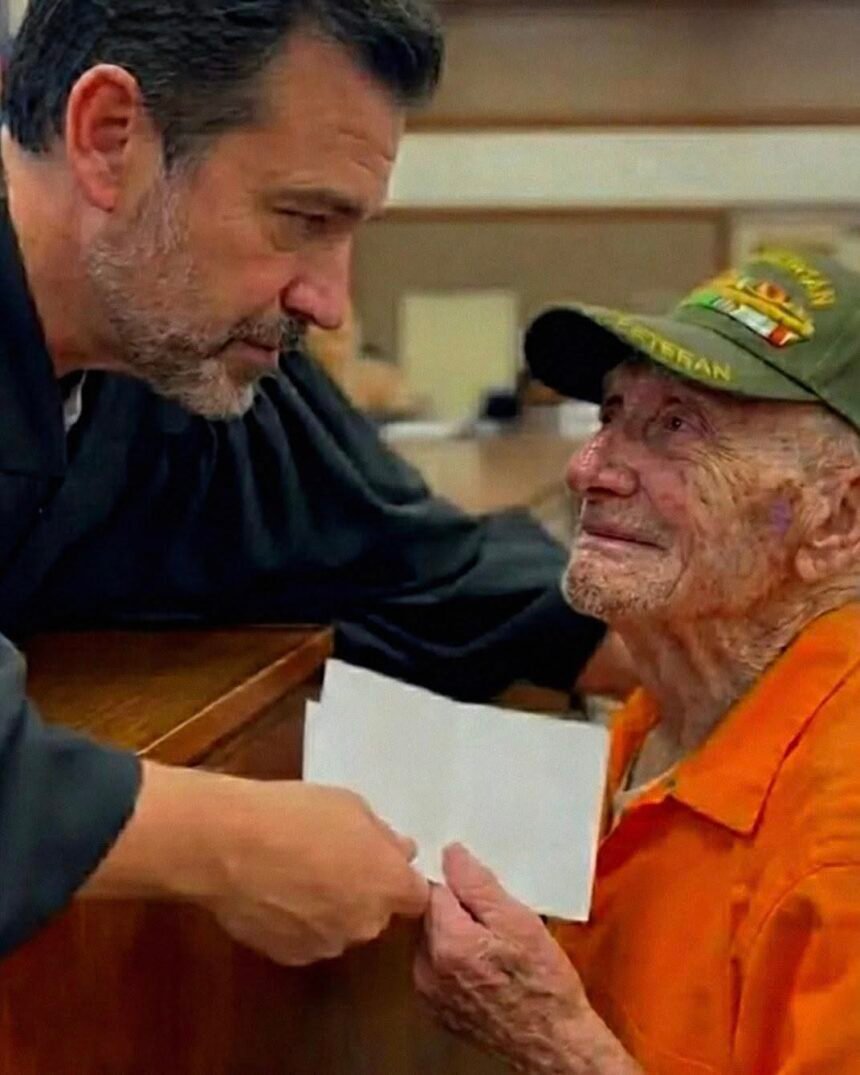
It felt strange to be down on the same level as the defendants and the lawyers. I walked slowly until I was standing directly in front of James.
The man was still looking at the floor, expecting the worst.
I reached out and placed a hand on his shoulder.
I needed his full attention for what came next.
It was a gentle touch, but he flinched.
I’d learned a little American Sign Language in college. It was many years ago, but it came in useful often enough that I’d remained fairly fluent. “Look at me,” I signed to him.
He lifted his head and looked at me with eyes filled with fear.
I pulled a folded paper from my robe pocket and held it out to him. He took it hesitantly.
I signed again, “Read this.”
He unfolded the paper, his old eyes squinting, struggling to focus on the letters.
He read the first few words, then the second line. His brow furrowed in deep concentration.
Then, slowly, painfully, his eyes widened.
Disbelief washed over his face, pushing away the shame and the terror.
His chin started to quiver. He read the final lines, lowered the paper a fraction, and then, silent, heavy tears streamed down his weathered cheeks.
It was in that quiet, intensely emotional moment that Carlton decided to chime in again.
“What now, Judge?” Carlton scoffed.
“Are we done pretending this man deserves special treatment?
Are we going to finalize this, or do you intend to run a soup kitchen from the bench all day?”
I turned slowly to face him. “We’re done pretending your behavior is harmless, Mr.
Carlton.”
A collective hush moved across the courtroom. I walked back behind the bench, reclaiming my rightful position.
I straightened the papers in my hand, making sure my actions were formal and official.
This wasn’t personal, I reminded myself.
This was the law. This was justice.
“Mr.
Carlton, based on your statements today, which were publicly delivered in this court of law, and the initial report I reviewed regarding the arrest of Mr.
Harris — a disabled, decorated veteran — I am formally referring your business to the State Civil Rights Commission for discriminatory treatment of a disabled veteran.”
Carlton’s face drained instantly. Murmurs rippled through the gallery.
The gallery members knew that a civil rights commission referral meant lawyers, fines, and public investigation.
“The Commission,” I continued, “has full authority to investigate your conduct, and to impose significant fines, sanctions, or required restitution if violations of state and federal law are confirmed.
You will receive formal notice of your hearing date within five business days.”
He spluttered, trying to recover his bluster.
“What?
You can’t do that! This is ridiculous! I’m the victim here!”
“I just did, and you will maintain appropriate courtroom behavior, Mr.
Carlton, or you will be removed for contempt. I have tolerated your rudeness thus far, but I won’t indulge you any longer.”
The bailiff stepped forward, his posture leaving no doubt about his intent.
Carlton, finally realizing the tables had turned, fell silent.
He slumped into his seat, looking small and defeated.
It was time to turn back to the man who mattered and deliver on the promise I made in the paper I asked him to read. “As for you, Mr.
Harris,” I said, simultaneously signing my words.
“All charges against you for trespassing and resisting arrest are hereby dismissed.”
The courtroom erupted in quiet, respectful cheers, quickly suppressed by the bailiff. “Furthermore, a veterans’ organization will secure emergency housing for you, Mr.
Harris.
They are also mandated to provide a comprehensive medical evaluation and long-term support.
They’re waiting for you right outside these doors now.”
James blinked hard, taking in the flood of information. He gripped the paper like it might float away if he loosened his fingers even slightly.
He looked like a man who had been drowning for years and had just been pulled onto dry land.
“You’re safe now, James,” I signed to him. “You won’t be spending another night on the streets.
You can go home.”
I gave him a small, genuine smile.
For the first time since he entered my courtroom, James Harris lifted his head with quiet dignity.
Sometimes, I thought, breaking every rule in the book is the only way to write a truly just verdict.
I watched James walk out, taller than when he had come in. Was the main character right or wrong?
Let’s discuss it in the Facebook comments.