

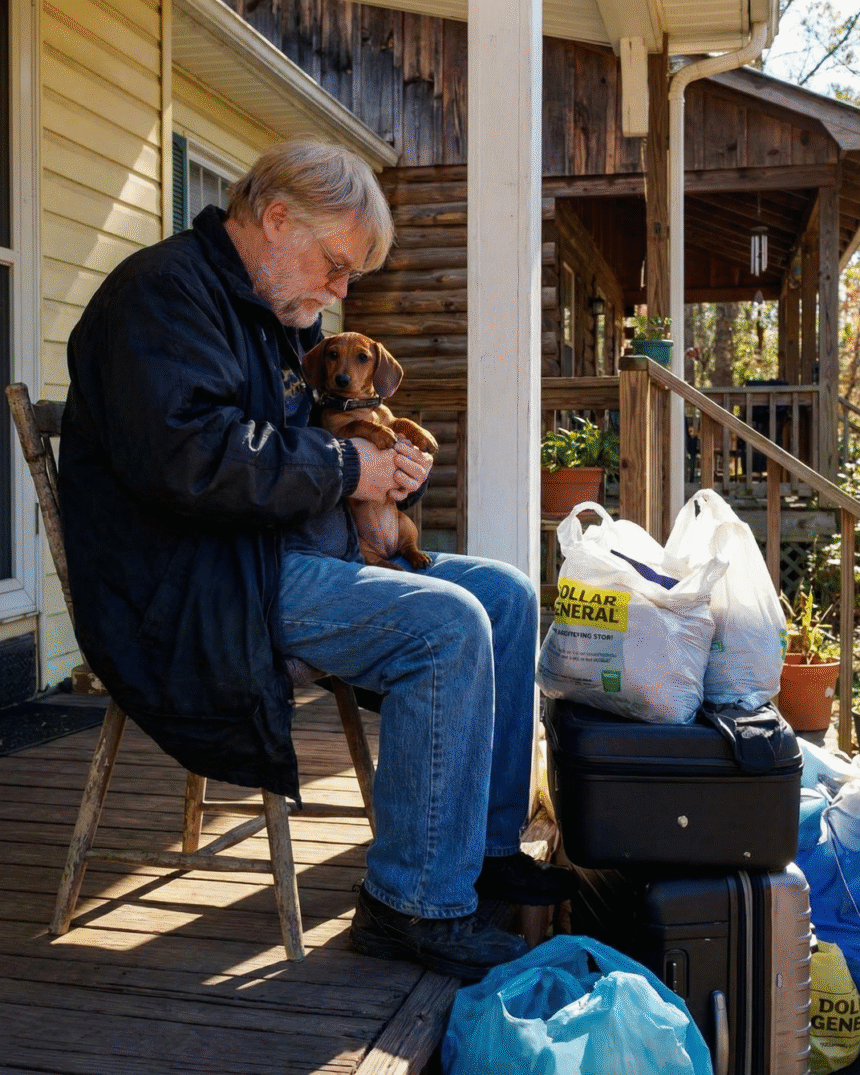
When I arrived at my granddad’s home that weekend, I never expected to find him sitting on the porch with a suitcase, two trash bags, and a tiny injured puppy resting in his arms. At 86, he looked smaller than I remembered, but the way he held that little dog showed nothing but warmth. Two years earlier, after my grandmother passed away, my dad and stepmom, Linda, had moved in with him “to help.” At first, I believed it.
But during my visits, I began noticing pieces of my grandmother’s life slowly disappearing—her photos removed from the mantel, her cherished china stored away, and finally, the bright floral curtains she had sewn being replaced with plain ones. My granddad never complained, but grief had made him quieter, and Linda’s changes seemed to push him further into the background of his own home.
Everything shifted the night he found the injured puppy near the roadside after visiting my grandmother’s grave. He brought her to the vet, named her Penny, and suddenly, there was a spark in him again—something gentle and hopeful.
Penny became his little companion, and he texted me photos of her every day, each one filled with more joy than I had seen in him since Grandma passed. That’s why seeing him on the porch that day broke my heart. He explained softly that Linda had insisted Penny was a burden and asked him to remove the puppy from the house.
When he refused, she told him he should leave instead. Even though the house legally belonged to him, he felt he had no choice. Hearing that, something inside me shifted from sadness to determination.
Respect, kindness, and family memories deserved better.
That night, I checked my granddad and Penny into a comfortable pet-friendly hotel and promised to make things right. Then I gathered every document confirming that the home belonged to him alone. With the help of a friend who worked in media, I visited the house the next morning.
Linda spoke freely about her frustrations and her belief that she had the right to make decisions for the household. Her words revealed not just a misunderstanding but a deeper disregard for the home’s history and emotional value. With everything documented clearly, I invited her to a calm conversation at the hotel restaurant, where my granddad quietly listened.
When I shared what we had recorded and explained the legal situation, the reality became clear: the house was not hers to control. The goal wasn’t to embarrass her but to create a boundary she had repeatedly crossed.
A few weeks later, my dad returned and took the situation seriously. After a careful discussion, he and Linda agreed to part ways, choosing a peaceful separation.
Granddad moved back into his home, and Penny stayed right by his side—her leg healed, her energy renewed. Now, when I visit, I see him sitting on the porch with Penny trotting around happily, the house feeling warm again. He once told me that he thought he lost everything when Grandma passed, but moments like these remind him that family, love, and compassion can rebuild even the quietest corners of a life.
And I realized something too: sometimes the kindest fight is simply standing up for someone who would never stand up for themselves.
I’m 50 and have been married to Jeffrey for over 20 years. Our kids are distant, and lately … so is he. Always “working late,” glued to his phone, forgetting anniversaries.
I feared the worst. So I planned a romantic island getaway. I booked it, packed everything – even his bag.
The day of the flight? He nearly missed boarding. “I’ve just been swamped.
I’m here now, aren’t I?” I said nothing. I just boarded. Mid-flight, I dozed off.
Then a flight attendant gently woke me. “Ma’am, please … check your husband’s carry-on while he’s away. YOU DESERVE TO KNOW THE TRUTH.” I froze.
Hands shaking, I unzipped the bag.
Inside, I didn’t find anything dramatic or suspicious—no secret phone, no hidden letters, nothing that hinted at betrayal. Instead, the bag was filled with neatly labeled folders, each one handwritten with names I didn’t recognize: “Project Harmony,” “Community Outreach,” “Volunteer Schedules.” Beneath them lay a small velvet pouch. With my heart pounding, I opened it.
Inside was a delicate necklace with my birthstone, engraved with, “For the next chapter, together.” I sat there stunned. All those nights he was “working late,” all the messages he shielded from me—they suddenly took on a different meaning. I felt embarrassment mix with relief as I realized the flight attendant must have misunderstood.
Jeffrey wasn’t hiding a secret life. He was planning something, but not the kind my imagination had feared.
When Jeffrey returned to his seat, he noticed my flustered expression. “Everything okay?” he asked, offering me a bottle of water.
I hesitated but decided honesty was better than letting the fear linger. Quietly, I told him what had happened and why I had checked his bag. I expected frustration or disappointment, but instead he smiled gently and took my hand.
“I should have told you sooner,” he said. “The community center needed volunteers for a long-term project, and I signed up. I’ve been organizing programs, tutoring kids after school, and… well, planning something for us, too.
I didn’t want to say anything until everything was ready.” He reached into the bag, retrieving a small envelope I hadn’t noticed earlier. Inside was a printed itinerary—not for the trip I booked, but for a renewal-of-vows ceremony he had arranged at a quiet beach on the island.
Tears welled up as the pieces fell into place. The distance I had sensed wasn’t emotional; it was simply exhaustion from everything he was juggling.
Our marriage hadn’t been drifting apart—he had been trying to strengthen it without overwhelming me. As the plane continued its journey through soft clouds, I rested my head on his shoulder, feeling an unexpected calm settle over me. Sometimes love doesn’t fade; it simply changes shape, waiting for us to notice.
And sometimes the truth isn’t something to fear but something that reminds us of the quiet devotion happening behind the scenes. By the time we landed, the weight on my heart had lifted. What began as a trip to fix our marriage had transformed into a journey toward understanding, gratitude, and a renewed beginning neither of us saw coming.
Guy Fieri’s year took an unexpected turn when a sudden misstep on set led to a serious leg injury that required emergency surgery.
While filming his new show, the beloved TV personality missed a small step, causing his leg to twist in a way that resulted in a rare quadriceps tear. Doctors noted that such an injury—occurring directly in the middle of the muscle—is highly unusual. Understanding the urgency, medical staff operated quickly to prevent further damage.
Despite the shock, the production team adjusted and continued filming while Guy began the recovery process. It was a moment that reminded everyone how quickly life can shift, even for someone known for boundless energy and nonstop enthusiasm.
Recovering at his ranch in Northern California, Guy now relies on a wheelchair and crutches while his leg heals. He has been instructed to avoid putting weight on it for several weeks before eventually transitioning into a cast and beginning rehabilitation.
The timing meant he had to make changes to his holiday plans, but his family stepped in with support and humor. His son Ryder joked that the injury finally gave him an opportunity to take charge in the kitchen for their large family Thanksgiving. With teamwork from Ryder, Hunter, and their cousin Jules, the younger generation took over cooking duties for the 40-person gathering, while Guy guided them from his wheelchair.
Even with the setback, he approached the situation with optimism, grateful for the chance to slow down and enjoy time with his family.
Just two months earlier, Guy had celebrated an important milestone—the wedding of his son Hunter to Tara, in a beautiful multi-day celebration at the family ranch in Sonoma. Surrounded by hundreds of loved ones, the weekend was filled with personal touches, heartfelt moments, and plenty of food that reflected the couple’s shared passions. A “Denim & Diamonds” welcome party featured dishes curated by Chef Lorena Garcia, while the wedding ceremony highlighted family traditions, including the charming appearance of Hunter’s grandmother as the flower girl.
Tara’s custom gowns added elegance to the festivities, and Hunter’s handwritten vows reflected deep emotion. The event blended style, joy, and connection in a way that felt perfectly suited to the Fieri family.
Since the wedding, Hunter and Tara have embraced married life with excitement and intention. They’ve emphasized that their partnership is grounded in friendship, commitment, and a shared dedication to supporting each other’s goals.
Even well-known friends, from Gordon Ramsay to Martie Duncan, shared warm wishes for the newlyweds. Tara has also expressed appreciation for Guy’s influence, noting how he has helped her grow more confident in the kitchen and more adventurous with food. While online comments varied—as they often do—most were filled with support and celebration for the couple.
Through the highs of the wedding and the challenges of recovery, the Fieri family continues moving forward with resilience, humor, and a deep sense of togetherness.
Father’s Day was supposed to be a simple celebration—pancakes, paper cards, and the joy of being together. I never imagined it would become the moment that reshaped my entire understanding of my family. My daughter Lily, bright and imaginative at five years old, has always filled our home with wonder.
She’s the kind of child who believes clouds are escaped marshmallows and that the moon follows our car because it likes our company. So when she asked an unexpected question—one spoken with innocence rather than intention—it caught me completely off guard. Her words, delivered from the back seat with a crayon still in hand, made me pause in a way nothing ever had.
I sensed she was sharing something she believed to be true, even if she didn’t fully understand it.
Instead of rushing into panic or letting confusion land on her tiny shoulders, I gently asked her more questions, hoping to understand without alarming her. She spoke with the honesty only children possess, mentioning visits while I was at work and little moments she thought were just part of everyday life. I didn’t want her to feel responsible for anything she didn’t yet grasp, so I suggested we turn her idea into a “surprise dinner game” for Father’s Day.
It allowed her to express herself freely while giving me a chance to understand the situation better. As she smiled with excitement, I felt a mix of worry and determination settle in. Whatever truth lay ahead, I wanted to approach it calmly—and with care for everyone involved.
On Father’s Day, while my wife was away for a photography session, Lily and I prepared a simple family meal together.
She picked sunflowers for the table centerpiece, proudly arranging them in a vase that leaned a little to one side. As the evening arrived, there was a knock at the door—a moment that would reveal answers I hadn’t expected. When someone familiar appeared, clearly surprised to find me home, the room grew tense.
The conversation that followed wasn’t dramatic or loud; instead, it was filled with long pauses, quiet explanations, and the realization that some misunderstandings and decisions from the past had gone unspoken for too long. Though difficult, the honesty shared that evening opened the door to conversations about trust, responsibility, and what it means to care for a child with wholehearted devotion.
In the days that followed, my focus remained on Lily—her sense of safety, her feelings, her routines. We talked gently about family, love, and what makes someone a parent beyond biology.
I reassured her that she was deeply loved and that nothing would ever change my place in her life. Whether or not we share DNA has never defined my bond with her. I’ve been there for every laugh, every scraped knee, every bedtime story.
She is my daughter in every way that truly matters. One night, she curled up beside me and whispered, “Are you still my daddy?” I held her close and told her the truth as simply as I could: “I always have been, and I always will be.” In that quiet moment, the world felt steady again—not because everything was perfect, but because love, honesty, and commitment were stronger than any confusion we had faced.
Every morning, countless drivers follow a familiar routine: start the car, shift into gear, and head out almost immediately. It feels efficient, especially during busy mornings when everyone is racing against the clock.
However, automotive experts warn that this seemingly harmless habit can quietly shorten the life of an engine. What many drivers don’t realize is that engines need a moment to prepare themselves after being started, and skipping this small pause can create unnecessary strain. Over time, the repeated stress of driving off too quickly can contribute to wear that only becomes noticeable years later, turning a simple oversight into a costly problem.
When a vehicle sits unused overnight, the engine oil naturally settles toward the lower parts of the system.
Because of this, the upper components—such as pistons, bearings, and camshafts—do not have a full protective layer of lubrication the moment the engine turns on. Once the ignition starts, the oil pump begins circulating lubricant throughout the engine, but this process isn’t instantaneous. Mechanics explain that it typically takes around 30 to 40 seconds for oil to fully reach all the moving parts.
Those few seconds may seem insignificant, but they are crucial for the engine’s longevity. Without complete lubrication, components experience more friction, which slowly leads to increased wear.
Driving away immediately after starting the engine means these important internal parts begin working at higher speeds before they are fully protected. Although this doesn’t cause sudden failure, the effects accumulate quietly.
Over many months and years, this added friction results in subtle deterioration—scratched surfaces, weakened bearings, and early signs of breakdown. Many auto repair specialists can easily identify engines affected by this habit because the wear patterns are so distinctive. While modern engines are built to withstand a lot, they still benefit from gentler warm-up practices.
Ignoring this small step can eventually lead to expensive repairs, including replacement parts and extensive labor that might otherwise have been avoided.
Fortunately, the solution is simple, practical, and requires almost no effort. Professionals recommend giving your car a brief moment to stabilize before driving—especially on cold mornings when oil thickens and takes longer to circulate. Allowing just half a minute for the engine to settle ensures proper lubrication begins before demanding movement.
After you start driving, avoid heavy acceleration until the temperature gauge begins to rise. These small adjustments not only protect the engine but can also reduce long-term maintenance costs. A short pause at the beginning of each drive is a smart investment toward keeping your vehicle running smoothly for many years to come.