

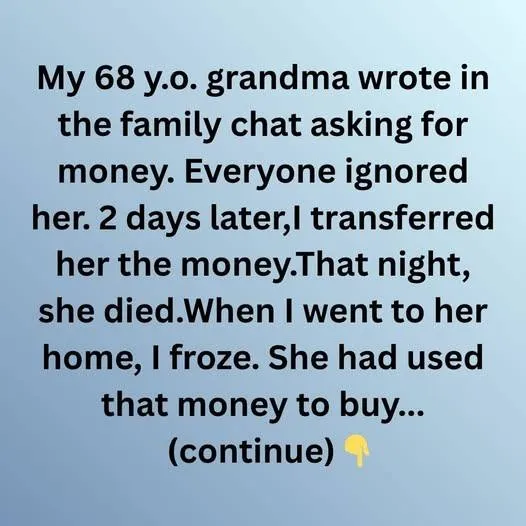
When I was little, she used to read me her stories before bed — tales about courage and forgiveness, about finding light in ordinary places.
She’d laugh and say, “Someday, you’ll write better ones.”
I always brushed it off. But sitting there with her final gift in my hands, it hit me like a punch to the chest — she’d meant it.
She’d believed in me long before I ever believed in myself.
At her funeral, everyone else brought flowers. Roses, lilies, wreaths.
I brought the small wrapped box, untouched except for the ribbon I’d carefully retied.
When it was my turn to speak, I placed it on the podium beside her photo.
“I didn’t come here to talk about loss,” I began. “I came to talk about love — the quiet kind. The kind that doesn’t ask for attention or thanks.”
I told them about the message she’d sent.
About the silence that followed. About how she spent her final days thinking not of herself, but of others — of me.
There wasn’t a dry eye in the room.
After the service, several relatives came up to me, ashamed, muttering about how they “meant to reply” or “just didn’t think it was urgent.” But Grandma had always been like that — never wanting to burden anyone, even when she needed help.
Her generation had a quiet kind of strength — they endured, adapted, and gave, even when the world turned a blind eye.
That night, I went home and placed her sketchbooks on my desk. I opened the first one.
On the inside cover, in faded pencil, she’d written another message:
“Stories never die, sweetheart. They just wait for someone brave enough to tell them.”
So I made her a promise.
I vowed to finish the book she never got to write — the one she’d talked about for years, the story she’d started but never had the courage to share.
Every night after work, I sat down with her sketchbooks and began writing. At first, it was just fragments — lines inspired by her stories, sketches of her favorite scenes.
Then slowly, it grew into something more.
Months passed. The act of writing became therapy. The ache in my chest began to dull, replaced by something softer — gratitude.
I started to see her in everything: in the scent of old paper, in the way sunlight hit the corner of my desk, in the hum of the kettle that always whistled just before she’d say, “Tea’s ready, darling.”
And one evening, as I turned the final page of her old notebook, I realized something.
The story I’d been writing — the one I thought was hers — was also mine.
It was about loss, yes, but also about resilience. About how love doesn’t vanish when someone dies. It lingers — in the small acts, the unfinished dreams, and the faith someone had in you long before you had it in yourself.
A year later, I printed the manuscript and placed the first copy on her grave.
I read her note again before setting it down.
And I whispered, “I did, Grandma. Because of you.”
Her story didn’t end with her death. It just changed hands.
Now, whenever people ask what inspired me to write, I tell them the truth — it wasn’t fame or ambition.
It was a $60 gift from a woman who had nothing to give except love, and gave it anyway.
The world will remember her as an ordinary woman who lived a quiet life. But to me, she was proof that the smallest gestures can echo louder than grand speeches — that love, expressed in its simplest form, can outlive everything else.
So if you ever find yourself hesitating to answer a message like hers — don’t. Pick up the phone.
Send the money. Offer the help. You never know what someone’s last act of kindness might be.
Because sometimes, the things we think are small — a few words, a few dollars, a simple act — are what keep someone else’s story alive long after we’re gone.
And if you’re lucky, maybe one day, someone will hold your gift in their hands and feel what I did — the warmth of a love that never really left.