

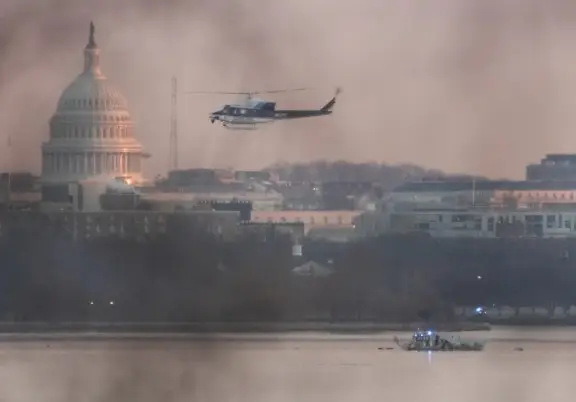
The key objectives of a COG mission include:
Maintaining the line of succession within the federal government.
Protecting high-ranking officials, including the president and vice president.
Ensuring secure communications for national security operations.
Facilitating rapid military response capabilities.
Though these missions are routine, their integration into high-traffic civilian airspace raises significant safety concerns—concerns that are now at the forefront of national discussions following this disaster.
Air Traffic Safety Concerns Intensify
Aviation experts and officials are now scrutinizing the coordination between military and civilian air traffic controllers. The fact that a sensitive military exercise was conducted near a major commercial flight path has prompted calls for stricter safety protocols.
Former Federal Aviation Administration (FAA) Administrator James Caldwell emphasized the importance of airspace coordination, stating, “Military exercises are vital for national security, but they must be precisely coordinated with the FAA to avoid endangering civilian flights.
The risks of shared airspace must be mitigated with absolute precision.”
Investigators are now reviewing whether proper communication was established between military air traffic controllers and civilian FAA officials at Reagan National Airport. They are also examining whether the Black Hawk was following an approved flight path that would have kept it clear of commercial traffic.
Government Response and Investigation
President Donald Trump addressed the nation on Thursday, extending his condolences to the victims’ families. However, his remarks quickly turned political as he criticized previous administrations for what he called a “decayed” aviation system.
“We must have only the highest standards for our aviation system,” Trump stated.
“I improved the Obama-era standards from mediocre to extraordinary.” He further alleged that past administrations prioritized diversity initiatives over merit-based hiring in sectors like air traffic control.
The comments have sparked mixed reactions, with some supporting his call for stricter standards, while others argue that political rhetoric should be set aside to focus on preventing future tragedies.
Next Steps in the Investigation
The National Transportation Safety Board (NTSB) has launched a full-scale investigation, with assistance from the FAA, the military, and the Department of Transportation. Investigators will analyze flight data recorders, review air traffic communications, and examine maintenance records to determine if mechanical failures played a role.
A key focus will be evaluating the integration of military flights into civilian airspace and identifying potential lapses in communication between controllers and pilots.
A Sobering Reminder for Aviation Safety
This disaster underscores the complexities of modern air travel and the need for strict adherence to safety regulations. Families of the victims—both military and civilian—are mourning their loved ones, while aviation officials work to ensure that such a tragedy never happens again.
As investigations continue, the nation awaits critical answers and reforms aimed at ensuring that military and civilian aviation can coexist safely in U.S.
skies.
https://www.cbsnews.com/video/black-hawk-chopper-involved-in-d-c-collision-was-on-training-flight/