

That became the pattern. I’d come home between deployments, and there would be some new crisis—scholarship applications, flight‑school interviews, his roommate drama at the detachment. I’d offer advice, make calls to people I knew, once even drove four hours to help him move out of a lease that had gone sideways.
He accepted it all with the casual assumption of someone who’d never had to ask twice. Our father liked to joke that Ethan had the right temperament for command. By which he meant Ethan was loud where I was measured, confident where I was careful.
Dad had done a stint in the Army decades back—long enough to have opinions, but not long enough to understand how much the military had changed. He saw Ethan and saw himself. He saw me and saw an exception he couldn’t quite categorize.
I made captain at twenty‑six, right on schedule. Ethan called to congratulate me, then spent twenty minutes talking about his own upcoming commissioning ceremony. I didn’t mind.
I was used to it. By then, I’d logged hundreds of flight hours, including a deployment to Kandahar that I couldn’t discuss in detail. I came back different—not broken, but recalibrated.
I understood things about fear and leadership that I couldn’t explain at a dinner table. My parents asked if I was okay, and when I said yes, they seemed relieved to move on. Ethan pinned on his second‑lieutenant bars three years after I made captain.
I was stationed in Germany, so I watched the ceremony on a choppy video call, my mother’s phone camera swinging wildly between Ethan’s face and the crowd. She cried. My father saluted—even though he’d been out for decades and it wasn’t quite appropriate.
Ethan stood there grinning, twenty‑two years old and certain the world was about to open up for him. And it did. He got a decent assignment, flew training missions, worked with the right people.
When he called, it was always to update me on his progress—sometimes to ask for advice that he’d repackage as his own insight later. I didn’t call him on it. What would have been the point?
I transferred to operations after my third deployment. It wasn’t a demotion, though my parents seemed to think it was. “So, you’re not flying anymore?” my mother asked, her voice careful.
“I’m managing the people who fly,” I said. “It’s a different kind of responsibility.”
“But you loved flying.”
“I still do. This is how I serve now.”
She didn’t understand, and I didn’t push it.
My father was more blunt. “Sounds like a desk job,” he said. “Sounds like you’re stepping back.”
I could have explained that operational command at this level meant coordinating missions across multiple airframes, managing personnel, making decisions that affected hundreds of lives.
I could have told him about the medevac escort I’d flown in Helmand Province, the one that had gone sideways in ways I still couldn’t discuss because half of it was classified. Instead, I said, “It’s where they need me,” and let it drop. Ethan made first lieutenant, then captain.
He called less often, but when he did, there was a new edge to his voice—confidence shading into condescension. “You should have stayed in the cockpit if you wanted to stay relevant,” he said once, laughing like it was a joke. I was a major by then, running a joint training wing with three hundred personnel under my purview.
I didn’t bother correcting him. Around that time, he started talking about his new commanding officer, Major David Hail. “He’s the real deal,” Ethan said.
“Flew combat missions in Afghanistan, got a Bronze Star, knows everybody. He’s the kind of officer I want to be.”
I didn’t recognize the name, but that wasn’t unusual. The Air Force is large, and my deployments had been years earlier.
I was glad Ethan had a good mentor. He needed one. What I didn’t know—what I couldn’t have known—was that David Hail had been on the ground in Helmand Province in the summer of 2013, part of a small forward‑operating unit that got pinned down during what was supposed to be a routine supply movement.
I’d been flying an armed escort that day—one of two A‑10 Warthogs tasked with providing overwatch. When the ambush hit, we diverted. And what followed was forty minutes of the kind of close air support that doesn’t make highlight reels because it’s too frantic, too close, too dependent on split‑second decisions that could kill the people you’re trying to save.
We got them out—all of them. I took shrapnel in the process, enough to earn a Distinguished Flying Cross and three weeks of recovery, most of which I spent furious that I wasn’t back in the cockpit. The citation was classified for years because of the mission details.
And by the time it was declassified, I was in a different career phase. I didn’t talk about it—not because I was modest, but because the people who needed to know already did, and everyone else wouldn’t understand what it meant. Ethan never asked about my deployments.
Not really. He’d say, “So, what was Afghanistan like?” and then check his phone before I could answer. My parents were the same.
They wanted the headline version—the thing they could mention to their friends. Our daughter served overseas. It sounded good.
It didn’t require details. So when Ethan’s promotion to captain came through and my parents started planning a family gathering to celebrate, I didn’t expect anything different. I was lieutenant colonel by then, stationed two states away, running operations for a wing that had just earned top marks in a readiness inspection.
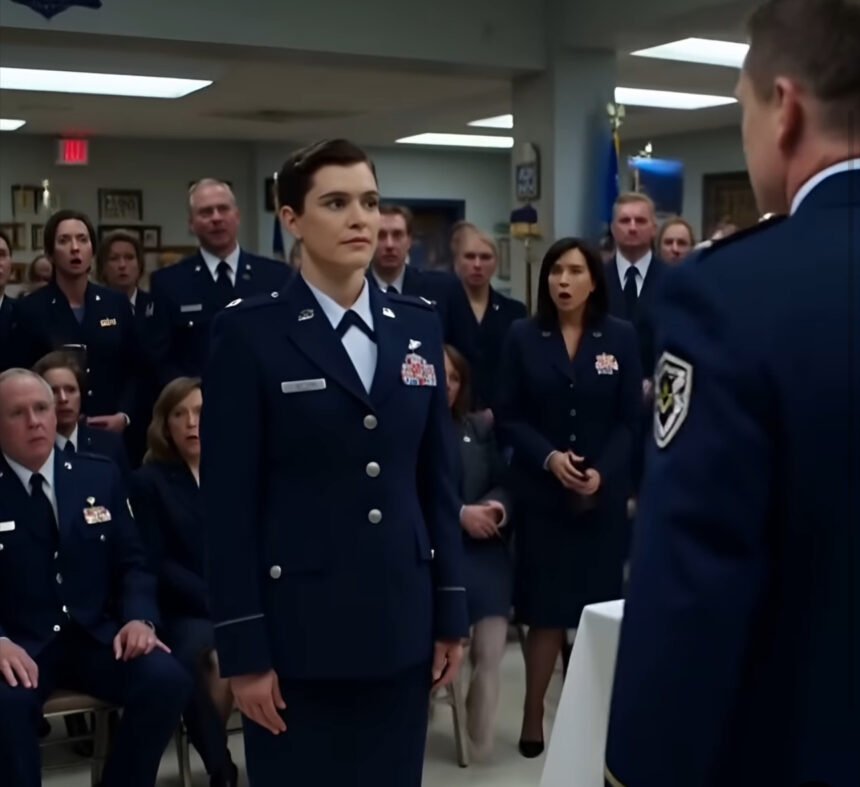
I should have been busy, but he was my brother and despite everything, I wanted to be there. I requested leave, booked a flight, pressed my service‑dress blues, and drove three hours to the base where his ceremony would be held. I arrived early, checked in at the gate, and parked near the building where they’d set up the reception.
The ceremony itself was fine. Ethan stood at attention while his squadron commander read the orders, pinned on the new rank, shook his hand. He looked sharp, composed—every inch the officer my parents had always wanted.
They sat in the front row, beaming. The reception was held in a wood‑paneled room that smelled like floor polish and coffee that had been sitting too long. There were maybe forty people—squadron mates, a few family friends, some junior officers who were there because attendance was expected.
I stood near the back in my service dress, the lieutenant colonel insignia on my shoulders visible, but apparently not interesting enough for anyone to notice. My mother found me first, kissed my cheek, told me I looked thin. “You’re working too hard,” she said.
“You need to take care of yourself.”
“I’m fine, Mom.”
“Are you eating enough? You know how you get when you’re stressed.”
I assured her I was eating, sleeping, functioning like a normal human being. She patted my arm and drifted back toward my father, who was holding court near the refreshments table.
Ethan was surrounded by well‑wishers, shaking hands, laughing at jokes I couldn’t hear. He saw me and waved, a quick acknowledgement that didn’t invite approach. I waved back and stayed where I was.
Someone had set up a small table with a cake that read “Congratulations, Captain James” in blue icing. My mother positioned herself next to it, holding a plastic cup of punch like it was champagne. She raised it high, waiting for the room to quiet.
“I just want to say a few words,” she announced. The conversations dimmed. People turned.
“We are so proud of Ethan. He’s worked so hard to get here, and we always knew he was destined for great things.”
“To our hero,” she pointed at Ethan, her smile wide and unshakable. My father stepped forward, grinning.
“That’s right. Our son, the officer. Finally, someone in this family doing something useful.”
He looked at me when he said it.
Not a glance, not an accident. A deliberate look paired with a laugh that suggested he was joking—but wasn’t. The room chuckled, uncomfortable but compliant.
I felt my spine straighten—an autonomic response. My face stayed neutral. I’d trained for worse than this.
Ethan looked down, maybe embarrassed, maybe just avoiding eye contact. My mother sipped her punch, oblivious or uncaring. The moment stretched.
Then the door opened. Major David Hail walked in, still in his flight suit, carrying a small wooden plaque under one arm. He was maybe thirty‑five, compact and precise—the kind of officer who looked like he’d been genetically engineered for competence.
He scanned the room, nodded at a few people. Then his eyes landed on me. He stopped.
His expression shifted—recognition, confusion, something close to shock. He walked toward me, weaving through the crowd with the single‑mindedness of someone on a mission. People stepped aside.
My father was mid‑sentence, saying something about Ethan’s next assignment, when Hail stopped directly in front of me. The room went quiet. “Ma’am,” he said.
His voice wasn’t loud, but it carried. “You’re the one from Helmand.”
I blinked. It took a second to place him—thinner then, younger, caked in dust and blood that wasn’t his.
Forward Operating Base Murphy, the supply convoy, the ambush. “Major Hail,” I said. “It’s good to see you.”
He didn’t smile.
He came to attention—sharp and formal—and saluted. “Ma’am, it’s an honor.”
I returned the salute—automatic, professional. He held it a beat longer than necessary, his eyes locked on mine, and I realized he wasn’t just acknowledging me.
He was making a point. The room was silent now—the kind of silence that has weight. My father’s mouth hung open.
My mother looked between us, confused. Ethan stood frozen near the cake, his new rank still shiny and unfamiliar on his shoulders. Hail lowered his salute, stepped back, and turned to Ethan.
“Captain James, congratulations on your promotion. Your sister is a hell of an officer. I hope you know that.”
Ethan nodded, mute.
Hail handed him the plaque, shook his hand, and turned back to me. “I didn’t know you were here, ma’am. If I’d known, I would have made sure you were properly recognized.”
“That’s not necessary,” I said.
“It is,” he said. “But I understand if you prefer it this way.”
He nodded once more, then walked to the refreshments table, poured himself a cup of coffee, and started talking to one of the other officers like nothing had happened. But everything had happened.
My mother approached me, her face a mask of polite confusion. “What was that about?”
“We served together,” I said. “In Afghanistan.”
“Oh, well, that’s nice.”
She didn’t ask for details.
My father was less diplomatic. He cornered me near the door, his voice low. “You never mentioned you knew a SEAD.”
“It didn’t come up.”
“You could have said something.
Made it a bigger deal.”
I looked at him—this man who’d spent my entire adulthood dismissing my career as either reckless or irrelevant—and felt nothing but tired. “I don’t make things a bigger deal than they are,” I said. “I just do the job.”
He frowned, started to say something else, then thought better of it.
Ethan found me as I was leaving. “Hey,” he said. “Wait.”
I stopped.
He looked uncomfortable—hands shoved in his pockets, eyes anywhere but on me. “Why didn’t you say you were in Helmand?”
“You never asked.”
“I didn’t know it was important.”
“It wasn’t. Not to you.”
He flinched.
“That’s not fair.”
“Isn’t it?” I kept my voice even. “Ethan, I’ve been in for seventeen years. I’ve deployed four times.
I’ve held commands, run operations, made decisions that kept people alive. And not once have you asked me what any of that was like. So, no, I didn’t bring up Helmand because I didn’t think you’d care.”
He opened his mouth, closed it, tried again.
“I care.”
“You care now because someone you respect made it matter. That’s different.”
I didn’t wait for a response. I walked to my car, got in, and drove back to my hotel.
My phone buzzed twice—once from my mother, once from Ethan. I didn’t check the messages until the next morning. Mom: “That was awkward.
You could have handled it better.”
Ethan: “I’m sorry. I didn’t mean for it to go like that.”
I deleted both. I flew back to my duty station the next day—1300 hours, wheels up.
The kind of flight where you stare out the window and think about nothing in particular. By the time I landed, I’d compartmentalized the whole event into a mental folder labeled FAMILY and filed it next to every other uncomfortable gathering I’d endured. It wasn’t anger exactly.
It was clarity. I’d spent years making allowances, offering support, showing up without expectation of acknowledgement. I’d done it because that’s what you do for family.
Or at least that’s what I’d been raised to believe. But standing in that reception hall, watching my father laugh at my expense while my mother toasted the son who’d never had to fight for her attention, I realized something simple: I was done. Not done with them necessarily—just done expecting them to see me.
Colonel Naomi Vargas was waiting in my office when I got back. She was fifty‑two, sharp‑eyed, with the kind of posture that made you stand straighter just by proximity. She’d been my mentor since I was a captain—one of the few senior officers who’d treated me like a person instead of a quota or a curiosity.
“You look like you had a great time,” she said, not looking up from the file she was reading. “It was fine.”
“That bad.”
I dropped my bag on the desk, sat down. “My parents held a reception for my brother’s promotion.
They toasted him as the family hero. My father made a joke about me finally doing something useful. Then my brother’s CO walked in, recognized me from Helmand, and saluted me in front of everyone.”
Vargas looked up.
“David Hail. You know him by reputation—good officer. Flew combat support in Afghanistan.
Did some time in joint operations.” She tilted her head. “So he recognized you from the medevac escort.”
“Apparently.”
“And your family didn’t know?”
“They never asked.”
Vargas set the file down, leaned back. “You never told them about the DFC.”
“It was classified for three years.
By the time it wasn’t, I was in a different job. It didn’t seem relevant.”
“It’s relevant if your family thinks you’re dead. Wait.”
I didn’t respond.
Vargas studied me for a moment, then sighed. “Ally, you’re one of the best officers I’ve worked with. You’re precise, strategic, and you don’t let ego cloud your judgment.
But you have a blind spot when it comes to your family.”
“I know.”
“Do you? Because from where I’m sitting, you keep giving them chances to see you, and they keep choosing not to. At some point, that’s on you.”
It was a hard thing to hear, but she wasn’t wrong.
I’d been operating under the assumption that consistency would eventually earn recognition—that if I just kept showing up and doing the work, they’d notice. But people don’t notice what they’re not looking for. “I’m not going to the next family dinner,” I said.
Vargas smiled. “Good. Now, let’s talk about your next assignment.”
She handed me the file she’d been reading.
It was a set of orders, freshly printed, transferring me from the joint training wing to an air‑mobility wing leadership position—command of my own unit. Over three hundred personnel split between active duty and reserve, responsible for everything from strategic airlift to aerial refueling. It was a significant step up—the kind of assignment that marked you as someone the Air Force was investing in.
“When?” I asked. “Sixty days. You’ll take command in a formal ceremony at McGuire.
They want you there by mid‑November.”
I looked at the orders, then at Vargas. “You recommended me for this.”
“I did. You’ve earned it.”
I nodded slowly, feeling the weight of it settle.
This was what mattered—not my parents’ approval, not Ethan’s belated recognition. This. The mission.
The people under my command. The work. “Thank you, ma’am.”
“Don’t thank me.
Just don’t screw it up.”
She stood, straightened her uniform. “And Ally—let the record speak for itself. You don’t need to explain yourself to people who’ve already decided not to listen.”
She left and I sat there for a long time, staring at the orders.
That evening, I drafted a short email to my mother. “I won’t be able to make Thanksgiving this year. I’m transferring to a new command and will be in the middle of turnover.
I’ll call when I’m settled.”
I didn’t mention Ethan. Didn’t offer an explanation beyond the logistical. I hit send and felt lighter.
Two days later, my mother called. I let it go to voicemail. “Ally, this is dramatic.
We didn’t mean anything by what we said at the reception. You’re being too sensitive. Call me back.”
I didn’t.
Ethan sent a text. “Hey, I know things were weird. I’m sorry.
Can we talk?”
I replied: “I’m in the middle of a transfer. We’ll talk later.”
Later became a flexible concept. The next three weeks were a blur of briefings, handoffs, and logistics.
I met with my successor—a sharp young lieutenant colonel named Briggs, who asked good questions and took notes like his life depended on it. I walked him through the personnel files, the ongoing projects, the landmines to avoid. I handed over my command with the same precision I brought to everything else.
Meanwhile, word got around. Hail had filed a formal commendation through official channels—a memo that referenced the Helmand mission and my actions in detail. It wasn’t flashy, but it circulated.
People I hadn’t spoken to in years sent congratulations. A few junior officers who’d heard the story approached me in the halls, asking questions. I deflected politely.
I didn’t need the attention, but I didn’t stop it either. My parents heard about the transfer through someone else—an old family friend whose son served in the Air Force and happened to see the announcement. My mother called again, this time leaving a voicemail that was half confusion, half hurt.
“Why didn’t you tell us you were taking a new command? We had to hear it from the Robinsons. This is a big deal, Ally.
You should have said something.”
I listened to the voicemail twice, then deleted it. Ethan tried harder. He called, texted, even sent an email with the subject line: CAN WE PLEASE TALK.
I responded once: “I’m not angry. I’m just busy. We’ll catch up when things settle.”
It was true—mostly.
I wasn’t angry. I was just done investing energy in people who didn’t invest back. The change‑of‑command ceremony at McGuire was held on a cold morning in mid‑November.
The sky was gray, the wind sharp enough to cut through dress blues. I stood on the platform next to the outgoing commander, a colonel named Patterson, who’d held the position for three years and looked ready to retire. Vargas was there representing the higher command.
A few hundred personnel stood in formation, faces young and old, all watching. The ceremony itself was ritual—orders read, guidon passed, salutes exchanged. I gave a short speech—no grand promises, no inspirational platitudes—just a clear statement of expectations.
“We exist to move people and equipment where they need to be, when they need to be there. That’s the mission. Everything else is secondary.
I expect professionalism, accountability, and respect for the people you work with. In return, I’ll fight for the resources you need to do the job right. Let’s get to work.”
Patterson handed me the guidon, the flag heavy and familiar in my hand.
Vargas saluted. I returned it, and it was done. I was in command.
Afterward, there was a small reception in the wing headquarters building. Junior officers introduced themselves. Senior NCOs sized me up.
I shook hands until my wrist ached. No family attended. I hadn’t invited them.
Late that afternoon, I found myself alone in my new office—a space that still smelled like the previous occupant’s coffee preference. I sat behind the desk, looked at the walls that would soon hold my own plaques and photos, and felt something close to peace. My phone buzzed.
A text from Hail. “Congratulations on the command, ma’am. Well‑deserved.”
I replied: “Thank you, Major.
Hope your squadron is treating you well.”
A pause, then: “They are. Captain James is learning—slowly, but he’s learning.”
I smiled at that. Another text came through, this time from an unknown number.
“This is Lieutenant Sullivan, ma’am. I’m assigned to your wing. Looking forward to serving under your command.”
I replied: “Welcome aboard, Lieutenant.
Let’s make it count.”
I set the phone down and stared out the window at the flight line where a C‑17 was taxiing into position. The engines roared, the aircraft lifted, and I watched it climb until it disappeared into the clouds. This was what I’d signed up for—not recognition, not validation—just the work done well with people who understood what it meant.
The rest was noise. Ethan struggled. I didn’t hear about it directly, of course, but word travels in the Air Force—especially when you’re connected to the same chain of command in even the loosest sense.
Hail remained his commanding officer, and Hail was the kind of leader who didn’t tolerate mediocrity. Six weeks after I took command at McGuire, I ran into a pilot from Ethan’s squadron at a joint readiness conference in Virginia. We were standing in line for coffee during a break, and she recognized my name.
Lieutenant Commander Roth—Navy, assigned to a joint evaluation team—mid‑forties with the kind of weathered competence that comes from decades at sea. “You’re Captain James’s sister?” she asked. “I am,” I said.
“How’s he doing?”
She hesitated, which told me everything. “He’s figuring it out. Major Hail’s a tough mentor, but fair.
Your brother’s got potential. He just needs to stop assuming the rank does the work for him.”
I nodded—unsurprised. “That sounds about right.”
“Hail talks about you sometimes,” she added.
“Not in detail, but enough that we know you’re someone worth respecting. I think your brother’s starting to realize he’s been operating in your shadow without knowing it.”
“He’ll figure it out,” I said. “Or he won’t.”
She gave me a sharp look.
“You’re harder on him than Hail is.”
“I’m realistic. There’s a difference.”
I didn’t elaborate, and she didn’t push. But she wasn’t wrong.
I’d stopped carrying the weight of Ethan’s success or failure. He was a grown man, an officer in the United States Air Force, responsible for his own decisions. If he wanted to build a career, he’d have to do it on his own merits.
I’d given him enough head starts. Around that same time, my parents tried again. My father called from a number I didn’t recognize, so I answered without thinking.
“Ally, it’s Dad.”
I almost hung up. “Hi.”
“Your mother and I have been trying to reach you.”
“I’ve been busy.”
“We know. We heard about your new command.
That’s a big deal.”
“It is.”
A pause. He was waiting for me to fill the silence—to make it easy for him. I didn’t.
Finally, he said,
“We’d like to come visit—see where you’re stationed, maybe take you to dinner.”
“That’s not necessary.”
“It’s not about necessary. We’re your parents.”
“And I’m your daughter—who you dismissed in front of a room full of people because I wasn’t the child you wanted me to be.”
The words came out calm, factual—not angry, just true. He sputtered.
“That was a joke, Ally. You’re being too sensitive.”
“Maybe. Or maybe you’ve been dismissive for so long you don’t recognize it anymore.”
“We’re proud of you,” he said, and it sounded hollow.
“Are you? Or are you embarrassed that you didn’t realize what I’d accomplished until someone else pointed it out?”
Silence. “I’m not angry,” I continued.
“But I’m also not going to pretend the last twenty years didn’t happen. You have my email. If you want to rebuild, start there—with honesty.
Not with visits and dinners that pretend everything’s fine.”
I hung up before he could respond. My hands were steady. Later that evening, I got an email from my mother.
It was three paragraphs long, full of justifications and deflections, ending with, “We just want to be a family again.” I read it twice, then filed it away without responding. Colonel Vargas visited McGuire in early December, part of a routine inspection tour. She found me in the operations center reviewing a fuel‑logistics report that didn’t add up.
“You look busy,” she said. “Always.”
She pulled up a chair. “I heard your wing earned top readiness scores for the quarter.”
“We did.”
“Command suits you.”
I looked up.
“It’s what I was trained for.”
“It’s more than that. You’re not just managing. You’re leading.
There’s a difference.”
I set the report aside. “What brings you here, ma’am? I doubt it’s just to compliment my readiness scores.”
She smiled.
“I wanted to see how you’re settling in—and to check that you’re not drowning in family drama.”
“I’m not. I’ve set boundaries.”
“Good.” She stood, walked to the window overlooking the flight line. “You know, I’ve watched a lot of officers burn out trying to prove themselves to people who will never appreciate them.
The best ones learn to let that go. The mediocre ones keep chasing it until it destroys them.”
“Which one am I?”
“You’re the one who stopped chasing.” She turned back. “That memo Hail filed—it’s made its way through the channels.
People know who you are now. Not because you demanded it, but because the record finally caught up.”
I nodded slowly. “And my family—”
“They’ll either come around or they won’t.
Either way, it’s not your problem anymore.”
She was right. It wasn’t. That night, I sat in my office after most of the wing had gone home and drafted a short email to Lieutenant Mark Sullivan, one of the young officers who’d reached out when I first took command.
He’d asked for mentorship, and I’d agreed to a monthly check‑in. “Lieutenant Sullivan,
Let’s talk about leadership. Not the kind they teach in textbooks, but the kind you live.
First rule: let your record outlast their opinions. People will doubt you. They’ll dismiss you, underestimate you, try to take credit for your work.
Let them. Your job isn’t to fight for recognition. It’s to do the work so well that recognition becomes inevitable.
Second rule: choose your battles. Not everything deserves a response. Some things you let slide because they’re not worth your energy.
Others you confront because staying silent would compromise your integrity. Learn the difference. Third rule: take care of your people.
They’re not tools. They’re human beings with families and fears and futures. If you remember that, they’ll follow you anywhere.
Looking forward to our next conversation. Respectfully,
Colonel James”
I hit send and felt something shift. This was how I’d move forward.
Not by convincing my family I was worth their respect, but by shaping the next generation of officers who’d never have to. A week later, Hail sent a brief email. “Colonel, I’m forwarding you an after‑action report from a joint training exercise.
Captain—sorry, Major—James performed well. Thought you’d want to know.”
Attached was a three‑page assessment. Ethan had led a flight coordination during a simulated combat scenario and, according to Hail, demonstrated improved judgment and communication under pressure.
It was progress—small but real. I replied: “Thank you, Major. I appreciate the update.”
I didn’t forward it to my parents.
They’d hear about it if Ethan wanted them to. As for me, I had a wing to run. The next eighteen months passed quickly.
My wing ran operations across three continents, logged over ten thousand flight hours, and maintained a safety record that made the higher‑ups take notice. I mentored junior officers, mediated conflicts, allocated resources, and occasionally flew as a mission observer to stay sharp. I was good at my job.
I knew it, my people knew it, and eventually the promotion board knew it, too. In March, I received word that I’d been selected for promotion to colonel—O‑6, full bird. The kind of rank that doesn’t come easy—that represents decades of competence and trust.
The notification came via official email at 0700 on a Tuesday. I read it twice, set my coffee down, and allowed myself thirty seconds of satisfaction before moving on to the day’s agenda. Vargas called an hour later.
“Congratulations, Colonel.”
“You’ve earned it. The ceremony’s scheduled for May, correct?”
“Yes, ma’am. McGuire.
1600 hours.”
“I’ll be there. And Ally—this is the rank where people start watching everything you do. Not because they’re looking for mistakes, but because they’re deciding if you’re ready for the next level.
Stay sharp. Always.”
The official promotion ceremony was set for May 15th. I sent a brief email to my parents and Ethan informing them of the date and location.
I didn’t invite them explicitly, but I didn’t exclude them either. The ball was in their court. My mother responded within an hour.
“We’ll be there. So proud of you.”
Ethan’s response came two days later. “Wouldn’t miss it.
Congratulations, Sis.”
I felt nothing reading those messages. No relief, no resentment—just acknowledgement. Meanwhile, my days were consumed with transition planning.
A promotion to O‑6 meant new responsibilities—likely a new command down the line. I was being positioned for something bigger, though the details were still forming. I met with Vargas in mid‑April to discuss options.
“They’re looking at you for a composite wing,” she said, spreading a folder across her desk. “Multi‑mission, about five hundred personnel, mix of active and reserve. It’s a challenge, but you’re ready.”
“Where?”
“That’s still being determined.
Could be stateside, could be overseas. You’ll know by July.”
I nodded. “What’s the timeline for transition?”
“You take command in early next year.
That gives you six months to wrap up at McGuire and prepare.”
It was the trajectory I’d been working toward for years. And yet, it felt surreal. Not because I didn’t think I deserved it, but because I’d spent so long being invisible that visibility still felt foreign.
Vargas must have seen something in my face. “You look concerned.”
“I’m not—just processing.”
“Second‑guessing yourself?”
“No, ma’am.”
“Good, because you’re one of the best officers I’ve worked with, and if you start doubting that now, I’ll be deeply disappointed.”
I smiled. “Understood.”
The promotion ceremony itself was held on the same flight line where I’d taken command of the wing eighteen months earlier.
The weather cooperated—clear skies, mild temperature—a light breeze that kept the flags moving. About three hundred personnel stood in formation along with a handful of senior officers from the regional command. My parents arrived early, dressed formally, looking older than I remembered.
Ethan came in uniform—now a major himself. He’d been promoted six months earlier—a fact I’d learned through official channels rather than a phone call. We exchanged brief greetings—professional, cordial, distant.
The ceremony followed the usual script—orders read, rank insignia removed, new insignia pinned. Vargas did the honors, her hands steady as she affixed the silver eagles to my shoulders. She stepped back, saluted, and I returned it.
Then she leaned in slightly and said, “Well done, Ally.”
I gave a short speech—no grand declarations, no emotional appeals—just a clear statement about the work ahead and the people who made it possible. “Leadership is a trust,” I said, my voice carrying across the formation. “It’s not about titles or rank.
It’s about the responsibility we accept when we put on this uniform—to serve with integrity, to lead with humility, and to never forget that the mission depends on every single person doing their job well. I’m honored to continue that work with all of you.”
The applause was polite but genuine. Afterward, there was a small reception in the wing headquarters.
My parents hovered near the refreshments, clearly uncertain how to approach me. Ethan stayed close to them, his posture stiff. Eventually, my mother worked up the courage.
“Ally, that was a beautiful ceremony.”
“Thank you.”
“We’re so proud of you. We always have been.”
I looked at her—this woman who’d spent decades making it clear that I was secondary—and felt a strange kind of pity. “I appreciate that,” I said, my tone neutral.
My father stepped forward. “Colonel—that’s really something.”
“We should have… I mean, we didn’t realize…”
He trailed off, searching for words that wouldn’t come. “It’s fine,” I said.
“Really?”
Ethan cleared his throat. “Can we talk privately?”
I glanced at my watch. “I have about ten minutes before I need to get back.”
We stepped outside, walking toward the edge of the flight line, where the noise of the reception faded.
He looked uncomfortable—hands in his pockets, eyes on the ground. “I owe you an apology,” he said finally. “You’ve said that before.”
“I know, but I mean it this time.” He looked up.
“I used to think you just got lucky. That you were in the right place at the right time—or that people cut you slack because you were a woman and they needed the numbers. I was wrong.”
I waited.
“You’re a better officer than I’ll probably ever be,” he continued. “And I spent years not seeing that because I was too focused on myself. I’m sorry.”
It was the most honest thing he’d ever said to me.
I let it sit for a moment, then nodded. “Apology accepted.”
“That’s it?”
“What else do you want me to say?”
“I don’t know… that we can start over. That things can be different.”
I considered that.
“Ethan, I don’t need things to be different. I need them to be honest. If you want a relationship, it has to be built on who we actually are—not who Mom and Dad wanted us to be.
Can you do that?”
He nodded slowly. “I can try.”
“Then we’ll see.”
I checked my watch. “I need to get back.”
He saluted—a gesture that felt more genuine than any of our previous interactions.
I returned it and we walked back to the reception together. My parents left shortly after—offering polite goodbyes and promises to stay in touch. I didn’t hold my breath, but I also didn’t close the door entirely.
The rest of the evening was a blur of congratulations and small talk. By the time the last guests left, I was exhausted. Two years later, I stood in a different building on a different base—wearing the same silver eagles and a different weight of responsibility.
The composite‑wing command had come through just as Vargas predicted. Five hundred personnel, three mission sets, operations spanning two continents. It was complex, demanding, and exactly where I wanted to be.
Ethan was overseas by then—a major running a logistics squadron in the Pacific. We emailed occasionally—brief updates that felt less obligatory than they used to. He’d grown into his rank, learned the difference between confidence and competence, started mentoring younger officers the way I once mentored him.
I’d hear about it through mutual contacts, and I was glad. My parents had settled into a tentative respect. They called less often, but when they did, the conversations were quieter, less performative.
My mother asked about my work without immediately pivoting to Ethan. My father stopped making jokes at my expense. It wasn’t warmth exactly, but it was honesty.
The promotion ceremony for my new command was held on a cold morning in November. Smaller audience this time—mostly personnel from the wing itself. Vargas attended—now a brigadier general and still my fiercest advocate.
The ceremony followed the same ritual—orders, guidon, speech. I kept it short. “We’re here to execute the mission with precision and integrity.
That’s the standard. Meet it and we’ll accomplish extraordinary things. Fall short and we’ll fix it together.
Let’s get to work.”
Afterward, as people filtered out, Ethan appeared. I hadn’t expected him. He was supposed to be deployed, but there he was in his service dress—looking older and more grounded than I remembered.
“Surprise,” he said. “What are you doing here?”
“Mid‑tour leave. I timed it so I could be here.”
He stepped closer, came to attention, and saluted—not the casual acknowledgement we’d exchanged at my last ceremony, but a full formal salute, the kind you give a superior officer you genuinely respect.
I returned it, surprised by the tightness in my chest. He lowered his hand. “I wanted to be here to see this—because you deserve to have family who shows up.”
“Thank you,” I said quietly.
“I mean it, Ally. I know I was late figuring it out, but I see you now—and I’m proud to be your brother.”
It was enough. Not perfect, not erasing years of dismissal, but enough.
We stood there for a moment—two officers on a cold flight line—and I realized that this—this small, honest acknowledgement—was more valuable than any ceremony. My parents arrived late, slipping into the back of the room just as the reception started. They didn’t make a scene, didn’t demand attention.
They simply stood there watching. And when I caught my mother’s eye, she nodded. A small gesture—but deliberate.
I nodded back. That evening, after everyone had left, I sat in my new office and stared out at the flight line. A C‑17 was taxiing for departure—engines roaring, lights cutting through the dusk.
Vargas’s words from years earlier echoed: Let the record speak for itself. It had—not loudly, not with fanfare—but steadily, undeniably. The missions flown, the people led, the decisions made under pressure.
The record was there, and it outlasted every dismissal, every joke, every moment I’d been invisible. Recognition, I’d learned, wasn’t a reward. It was a record finally catching up.
And sometimes, if you were patient, the people who mattered most would catch up, too. I stood, straightened my uniform, and walked out into the night. There was work to do, and I was exactly where I needed to be.
Respect, once demanded, fades. Earned, it stays. I left the ceremony early, as I always did—not out of rudeness, but because the work didn’t stop for celebrations.
There was a readiness briefing at 0600 the next morning, a personnel issue that needed resolution, and a budget reconciliation that had been sitting on my desk for three days. The rank on my shoulders didn’t change the fundamentals. People still needed leadership.
Aircraft still needed maintenance. Missions still needed execution. Ethan caught up with me in the parking lot.
“You’re leaving already?”
“I have work.”
“It’s your promotion ceremony. You’re allowed to enjoy it.”
I unlocked my car, tossed my cover onto the passenger seat. “I did enjoy it.
Now I’m going back to the office.”
He leaned against the door frame, preventing me from closing it. “Can I ask you something?”
“You’re going to anyway.”
“Do you ever regret it? The sacrifices, the missed family stuff, all the years you spent proving yourself to people who didn’t notice.”
I looked at him—this man who’d once been a boy I’d helped through calculus—and felt the distance between who we’d been and who we’d become.
“No,” I said simply. “Because I wasn’t proving myself to them. I was building something that mattered.”
“What about now?”
“Now that they see you?”
“Now, it’s just facts.
They can accept them or not. Either way, I have a wing to run.”
He stepped back, letting me close the door. Through the window, I saw him shake his head, half‑smiling.
“You’re the toughest person I know.”
“I’m just clear about what matters.”
I drove back to the base, checked in with the night operations desk, and spent two hours reviewing the next week’s flight schedule. By the time I left, it was past 2200 hours. The base was quiet—most personnel either home or in the barracks.
I walked to my quarters, the air cold enough to see my breath. Inside, I changed into civilian clothes, made tea, and sat at the small desk where I kept my personal files. There was a folder I rarely opened—filled with commendations and citations accumulated over two decades.
The Distinguished Flying Cross from Helmand. The Meritorious Service Medal from my first command. Letters of appreciation from units I’d supported, personnel I’d mentored, missions that had gone right because someone made the hard call at the right time.
I pulled out the DFC citation and read it again—not out of pride, but curiosity. The language was bureaucratic, clinical—“for extraordinary achievement while participating in aerial flight… disregard for personal safety directly contributed to the successful extraction of personnel under hostile fire.”
What it didn’t say: that I’d been terrified. That the radio chatter had been chaos—voices overlapping, someone screaming about casualties.
That I’d made three gun runs at an altitude low enough to see individual faces—close enough that the aircraft took damage I’d lied about in the debrief because I didn’t want to be grounded. What it didn’t say: that David Hail had been one of those faces; that when I’d circled back for the final pass, I’d seen him dragging another soldier toward the extraction point—both of them moving in that horrible slow‑motion way that means someone’s badly hurt. What it didn’t say: that I’d gone home three weeks later and my parents had asked if I’d seen any action—and when I said yes, my father had said, “Well, don’t let it go to your head.”
I put the citation back in the folder and closed it.
The record was there. That was enough. The next morning, I arrived at the operations center at 0530—earlier than necessary, but consistent with habit.
The night crew was finishing their shift, handing off to the day team. I poured coffee, reviewed the overnight reports, and flagged two items for follow‑up: a minor maintenance delay on one of the C‑17s and a personnel conflict in the logistics squadron that the first sergeant wanted me aware of. Lieutenant Sullivan found me around 0700.
He was twenty‑four now—no longer the nervous second lieutenant who’d emailed me two years ago. He’d grown into his role, earned the respect of his peers, and was being considered for early promotion. “Morning, ma’am.”
“Lieutenant.”
“I wanted to thank you for the recommendation letter.
It made a difference.”
I’d written it the previous month—a straightforward assessment of his performance and potential. No hyperbole, just facts. “You earned it.”
“Still, I know you don’t have to do that.”
“Actually, I do.
It’s part of the job.”
He hesitated, then said, “Can I ask you something?”
“Go ahead.”
“How do you know when you’re ready for the next level? When you’re not just competent, but actually ready to lead at a higher level.”
It was a better question than most officers asked. “You’re never fully ready,” I said.
“The job is always bigger than you think it is. But you’re ready enough when you stop worrying about whether people think you deserve it and start focusing on the people who need you to succeed.”
“That makes sense.”
“You’ll be fine, Sullivan. Just keep doing what you’re doing.”
He left and I returned to the reports.
Around 0800, my executive officer, Major Karen Delcroy, knocked on the door frame. “Ma’am, you have a call on line two. It’s a Major Hail.”
I picked up.
“Colonel James.”
“Good morning, ma’am. I hope I’m not interrupting.”
“Not at all, Major. What can I do for you?”
“I wanted to give you a heads up.
I’m putting Captain—sorry, Major—James in for a squadron‑commander position. He’s ready, and I think he’ll do well, but I wanted you to know before the official notifications went out.”
I felt a flicker of something—not quite pride, but close. “I appreciate that.
He’s come a long way.”
“Took him a while to figure out that leadership isn’t about being the loudest voice in the room—but he got there.”
“That’s good to hear.”
“He talks about you sometimes. Not in a my‑sister‑is‑a‑colonel way, but in a this‑is‑how‑I‑learned‑to‑do‑it‑right way. I thought you should know that, too.”
I didn’t know what to say to that, so I settled for “Thank you, Major.”
“Anytime, ma’am.
Take care.”
The call ended, and I sat there for a moment, staring at the phone. Ethan was going to command a squadron. He’d earned it on his own merits, shaped by a mentor who didn’t tolerate shortcuts.
I was genuinely glad for him. I didn’t call to congratulate him. He’d get the official notification soon enough and we’d talk then.
For now, I had my own responsibilities. Three months later, I received orders for my next assignment: command of a joint composite wing at Joint Base Lewis‑McChord. It was a significant step up—over eight hundred personnel, multiple mission sets, operations spanning the Pacific theater.
The kind of assignment that put you on the short list for flag‑officer consideration. Vargas—now Brigadier General Vargas—called to congratulate me. “You’re moving into the big leagues, Ally.”
“Feels like I’ve been in the big leagues for a while, ma’am.”
“This is different.
This is where they’re deciding if you’re one of the handful who goes further. Joint command, strategic visibility, high operational tempo. You’ll be under a microscope.”
“And Ally—you’re ready.
I wouldn’t have endorsed this if you weren’t.”
The transition took four months. I handed over my current command to a sharp colonel named Morrison, who’d been waiting for his shot. I briefed him on every detail, introduced him to key personnel, walked him through the landmines.
By the time I left, he was ready. My change‑of‑command ceremony at Lewis‑McChord was held on a gray morning in September—rain threatening, but holding off. The formation was larger this time—nearly a thousand personnel standing in precise rows.
Senior officers from three services attended, a reflection of the joint nature of the command. My parents didn’t come. They’d called to say they couldn’t make the trip, and I’d told them it was fine.
It was. Ethan sent a message. “Wish I could be there, but I’m in the middle of a deployment workup.
Proud of you, Sis. Go show them how it’s done.”
I read it twice, then filed it away. The ceremony itself was efficient—orders read, guidon passed, brief remarks from the outgoing commander, then my turn.
I kept it simple. “Leadership at this level isn’t about individual achievement. It’s about creating the conditions for eight hundred people to do their jobs well.
My role is to remove obstacles, provide resources, and make decisions that keep us mission‑ready. Your role is to execute with precision and integrity. Together, we’ll accomplish what needs to be done.”
The applause was steady, professional.
I shook hands, accepted congratulations, and by 1500 hours, I was in my new office reviewing the operations plan for the next quarter. Major Delcroy had transferred with me—now serving as my deputy commander. She found me at my desk around 1500 hours, holding a folder.
“Ma’am, you need to see this.”
It was a message from the Pentagon informing me that I’d been selected for a strategic‑planning group focused on future air‑mobility operations. It was the kind of assignment that came with increased visibility and the potential for further advancement. “When do they need a response?” I asked.
“Two weeks.”
“I’ll review it and get back to them.”
She left and I sat there looking at the message. Two decades in and the trajectory was still climbing. Part of me wanted to be satisfied—to say, This is enough.
But the other part—the part that had learned to let the record speak for itself—knew that there was still work to be done. I thought about Lieutenant Sullivan, now Captain Sullivan, mentoring the next generation of officers. I thought about Ethan, commanding a squadron and finally understanding what leadership actually meant.
I thought about all the people I’d served with, led, learned from. Recognition, I’d learned, wasn’t a destination. It was a byproduct of work done well over time.
And the work was never finished. I pulled up my email and started drafting a response to the Pentagon. Outside, a C‑17 roared down the runway—engines screaming, lifting into the gray sky.
I watched it climb until it disappeared into the clouds, then turned back to my screen and kept working. The record would speak for itself. It always did.
The strategic‑planning group met quarterly in Washington, which meant I spent one week every three months away from Lewis‑McChord. The work was abstract compared to operational command—policy papers, capability assessments, long‑range planning documents that wouldn’t see implementation for years. But it mattered.
The decisions made in those conference rooms would shape how the Air Force moved people and equipment a decade from now. I was the only O‑6 in a room full of generals and civilian defense analysts. The first meeting, I sat quietly—observing the dynamics.
By the second meeting, I was contributing. By the third, people were asking for my input before I offered it. “Colonel James, what’s your assessment of the Pacific logistics infrastructure?”
“Colonel, you’ve run composite wings.
How would this affect operational readiness?”
“We need someone who understands the ground truth. Colonel James, can you brief us next quarter?”
I said yes to all of it—not because I was ambitious, but because the work needed to be done right. Between meetings, I ran my wing.
We executed missions across the Pacific—humanitarian relief in the Philippines after a typhoon, routine supply runs to Guam and Okinawa, support for joint exercises with South Korea and Japan. My personnel were good—professionals who took pride in their work. I made it a point to know their names, their career goals, the problems that kept them up at night.
One afternoon, I was walking through the maintenance hangar when a senior airman stopped me—young, maybe twenty‑three, with grease‑stained hands and uncertain eyes. “Ma’am, can I ask you something?”
“Go ahead, Airman.”
“How do you know if you’re good enough? Like—really good enough to keep doing this?”
I studied him.
“You worried about your performance?”
“Not exactly. I’m just… I see people who seem so confident—like they know they belong here—and I keep waiting to feel that way.”
“What’s your name?”
“Senior Airman Marcus Webb, ma’am.”
“How long have you been working on these aircraft, Webb?”
“Three years, ma’am.”
“Any major incidents? Failed inspections?”
“No, ma’am.
My record’s clean.”
“Then you’re good enough. Confidence comes later. Competence comes first.
Keep doing the work and eventually you’ll stop questioning whether you belong.”
I started to walk away, then turned back. “Webb—the people who seem most confident? Half of them are faking it.
The difference is they don’t let the doubt stop them from doing the job. Neither should you.”
He smiled—a quick flash of relief. “Yes, ma’am.”
I thought about that conversation for days afterward—how much of my career had been doing the work despite doubt, despite dismissal, despite the quiet voice that said I wasn’t enough—and how eventually the work itself had become the answer.
Ethan took command of his squadron in December. I couldn’t attend—I was in the middle of a major exercise—but he sent photos afterward. Him standing at attention, his squadron arrayed behind him, the guidon in his hands.
He looked competent, steady—like someone who’d earned his position. We spoke on the phone a week later. “How’s it going?” I asked.
“Terrifying,” he admitted. “I thought I was ready, but actually being responsible for a hundred and fifty people is different than I expected.”
“It always is.”
“How did you handle it—the first time you took command?”
I leaned back in my chair, remembering. “I focused on the mission, not my feelings about the mission.
I listened to my senior NCOs, made decisions based on information rather than ego, and accepted that I’d make mistakes.”
“Did you make mistakes?”
“Of course. Everyone does. The key is fixing them quickly and learning from them.”
“Any advice?”
“Take care of your people.
Everything else flows from that.”
He was quiet for a moment. “I’m trying to do it the way you would. Not copy you exactly, but use what you taught me.”
“I didn’t teach you much, Ethan.”
“You taught me more than you think.
I just wasn’t paying attention.”
It was the most honest our conversations had ever been. No pretense, no competition. Just two officers trying to do difficult work.
“Well, you’ll be fine,” I said. “Just remember why you’re there.”
“I will. Thanks, Ally.”
After we hung up, I sat in the quiet of my office and felt something close to peace—not because Ethan had finally recognized what I’d done, but because he’d found his own path.
The help I’d given years ago had mattered, even if it took him a decade to realize it. My parents called less frequently, but when they did, the conversations were different—shorter, more substantive. My mother asked about my work without needing me to translate it into terms she found impressive.
My father stopped comparing me to Ethan entirely. One evening in February, my mother called while I was reviewing a training schedule. “Ally, I need to tell you something.” Her tone made me set down the paperwork.
“What’s wrong?”
“Nothing’s wrong. I just… I owe you an apology. A real one.”
“Your father and I spent years not seeing you.
We were so focused on Ethan—on what we thought success looked like—that we didn’t notice what you were accomplishing. And when we finally did notice, we acted like it was surprising instead of inevitable. That was wrong.”
“Mom—”
“Let me finish.
I’m not asking you to forgive us or pretend it didn’t happen. I just need you to know that I see it now. What you’ve built.
Who you’ve become. And I’m sorry we weren’t there for most of it.”
I took a breath. “I appreciate that.”
“Are we… are we okay?”
“You and me—we’re honest.
That’s better than okay.”
She laughed—a soft, sad sound. “You always were the smartest one in the family.”
“I learned from good teachers—just not the ones you expected.”
We talked for a few more minutes—surface‑level updates about her garden and my father’s health. When we hung up, I felt lighter.
Not because the past had changed, but because we’d finally acknowledged it. In March, I briefed the strategic‑planning group on Pacific logistics challenges. I’d spent six weeks preparing—compiling data from my own operations and coordinating with other commands.
The brief was thirty slides, dense with information, focused on capability gaps and potential solutions. I delivered it in twenty minutes, then opened for questions. They came fast—pointed, technical, sometimes challenging.
I answered each one directly—no hedging, no corporate‑speak. When I didn’t know something, I said so and offered to follow up. Afterward, a two‑star general approached me—Major General Patricia Keane, head of Air Mobility Command Strategic Planning Division.
“That was excellent, Colonel.”
“I mean it. You didn’t just identify problems—you brought solutions. That’s rare at this level.”
“I’ve had good mentors.”
“Naomi Vargas speaks highly of you.”
“General Vargas has been instrumental in my career.”
“She thinks you’re ready for your star.”
I blinked—momentarily thrown.
A star. Brigadier General. O‑7.
“I appreciate her confidence, ma’am.”
“Do you think you’re ready?”
I considered the question carefully. “I think I’m ready to serve at whatever level I’m needed.”
“Good answer.”
She handed me her card. “We’ll be watching your career, Colonel.
Keep doing what you’re doing.”
She walked away and I stood there in the empty conference room holding a business card that felt heavier than it should. A star. I’d never let myself think that far ahead.
I’d focused on the job in front of me, the people under my command, the mission at hand. But somewhere along the way—without trying—I’d built a record that suggested I could go further. I thought about Lieutenant Colonel Ally James from twenty years ago—fresh out of the cockpit and trying to figure out how to lead people who didn’t think she belonged.
I thought about all the times I’d been dismissed, overlooked, told I was too cautious or too aggressive or just too different. And I thought about Senior Airman Webb asking if he was good enough. Competence comes first.
Confidence comes later. I’d been competent for years. Maybe it was time to be confident, too.
I called Vargas—now General Vargas—that evening. “You told General Keane I was ready for a star.”
“I did.”
“That’s a significant endorsement.”
“You’ve earned it, Ally—multiple times over.”
“The timing?”
“The timing is right. You’re running a major joint command successfully.
You’re contributing to strategic planning. And you have a record that speaks for itself. The board will consider you when they’re ready.
Until then, keep doing what you’re doing.”
“And if they don’t select me?”
“Then you’re still a colonel running one of the most important commands in the Air Force. That’s not a consolation prize.”
She was right. I knew she was right.
But the possibility had lodged itself in my mind, and I couldn’t quite shake it. “When did you stop proving yourself and start just being yourself?”
She laughed. “About two years after I made general.”
“So, relatively recently.
That’s not encouraging.”
“It’s honest, Ally. You’re going to spend your entire career with people questioning whether you belong. It doesn’t stop at O‑7 or O‑8 or anywhere else.
The difference is that eventually you stop caring about their questions and start trusting your own answers.”
“When did that happen for you?”
“When I realized that my record would outlast everyone’s opinions—including my own doubts.”
I thanked her and hung up, her words settling into place alongside everything else I’d learned. The record would outlast the opinions. It always had.
Spring turned to summer. My wing continued operations, executed exercises, maintained readiness. I mentored officers, resolved conflicts, made decisions that affected hundreds of lives.
The work was hard, demanding, sometimes exhausting. It was also exactly what I’d trained for. In June, Ethan’s squadron earned top marks in an operational‑readiness inspection.
He called to tell me—his voice tight with relief and pride. “We did it. Clean sweep.
No major findings.”
“Congratulations. That’s significant.”
“I couldn’t have done it without remembering what you said—take care of your people. Everything else flows from that.”
“You did the work, Ethan.
Own it.”
“I am. But I wanted you to know it mattered—what you taught me.”
“I’m glad.”
We talked for a few more minutes—comparing notes on the challenges of command. When we hung up, I realized our relationship had finally become what it should have been all along: two professionals with mutual respect, shaped by different paths but heading in the same direction.
In August, I received notification that I’d been nominated for the Brigadier General Selection Board. It wasn’t a guarantee—the selection rate was low and there were dozens of qualified colonels competing for a handful of slots—but it was acknowledgment that someone, somewhere, thought I belonged in that conversation. I didn’t tell my parents.
I didn’t tell Ethan. I told Vargas—because she deserved to know—and Major Delcroy—because she’d need to prepare for the possibility of my departure. Then I went back to work.
The board would meet in October. I’d know by November. Until then, there was a wing to run, missions to execute, people to lead.
The record would speak for itself. It always had, and it always would. “You’re too dramatic for a classy event like this,” my mom said, her voice dripping with that familiar condescension I’d grown up hearing.
She was standing in my kitchen, arms crossed, looking at me like I was some kind of embarrassment she needed to manage. “Cousin Stephanie’s wedding is going to be elegant and sophisticated. We can’t have you causing a scene.”
I set down my coffee cup slowly, processing what she’d just said.
My entire family had been invited to Stephanie’s destination wedding in Napa Valley. Every single person—except me. My name is Jennifer.
I’m twenty‑seven years old, and I work as a social media manager for a boutique marketing firm here in Portland, Oregon. I’ve always been the black sheep of my family. The one who spoke up when things weren’t fair.
The one who called out hypocrisy when I saw it. Apparently, that made me “dramatic.”
“I wish them the best,” I said calmly, surprising even myself with how steady my voice sounded. Inside, though, I was reeling.
This wasn’t just about missing a wedding. This was about being deliberately excluded from a major family event because my own mother thought I was too much trouble to bring along. Mom shifted uncomfortably, clearly expecting more of a reaction.
“It’s nothing personal, Jennifer. It’s just that Stephanie specifically requested a drama‑free celebration. And you know how you can be when you get worked up about things.”
“How I can be,” right?
Like when I’d called out my uncle for making racist comments at Christmas dinner last year, or when I’d defended my cousin Maya when the family was gossiping about her divorce. Apparently, standing up for what’s right made me the family troublemaker. “When is it?” I asked, keeping my tone neutral.
“Next weekend. It’s a three‑day affair at some fancy vineyard. They’re doing the whole thing properly—with welcome drinks, the ceremony, and a reception that’s supposed to go until dawn.”
She was practically glowing with excitement about an event I wasn’t invited to.
“Your aunt Helen says it’s going to be featured in some wedding magazine.”
Of course it was. Stephanie had always been the golden child of our extended family—beautiful, wealthy husband, picture‑perfect life that everyone loved to fawn over. And now she was having the kind of wedding that would make for glossy magazine spreads—the kind where every detail was curated for maximum social‑media impact.
“That sounds lovely,” I said. “I’m sure you’ll all have a wonderful time.”
My mom looked confused by my calm reaction. She’d clearly been bracing for tears, arguments, or some kind of dramatic outburst that would prove her point about why I couldn’t be trusted at “elegant” family events.
“You’re not upset?” she asked suspiciously. “Why would I be upset? You’ve made it clear that my presence would somehow tarnish the event.
I respect Stephanie’s wishes for her special day.”
I picked up my phone and started scrolling through my calendar as if I were already making plans for that weekend. The truth was, I was devastated. But I’d learned a long time ago that showing my real emotions to my family only gave them ammunition to use against me later.
They wanted to see me as the dramatic, unstable one so they could justify treating me like I was less than. My mom lingered for a few more minutes, clearly hoping I’d give her the reaction she was expecting. When I didn’t, she made some excuse about needing to get to the airport to help with wedding preparations and left.
As soon as she was gone, I sank onto my couch and let the weight of what had just happened hit me. My own family had decided I wasn’t worthy of being included in one of the most important celebrations in recent memory. They’d had meetings, made decisions, sent out invitations, booked flights and hotel rooms—all while deliberately excluding me.
I thought about all the family events I’d attended over the years. All the times I’d bitten my tongue when relatives said things that made my skin crawl. All the effort I’d put into maintaining relationships with people who clearly saw me as a liability.
But as I sat there, something else started bubbling up alongside the hurt. A spark of something that felt almost dangerous. They thought I was dramatic.
They thought I would cause a scene at their precious, perfect wedding. I pulled up Instagram and started scrolling through Stephanie’s feed. Her engagement photos were pristine—professional shots that looked like they belonged in a bridal magazine.
Her wedding hashtag was already trending among our extended family and their friends. Everything was perfectly curated, perfectly planned, perfectly designed to showcase their perfect life. My phone buzzed with a text from my best friend.
“Want to grab drinks tonight? I have news.”
I smiled for the first time since my mom had dropped her bombshell. Chloe always had the best timing.
She was a wedding photographer—one of the most sought‑after on the West Coast—and she’d been working nonstop for the past few months. “Definitely,” I texted back. “I have some news, too.”
That evening, I met Chloe at our usual spot—a cozy wine bar in the Pearl District.
She was practically bouncing with excitement when I arrived. “You’re never going to believe what happened,” she said before I could even sit down. “I just booked the most incredible last‑minute wedding—like dream venue, unlimited budget—and the couple specifically wants something that will go viral.
They saw my work and hired me on the spot.”
“That’s amazing,” I said, genuinely happy for her despite my own situation. “When is it?”
“Next weekend. I know it’s short notice, but they had a cancellation and they’re willing to pay triple my usual rate to make it happen.”
She paused, studying my face.
“Wait, why do you look like someone kicked your puppy?”
I told her everything about the family exclusion—about being labeled too dramatic, about missing Stephanie’s perfect magazine‑worthy wedding because my own mother thought I was an embarrassment. Chloe’s expression grew darker with every word. “Are you kidding me?
They uninvited you from a family wedding because you have opinions and a backbone?”
“I was never invited in the first place,” I corrected. “They just made sure I knew I wasn’t welcome.”
“This is unbelievable. You’re the most loyal person I know.
You’ve put up with their garbage for years, and this is how they repay you?”
Chloe shook her head in disgust. “You know what? Forget them.
Come with me to this wedding next weekend. It’s going to be absolutely stunning.”
The idea of crashing someone else’s wedding to avoid thinking about my family’s rejection seemed both appealing and slightly pathetic. But Chloe wasn’t taking no for an answer.
“I’m serious,” she said, leaning forward with that determined look she got when she was plotting something. “The couple specifically said they want their photographer’s creative vision to shine through. They’re all about authentic moments and artistic shots.
Having you there as my assistant would actually be perfect.”
“I don’t know anything about wedding photography,” I protested. “You don’t need to. You know about social media.
You have an eye for what makes content shareable. And honestly, I could use someone to help me capture behind‑the‑scenes content. This couple wants full coverage—including social media content they can use for their own platforms.”
The more she talked, the more intrigued I became.
I’d been working in social media long enough to know what made content go viral, and wedding content was particularly powerful when done right. There was something appealing about throwing myself into someone else’s celebration instead of wallowing in my family’s betrayal. “Where is this wedding happening?” I asked.
“Multnomah Falls. They’ve rented out the entire lodge, and they’re doing the ceremony right by the waterfall. It’s going to be absolutely magical.”
Chloe’s eyes were sparkling with excitement.
“The bride is some kind of influencer, and the groom owns a tech company. They met through mutual friends and got engaged after only six months, but they said they didn’t want to wait to start their lives together.”
There was something so refreshing about that story—a couple who knew what they wanted and went after it, instead of spending years playing games and trying to impress other people. It was the complete opposite of my family’s approach to everything, where appearances mattered more than authenticity.
“What time is the wedding?” I asked. “Saturday afternoon, starting at two p.m. The whole thing is designed to take advantage of the golden‑hour lighting for photos.
Then they’re having the reception at the lodge with dancing until midnight.”
Saturday afternoon—the exact same time as Stephanie’s ceremony in Napa Valley. While my family was sipping champagne and pretending I didn’t exist, I could be capturing someone else’s joy and creating content that might actually make a difference. “You know what?
Yes. I’ll do it.”
The decision felt right as soon as I said it. “I’ll be your assistant.”
Chloe practically squealed with delight.
“This is going to be amazing. I’ll text the couple tonight and let them know I’m bringing additional support for social media content. They’re going to love it.”
We spent the rest of the evening planning the logistics.
Chloe filled me in on her shooting style, the timeline for the day, and what kind of behind‑the‑scenes content might work well. She also mentioned that the bride had specifically requested that all the content be shareable immediately, since they were hoping to use their wedding as a launching pad for some kind of joint business venture. By the time we parted ways, I felt energized in a way I hadn’t in weeks.
Instead of spending the weekend feeling sorry for myself, I was going to be part of something creative and meaningful—something that had nothing to do with my family’s drama or their opinions about who I was supposed to be. The next few days passed in a blur of preparation. I researched the venue, studied trending wedding hashtags, and put together a social‑media strategy that could help the couple maximize their reach.
I also found myself thinking less and less about Stephanie’s wedding and more about the creative possibilities ahead. On Thursday evening, my phone rang. It was my aunt Helen—Stephanie’s mother.
“Jennifer, honey, I heard about the wedding situation,” she said, her voice dripping with fake sympathy. “I want you to know that it wasn’t personal. Stephanie just wants everything to be perfect.
And you know how sensitive you can be about family things.”
“Sensitive,” right? Another word for “dramatic,” just dressed up to sound nicer. “I understand completely,” I said.
“I hope she has a beautiful day.”
“You’re being so mature about this. I have to say I’m proud of how you’re handling it.”
Aunt Helen sounded genuinely surprised. “Maybe this will be a good learning experience for you—about how to be more flexible when it comes to family expectations.”
I bit back the response that immediately came to mind.
Instead, I said, “I’m actually working that weekend anyway, so it all worked out for the best.”
“Working on a Saturday?”
“Yes. I’m helping with a wedding—professional development opportunity.”
I kept my tone light and positive, giving her nothing to criticize. After I hung up, I realized something had shifted.
I wasn’t angry anymore. I wasn’t hurt. I was focused on something that excited me—something that had nothing to do with proving myself to people who’d already decided I wasn’t worth including.
On Friday morning, Chloe and I met at her studio to go over equipment and final details. She’d been in touch with the couple, and they were thrilled to have additional social‑media support. “They specifically said they want their wedding to inspire other people,” Chloe told me as we packed her camera gear.
“They’re not trying to show off or prove anything. They just want to share their happiness.”
The contrast with my family’s approach couldn’t have been starker. Stephanie’s wedding was all about appearance and status—about creating the perfect image for magazine spreads and social‑media envy.
This couple wanted to share genuine joy. “Did you see the weather forecast?” Chloe asked. “It’s supposed to be absolutely perfect.
Sunny, seventy‑five degrees, light breeze. The lighting by the waterfall is going to be incredible.”
I pulled up Instagram and glanced at the latest posts from my cousins—all of them sharing their excitement about the Napa Valley weekend. Group photos at the airport, shots of their elegant hotel, behind‑the‑scenes glimpses of wedding preparations.
They were all using Stephanie’s hashtag, creating a digital trail of their perfect family celebration. Something occurred to me then—something that made my pulse quicken with possibility. They weren’t the only ones who knew how to create compelling social‑media content.
And they weren’t the only ones who had access to a beautiful wedding. I screenshotted several of their posts, studying the angles, the lighting, the captions they were using. Professional habit, I told myself—but deep down I knew it was something more.
“Ready to create something amazing tomorrow?” Chloe asked, shouldering her camera bag. “More than ready,” I said. And I meant it.
Saturday morning dawned clear and bright—exactly as the forecast had predicted. I woke up feeling energized and purposeful in a way I hadn’t experienced in months. While my family was probably having their elegant brunch in Napa Valley, I was preparing to be part of something that felt infinitely more meaningful.
Chloe picked me up at ten a.m., and we drove out to Multnomah Falls with her car packed full of equipment. The drive gave us time to go over our strategy one more time. “I’ve been thinking about the social‑media angle,” I told her as we wound through the Columbia River Gorge.
“This location is already incredibly photogenic. But what if we focus on capturing the raw emotion instead of just pretty pictures? People connect with authenticity more than perfection.”
“That’s exactly what I was thinking,” Chloe agreed.
“This couple has such genuine chemistry. I want to capture that connection—not just pose them in beautiful settings.”
When we arrived at the lodge, I was struck by how different the atmosphere was from what I’d expected. There were no frantic coordinators barking orders or stressed family members arguing about seating arrangements.
Instead, there was a sense of calm excitement—like everyone present genuinely wanted to be there. The bride, Jasmine, was getting ready in one of the lodge’s suites with just her sister and best friend helping her. No massive bridal party, no elaborate hair‑and‑makeup team—just intimate moments with the people who mattered most to her.
“You must be Jennifer,” Jasmine said when Chloe introduced us. “Thank you so much for helping with this. I know it’s last minute, but having someone who understands social media is exactly what we needed.”
She was stunning in an understated way, wearing a flowing dress that looked like it belonged in a fairy tale.
But what struck me most was how relaxed and happy she seemed. There was no bridezilla energy, no stress about every detail being perfect. She was simply excited to marry the person she loved.
“Tell me about your vision for sharing this day,” I said, pulling out my phone to take some notes. “We want people to see that love doesn’t have to be complicated or expensive to be meaningful,” Jasmine explained. “We planned this whole wedding in six weeks because we realized we were spending more time talking about getting married than actually being engaged.
We want to show other couples that it’s okay to prioritize your relationship over other people’s expectations.”
The irony wasn’t lost on me. Here was a couple who’d chosen authenticity over appearances—while my own family had excluded me for being too real for their perfect image. I spent the morning capturing behind‑the‑scenes moments as Jasmine and her small bridal party got ready.
The natural light streaming through the lodge windows was perfect, and every shot felt genuine and unforced. I found myself thinking about composition and storytelling in ways I hadn’t since college—when I’d briefly considered studying photography before switching to marketing. Meanwhile, Chloe was working with the groom, Oliver, and his friends as they prepared for the ceremony.
From what I could see through the windows, they were having just as much fun—laughing and sharing stories instead of stressing about whether everything looked perfect. At one‑thirty, we made our way down to the ceremony site by the waterfall. I’d seen Multnomah Falls dozens of times, but I’d never seen it transformed into a wedding venue.
The natural beauty of the cascading water and lush greenery created a backdrop that no amount of money could buy. As guests began to arrive, I noticed how diverse and genuinely happy the crowd was. These weren’t people who were there out of obligation or social expectation.
They were friends and family members who clearly adored the couple and were excited to celebrate with them. I started taking candid shots of the guests—capturing their reactions as they saw the stunning ceremony setup. The natural beauty of the location combined with the intimate size of the gathering created an atmosphere that felt magical and authentic.
At exactly two p.m., the ceremony began. Oliver stood at the altar with tears in his eyes as Jasmine walked down the aisle—not to traditional wedding‑march music, but to an acoustic version of the song they danced to on their first date. There was something so personal and meaningful about that choice.
As I captured the ceremony through my camera lens, I couldn’t help but think about what was happening at the exact same moment three hundred miles south. Stephanie was probably walking down her own aisle—surrounded by elaborate floral arrangements and a hundred guests dressed in their finest clothes. The contrast couldn’t have been starker.
But what struck me most was the emotion. Jasmine and Oliver couldn’t stop looking at each other—couldn’t stop smiling—could barely get through their vows without tearing up. Their joy was so genuine and infectious that I found myself getting emotional behind the camera.
After they kissed and were pronounced married, the guests erupted in cheers that echoed off the waterfall walls. It was pure celebration—uncomplicated by pretense or performance. I captured every moment—from the flower petals thrown in celebration to the spontaneous group hug that enveloped the newlyweds.
During the cocktail hour, I started editing and posting some of the photos I’d taken. I crafted captions that highlighted the authentic emotion and natural beauty of the day—using hashtags that would reach people interested in intimate weddings and genuine love stories. The response was immediate and overwhelming.
Within an hour, the posts were getting hundreds of likes and comments from people who were moved by the authenticity of what they were seeing. Complete strangers were sharing the photos and talking about how refreshing it was to see a wedding focused on love instead of spectacle. “This is exactly what we hoped for,” Oliver told me during the reception.
“We want people to see that you don’t need to spend a fortune or stress yourself out to have a meaningful wedding. You just need to focus on what really matters.”
As the evening wore on, the social‑media momentum continued to build. The photos were being shared across platforms, with people commenting about how beautiful and authentic the celebration looked.
Several wedding blogs had already reached out asking about featuring the wedding. I found myself completely absorbed in the creative process—in capturing and sharing something that felt genuinely meaningful. For the first time in weeks, I wasn’t thinking about my family’s rejection or my own hurt feelings.
I was focused on something bigger than myself—something that was bringing joy to thousands of people I’d never met. As the reception moved into full swing—with dancing under string lights and laughter echoing off the lodge walls—I realized something important had shifted. I wasn’t angry about being excluded from Stephanie’s wedding anymore.
I was grateful. Because if I’d been in Napa Valley—sitting through another family event where I had to watch my words and tone down my personality—I never would have experienced this. I never would have been part of something so genuine and joyful.
My phone buzzed with notifications as the posts continued to gain traction. But more importantly, it buzzed with a text from my mom. “Saw your posts.
Looks beautiful. Call me tomorrow.”
I smiled and put the phone away. Tomorrow could wait.
Tonight was about celebrating love and authenticity, and I wasn’t going to let family drama intrude on that. Sunday morning brought a revelation that changed everything. I woke up to my phone buzzing incessantly with notifications.
And when I checked the metrics on the wedding posts, I couldn’t believe what I was seeing. The content from Jasmine and Oliver’s wedding had exploded overnight. What had started as a few hundred likes had turned into something viral.
The main ceremony video I’d posted had over fifty thousand views, and the engagement was climbing exponentially. Comments were pouring in from around the world—with people sharing their own stories about choosing authenticity over expectation in their relationships. But it wasn’t just the numbers that caught my attention.
It was the tone of the comments. People weren’t just liking pretty pictures. They were genuinely moved by the story.
Couples were tagging each other, saying things like, “This is what I want our wedding to be like,” and “Look how happy they are without all the stress and expense.”
I screenshotted the analytics and sent them to Chloe, who called me immediately. “Jennifer, this is insane,” she said, her voice still heavy with sleep. “I’ve never had wedding content perform like this.
My business inquiries have tripled overnight.”
“It’s because it was real,” I said, scrolling through more comments. “People are hungry for authenticity. They’re tired of weddings that look like magazine spreads but feel empty.”
As I was talking to Chloe, another call came in.
It was Jasmine. “I have to call you back,” I told Chloe, switching lines. “Jennifer, I don’t know what you did, but our wedding is everywhere,” Jasmine said, laughing with disbelief.
“Oliver and I just woke up to messages from people all over the world. Wedding planners want to feature our story, and we’ve gotten inquiries about the business we’re launching. This is beyond anything we imagined.”
I explained the reach and engagement we’d achieved—and how the authentic storytelling had resonated with people who were craving something real in their social‑media feeds.
“Would it be okay if I continued sharing some of the content over the next few days?” I asked. “I think this story has legs, and it could help other couples see that there are alternatives to traditional wedding pressure.”
“Absolutely,” Jasmine said without hesitation. “Oliver and I talked about it this morning, and we want to hire you officially.
Would you be interested in managing our social media as we launch our new venture?”
The offer was tempting, but I already had a full‑time job. Still, the success of the wedding content had sparked something in me that I hadn’t felt in years—a sense of purpose, of creating something that mattered to people. After I hung up with Jasmine, I spent some time crafting follow‑up posts that would keep the momentum going.
I shared behind‑the‑scenes moments, details about the vendors who’d made the day special, and quotes from Jasmine and Oliver about their philosophy on love and marriage. Each post performed better than the last. By noon, the wedding hashtag I’d created was trending locally, and several major wedding accounts had shared our content to their millions of followers.
That’s when my phone started ringing with calls from my family. The first was from my cousin Maya, who’d been at Stephanie’s wedding. “Jennifer, what is this wedding you’re posting about?” she asked, her voice tight with something I couldn’t identify.
“It’s all over my feed. People keep sharing it and talking about how beautiful and authentic it is.”
“I helped photograph a wedding yesterday,” I said simply. “The couple was wonderful, and the story resonated with people.”
“Yesterday?
But that was when Stephanie’s wedding was happening. Where did you even find another wedding to go to?”
There was an accusation in her voice that I didn’t appreciate—as if I’d somehow manufactured this opportunity just to compete with Stephanie’s big day. “My friend is a photographer, and she needed assistance with social‑media content.
It worked out perfectly since I wasn’t invited to Stephanie’s wedding anyway.”
Maya went quiet for a moment. “The posts are getting more engagement than Stephanie’s wedding content. A lot more.”
That’s when it hit me.
While I’d been focused on celebrating Jasmine and Oliver’s authentic love story, my family had been documenting Stephanie’s elaborate celebration. And their carefully curated content about the perfect Napa Valley wedding was being completely overshadowed by our genuine, heartfelt posts from Multnomah Falls. “That’s not really my concern,” I said, though I could feel a spark of satisfaction.
“I was just doing my job.”
After Maya hung up, I checked Stephanie’s wedding hashtag out of curiosity. Her posts were beautiful—perfectly staged and exactly what you’d expect from a high‑end destination wedding. But the engagement was surprisingly low for the amount of money and effort that had clearly gone into the event.
The comments were polite, but generic—the kind of responses you get when people feel obligated to like something but aren’t genuinely moved by it. My phone rang again. This time, it was my mother.
“Jennifer, I need to understand what’s happening,” she said, skipping any pleasantries. “Your cousin’s wedding posts are being overshadowed by some other wedding that happened the same day. People are commenting on Stephanie’s photos—asking why her wedding wasn’t as authentic as this other one they keep seeing.”
I could hear the frustration in her voice—the confusion about how the family’s carefully planned perfect event was being upstaged by something they hadn’t even known was happening.
“I was working,” I said, using the same calm tone I’d maintained all week. “I helped document a beautiful wedding, and people connected with the story.”
“But people are making comparisons, Jennifer. They’re saying that this other wedding looked more meaningful than Stephanie’s.
Some of the comments are actually criticism of how much money was spent on flowers and decorations when this other couple had something so simple and beautiful.”
The irony was perfect. My family had excluded me because they thought I would cause drama at their elegant event. Instead, by simply doing good work and sharing an authentic story, I’d inadvertently created a situation where their expensive, curated celebration looked shallow by comparison.
“I’m sorry people are making comparisons,” I said—though I wasn’t sorry at all. “That wasn’t my intention.”
“Well, what was your intention? Because from where I’m sitting, it looks like you deliberately tried to upstage Stephanie’s wedding.”
There it was—the accusation I’d been waiting for.
Even when I wasn’t present—even when I’d been nothing but supportive—I was still somehow the problem. “My intention was to do my job well,” I said, letting a little steel creep into my voice. “I helped document a couple’s special day and I shared their story in a way that resonated with people.
The fact that it happened to coincide with Stephanie’s wedding is just timing.”
“Jennifer, you need to understand how this looks. People are talking about how much more beautiful and meaningful this other wedding was. It’s embarrassing for Stephanie.”
“Maybe the problem isn’t that I shared something beautiful,” I said—my patience finally starting to fray.
“Maybe the problem is that you’re all so focused on appearances and status that you’ve forgotten what actually matters to people.”
There was silence on the line for a long moment. “I can’t believe you’re being so callous about this,” my mother finally said. “Stephanie is family.
You should be supporting her, not competing with her.”
“I wasn’t competing with anyone. I was excluded from her celebration. Remember?
You told me I was too dramatic for a classy event. So I found somewhere else to be—and I did something meaningful with my time.”
“But now it looks like—”
“It looks like what? Like I’m capable of creating something beautiful and authentic without your permission?
Like maybe the person you thought was too dramatic to include actually has value to offer?”
I could hear my mother’s sharp intake of breath, but I wasn’t done. “You know what, Mom? I spent years trying to make myself smaller so you wouldn’t be embarrassed by me.
I watched my words, toned down my personality, and let you all treat me like I was some kind of liability. And you still decided I wasn’t good enough to include in a family celebration.”
“That’s not what happened.”
“That’s exactly what happened. You decided I was too much trouble, so you excluded me.
And while you were all having your perfect drama‑free wedding, I was out creating something that actually touched people’s hearts—something real.”
The silence stretched between us—heavy with years of unresolved tension and hurt feelings. “So what happens now?” my mother finally asked, her voice smaller than before. “Now I continue doing work that matters to me,” I said.
“And maybe you all figure out why an amateur social‑media manager created content that resonated with more people than your professional, magazine‑worthy celebration.”
I hung up before she could respond—my heart pounding with adrenaline. I’d never spoken to my mother that way before—had never directly confronted the family dynamics that had made me feel like an outsider my entire life. But instead of guilt or regret, I felt something else entirely: liberation.
The afternoon brought a cascade of calls from various family members—each with their own version of “concern” about the situation. By the fourth call, I’d stopped answering numbers I recognized and was letting everything go to voicemail. But I couldn’t ignore the metrics.
The wedding content was still climbing—now approaching one hundred thousand views across all platforms. Wedding planners, photographers, and venues were reaching out to both Jasmine and me—wanting to collaborate or feature the story. The hashtag had gone from local trending to national conversation starter.
More importantly, the comments had evolved from simple appreciation to deeper discussion about wedding culture and what celebration should really mean. People were sharing their own stories about pressure they’d felt to have expensive, elaborate weddings that didn’t reflect their values. Others were talking about how they’d chosen simple ceremonies and felt judged for it.
I found myself at the center of a conversation I’d never intended to start—but one that clearly needed to happen. Around three p.m., Chloe arrived at my apartment with coffee and pastries—looking as overwhelmed as I felt. “My phone hasn’t stopped ringing,” she said, settling onto my couch.
“I’ve gotten more business inquiries in one day than I usually get in a month. But I also got a very interesting call that I think you should know about.”
“From who?”
“A producer from a lifestyle show. They want to do a segment on authentic weddings versus traditional elaborate ones.
They specifically mentioned your social‑media strategy and how the content went viral.”
I stared at her. “They want to interview me?”
“They want to interview both of us—plus Jasmine and Oliver. The angle is about how genuine emotion and authentic storytelling can be more powerful than expensive productions.”
Chloe paused, studying my face.
“But here’s the thing that I think you’ll find interesting. They also reached out to your cousin about featuring her wedding as the contrast example.”
My stomach dropped. “What?”
“Apparently, someone connected to the show saw both weddings trending and thought it would make for compelling television.
The idea is to show two different approaches to wedding celebration—and let viewers decide which one feels more meaningful.”
I could only imagine how my family was reacting to that news. Being asked to participate in a show that would essentially pit their expensive, traditional celebration against my authentic, intimate alternative would be their worst nightmare. “Did Stephanie agree to participate?”
“From what I understand, she declined.
But the producers seem to think that just made the story more interesting. They’re calling it ‘the wedding that went viral while the family watched.’”
The irony was so perfect it almost hurt. My family had excluded me to avoid drama—and their attempt to have a drama‑free celebration had created the biggest drama of all.
My phone buzzed with a text from an unknown number. “This is Stephanie. We need to talk.”
I showed Chloe the message and she raised her eyebrows.
“Are you going to respond?”
“I don’t know. What could she possibly want to talk about now?”
But even as I said it, I knew I was curious. Stephanie and I had never been particularly close—but we’d also never been enemies.
She was eight years older than me and had always seemed to exist in a different sphere of the family hierarchy. I decided to call her back. “Jennifer, thank you for calling,” Stephanie said when she answered.
Her voice was carefully controlled, but I could hear stress underneath the politeness. “I wanted to understand what happened yesterday. From my perspective, I had my wedding and it was beautiful.
Then I woke up this morning to find that some other wedding is trending—and people are comparing it to mine, and not favorably.”
There was hurt in her voice that I hadn’t expected. For all her privilege and perfection, she sounded genuinely confused about why her celebration wasn’t getting the reaction she’d hoped for. “Stephanie, I wasn’t trying to compete with your wedding.
I didn’t even know the content would take off like this.”
“But it did take off. And now people are saying that your friend’s wedding was more authentic and meaningful than mine. They’re saying my wedding looked expensive but empty.”
I could hear her voice starting to crack.
And despite everything, I felt a pang of sympathy for her. “I’m sorry people are making those comparisons,” I said—and I meant it. “That wasn’t my intention.”
“Then what was your intention?
Because from where I’m sitting, it looks like you deliberately created something to overshadow my day.”
The same accusation my mother had made. But coming from Stephanie, it sounded more like confusion than anger. “My intention was to help my friend document a beautiful wedding and share it in a way that would make the couple happy.
The timing was coincidental.”
“But you knew our wedding was happening. You knew the family would be posting about it.”
“Yes, I knew. And I also knew I wasn’t invited to be part of it.”
Stephanie went quiet for a moment.
“That wasn’t my decision alone.”
“Whose decision was it?”
“The family felt… they felt like there might be conflict. You’ve been so outspoken about things lately, and we wanted everything to be peaceful.”
“So you decided to exclude me rather than address whatever conflicts you were worried about.”
“We thought it would be easier for everyone.”
“Easier for everyone except me.”
Another long pause. “I didn’t think about how that would feel for you.
I was so focused on having everything be perfect that I didn’t consider… I’m sorry, Jennifer. That was wrong.”
Her apology surprised me. I’d been prepared for defensiveness or blame—not genuine remorse.
“Thank you for saying that,” I said. “But I don’t know what to do now. People are sharing posts about this other wedding—and talking about how much better it was than mine.
It’s becoming a whole thing on social media.”
I could hear the vulnerability in her voice, and it made me think about the pressure she must have been under to create the perfect celebration—the kind of pressure that led to excluding family members who might disturb the carefully curated image. “Stephanie, can I ask you something? Did you enjoy your wedding?”
“What do you mean?”
“I mean—in the moment when you were getting married—were you happy?
Were you focused on Daniel and your love for him? Or were you thinking about how everything looked?”
There was a long silence before she answered. “I was thinking about how everything looked,” she admitted quietly.
“I spent most of the day worried about whether the flowers were right, whether the photographer was getting the shots we needed, whether people were having fun. I barely remember actually getting married.”
My heart ached for her. She’d spent a fortune and excluded family members to create a perfect event—and she’d missed her own wedding in the process.
“That’s the difference,” I said gently. “Jasmine and Oliver were completely present for their ceremony. They were so focused on each other that everything else faded into the background.
That’s what people are responding to in the content. Not the location or the flowers or the budget—the genuine emotion.”
“So, what do I do now?”
It was such a vulnerable question—and it made me realize something important. This wasn’t about competition between weddings.
This was about two completely different approaches to celebrating love—and the unexpected consequences of those choices. “You could start by thinking about what actually matters to you,” I said. “Not what looks good on social media or what impresses other people.
What makes you genuinely happy?”
“And the social‑media situation?”
“The internet moves fast. This will be old news in a week. But the relationships you damaged by excluding family members—those take longer to heal.”
By Monday morning, the wedding content had reached numbers that felt surreal.
Over two hundred thousand views across platforms—with shares and comments still climbing. Wedding‑industry publications were reaching out for interviews, and several major lifestyle brands wanted to discuss collaboration opportunities. But more importantly, I’d woken up to a voicemail from my boss at the marketing firm.
“Jennifer, it’s Patricia. I’ve been watching your personal social media over the weekend, and I’m impressed. Can you come in early today?
I’d like to discuss some opportunities.”
I arrived at the office an hour before my usual start time to find Patricia waiting with coffee and a stack of printouts showing the analytics from the weekend. “Explain to me how you created content that outperformed accounts with millions of followers,” she said without preamble. I walked her through the strategy—the focus on authentic emotion over staged perfection—and the way we’d crafted captions that invited people into the story rather than just showing them pretty pictures.
“You’ve proven something I’ve been trying to tell clients for months,” Patricia said, leaning back in her chair. “Authentic content will always outperform polished but empty content. People can sense when something is real.”
“It helped that the couple was genuinely happy and present,” I said.
“It’s hard to fake that kind of emotion.”
“But you knew how to capture it and package it in a way that resonated. That’s the skill that makes the difference.”
She pulled out a contract from her desk drawer. “I want to offer you a promotion—Creative Director for our social‑media division—with a focus on authentic storytelling for brand clients.”
The offer was generous, both in terms of salary and creative freedom.
It would mean leading a team, developing strategies for major clients, and having the resources to create campaigns that actually mattered to people. “There’s one condition,” Patricia continued. “I want you to do a case‑study presentation about this weekend’s success.
I have three major clients who could benefit from this approach, and they’re willing to pay premium rates for authentic content strategy.”
I accepted on the spot. For the first time in my career, I felt like my natural instincts and values were being recognized as assets rather than problems. The rest of the week was a whirlwind of interviews, strategy sessions, and planning for my new role.
The wedding content continued to perform well, though the initial viral surge had begun to level off. More importantly, Jasmine and Oliver’s business launch had been incredibly successful—with hundreds of inquiries from couples who wanted help planning authentic celebrations. On Thursday evening, my phone rang.
It was my mother. “Jennifer, I’ve been thinking about our conversation,” she said, her voice more subdued than usual. “And I owe you an apology.”
I stayed quiet—waiting for her to continue.
“I watched some of the videos from the wedding you worked on, and I read the comments. People weren’t just saying it was pretty. They were saying it made them feel something.
It made them think about their own relationships and what really matters.”
“That was the goal,” I said simply. “I also talked to Stephanie. She told me about your conversation—about how she missed her own wedding because she was so worried about appearances.” My mother’s voice was getting softer.
“I think I did that to her. I put so much pressure on her to have the perfect celebration that she forgot to actually celebrate.”
It was the closest to self‑reflection I’d ever heard from my mother, and it caught me off guard. “Let me finish.
I also realized that I did the same thing to you—but in reverse. I was so worried about you not fitting into our idea of perfect that I never saw the value you bring. The work you did this weekend proved that you understand something important about connecting with people—something the rest of us missed.”
I felt tears prick at my eyes—emotions I’d been holding back for days finally surfacing.
“I never wanted to compete with Stephanie,” I said. “I just wanted to be included.”
“I know. And excluding you was wrong.
Not just wrong, but stupid. You could have helped make her wedding more meaningful instead of just more expensive.”
We talked for another hour—really talked in a way we hadn’t in years. She told me about the pressure she’d felt to have the perfect family—and how that had led her to try to control everyone’s behavior instead of celebrating what made each of us unique.
I told her about years of feeling like I had to minimize myself to be acceptable—and how exhausting that had been. “So—what happens now?” she asked, echoing Stephanie’s question from earlier in the week. “Now I do work that excites me—and hopefully we figure out how to be a family that supports each other instead of trying to manage each other.”
“I’d like that,” she said quietly.
The following weekend, I got an unexpected call from Stephanie. “Jennifer, I have a proposition for you,” she said—sounding more energetic than I’d heard her since the wedding controversy began. “What kind of proposition?”
“Daniel and I have been talking—and we want to do something different.
We want to have a second ceremony—a small one, just focused on us and what actually matters. And we want you to help us share that story.”
I was stunned. “You want to have another wedding?”
“Not exactly another wedding.
More like a recommitment ceremony—but done right this time. Just our immediate families—somewhere meaningful to us—focused on the actual commitment instead of the performance.”
“And you want me to document it?”
“We want you to help us create something authentic—something that shows people it’s never too late to refocus on what really matters.”
The project turned out to be one of the most rewarding of my career. Stephanie and Daniel’s recommitment ceremony was held in the backyard where they’d had their first date—with twenty guests who truly mattered to them.
The content we created together told a story about learning from mistakes, about choosing substance over style, and about the courage to start over when you realize you’ve lost your way. It performed even better than the original wedding content. But more importantly, it started a conversation about the pressure people feel to have perfect celebrations—and the freedom that comes from choosing authenticity instead.
Six months later, I was leading a team of five social‑media strategists—working with clients who wanted to build genuine connections with their audiences instead of just impressive follower counts. The promotion had led to opportunities I never could have imagined, including speaking at conferences about authentic content creation and the power of real storytelling. But the most meaningful outcome was the change in my family relationships.
We still didn’t always agree, and we still had different approaches to life—but there was a new respect for what each person brought to the table. My “dramatic” tendencies were now seen as passion and authenticity. My willingness to speak up about problems was valued as leadership.
The wedding that excluded me had ended up being the catalyst for everything that followed. By being forced to find my own path, I discovered work that excited me, values that guided me, and a voice that people wanted to hear. Three months after the wedding weekend that changed everything, I was sitting in a television studio in Los Angeles—preparing for what would become the most satisfying moment of my professional life.
The lifestyle show that had initially reached out to Chloe and me had evolved their concept into something much bigger. What started as a simple segment about authentic weddings had become a full episode called “When Real Goes Viral: The Wedding That Outshone the Family.”
I was scheduled to appear alongside Jasmine and Oliver—whose business had exploded after our content went viral. They’d launched a wedding‑planning service focused on intimate, meaningful celebrations, and they were already booked solid for the next eighteen months.
But the real twist was that Stephanie had also agreed to participate. After our successful collaboration on her recommitment ceremony, she’d become an advocate for authentic celebration—and wanted to share her story about learning from the pressure she’d felt to create the perfect image. “Are you nervous?” Chloe asked as we sat in the green room, watching the monitor that showed the studio being prepared.
“Not nervous,” I said, adjusting the blazer I’d chosen for the interview. “Excited. This feels like the culmination of everything that started that weekend.”
The past few months had been transformative in ways I never could have anticipated.
My new role as Creative Director had exceeded all expectations—both in terms of creative fulfillment and financial success. The clients I worked with were seeing unprecedented engagement rates, and my team had developed a reputation for creating campaigns that actually moved people instead of just impressing them. More importantly, the success had given me a platform to talk about authenticity in an industry obsessed with artificial perfection.
I’d spoken at three major marketing conferences, written articles for industry publications, and consulted with brands that wanted to connect with audiences craving genuine content. The irony wasn’t lost on me that being excluded from one family event had led to opportunities I never would have discovered otherwise. “Jennifer Anderson,” a production assistant appeared in the doorway.
“We’re ready for your segment.”
As I walked onto the set, I felt a surge of confidence that had nothing to do with nerves—and everything to do with knowing that I was exactly where I was supposed to be. The studio lights were bright, but the host, Maria Santos, had a warm presence that immediately put me at ease. “We’re here with Jennifer Anderson—the social‑media strategist whose wedding content went viral and sparked a national conversation about authenticity and celebration,” Maria began.
“Jennifer, take us back to that weekend. You’d been excluded from your cousin’s wedding—and instead of wallowing at home, you chose to document someone else’s celebration. What was going through your mind?”
“Honestly, I was hurt,” I said, settling into the interview rhythm.
“Being excluded from a family event because you’re considered ‘too dramatic’ forces you to examine what that really means. In my case, it meant I cared too much about honesty and wasn’t willing to pretend everything was perfect when it wasn’t.”
“And that quality that your family saw as problematic turned out to be exactly what audiences were craving.”
“Exactly. People are exhausted by content that looks perfect but feels empty.
When we shared Jasmine and Oliver’s genuine emotions and authentic celebration, it resonated because it was real. You can’t manufacture that kind of connection.”
Maria pulled up some of the analytics on a screen behind us—showing the viral trajectory of the wedding content compared to typical wedding posts. “These numbers are extraordinary,” she said.
“But what’s even more interesting is the conversation it started. Tell us about the response you received.”
“The comments weren’t just about the pretty pictures,” I explained. “People were sharing their own stories about wedding pressure—about choosing authenticity over expectation—about times when they’d felt forced to prioritize appearances over meaning.
It became a community conversation about what celebration should really look like.”
“And this success led to significant changes in your career.”
“It did. My company recognized that I’d tapped into something important about how people want to connect with content. I was promoted to Creative Director—and now I work with brands that want to build genuine relationships with their audiences instead of just impressive metrics.”
Maria leaned forward—clearly preparing for the more personal part of the interview.
“But this story isn’t just about professional success. It’s also about family dynamics and the unexpected consequences of exclusion. How has this experience changed your relationships with the family members who excluded you?”
I took a breath—thinking about how to answer honestly without being vindictive.
“It forced all of us to examine what we really valued,” I said. “My family was so focused on avoiding drama that they created the biggest drama of all. But more importantly, it made us realize that our different approaches to life could be strengths instead of problems to manage.”
“Your cousin Stephanie has actually become an advocate for authentic celebration after her own experience.
She’s joining us after the break to talk about what she learned from watching your content outperform her own wedding posts.”
As we cut to commercial, I felt a profound sense of satisfaction. Not because I’d gotten revenge on my family—but because I’d turned their rejection into something that benefited not just me, but thousands of people who’d been inspired by the conversation we’d started. When we returned from break, Stephanie joined us on the set.
She looked polished and confident—but there was also a vulnerability in her expression that I’d never seen before. “Stephanie, you had what most people would consider a dream wedding,” Maria began. “Destination location, unlimited budget, featured in magazines.
But when your cousin’s content went viral the same weekend, it sparked some difficult realizations for you.”
“It did,” Stephanie said, her voice steady. “I spent months planning every detail of my wedding, and I barely remember actually getting married. I was so focused on how everything looked that I missed the whole point of the celebration.”
“And that realization led to some significant changes.”
“It led to Jennifer and me working together on a recommitment ceremony that was everything my original wedding wasn’t—small, intimate, focused on Daniel and our relationship instead of impressing other people.
The content Jennifer created for that event was some of the most meaningful of my life.”
Maria turned back to me. “So—the family member who was excluded for being ‘too dramatic’ ended up helping create the authentic celebration that had eluded you the first time.”
“Jennifer showed me that drama and authenticity aren’t the same thing,” Stephanie said. “Being willing to speak honestly about what matters isn’t dramatic.
It’s brave.”
The second half of the interview took an unexpected turn when Maria brought up the broader impact our story had had on the wedding industry. “Jennifer, since your content went viral, we’ve seen a shift in how couples approach their celebrations. Wedding planners are reporting increased demand for intimate ceremonies—and social‑media engagement for authentic wedding content has significantly outperformed traditional luxury‑wedding posts.
You’ve inadvertently started a movement.”
“I think the movement was already happening,” I said. “People were already questioning why they should spend a year’s salary on one day—why they should invite people who don’t really support their relationships—why they should prioritize photos over presence. Our content just gave them permission to admit what they were already feeling.”
“Stephanie, as someone who initially chose the traditional route, what would you tell couples who are feeling pressured to have elaborate celebrations?”
“I’d tell them that the most expensive wedding I’ve ever attended was also the most forgettable—including my own,” Stephanie said.
“The recommitment ceremony Jennifer helped me plan cost less than the flowers at my original wedding—but it was infinitely more meaningful because it was actually about Daniel and me.”
Maria pulled up social‑media posts showing the reach and engagement of both events. “The numbers tell an interesting story. Stephanie’s original wedding—which cost over a hundred thousand dollars and was featured in a major magazine—received modest social‑media engagement.
Her recommitment ceremony—which cost less than three thousand dollars—has been shared millions of times and inspired countless couples to reconsider their own celebration plans.”
“Because authenticity doesn’t have a price tag,” I added. “You can’t buy genuine emotion or manufacture real connection. But you can choose to prioritize what actually matters.”
“Let’s talk about the family‑dynamics aspect of this story,” Maria said—turning to address both of us.
“Stephanie, the decision to exclude Jennifer from your wedding was presented as preventing drama. Instead, it created a situation where she inadvertently overshadowed your celebration. How do you look back on that decision now?”
Stephanie looked uncomfortable for a moment—then straightened her shoulders.
“It was cowardly,” she said bluntly. “We were so afraid of any imperfection—any moment that might not photograph well or fit our image—that we excluded someone who could have actually helped us create something meaningful. We chose the illusion of harmony over actual family connection.”
“And Jennifer, how did being excluded affect your approach to the content you created?”
“It freed me,” I said without hesitation.
“I wasn’t trying to maintain family peace or avoid stepping on anyone’s toes. I was just focused on doing good work and sharing a beautiful story. Sometimes being pushed outside your comfort zone forces you to discover capabilities you didn’t know you had.”
“There’s an interesting parallel here to the current conversation about authenticity in social media generally,” Maria said.
“Jennifer, your success suggests that audiences are craving real content over polished perfection.”
“Absolutely. The algorithms favor engagement—but engagement comes from emotion. You can’t create emotional connection with stock‑photo‑perfect content.
People want to see themselves reflected in the stories brands tell—and they want to feel like they’re part of something genuine rather than being sold something artificial.”
Maria looked directly into the camera. “When we return, we’ll be joined by Jasmine and Oliver—the couple whose authentic wedding celebration started this entire conversation—and we’ll explore how their business—built on genuine connection—has revolutionized their industry.”
During the commercial break, Stephanie turned to me. “I never properly apologized for the exclusion,” she said quietly.
“Not just the decision—but the reasoning behind it. Calling you ‘too dramatic’ was our way of avoiding looking at why we were so uncomfortable with authenticity.”
“Thank you for saying that,” I replied. “But honestly, I’m grateful it happened.
If I’d been at your wedding—trying to be the version of myself that wouldn’t cause problems—I never would have discovered what I was actually capable of.”
When we returned, Jasmine and Oliver joined us—looking as genuinely happy as they had on their wedding day six months earlier. “Jasmine and Oliver, your wedding was planned in six weeks—cost a fraction of what most couples spend—and yet, the content documenting your celebration has been viewed millions of times. What do you think resonated so deeply with people?” Maria asked.
“We weren’t trying to impress anyone,” Oliver said simply. “We were just excited to get married—and wanted to share that joy with people who mattered to us. I think that authenticity came through in every photo and video.”
“And the business you’ve built since then reflects those same values.”
“Our clients aren’t interested in keeping up with wedding trends,” Jasmine explained.
“They want celebrations that reflect their actual relationships and values. We help couples figure out what matters to them—not what looks good on social media.”
“Jennifer, you’ve worked with them to develop their social‑media strategy. How do you apply the lessons from your viral wedding content to other businesses?”
“The principles are the same whether you’re planning a wedding or launching a product,” I said.
“Authenticity can’t be faked—but it can be showcased. Our job is to help brands and individuals identify what makes them genuinely unique and then share that story in ways that create real connection.”
“And that approach has been successful beyond just the wedding industry.”
“Incredibly successful. The clients I work with now see engagement rates that are three to five times industry averages—because we focus on creating content that actually means something to people.
When you give audiences something real to connect with, they respond.”
Maria wrapped up the segment by highlighting the broader implications of our story. “What started as a family exclusion has become a case study in the power of authentic content and genuine connection. Jennifer, Stephanie, Jasmine, and Oliver have shown us that sometimes the most meaningful celebrations—and the most successful content—come from choosing substance over style.”
As the cameras stopped rolling, I felt a profound sense of completion.
The journey that had begun with hurt and exclusion had led to professional success, stronger family relationships, and a platform to advocate for authenticity in an industry often obsessed with artifice. But more than that, it had proven something I’d always suspected but never had the courage to test—that being genuinely myself, even when it made others uncomfortable, was not just acceptable, but valuable. The months following the television appearance brought opportunities that exceeded even my most optimistic expectations.
The episode had been viewed over five million times online, and my inbox was flooded with speaking requests, collaboration offers, and interview opportunities. But the moment that felt like the ultimate vindication came eight months after the original wedding weekend, when I received a call from the biggest social‑media conference in the industry. “Jennifer, we’d like you to deliver the keynote address at our annual summit,” the event director said.
“Your story about authentic content creation has become required reading for our attendees—and we want you to share your insights with the entire industry.”
The keynote opportunity was the kind of career milestone that most people spend decades working toward. The conference drew thousands of marketing professionals, brand executives, and content creators from around the world. It was the platform I dreamed of having to share the message about authenticity and genuine connection.
As I worked on my presentation, I reflected on the journey that had brought me to this point. The family that had excluded me for being “too dramatic” was now watching me address industry leaders about the value of authentic storytelling. The qualities they’d seen as problematic had become the foundation of my professional success.
The irony was perfect. But what felt even better was knowing that the success wasn’t just about proving them wrong. It was about proving that authenticity and genuine emotion could compete with—and outperform—the polished perfection that dominated social media.
Two weeks before the conference, I had lunch with my mother in Portland. Our relationship had continued to evolve since our conversation after the viral wedding weekend, and she’d become one of my strongest supporters. “I’ve been thinking about that conversation we had right after Stephanie’s wedding,” she said as we sat in the restaurant where I’d first told Chloe about being excluded—“when I accused you of trying to upstage the family celebration.”
“That feels like a lifetime ago,” I said.
“I was so focused on protecting the image of perfect family harmony that I couldn’t see how harmful that actually was—not just to you, but to all of us. We were performing family instead of actually being one.”
“But look what came from it. Stephanie and I have a better relationship now than we ever did when we were trying to avoid conflict.
And you and I are actually talking about real things instead of just managing each other’s reactions.”
“That’s true. But I still regret the hurt we caused. Watching you give that keynote speech next week—knowing that your success came from the qualities we tried to suppress—feels like poetic justice.”
“It feels like coming full circle,” I agreed.
The day of the keynote arrived, and I stood backstage at the San Diego Convention Center, looking out at an audience of three thousand industry professionals. Instead of nerves, I felt a deep sense of purpose. This was the moment to share everything I’d learned about the power of authenticity—not just as a marketing strategy, but as a way of connecting with people who were hungry for something real.
“Eighteen months ago, I was excluded from a family wedding because I was considered too dramatic for an elegant celebration,” I began, my voice carrying clearly through the auditorium. “Today, I want to talk about how that exclusion led to the most successful content I’ve ever created—and what it taught me about what audiences actually want from the brands and people they choose to follow.”
I walked the audience through the entire story—from the hurt of being left out to the decision to help document Jasmine and Oliver’s authentic celebration to the viral success that followed. But more importantly, I talked about the principles that had driven that success.
“Authenticity isn’t just a buzzword,” I explained. “It’s a strategy that works because it taps into what people actually crave from their media consumption. They want to feel connected to something real—not impressed by something artificial.”
I shared case studies from my clients—showing how authentic content consistently outperformed polished but empty campaigns.
I talked about the wedding‑industry shift toward intimate celebrations, the rise of brands built on genuine values rather than aspirational lifestyles, and the increasing consumer demand for transparency and honesty. “The family that excluded me thought I was ‘too dramatic’ because I cared too much about honesty over harmony,” I continued. “What they didn’t realize was that audiences are desperate for that same honesty.
They’re tired of being sold perfection that doesn’t exist. They want to see real emotion, genuine connection, and authentic experiences they can relate to.”
The response was immediate and overwhelming. The audience was engaged in a way I’d rarely seen at industry conferences—asking thoughtful questions about implementation strategies, measurement techniques, and the courage required to choose authenticity over artificial polish.
During the Q&A session, a young woman stood up and said, “Your story about being excluded resonates with me because I’ve always felt pressure to tone down my personality to fit into corporate environments. How do you maintain authenticity while still being professional?”
“The key is understanding that authenticity and professionalism aren’t opposites,” I replied. “You can be genuine while still being appropriate for your environment.
The goal isn’t to share every personal detail or eliminate all boundaries. It’s to bring your real values, genuine enthusiasm, and honest perspective to your work.”
Another audience member asked about measuring the success of authentic content beyond traditional metrics. “Engagement quality matters more than engagement quantity,” I explained.
“A thousand comments from people who are genuinely moved by your content will always be more valuable than ten thousand generic likes. Look for responses that indicate real connection—people sharing personal stories, asking meaningful questions, or taking action based on your content.”
As the session concluded, I felt a profound sense of satisfaction that had nothing to do with career advancement and everything to do with purpose. I’d taken the pain of family rejection and transformed it into a message that was helping other people find the courage to be authentic in their professional lives.
The standing ovation that followed felt like validation—not just of my professional expertise, but of the choice to turn exclusion into empowerment, hurt into helping others, and rejection into a platform for positive change. Six months later, my family gathered for my grandmother’s eightieth birthday celebration. But this time, the gathering felt completely different.
Instead of performing perfect family dynamics, we were actually enjoying each other’s company. Instead of managing everyone’s reactions to avoid conflict, we were having genuine conversations about our lives and experiences. During the party, Stephanie pulled me aside.
“I’ve been thinking about something,” she said. “Do you remember what you told me after my wedding—about how the internet moves fast, but relationships take longer to heal?”
“I remember.”
“I think you were wrong about the first part. Your story hasn’t been forgotten.
If anything, it’s become more influential over time. You’ve created something lasting.”
Looking around at my family—all of whom had learned to appreciate authenticity over artificial harmony—I realized she was right. The viral wedding content had been just the beginning.
The real transformation had been in how we all approached relationships—both personal and professional—with a commitment to genuine connection over perfect appearances. The “dramatic” family member who had been excluded for caring too much about honesty had become the person who helped everyone else discover the value of authenticity. The rejection that had felt like an ending had actually been the beginning of everything that mattered.
The family members who had orchestrated my exclusion faced consequences that extended far beyond social‑media embarrassment. My mother spent months in therapy—working through the realization that her pursuit of perfect appearances had damaged her relationships with her children. Stephanie’s first marriage struggled under the weight of unmet expectations and artificial pressures—leading to a separation that forced both her and Daniel to examine what they actually wanted from their partnership.
The extended family members who had participated in the exclusion found themselves gradually sidelined from meaningful family gatherings as the rest of us gravitated toward more authentic connections. Their commitment to maintaining surface‑level harmony had left them ill‑equipped to handle the deeper relationships that emerged when we stopped performing for each other and started being genuine. As I sit in my home office today—looking at the wall of awards and speaking opportunities that grew from that painful weekend of exclusion—I’m struck by how perfectly everything worked out.
The family that thought I was too dramatic to include in their celebration gave me exactly what I needed: the freedom to discover what I was truly capable of when I stopped trying to make myself smaller to fit their expectations. Sometimes the greatest gift people can give you is their rejection—because it forces you to build something better than what they were offering in the first place. I’m standing behind the counter of my diner for the last time.
It’s December 15th, 2022, and after 43 years, Holloway’s Diner is closing its doors forever. The bank’s coming tomorrow to take the keys. I’m 68 years old, broke, and saying goodbye to the only thing I have left of my wife.
All night, I kept hearing her laugh in the plumbing, the way the old pipes pop when the heat kicks on. Joanne always said the diner talked back, like it knew when we were tired. The specials board is still up by the pass-through window, and I haven’t erased her handwriting.
“Thursday: Chicken-fried steak, mashed potatoes, gravy.” She wrote it the week she got sick, and after she was gone, I couldn’t bring myself to rub it out. It feels like erasing her voice. I’ve packed most of the obvious things—the spare aprons, the pie plates, the ketchup bottles—but the small things are still everywhere: her little tin of mints under the register, the faded Polaroid of us taped inside the cabinet door, the stack of handwritten notes she left for me over the years.
“Don’t forget to order flour.” “Tell Mrs. Henderson happy anniversary.” “Frank—eat something, even if you’re busy.”
The bank doesn’t care about any of that. To them, Holloway’s Diner is a line of numbers on a statement.
To me, it’s every winter storm we waited out together, every Friday night rush, every kid who grew up sliding into these booths and coming back as an adult to show me their own babies. And tomorrow morning, somebody in a pressed shirt is going to turn my key like it was never mine at all. But then three strangers walk in with a lawyer, and one of them says something that stops my heart.
“Mr. Holloway, do you remember the blizzard of 1992?”
Have you ever helped a stranger and wondered what happened to them? Share your story in the comments below.
It’s 6:00 a.m. on a Thursday morning in December, the coldest day of the year so far in Valentine, Nebraska. A small town on Highway 20, halfway between nowhere and nothing.
Population’s been declining for 20 years—ever since the meatpacking plant closed and the young people started leaving for Omaha, or Denver, or anywhere with more opportunity than a dying prairie town could offer. I’ve been awake since 4:00, like I have been every morning for the past 43 years. Old habits don’t die just because your business is dying.
I lay in bed for an hour in the apartment above the diner—the same apartment Joanne and I moved into in 1979 when we were 25 years old and stupid enough to think we could make a living selling eggs and coffee in rural Nebraska. The same bed where she died two years ago, holding my hand, telling me to keep the diner open. To not give up.
I gave up anyway. Not right away, but slowly—month by month, bill by bill—until there was nothing left to do but surrender. I unlock the front door of Holloway’s Diner, flip on the lights, and stand there for a moment, looking at the place I built with my own hands.
Red vinyl booths along the windows, re-covered twice—in 1991 and 2008—getting more expensive each time. A long Formica counter with chrome-legged stools, some of them wobbling now because the welds are old and I can’t afford to fix them. A jukebox in the corner that hasn’t worked since 2003, but I can’t bring myself to throw it away because Joanne loved that jukebox.
Used to play Patsy Cline while she waited tables. The walls are covered with photos—layers of them, decades of them overlapping like pages in a scrapbook. Customers celebrating birthdays.
Local high school sports teams after championship games. The Valentine High School class of ’89 after prom, all of them crammed into the back room in their tuxedos and puffy dresses. The annual pancake breakfast fundraiser that we hosted for 35 years straight.
Community events from four decades of being the heart of this town. There’s a photo of me and Joanne on opening day, front and center above the register. Both of us 25 years old, grinning like idiots in front of our brand-new diner.
She’s wearing her waitress uniform—pink dress with a white apron, her name embroidered on the pocket, hair pulled back in a ponytail. I’m in my cook’s apron, skinny as a rail back then, a full head of brown hair that’s now completely gray. We look like we’re going to live forever.
Like nothing bad will ever happen to us. Like this diner will outlast us both. Two out of three wasn’t bad.
Joanne died two years ago—2020, right before the pandemic hit and the world went insane. Pancreatic cancer. Diagnosis to death in four months.
She spent her last weeks in the apartment upstairs, in our bed, looking out the window at the diner below. Sometimes customers would wave up at her. She’d wave back even when she was too weak.
“Promise me you’ll keep it open,” she said three days before she died. Her voice was barely a whisper. “The diner.
It’s our legacy, Frank. It’s what we built together.”
“I promise,” I said. I tried.
God knows I tried. But the pandemic destroyed us. We went to takeout only for 18 months.
Lost 70% of our revenue. The overhead stayed the same—rent, utilities, insurance, equipment leases. I took out loans I couldn’t afford, maxed out credit cards, applied for every grant, every assistance program.
Some helped. Most didn’t. By 2021, I was underwater.
By 2022, I was drowning. The bank sent the foreclosure notice in September. I had 90 days.
I spent those 90 days trying to find a buyer—someone who wanted a diner in a dying town. Nobody did. Why would they?
Valentine, Nebraska wasn’t exactly a growth market. So here we are. December 15th, 2022—the last day.
Tomorrow, the bank takes the keys and Holloway’s Diner becomes whatever corporate chain they can sell it to. Probably a Dollar General. Everything becomes a Dollar General eventually.
I walk behind the counter, tie on my apron—the same style I wore in that photo, just 43 years more worn, the white fabric gone gray from a thousand washings—and start the coffee. The big industrial machine Joanne and I bought used in 1982 has broken down 50 times, and I fixed it 50 times because I refused to replace it. It groans to life, gurgling and hissing, and within minutes the smell of coffee fills the diner—rich, dark, familiar.
The same smell that’s greeted customers every morning since 1979. Outside, the sun’s starting to come up over the Nebraska plains. December sunrise, painting the frozen grass gold and pink, long shadows stretching across Highway 20.
It’s beautiful. It’s always been beautiful. That’s what Joanne used to say.
“We might not have much, Frank, but we have this view. We have this light that’s worth something.”
Worth something, but not worth $180,000. Not worth saving the diner.
I crack eggs onto the grill, lay out bacon, make hash browns from scratch like I’ve done every morning for 43 years. Muscle memory. Knife work I could do blind.
The rhythm of cooking that’s been my meditation, my prayer, my way of processing life since I was younger than my customers’ grandkids. This is the last time I’ll make coffee in this diner. The last time I’ll crack eggs on this grill.
The last time I’ll hear the bell above the door jingle when customers walk in. The bell jingles. “Morning, Frank.”
It’s Deputy Jimmy Scott, Sheriff’s Department.
Works the night shift. Stops in every morning at 6:15 for coffee and eggs before going home. Been doing it for 12 years.
“Morning, Jimmy. Usual?”
“Yeah.”
And then, “Frank…” He pauses, takes off his hat. “I’m real sorry about today.
This town won’t be the same without this place.”
“Thanks, Jimmy.”
He sits at the counter. I pour his coffee. We don’t talk.
What’s there to say? Jimmy’s eyes flick to the photo above the register—the one where Joanne and I look like we own the future. He doesn’t say her name, but I feel it there between us, heavy and familiar.
In small towns, some losses are too big for words. The regulars have been coming by all week to say goodbye, to tell me stories about their first date here, or their wedding reception in the back room, or Sunday breakfast after church for 30 years straight. A lot of crying.
A lot of hugging. A lot of “I’m so sorry, Frank.”
Me, too. I’m sorry, too.
The morning rush—if you can call eight people a rush—comes and goes. The Hendersons, married 62 years. Same booth by the window.
Same order. Two scrambled, bacon, wheat toast, split a side of hash browns. They don’t say much.
Just hold hands across the table and cry quietly while they eat. Pastor Williams from First Lutheran. Black coffee, stack of pancakes, leaves me a $50 tip he can’t afford.
The Choi family, who’ve owned the hardware store since 1989, bring their three kids, let them order whatever they want—chocolate chip pancakes, extra whipped cream, the works. When they leave, Mr. Choi shakes my hand and says, “You were here when we arrived in this town.
You made us feel welcome when not everyone did. Thank you.”
By noon, the lunch crowd has thinned out. Just a few stragglers.
Teenagers from Valentine High School cutting class to eat burgers one last time. Old farmers nursing coffee and complaining about the weather like they’ve done at this counter for decades. I’m in the back washing dishes when I hear the bell above the door.
“Be right with you,” I call out, drying my hands on a towel. When I come back to the front, there are four people standing by the door. Three of them are in their 30s—two men and a woman—all dressed nice, like they’ve got somewhere important to be.
The fourth is an older man in a suit carrying a briefcase. Lawyer, probably. You can always tell.
They look out of place in my diner. Too polished. Too expensive.
Not the kind of people who usually stop in Valentine unless they’re lost. “Afternoon,” I say, grabbing menus. “Sit anywhere you like.”
They choose a booth by the window.
I bring them water and silverware, pull out my order pad. “What can I get you folks?”
The woman speaks first. She’s maybe 39.
Auburn hair. Sharp green eyes. Wearing an expensive black blazer.
“Just coffee for now, please. For all of us.”
“Coming right up.”
I pour four coffees, bring them to the table. They’re all staring at me with this strange expression.
Not quite pity. Not quite curiosity. Something else.
“You folks passing through?” I ask, trying to make conversation. Small-town instinct. You talk to strangers because everyone else you already know.
“Not exactly,” one of the men says. He’s younger, maybe 35. Dark hair.
Nervous energy. “We came here specifically to see you, Mr. Holloway.”
I blink.
“Do I know you?”
“No,” the woman says gently. “But we know you. Or we did, a long time ago.”
She takes a breath.
“Mr. Holloway… do you remember December 1992? A blizzard?
A family that broke down outside your diner?”
The world tilts sideways. December 1992. The blizzard.
The family with three little kids. “Oh my God,” I whisper. “The Doyles.”
The woman’s eyes fill with tears.
“Yes. I’m Ashley Doyle. This is my brother Jeremy, and my brother Zach.”
I swallow.
“You let us sleep in your diner that night. You fed us. You gave our parents money for car repairs.
You saved us.”
I have to sit down—pull up a chair from the next table—and just sit because my legs won’t hold me anymore. “You were just kids,” I say. “You were… you were tiny.
I don’t… I don’t understand. How did you find me?”
And then, like the past is a door that’s been kicked open, the memory crashes in. Let me tell you about that night in December 1992.
Let me tell you how this started. Let me tell you about the night that changed everything—even though I didn’t know it at the time. It was December 23rd, 1992, two days before Christmas.
Joanne and I had been running the diner for 13 years by then. We were 38 years old—still young, still hopeful, still trying for kids, even though the doctors kept telling us it probably wasn’t going to happen. The blizzard hit around 4:00 p.m.
Not the gentle snow that drifts down and makes Nebraska look like a Christmas card. The violent kind. The kind that kills people.
Wind so strong it knocked out power lines across three counties. Snow so thick you couldn’t see ten feet in front of you. Temperatures dropping to fifteen below zero.
Wind chill making it feel like thirty below. The National Weather Service was calling it the worst blizzard to hit western Nebraska in 20 years, telling people to stay home, stay off the roads. This was life-threatening weather.
I was supposed to close at 9:00 p.m., but by 6:00 p.m. the roads were impassable. Highway 20 was a skating rink.
The parking lot was buried under two feet of snow, and it was still coming down. The last customer left around 6:30. Old Mr.
Peterson, who lived three blocks away and insisted he could walk home—even though Joanne and I both told him he was crazy—he made it. We checked on him the next day. After that, nothing.
Just me and Joanne, and the howling wind, and snow piling up against the windows like the world was trying to bury us alive. “We should close,” Joanne said around seven. She was wiping down the counter, looking out at the whiteout conditions outside.
“Nobody’s coming out in this. Anyone with sense is already home.”
“Yeah,” I agreed. I was in the kitchen cleaning the grill, putting away food that would probably spoil before we could use it because the power kept flickering.
“Let’s clean up and go upstairs.”
We lived in the apartment above the diner back then. Still do, actually. Twenty-eight steps up the back stairs.
Easiest commute in America. Joanne used to joke that she could roll out of bed and be at work in under a minute. I timed her once.
Forty-seven seconds. She was competitive like that. We were wiping down tables, turning off lights, getting ready to call it a night when we heard it.
A car engine. Sputtering. Coughing.
Dying. Then silence. Joanne and I stopped, looked at each other across the empty diner.
“Did you hear that?” she asked. We went to the window, pressed our faces against the glass, trying to see through the snow that was hitting the window so hard it sounded like someone throwing rice at a wedding. There was a car in the parking lot—an old station wagon, maybe a mid-’80s Ford Country Squire with the fake wood paneling on the sides—covered in snow and ice, exhaust smoke pouring from under the hood.
Not good smoke. Burning smoke. The driver’s door opened.
A man got out. Then the passenger door. A woman.
Then the back doors. Three small children. Five people in the middle of a blizzard.
Car broken down. Middle of nowhere. “Oh no,” Joanne breathed.
“Oh, Frank. No.”
I was already moving—unlocking the door, stepping out into wind so cold it felt like knives on my face. “Get inside!” I shouted over the howl of the storm.
“Come on—get inside, now!”
They stumbled toward the diner. The man was carrying the youngest child. Couldn’t have been more than five years old.
Little boy crying and clinging to his father’s neck. The woman had a boy by the hand, maybe seven or eight. A girl—older, nine or ten maybe—was walking between them, head down against the wind.
They fell through the door more than walked through it. All five of them covered in snow, shaking from the cold. The kids crying.
The parents looking shell-shocked and terrified. Joanne slammed the door shut behind them, locked it. The wind was still trying to get in—rattling the windows, making the whole building creak.
“Oh my God,” the woman said. Her teeth were chattering so hard she could barely speak. “Oh my God, thank you.
Thank you so much.”
“Are you hurt?” Joanne asked, immediately going into nurse mode. She wasn’t a nurse, but she’d taken classes, first aid, CPR, always wanted to help people. “Is anyone injured?”
“N-no,” the man stammered.
His lips were blue. Actually, blue. Hypothermia blue.
“Just… cold. So cold. Our car died.”
The kids were all crying now.
The girl trying to be brave, biting her lip, but tears streaming down her face. The middle boy openly sobbing. The youngest just screaming into his father’s shoulder.
“Please,” the man said. “Is there a hotel in town somewhere we can stay? We just need to get the kids warm.”
“There’s a motel,” I said.
“Valentine Motor Lodge. About two miles east on Highway 20. But you can’t get there in this.
You’d freeze to death before you made it a hundred yards.”
The woman made a sound like a wounded animal. “What are we going to do?”
“We can’t stay in the car. We’ll die.”
Joanne didn’t even hesitate.
She never did. That was one of the things I loved about her. When something needed to be done, she just did it.
“They’re staying here,” she announced. Not a question. A fact.
“Frank, get the space heaters from the back storage room. Get every blanket we have. I’ll make soup.”
“We can’t ask you to do that,” the man protested weakly.
But you could see the relief in his eyes. The hope. “You’re not asking,” Joanne said firmly.
She was already moving, grabbing towels from behind the counter, ushering the kids toward the back booth. “You’re staying.”
End of discussion. “This is a blizzard.
You have children. You’re staying. Now, get those wet coats off before you catch pneumonia.”
I loved her so much in that moment.
Loved her every moment, but especially then, watching her take charge. Take care of people. Be exactly who she was meant to be.
We set them up in the back booth, the big corner one we used for parties and large groups. It had tall sides that would block the drafts. I brought out every space heater we owned, three of them, ancient things that were probably fire hazards, but they worked.
Set them up around the booth, cranked them to high. Joanne brought out every blanket we had, the emergency ones we kept in the office, the picnic blankets from summer, even the tablecloths from the storage closet, anything that could keep them warm. The kids were still crying, huddled together in wet clothes, shivering so hard I could hear their teeth chattering from across the room.
“Let’s get you out of those wet things,” Joanne said gently to the mother. “I’ve got some dry clothes upstairs. They’ll be too big, but they’re warm.”
She looked at me.
“Frank, go get my sweats and some T-shirts. Big ones.”
I ran upstairs, grabbed armfuls of clothing—sweatpants, sweatshirts, T-shirts, socks. When I came back down, Joanne had already taken the mother and the kids into the bathroom to change.
I heard her voice through the door, soft and soothing, talking to the children like they were her own. The man was still sitting in the booth, looking dazed. I handed him dry clothes.
“Bathroom’s occupied. You can change in the kitchen if you want.”
“Thank you,” he said. His voice broke.
“Thank you so much. I don’t know what we would have done if you weren’t here.”
“You’re here now,” I said. “That’s what matters.”
After he changed, I went into the kitchen, started making food.
Joanne was already ahead of me. She’d put a huge pot of vegetable soup on the stove before she went to help with the kids. I made grilled cheese sandwiches—about a dozen of them.
Kids love grilled cheese. Comfort food. By the time everyone was changed and warming up by the space heaters, the food was ready.
I’ll never forget the look on those kids’ faces when we brought out the soup and sandwiches, like we’d given them a feast instead of simple diner food. They ate like they were starving, which they probably were. Stress and cold and fear all burn calories.
The man introduced himself while they ate. His name was Samuel Doyle. His wife was Tracy.
The kids were Ashley, nine years old, Jeremy, seven, and Zachary. They called him Zach, who was five. “We’re from Kansas City,” Samuel explained.
He was warming his hands on a mug of coffee, color finally coming back to his face. “Driving to Tracy’s parents’ place in Rapid City, South Dakota for Christmas. We were supposed to stop in North Platte for the night, but we were making good time.
Thought we could push through, save the hotel money, get there earlier tomorrow.”
“Then the storm hit,” Tracy added quietly. “We should have stopped. Should have found shelter earlier, but by the time we realized how bad it was going to get, we were in the middle of it.
And then the car started making that terrible noise and smoke started coming from the engine…”
She didn’t finish. Didn’t need to. We all knew how close they’d come to disaster.
“What’s wrong with the car?” I asked. “I have no idea,” Samuel said with a bitter laugh. “I’m an accountant.
I can tell you how to structure your tax return, but I can’t tell you what’s wrong with a car. We were going to have Tracy’s dad look at it when we got to Rapid City. He’s handy with cars.”
“I’ll take a look in the morning,” I said.
“When the storm clears. I’m not a mechanic, but I know enough to figure out what’s wrong.”
“We don’t have money for repairs,” Tracy said quietly. She was looking down at her soup, not meeting our eyes.
“We spent everything we had on Christmas presents for the kids and gas to get to Rapid City. We were counting on staying with my parents, not paying for hotels or car repairs. We’re broke until Samuel’s next paycheck in January.”
The shame in her voice broke my heart.
That particular shame of not having enough. Of being stranded and helpless. I’d been there.
Different circumstances, but I’d been there. Joanne reached across the table, took Tracy’s hand, squeezed it. “Don’t worry about that now,” she said softly.
“Let’s just get through tonight. Tomorrow, we’ll figure out the rest. Right now, you’re safe.
Your kids are warm. That’s all that matters.”
Zach, the youngest boy, looked up at Joanne with these big brown eyes. “Are you an angel?”
Joanne laughed.
“No, sweetie. Just a person trying to help.”
“You seem like an angel,” he insisted. We stayed up with them until almost 2:00 in the morning.
The kids fell asleep first, exhausted and full and finally warm. They curled up in the booth under piles of blankets, looking like a puppy pile, all tangled together. Samuel and Tracy tried to stay awake but eventually dozed off too, sitting up in the booth.
Tracy’s head on Samuel’s shoulder, his arm around her. Joanne and I sat at the counter drinking coffee, watching them sleep, listening to the storm rage outside. “We’re not charging them,” Joanne said after a long silence.
It wasn’t a question. “No,” I agreed. “We’re not.”
“And you’re going to fix their car.”
“If I can.
If it’s something I can fix.”
“And you’re going to give them money.”
I looked at her. She was smiling. That smile that made me fall in love with her when we were 19 years old and she was waitressing at a truck stop in Scottsbluff and I was a cook just back from Vietnam with no idea what to do with my life.
“How much?” I asked. “However much they need,” she said simply. “Jo, we’re not rich.
We’re barely making ends meet as it is.”
“I know, but they have less than we do. And it’s Christmas. And look at them, Frank.
Look at those babies sleeping. What kind of people would we be if we didn’t help?”
I looked at the Doyle family sleeping in our diner. Looked at my wife, beautiful and stubborn and kind to her bones.
Made a decision that felt right in my chest in the place where good decisions live. “Okay,” I said. “We’ll help them.
Whatever it takes.”
She kissed me right there at the counter. “That’s why I married you,” she said. “Because you’re good, Frank Holloway, all the way through.”
The storm cleared around 5:00 a.m.
I went out to look at their car while everyone was still sleeping. It was bad. Really bad.
They’d need a tow to a real mechanic. Probably $400 to $600 in repairs, plus the cost of the tow. They didn’t have it.
I knew they didn’t have it. I went back inside. Joanne was making breakfast.
Pancakes, scrambled eggs, bacon, the works. The kids woke up to the smell of food and the sight of snow sparkling in the morning sun. “It’s like a Christmas miracle,” little Zach said, his eyes wide.
After breakfast, I pulled Samuel aside. “I looked at your car,” I said. “The transmission’s shot.
You’re going to need a tow and a mechanic.”
His face fell. “I don’t… we can’t afford that. I’ll have to call Tracy’s parents, see if they can wire us money, but it’s Christmas Eve tomorrow and I don’t know if the banks are even open.”
I pulled $100 out of my wallet, put it in his hand.
“Here,” I said. “There’s a mechanic in town, Joe’s Garage on Main Street. He’s good and he’s honest.
Tell him Frank sent you. He’ll come here and get you fixed up.”
“I can’t take this.”
“Yes, you can.”
“Consider it a Christmas present.”
I put my hand on his shoulder. “But Samuel… you’ve got three kids who want to see their grandparents for Christmas.
You’ve got a wife who’s been nothing but gracious and kind, even though you’re stranded in a strange town. Take the money. Get your car fixed.
Get to Rapid City. Have a good Christmas. That’s all I want.”
His eyes filled with tears.
“How do I pay you back?”
“You don’t. Don’t worry about it.”
They left around noon on December 24th, 1992. Joe had fixed their transmission for $200, charged them half his usual rate because I asked him to.
Samuel tried to give me the hundred back, said they’d make do with the money Tracy’s parents could send, but I refused. “Merry Christmas,” I said. Tracy hugged Joanne.
“We’ll never forget this.”
“Never.”
The kids waved from the back window as they drove away. Little Zach pressed his hand against the glass. I waved back.
That was the last time I saw them. Until today. December 15th, 2022.
Thirty years later. “How did you find me?” I ask again. I’m still sitting at their table, coffee going cold in my cup, staring at three adults who used to be the children I fed pancakes to three decades ago.
Ashley answers. “It took us years after our parents died in 2008. We found Dad’s journal.
He’d written about that night, about you and your wife. About how you saved us.”
She swallows. “He tried to pay you back.
You know, he mailed a check here in 1995. $100 plus interest, but it came back. Wrong address or something.”
She opens her purse, pulls out an envelope.
Inside is a check dated 1995, made out to Frank Holloway for $150. Never cashed. The envelope is marked Return to Sender.
“He kept trying,” Jeremy says. His voice is thick with emotion. “Different years.
Different addresses he found. Nothing worked. He felt terrible about it.
Said he owed you a debt he could never repay.”
“There was no debt,” I say. “I didn’t want to be paid back.”
“We know,” Zach says. “But Dad did.”
“And after he and Mom died in a car accident, we inherited that debt,” Jeremy adds.
“The three of us. We made a promise at their funeral that we’d find you, that we’d thank you, that we’d pay you back.”
“But we were in our 20s,” Ashley continues. “Broke.
In school. We couldn’t do much, so we waited. We worked.
We built our lives.”
She gestures to her brothers. “I became a surgeon. Jeremy’s a commercial real estate developer.
And Zach is a corporate attorney.”
“And once we had the means,” Jeremy says, “we started looking for you in earnest.”
The man in the suit speaks for the first time. “I’m Leonard Koy, attorney for the Doyle Family Trust.”
He sets his briefcase on the table. “Took 18 months searching, but we found you.
Found out about the diner. Found out about…”
He pauses delicately. “Your situation.”
My situation.
My bankruptcy. My shame. “I don’t understand,” I say.
“What do you want?”
Ashley smiles through her tears. “Mr. Holloway… Frank… we’re not here to thank you, though we are thankful.”
“We’re here to pay you back.
All of it. Everything you’ve done for us—directly and indirectly.”
“What does that mean?”
Jeremy pulls out a folder, opens it. Inside are legal documents.
“This is the deed to Holloway’s Diner,” he says. “As of this morning, we own it. We bought it from the bank.
Paid off your entire debt. $180,000. The property is ours.”
My heart stops.
“But we don’t want it,” Ashley says quickly. “We’re giving it to you free and clear. No mortgage.
No debt. It’s yours again, Frank. Completely paid off.”
I can’t breathe.
Can’t process what they’re saying. “There’s more,” Zach adds. “We’ve set up an operational fund, $50,000, to cover expenses, repairs, upgrades, whatever you need.
If you want to keep running the diner, you can. If you want to retire and hire someone else to run it, that’s fine, too. But Holloway’s Diner isn’t closing.”
Not today.
Not ever. Leonard Koy slides the documents across the table. “All we need is your signature.”
I’m crying.
Sixty-eight years old, sitting in my diner that I thought I’d lost, crying like a child while three strangers, no, not strangers, never strangers, watch me with gentle smiles. “I don’t… I can’t accept this,” I manage to say. “Yes, you can,” Ashley says, echoing the words I said to her father 30 years ago.
“You helped us when we needed it. Now we’re helping you. That’s how this works.”
“Your wife,” Jeremy says softly.
“Joanne, she was part of this, too. We wish we could thank her. She’d be so happy.”
“She’d be so damn happy,” I whisper.
They stay for four hours. We talk about everything. Their parents, Samuel and Tracy, who apparently never stopped talking about that night in the blizzard.
How it became family legend. How they raised their kids to believe in kindness, in helping strangers, in paying forward what was given to them. Ashley tells me about medical school, about becoming a surgeon, about the clinic she volunteers at every week in Kansas City for people who can’t afford health care.
Jeremy talks about his real estate business, about the affordable housing developments he builds, about choosing people over maximum profit margins. “Dad always said you could have charged us for that night,” Jeremy says. “For the food.
The warmth. Everything. But you didn’t.
That stuck with me.”
Zach, the little five-year-old who cried in his mother’s arms, is a corporate attorney who does pro bono work for struggling small businesses. “Guys like you,” he says. “People who built something with their own hands and just need a fighting chance.”
They’re good people.
Samuel and Tracy raised them right. “They’d be so proud of you,” I tell them. Ashley nods.
“Right up until the end.”
By evening, word has spread through Valentine. Small towns. You can’t keep secrets.
Someone saw the fancy cars outside the diner. Someone else saw me crying. By 6:00 p.m., the diner is packed.
The Hendersons come back. Pastor Williams. The Choi family.
Some customers I haven’t seen in years. They’re all here celebrating, crying, hugging me, hugging the Doyle siblings. “You’re staying open?” Mrs.
Henderson asks, gripping my hand. “I’m staying open,” I confirm. The cheer that goes up rattles the windows.
Joe, the same mechanic who fixed the Doyles’ car in 1992, comes in with a toolbox. “Frank, I heard what happened. Let me look at your equipment.
Whatever needs fixing, I’ll fix it. No charge.”
Maria Lopez, who worked for me as a waitress 20 years ago, shows up. “I heard you might need staff.
I’m between jobs. Can I come back?”
By 8:00 p.m., I’ve got a full staff committed, a list of repairs being handled by locals, and a reservation book filling up with people who want to support the diner. The Doyle siblings watch all of this with wonder.
“You gave more than you knew that night,” Ashley says quietly. “You gave us hope. But you gave this town something, too.
A heart. A center that’s worth saving.”
They stay in Valentine for three days. We have meals together.
They meet everyone in town. Before they leave, Ashley gives me one more thing, an envelope. “What’s this?” I ask.
“Open it when we’re gone,” she says. They hug me. All three of them.
Long, tight hugs that feel like family. “Thank you for saving us,” Jeremy says. “Thank you for saving me,” I reply.
After they drive away, I open the envelope. Inside is a check for $100 and a note in handwriting I don’t recognize, but somehow know is Samuel’s, dated 1995. Dear Frank,
I’ve tried to return this money five times.
It keeps coming back. So maybe this is meant to stay with you until the day you need it most. Thank you for teaching my children that kindness matters.
Thank you for giving us Christmas when we had nothing. You saved more than our trip that night. You saved our faith in people.
I hope you’re well. I hope your diner is thriving. I hope Joanne is still making the best pancakes in Nebraska.
And I hope you know that what you did mattered. It mattered then. It matters now.
It will matter forever. With eternal gratitude,
Samuel Doyle
I sit down at the counter, my counter, debt-free, mine again, and cry. It’s been six months since that December day.
Holloway’s Diner is thriving. We’re busier than we’ve been in a decade. People drive from three counties over just to eat here, to be part of the story.
I hired back my old staff, gave them raises I can finally afford. The Doyle siblings visit every few months, and every morning when I unlock the door and turn on the lights and start the coffee, I look at the photo of me and Joanne from opening day. I talk to her like she’s still here.
“We made it, Jo,” I say. “The diner’s going to be okay. We’re going to be okay.”
So let me ask you, what would you have done in my position all those years ago?
Would you have let them stay? And what would you do if someone showed up 30 years later to repay a kindness you’d forgotten about? Let me know in the comments below.
And if this story touched your heart, if it reminded you that good deeds matter, hit that subscribe button because the world needs more stories like this. Stories that prove kindness doesn’t disappear. It just waits for the right moment to come
The first thing I did with the Doyle money wasn’t big.
It wasn’t a shiny new espresso machine or some fancy remodel with exposed brick and Edison bulbs. It wasn’t a social media manager or a neon sign that said EAT HERE. It was the bell.
The little brass bell above the front door had been hanging there since 1979. It had a crooked smile to it, like it wanted to greet you even when the whole world was tired. Joanne loved that bell.
She’d say you could tell what kind of day it was just by the sound—light and quick meant the high school kids were in; slow and heavy meant old farmers coming in to talk about cattle prices and the weather. For years, the bell had been getting weaker, like it was losing its will. Some days it didn’t ring at all.
I kept meaning to fix it, then kept not fixing it, because when you’re counting pennies you learn to live with broken things. The morning after the Doyle siblings drove away—after the hugs, after the crying, after the town packed my diner like it was the Fourth of July—I came down the stairs at 4:30 a.m. and stood under that bell.
I tapped it with my knuckle. It gave a dull clink. “Not anymore,” I muttered.
Joe from the garage was already there, because in Valentine, news travels faster than wind on the plains. He was sitting at the counter with a cup of coffee and his toolbox open like a doctor getting ready for surgery. “You want me to start with the grill or the fryer?” he asked.
“The bell,” I said. Joe blinked. “The bell?”
“Yeah,” I said.
“The bell.”
He stared at me for a second, then his face softened like he understood something I didn’t have words for. “All right,” he said. “We’ll fix your bell.”
By noon, it rang again—bright, clean, loud enough to cut through the whole room.
And for the first time since Joanne died, I laughed out loud without meaning to. Maria Lopez came back the same day. She walked in like she owned the place, which she used to, in a way—she’d worked my floor for eight years back when she was young and fast and could carry four plates on one arm without wobbling.
She looked around at the packed booths and the new energy in the air. “You really doing this?” she asked. “I guess I am,” I said.
Maria’s eyes landed on Joanne’s photo above the register. “About time,” she whispered, and went straight to the back to grab an apron. The next week felt like someone had flipped a switch on our town.
People came in not just to eat, but to stand in the doorway and look around like they were visiting a place they thought they’d lost. They touched the booth backs. They stared at the photos.
They stood under the register and pointed to old faces and told stories. “I proposed to her in that booth.”
“My son learned to read sitting right there.”
“We used to come here after basketball games and blow our whole paycheck on pie.”
Pie. That was the second thing I fixed.
Joanne’s pies were a legend—lemon meringue, cherry, apple with a crumble top so buttery it should’ve been illegal. After she got sick, I tried to keep making them the way she did. I watched her old recipe cards until the ink nearly bled off the paper.
But I could never get the crust right. It always came out a little too tough, a little too sad. On the third Saturday after the Doyles came, the diner was so full we had a wait list on a legal pad.
Maria was spinning through the room like she’d never left. Jimmy Scott was back on day shift and sitting with the Hendersons, laughing for the first time in I don’t know how long. And then a woman I didn’t recognize walked in carrying a pie tin.
She set it on the counter like it weighed a hundred pounds. “Frank?” she said. “Yeah,” I said, wiping my hands on my apron.
“My name’s Linda Barnes,” she said. “Joanne taught me to make pie in 1996. When I was seventeen and pregnant and everyone in town was looking at me like I was a bad decision.”
My throat tightened.
“I remember,” I said. “She told me,” Linda continued, “that a good crust is just patience and cold butter. And that people can change their minds about you if you keep showing up.”
Linda slid the pie tin toward me.
“I heard you’re open again,” she said. “I figured you might need help.”
I looked down. Cherry pie.
Perfect lattice top. “I’m not asking,” Linda said, and smiled in a way that made me see Joanne for half a second. “You’re staying,” I heard my wife’s voice say in my head.
I cleared my throat. “All right,” I said. “We’ll sell pie again.”
The diner’s changes came in small pieces, like stitches pulling a torn thing back together.
Joe rewelded the stools, one by one, humming under his breath while he worked. A group of teenagers—kids who had once cut class to eat my burgers—showed up with paint supplies and repainted the back hallway without me asking. Pastor Williams organized a fundraiser that wasn’t a fundraiser, because nobody wanted to call it that.
They just called it “Saturday Breakfast,” and somehow, a jar on the counter filled with cash. I tried to refuse it. Maria smacked my arm.
“Stop,” she said. “Just stop. Let people love you.”
The Doyle siblings came back in March.
They didn’t announce it. They didn’t make a big thing. I was cutting onions for chili when the bell rang and I looked up.
Ashley was standing there with a scarf around her neck, cheeks pink from the cold, eyes bright. “Hey,” she said. Behind her, Jeremy was holding two paper bags that smelled like bakery sugar, and Zach was carrying a cardboard box that looked too carefully taped to be anything good.
“Don’t tell me you brought me paperwork,” I said, half-joking. Zach grinned. “Nope,” he said.
“We brought you a problem.”
He set the box on the counter. I opened it. Inside, wrapped in bubble wrap, was the cracked old faceplate of my jukebox.
I stared at it. “You fixed it?” I said. “We didn’t,” Ashley said.
“We found a guy in Omaha who specializes in vintage machines. We sent him the parts. He rebuilt the whole thing.”
My hands shook as I lifted the faceplate.
The jukebox had been Joanne’s favorite thing in the diner besides the people. She used to put on Patsy Cline on slow afternoons and spin between tables like she was in a music video. I swallowed.
“I can’t…” I started. Ashley stepped closer. “Frank,” she said gently, “you already did.”
She nodded toward the booth by the window.
“Can we sit?”
We sat. We drank coffee. For a while, nobody talked.
Outside, the Nebraska wind moved over the plains like it was breathing. Finally, Jeremy cleared his throat. “We’ve been talking,” he said.
“Uh-oh,” I said. Zach laughed. “Not like that,” he said.
“We’ve been talking about Joanne.”
I felt my stomach twist. Ashley reached into her purse and pulled out a folded piece of paper. “We went to Kansas City,” she said.
“To Mom and Dad’s old house. We were cleaning out some boxes we never finished sorting.”
She slid the paper to me. It was a photograph.
Joanne. Standing with Samuel and Tracy outside my diner in 1992. They were bundled in coats, laughing like they couldn’t believe they were alive.
Joanne had her arm around Tracy’s shoulders. Samuel’s hand was on Jeremy’s head. Ashley was in front, holding a grilled cheese sandwich with both hands.
Little Zach was leaning against Joanne’s hip like she belonged to him. I stared at the picture until my eyes blurred. “I’ve never seen this,” I whispered.
Ashley nodded. “Dad kept it,” she said. “He wrote on the back.”
I flipped it over.
The handwriting was neat, careful. Frank & Joanne Holloway. Valentine, Nebraska.
The people who saved us. I pressed the photo to the table, like I could pin the moment down. “You know what’s funny?” Jeremy said.
“What?” I managed. Jeremy glanced around the diner. “All of this,” he said, “was just a stop on the road for you.
One night. One decision.”
I shook my head. “It didn’t feel small,” I said.
Ashley smiled. “It wasn’t,” she said. “It’s just… growing up, we thought everyone had a Joanne.
We thought everyone would open a door in a storm.”
Zach’s voice went quiet. “When we got older,” he said, “we realized they won’t.”
He looked at me. “That’s why Dad never stopped talking about it,” he added.
“Because it wasn’t normal. It was… grace.”
Grace. It’s not a word I use much.
But sitting there, with my wife’s photo on the table and the hum of my diner all around me, it felt like the only word that fit. That spring, Ashley insisted I come to Kansas City. “I don’t travel,” I told her.
“You do now,” she said. Jeremy offered to drive. Zach offered to handle my dog—except I don’t have a dog.
“I’ll water your plants,” he said. “I don’t have plants,” I said. Ashley leaned forward.
“Frank,” she said, “we’re not asking.”
I laughed, sharp and helpless. “All right,” I said. “All right.”
Kansas City felt like another planet.
Too big. Too loud. Too many cars that didn’t know how to wave.
But the Doyles didn’t take me to fancy places. They took me to their parents. Samuel and Tracy were buried in a quiet cemetery under a line of trees that moved softly in the wind.
Ashley brought flowers. Jeremy brought a little plastic toy—something Zach’s kid had wanted to leave for Grandpa. Zach stood with his hands in his pockets like he was trying not to look broken.
Ashley knelt, set the flowers down, and whispered something I couldn’t hear. Then she stood and looked at me. “Do you want to say anything?” she asked.
I stared at the headstone. Samuel Doyle. Tracy Doyle.
Beloved parents. “I’m sorry I couldn’t save you,” I said quietly. Ashley blinked.
“You did,” she said. “No,” I said. “I saved you.”
“And we became them,” she said.
Her eyes filled. “Because of you,” she added. I didn’t know what to do with that.
So I did the only thing I could. And I let the wind take the rest. Back in Valentine, summer came like it always does—hot and bright, with thunderstorms rolling in over the plains like bruises.
We hosted the pancake breakfast fundraiser again. The one we hadn’t done since Joanne got sick. Maria ran the dining room like a general.
Linda Barnes baked pies so fast I thought her oven might catch fire. Joe fixed my fryer for the hundredth time and refused to let me pay him. And when the diner filled up with people, when the air got thick with butter and coffee and laughter, I found myself turning toward the photo above the register like she might be watching.
“We’re doing it,” I whispered. The jukebox worked again. On a Tuesday afternoon in August, when the sun was baking the asphalt outside and the diner was quiet except for one old farmer sipping coffee, I walked over and fed a dollar into the slot.
I pressed a button. Patsy Cline came out of the speaker, warm and a little scratchy. I stood there, listening.
And for a second, I could almost see Joanne, ponytail swinging, wiping tables with a rag and singing under her breath. I didn’t cry. Not that time.
I just let the song play. Then winter came back around. It always does.
December in Nebraska isn’t gentle. It doesn’t whisper. It shows up like a hand on your shoulder.
On December 22nd, 2023, the forecast started talking about a storm. Not “maybe some snow.”
Not “watch for slick roads.”
The kind of storm that makes everyone in town check their generators. I stood behind the counter, staring at the little TV above the pass-through where the weather guy was pointing at a red smear across the map.
Maria came up beside me. “You thinking what I’m thinking?” she asked. I didn’t answer right away.
I thought about December 23rd, 1992. I thought about five people stumbling through my door. I thought about Joanne’s voice.
They’re staying. “I’m thinking we make soup,” I said. Maria nodded.
“Good,” she said. “Because I already ordered extra bread.”
By sundown, the wind had picked up. The diner was full—half the town eating early, trying to beat the weather.
Jimmy Scott came in off duty, wearing a heavy coat and that serious look he gets when he’s thinking about highway accidents. “We might lose power,” he warned. Joe showed up with a flashlight and a toolbox.
“Just in case,” he said. Pastor Williams brought blankets. Linda Barnes brought pies.
And when the snow started, thick and fast, like the sky was dumping its whole heart onto the ground, I looked around my diner and realized something. This wasn’t just my place anymore. It was theirs.
The storm hit hard around 8:00 p.m. The roads disappeared. The wind shook the windows so hard the photos on the walls rattled.
The power flickered once. Twice. Then held.
Somewhere around 9:30, the bell rang. A sound I will never forget. A family stood in the doorway.
A man, soaked with snow, carrying a little girl wrapped in a puffy coat. A woman, face pale, holding a boy’s hand. The boy’s cheeks were red from the cold.
His eyes were wide with that particular kind of fear that kids have when they’re not sure if adults can fix it. “We saw the lights,” the man said, voice shaking. “Our truck… it just died.
We tried the motel but nobody answered. We—”
He swallowed. “We don’t know what to do.”
I didn’t look at Maria.
I didn’t look at Jimmy. I didn’t look at anyone. I just stepped around the counter and walked to the door.
The man’s shoulders sagged with relief so deep it was almost painful to watch. “Come on,” I said. “Get inside.”
Maria was already moving, grabbing towels, pointing toward the back booth like she’d been doing it her whole life.
“Coats off,” she said. “Shoes off if they’re wet. We’ve got soup.”
The little girl started crying.
Not loud. Just quietly, like she’d been holding it in too long. I watched her, and for a second my mind flashed to Ashley at nine, Jeremy at seven, Zach at five.
Time folding in on itself. The mother looked at me. “I’m sorry,” she whispered.
“We don’t have—”
“Stop,” I said gently. “You don’t have to apologize for being cold.”
We settled them in the corner booth. Joe brought over one of the space heaters we kept in the back now—newer ones, safe ones, because the Doyle money meant I didn’t have to rely on fire hazards.
Linda wrapped the kids in blankets. Jimmy stepped outside for a moment to call dispatch and tell them to mark Highway 20 closed. And in the middle of it all, I felt something warm in my chest.
Not pride. Not relief. Something quieter.
Like a promise being kept. Hours passed. More people showed up.
A college kid whose car slid into a ditch. An older couple whose furnace went out. Two truckers who’d been trying to push through and realized too late that Nebraska doesn’t care about your schedule.
We fed them. We gave them coffee. We made room.
At midnight, the power finally went out. The diner went dark. For a heartbeat, the room held its breath.
Then Joe clicked on a lantern. Pastor Williams lit candles. Maria kept moving like darkness didn’t matter.
“Soup’s still hot,” she said. “We’ve got propane.”
The jukebox didn’t work, but Linda started humming Patsy Cline under her breath, and then someone else joined in, and then someone laughed, and the diner didn’t feel dark at all. I stood behind the counter, hands on the worn wood, listening to my town take care of each other.
And I looked up at Joanne’s photo. For the first time since she died, I didn’t feel like I was talking to an empty room. “We’re still doing it,” I whispered.
Outside, the storm roared. Inside, we stayed warm. By morning, the snow had eased.
The roads were still buried, but the wind had softened, like it was tired of being angry. People started stretching, rubbing sleep out of their eyes, sipping the last of their coffee. The little girl in the corner booth smiled at me over the rim of her mug of hot chocolate.
“You live here?” she asked. “Pretty much,” I said. She nodded like that made perfect sense.
When the first plow finally came through, when the town started waking up to white drifts and silence, I watched families bundle back into their cars. The father who’d carried his kid in shook my hand. “I don’t know what would’ve happened if you weren’t open,” he said.
I thought about 1992. I thought about Samuel. I thought about the letter in my drawer.
“You’d have found something,” I said. He shook his head. “No,” he said.
“We found you.”
After they left, I sat at the counter alone. The diner smelled like soup and wet coats. The windows were fogged.
The photos on the walls looked softer in the morning light. I reached under the register and pulled out the framed check Samuel had tried to send back. I’d framed it after Ashley showed it to me, along with his letter.
Not because I needed the money. Because I needed the reminder. I traced the glass with my thumb.
Kindness doesn’t disappear. It just waits. And sometimes, if you’re lucky, it comes back with company.
If you’re reading this and you’ve ever wondered whether the small things matter—the coffee you bought for someone, the door you held open, the blanket you offered—let me tell you what I know at 69 years old. They matter. You might not see it for thirty years.
You might not see it at all. But somewhere out there, someone is carrying that warmth forward like a lantern in a storm. And if you ever find yourself standing in the doorway of a place you thought was over—if you ever hear the bell ring and feel your heart stop—take a breath.
Open the door. You never know what’s walking back in. At Dinner, My Mom Smiled And Said, “We’re Passing The Cottage His Parents Gave You Over…”
Seattle in early winter has a way of pretending it isn’t cold—rain instead of snow, streetlights blurred into soft halos, the air smelling faintly of salt and espresso and wet cedar.
That night, the city was dressed up for us: a hotel ballroom downtown, linen-draped tables, tiny candles in glass cups, and a pianist playing songs everyone recognized but no one could name. I should have felt light. Rehearsal dinners are supposed to be the easy part, the warm-up before the vows, the night when people toast the love story and you let yourself believe you’re allowed to be happy.
Instead, I kept checking the doorway like I was waiting for something to swing open and let the wind in. Evan stood beside me, adjusting his cufflinks with calm hands, the way he did everything—like steadiness wasn’t an act, it was his native language. He leaned close and murmured, “You okay?” And I nodded, because nodding had always been easier than telling the truth out loud.
My mother arrived in a sweep of perfume and confidence, a tailored dress that looked expensive without ever looking loud. She hugged me a little too quickly, her cheek cool against mine, and then she turned her smile on the room the way a politician turns toward a camera. Chloe arrived after her, as if timing itself was something she could control.
She wore a dress that made her look soft and breakable, and she carried that softness like a weapon. I watched her take in the tables, the place cards, the chandelier light. I watched her eyes briefly snag on Evan’s parents—the Hails—before she looked away, already filing information away for later.
I told myself I was imagining it. I told myself my stomach was tight because weddings make everyone weird. I told myself I was thirty and I didn’t have to be scared of a dinner table anymore.
Then the glasses clinked, and my mother stood. At dinner, in front of everyone, my mom lifted her glass, smiled at me, and announced, “We’re passing the cottage his parents gave you over to your sister.” The kind of line that slices through a room without raising its volume. Chloe laughed, tossing out, “Relax.
It’s just a cottage,” like she was doing me a favor. Guests froze. My groom didn’t.
He watched her with a look I’d never seen before. People say families fall apart in private. They’re wrong.
Mine began to unravel right there between the clinking glasses and the sentence my groom was about to say next. My name is Lucy, and I grew up in a family where love was measured by how much you could give without breaking. From the outside, we looked polished—holiday photos lined perfectly on the mantle, matching outfits for every Thanksgiving.
My mother, Evelyn, always smooth and confident as she told friends how blessed we were. But inside, there was a current you learned to navigate early. A quiet rule book no one wrote, but everyone followed.
Khloe shines. Lucy manages. I didn’t always understand the rules.
When you’re a kid, you think families are just families. You think love is something that floats around the house like warm air, automatic and endless. In our house, love had conditions, and the conditions were never written down.
They were shown. If Chloe cried, my mother moved first. If Chloe wanted, my father agreed.
If Chloe failed, it became a story about how she’d been misunderstood, how the world was too harsh, how she needed more time, more patience, more room. If I succeeded, it became a story about how I “always handled things,” how I “didn’t need much,” how I was “easy.”
Easy was another word for convenient. I remember one Christmas when I was nine, the year my school choir was invited to sing at the mall.
I practiced for weeks, kneeling by my bed with the lyrics, trying to hit the notes right. I wanted my parents to sit in the folding chairs and look at me like I mattered. The night of the performance, Chloe decided she didn’t want to go.
She said she felt “off.” She said the lights made her dizzy. She made a face like she might throw up, and my mother immediately began gathering coats. “We can’t push her,” Evelyn said, already apologizing to Chloe for a disappointment Chloe hadn’t even tried to hide.
I stood by the door in my choir sweater, my hair combed into place, my little black shoes pinching. I opened my mouth to say, But I’m going, and the words died when my father looked at me—heavy, pleading, like it would be easier for everyone if I just… didn’t. I learned that night what managing looked like.
I took off the choir sweater and folded it carefully, like a small surrender. Years later, in high school, I won a scholarship—nothing glamorous, but enough to make me feel for a second like the world had noticed my effort. My mother told her friends I’d “been lucky.” Then she turned to Chloe, who had dropped another class, and said, “Sweetheart, you’ll find your path.”
I wasn’t jealous of Chloe’s softness.
I was jealous of the fact that she was allowed to have it. Because I wasn’t. When Dad Thomas came home tired, I poured his coffee.
When Mom had a headache, I turned the TV down. When Chloe forgot her homework, I ran it to school. When Chloe wanted the last slice of pie, I said, “It’s fine.”
Every time I said it’s fine, a part of me shrank a little more.
Not because I wanted pie or praise. Because I wanted someone to notice that I was also a person inside this family, not just a stabilizing beam holding up a house that leaned too hard in one direction. And the thing about being the stabilizing beam is this: people only look at you when you crack.
I was the child who learned to make myself small so the family machine ran smoothly. When we were little, Khloe always wanted the bigger bedroom because my friends will come over more. Evelyn agreed immediately.
Dad Thomas nodded. I didn’t argue. I helped her move into the room that smelled like fresh paint while I took the one with the humming vent and the view of the back fence.
They said I was strong, responsible, mature. Words that sounded like compliments until I realized they really meant you won’t fight back. That dynamic didn’t dissolve as we became adults.
It sharpened. Chloe drifted from job to job, relationship to relationship, always certain someone would catch her. And someone always did—usually me.
By the time we were adults, Chloe had perfected the art of falling without ever hitting the ground. There was always a couch to land on, always a hand to catch her, always a story to explain why her latest collapse wasn’t her fault. The first time she asked me for money, I was twenty-two.
She’d called with a hiccuping sob and a breathless panic about a security deposit, a roommate who’d bailed, a landlord who “wouldn’t listen.” I transferred the money before I even finished my sandwich at work. When I told my mother later, she said, “See? You’re such a good sister.”
The second time, Chloe didn’t cry.
She acted irritated, like I owed it to her. She called it “a loan” and then forgot it existed the moment the payment cleared. After that, it became a rhythm.
The car needs tires. The phone got shut off. The rent is due.
There’s an overdraft fee. The dog needs the vet. The job is toxic.
The boyfriend is cruel. The world is unfair. And every time, I did what I’d been trained to do: I managed.
I soothed. I fixed. I paid.
I told myself I was choosing kindness. I told myself I was choosing family. But the truth was, I was choosing the version of me they had built.
The dependable one. The quiet one. The one who didn’t take up space.
Once, I tried to stop. I tried to say no. It was a Tuesday afternoon.
Chloe had called asking for help with “just one more thing,” and for the first time, something in me snapped, not dramatically, just quietly. I said, “I can’t.”
The silence on the line was almost comedic. Then she laughed, sharp and incredulous.
“Wow,” she said. “Okay. Guess I know where I stand.”
By dinner that night my mother was texting me paragraphs about loyalty and compassion.
My father was leaving voicemails that sounded like he’d been coached. Chloe posted something vague on social media about people who “abandon you when you’re down.”
I caved. Not because I believed them.
Because I couldn’t stand the feeling of being the reason the house shook. And that is how control works in families like mine. It’s not fists or screaming.
It’s guilt packaged as love, delivered in a tone so familiar you mistake it for truth. I loaned her money she never repaid. I covered bills she forgot.
I listened to her cry over choices she made, then watched her walk away when I needed even an ounce of the support I’d given. Still, I tried to keep the peace. That’s what families do, right?
That’s what daughters with strong shoulders do. But things shifted when I met Evan. I met Evan in the least romantic way possible: a conference room with bad coffee and fluorescent lights.
My company had partnered with his firm on a project, and I’d been sent to coordinate timelines and deliverables—another role that required being the responsible adult in the room. He was late by three minutes. Not late-late.
Not disrespectful late. The kind of late that happens when you stop to hold a door for someone and refuse to let their rush become your rudeness. When he walked in, he apologized to everyone and then looked directly at me, like he could tell I was the one making the whole thing run.
During the meeting, he didn’t interrupt. He didn’t mansplain. He didn’t posture.
He asked one question that actually mattered, and when I answered, he nodded like he believed me. Afterward, as people gathered their laptops and rushed back into their lives, he lingered. “You handled that well,” he said.
I shrugged, automatically dismissive. “It’s my job.”
“Yeah,” he said, and he smiled a little. “But you did it like you’ve been doing it your whole life.”
Something in that landed too close to home.
He asked if I wanted to grab coffee. Not in a slick way, not in a “what can I get from you” way. In a simple, human way, like maybe life could be that uncomplicated.
I almost said no out of habit. Then I heard myself say yes. Over coffee, Evan didn’t ask me to perform.
He didn’t ask me to be funny or impressive or agreeable. He asked me what I liked to do when no one needed anything from me. I stared at him for a full second because I didn’t know the answer.
That’s what he gave me, slowly, over months: questions that made space for the part of me I’d been folding up and putting away. When he met my family, he was polite, warm, steady. And I watched my mother study him the way she studied any new element she couldn’t immediately control.
Evan’s parents were the opposite of mine. The Hails were generous without being transactional, kind without keeping score. His mother listened with her whole face.
His father made jokes that weren’t at anyone’s expense. They asked about my work and actually remembered my answers. The first time we visited their home, Mrs.
Hail took me into the kitchen and handed me a dish towel like it was an invitation, not an expectation. We dried dishes side by side, and she said, “We’re really glad you’re here.”
No strings. No subtext.
Just glad. I went home afterward and cried in my car, shocked by the grief of realizing how little of that I’d had. Evan saw me, not the version of me my mother preferred—the polite, reliable daughter who absorbed shock after shock without complaint—but the real me.
He asked about my job, my projects, my dreams, and he listened like my answers mattered. For the first time, I felt like someone wasn’t expecting me to hold up an entire world. When his parents, the Hails, gifted us the cottage as a wedding present—a small white house tucked on a quiet street in Seattle—it felt like the first foundation I’d ever been handed instead of forced to build alone.
It wasn’t just a place to live. It was safety, independence, our beginning. The cottage didn’t fall into our lives like a fantasy.
It was practical, almost modest—white siding, a small porch, a narrow driveway, hydrangea bushes that looked like they’d survived a hundred rainy seasons. But when Mrs. Hail handed us the keys, she did it with a kind of ceremony that made my throat tighten.
“We wanted you to have a start that feels like yours,” she said. “Not borrowed. Not temporary.”
Mr.
Hail cleared his throat and added, “And before you panic—yes, there’s paperwork. We had it set up the right way.”
He said it gently, like he understood that gifts in my world always came with traps. The agreement was simple, protective, thoughtful.
A trust arrangement designed to keep the cottage from becoming a bargaining chip, designed to keep it from being swallowed by anyone else’s needs or anyone else’s drama. I remember Evan reading it at our kitchen table, his hand resting over mine. “This is love,” he said quietly.
“The kind that thinks ahead.”
I didn’t know what to do with that kind of care at first. I kept waiting for the catch, the moment someone would say, Now here’s what you owe. It never came.
So when my mother’s curiosity sharpened into interest, when she began circling the cottage like it was something she’d misplaced, I felt an old panic rise in me. Because the first thing I’d ever been given freely was also the first thing my family tried to take. And maybe that’s why my mother couldn’t stand it.
In the weeks leading up to the rehearsal dinner, she grew interested—too interested—asking questions about the cottage, whether it would stay in the family, whether Chloe would have access to it during a transitional phase. In the weeks before the rehearsal dinner, the questions came dressed as concern. Evelyn called while I was folding laundry in the cottage, her voice light.
“So, Lucy, honey… that little house. It’s in your name, right? Or Evan’s?
How does that work?”
When I told her it was in a trust, her pause was tiny but sharp. “A trust,” she repeated, tasting the word. “And that means… what, exactly?”
After that, Chloe started mentioning the cottage too.
“It must be so nice to have something stable,” she’d say, and my stomach would twist with the old reflex to feel responsible for her feelings. Evan noticed. One night, he came up behind me and said softly, “Your mom’s fishing.
And your sister’s baiting the hook.”
I whispered, “I don’t want a fight.”
“I know,” he said. “But you also don’t want to spend your whole life paying for their peace.”
The day of the rehearsal dinner, I stood in front of the mirror, adjusting my dress, and I looked like a woman about to get married. I still felt like the girl by the front door, taking off her choir sweater so nobody would be upset.
I ignored the unease curling in my stomach. I wanted to believe she was curious, not calculating. But deep down, I knew my mother.
Evelyn never touched anything without a plan. And when she saw something she wanted, especially something meant for me, she had a way of reaching for it with a smile so warm you didn’t notice the cold behind it. Still, nothing prepared me for the moment at the dinner table when she stood, lifted her glass, and took something that wasn’t hers to take.
The rehearsal dinner was supposed to feel like a celebration, but from the moment I walked into the ballroom, something felt tilted. Like the floor was level, but the room wasn’t. The chandeliers glowed too brightly.
The clinking of silverware sounded too sharp. And every smile from my mother looked stretched just a bit too thin, as if she’d spent hours practicing it in the mirror. Chloe was already at the center table laughing louder than necessary, her hand fluttering dramatically as she told some story about how life was just so chaotic lately.
People leaned in sympathetically. She always knew how to paint herself as fragile. I took my seat beside Evan, and the second I did, Khloe’s eyes flicked to me—quick, assessing, like she was checking whether her performance was landing.
“Rough day?” she asked, voice dipped in sugar. I forced a small smile. “I’m good.”
Her grin widened like she knew something I didn’t.
“Well, um, you will be.”
The comment lodged in my chest, unsettling and vague. Before I could respond, my mother swept in, placing a manicured hand on Khloe’s shoulder with theatrical affection. “Sweetheart, everything’s going to work out beautifully,” she said, loud enough for nearby guests to hear.
It was a performance. I didn’t know the script yet, but they clearly did. Throughout dinner, the tension grew in subtle jabs wrapped as politeness.
Evelyn complimented the Hails on their generosity to the whole family, emphasizing the last three words with a brightness that made my stomach coil. Khloe repeated more than once how she just needed a stable place to get back on her feet. Each time, my parents nodded sympathetically.
Each time, more guests overheard. It was a setup, and I hadn’t realized I’d already been cast. My father barely looked at me.
He kept sipping his drink, eyes darting to Evelyn as if waiting for cues. The Hails seemed puzzled, whispering to each other, watching the dynamic play out with growing confusion. Evan stayed close, hand occasionally brushing mine under the table, grounding me without saying a word.
Then dessert was served, and something shifted inside me—like the air thickened just before a storm breaks. Evelyn stood, smoothed the front of her dress, and tapped her glass. That smile, the one that never reached her eyes, twisted up her face as she began her little speech.
But before the words left her mouth, before the chandelier light caught the rim of her glass, before she dropped the sentence that would crack the night open, I saw it. Chloe leaned back in her chair and smirked. It wasn’t a kind smile.
It wasn’t nervous. It wasn’t grateful. It was the look of someone who had already won.
And suddenly, pieces began fitting together—the questions about the cottage, the sudden interest from my mother, the sympathetic murmurs directed toward Khloe throughout the night. This wasn’t spontaneous. It wasn’t thoughtless.
It was choreographed. Still, nothing prepared me for the sound of my sister’s laugh after my mother made her announcement. High, delighted, rehearsed.
“Relax,” she said, waving a dismissive hand. “It’s just a cottage.”
Just a cottage. As if the future I fought for, the boundary I finally built, the stability I never had, was nothing more than a spare object for her convenience.
In that moment, the humiliation burned hotter than anger. And beneath it, something older—something I’d carried for years—finally cracked open. This wasn’t them being inconsiderate.
This was them taking and expecting me to thank them for it. The applause after my mother’s announcement faded, but the ringing in my ears didn’t. It felt like the room had tilted sharply, like all the air gathered in one corner and left me standing in a vacuum.
People whispered, eyes darting between Kloe and me, gauging my reaction like it was part of the entertainment. I didn’t say anything. And that silence—the same silence they’d mistaken as obedience my whole life—spread across the table like a calm surface, hiding a deep current.
Evan leaned in, voice low. “Lucy. Look at me.”
I did.
His expression wasn’t shocked. It was steady, deliberate—the look of someone who had been waiting to see whether I wanted to run or fight. “You don’t owe them a scene,” he whispered.
“You owe yourself the truth.”
That landed somewhere deep. My mother took my silence as permission and kept talking, describing Khloe’s transition period and how family supports family. Kloe nodded along, playing her part perfectly.
Innocent. Overwhelmed. Oh, so grateful for this sudden twist of generosity.
She even dabbed the corner of her eyes, pretending to get emotional. I excused myself before I suffocated. The hallway outside the ballroom was dimmer, cooler.
My hands shook as I pressed them against the wall, grounding myself. After a moment, Evan joined me. He didn’t touch me.
He waited, giving me space to choose. When I finally spoke, my voice came out thin. “They planned this.”
He nodded once, no hesitation.
“I know.”
And then, almost on cue, my phone buzzed. Normally, I would have ignored it. But something made me look—maybe instinct.
Maybe 30 years of knowing how my family moved when they wanted something. It was a preview of a group message, a thread I didn’t recognize at first. Then my stomach dropped.
I remembered I had been added months ago for an event. I’d never muted the thread. The preview showed just a fragment—Evelyn’s name at the top.
Make sure she feels guilty tonight. My breath stalled. I opened the messages.
The screen in my hand was too bright in the dim hallway, the words too crisp, as if clarity itself could cut. I scrolled up and down, my thumb shaking, and with every message I saw a little more of the machinery behind my life. It wasn’t just one plan.
It was a pattern. They’d been planning me for years. Evelyn’s messages weren’t messy.
They were structured, bullet-pointed without the bullets. She had written a script and assigned roles like she was directing a play. Chloe’s responses were emojis and “okay” and “got it,” little confirmations that felt like knives.
My sister had agreed to this the way she’d agreed to everything that made her the favored one—without thinking about who she was stepping on. And there were notes about Evan’s parents too. Little assessments: Mrs.
Hail is soft. Mr. Hail will follow her lead.
Be grateful. Be overwhelmed. Make them feel like they’re helping a family.
It made me nauseous, not because it was clever, but because it was so familiar. My mother had always used other people’s goodness as a tool. In the hallway, I could still hear muffled laughter from the ballroom, the clink of forks.
Life continuing, unaware that I’d just been handed proof that the entire evening had been staged around my obedience. Evan watched my face change as I read. He didn’t ask me to calm down.
He didn’t try to pull the phone away. He just breathed with me, steady and patient, like he understood that this was a kind of grief. Because it was.
It was the grief of realizing you weren’t loved for who you were. You were valued for what you surrendered. What waited inside felt like stepping into a room and realizing the lights were off because someone didn’t want you to see what was happening.
There were instructions—actual instructions. Lines from Evelyn telling Kloe what tone to use, when to laugh, when to pretend to be overwhelmed, how to sway the guests. Notes about painting the cottage as a community family asset, wording designed to manipulate the Hails’ kindness.
And the clearest sentence in the entire thread:
Lucy won’t refuse in public. She never does. The words hit harder than the announcement itself, not because they were cruel, but because they were true.
Or they had been. Evan exhaled beside me, seeing the screen. “So this wasn’t thoughtless,” he murmured.
“It was deliberate.”
My throat tightened. “They think I’m still that girl.”
He looked at me, then, eyes sharp with a quiet fire. “Then show them you’re not.”
For a long moment, I didn’t speak.
I let the weight of the messages settle—not as chains, but as clarity. The humiliation, the setup, the entitlement—none of it was accidental. They had built a script, expected me to follow it, and believed I’d fall in line the way I always had.
But something inside me had shifted the moment I saw Khloe smirk. By the time we walked back toward the ballroom, my steps were steady, my breathing calm. I wasn’t walking into a trap anymore.
I was walking toward the truth. When we stepped back into the ballroom, the atmosphere had shifted. Conversations were flatter, glances sharper—the kind of hush that forms when people sense something is about to happen, but don’t know what.
Evelyn was mid-sentence, still riding the high of her announcement. Chloe at her side, glowing with practiced gratitude. They didn’t see us re-enter, didn’t notice the resolve that had carved itself into my posture.
But Evan did. He squeezed my hand once, not to steady me, but to anchor the moment. I returned to my seat with quiet precision.
My mother looked over, a flicker of annoyance crossing her face at my disappearance, but she brightened quickly, voice sickeningly sweet. “Lucy, honey, are you all right? Your sister is overwhelmed with gratitude.
This is such a beautiful family moment.”
Family moment. The words soured on my tongue. I set my phone on the table.
Not hidden, not displayed—just present. A quiet threat they hadn’t recognized yet. Chloe leaned forward, eyes glistening with faux sincerity.
“I mean it, Lucy. This cottage will change everything for me. I don’t know what I do without you.”
She said it like she was reading from a script.
Which, technically, she was. My groom just looked at her. This time, Evan didn’t wait for a cue.
His chair scraped softly as he straightened. “Actually, Lucy and I need to clarify something right now.”
Evelyn froze mid-smile. “There’s nothing to clarify, dear.”
“There is,” he said.
“A lot, actually.”
The firmness in his voice rippled across the table. Guests shifted, sensing heat beneath the surface. My father frowned, already uncomfortable, already preparing to side with whichever version of the story made his life easiest.
I lifted my chin. “Mom, Chloe, the cottage isn’t available.”
Khloe’s brows shot up. “What are you talking about?
You just heard. Mom, it’s a done deal.”
“No,” I said calmly. “It isn’t.”
Evelyn narrowed her eyes, her posture sharpening.
“Lucy, don’t embarrass yourself or us. The decision has been made.”
“By who?” I asked softly. “Because it wasn’t me.”
Her lips pinched.
“It doesn’t need to be you. We’re your family. We decide things together.”
That was the moment the room shifted.
Not loudly. But decisively. A collective lean in.
A crack in the mask Evelyn wore. I reached for my phone, tapped the screen, and slid it slightly toward her. “Before you decided, you might have wanted to check the terms of the trust agreement Mr.
and Mrs. Hail placed the cottage under.”
Mrs. Hail’s eyebrows lifted.
Mr. Hail folded his napkin deliberately, watching Evelyn with cool, assessing eyes. They hadn’t been informed of any passing down.
“The property,” I continued, “cannot be cohabited, lent, or assigned to any non-spousal individual. It’s protected as a foundational asset for our marriage. Violating that clause would trigger reversion.”
Evelyn blinked.
Once. The smile dropped. “You’re making this up.”
“I read the agreement,” I replied, voice steady, every word.
A ripple of murmurs fluttered across the room. My father bristled. “Why would they put such a ridiculous restriction?”
Mr.
Hail cut him off. “To ensure our gift wasn’t misappropriated.”
A simple sentence. A surgical incision.
Evelyn paled. Kloe, however, wasn’t finished with her performance. She inhaled sharply, summoning tears.
“I can’t believe you do this,” she whispered. “In front of everyone. You’re humiliating me.”
“You humiliated yourself,” I said quietly.
“The moment you agreed to follow Mom’s plan.”
Her tearful expression faltered. Evelyn’s eyes snapped toward her. “What plan?”
“H—here we were.”
I tapped my phone again and opened the group messages.
The ones I’d been accidentally left in months ago. The ones detailing exactly how they intended to push me, corner me, shame me into compliance. Gasps floated across the table as I began reading aloud.
Cry if you need to. People should see you as vulnerable. She won’t refuse in public.
She never does. We need to frame the cottage as a family asset. She’ll fold if others agree.
Each sentence landed like a stone in a still pond. No one breathed. Even the wait staff froze.
Khloe’s tears dried instantly, her face draining of color. “Lucy, stop! This is out of context.”
“Do you want me to read the rest?” I asked.
She had no answer. Then Evelyn lunged for dignity, for control. “This is absurd.
You invaded our private messages.”
“You sent them to me,” I said simply. “You didn’t remove me from the thread.”
A few guests choked back shocked laughs. Evelyn seethed, glancing around desperately for an ally.
There were none. Mr. Hail stood slowly.
“Evelyn, this was deceitful. You manipulated our gift and attempted to coerce your daughter into surrendering something that wasn’t yours.”
Evelyn’s voice cracked. “I was trying to help Chloe.
She needs stability.”
“So does Lucy,” Mrs. Hail said, gently but firmly. “And she doesn’t exploit people to get it.”
Evan’s hand found mine under the table.
“Lucy, you don’t owe them anything,” he murmured. My mother’s composure finally shattered. “This is what you want,” she hissed.
“To make your own mother look like a villain on the eve of your wedding.”
“I didn’t make you look like anything,” I said. “I just stopped protecting the image you wanted everyone to believe.”
A single sentence, but it broke something in her. Her breath quickened.
Her hands trembled. “You’re ungrateful,” she spat. “After everything I’ve done, I gave you life, and this is how you repay me.
By siding with strangers.”
“Strangers didn’t teach me that love is a transaction,” I replied softly. “You did.”
She recoiled like I’d struck her. Khloe’s whisper cracked.
“So the cottage… it’s gone.”
“It was never yours,” Evan said. “And it never will be.”
The room had gone silent. Not heavy.
Decisive. Like a verdict had been delivered. One by one, guests stood.
Not dramatically, not angrily—just with quiet disapproval. And as they left, the truth settled around Evelyn and Khloe like dust after a collapse. This wasn’t just a confrontation.
This was exposure. Evelyn’s final attempt at power flickered out right there under the chandelier lights. She sank into her chair, unable to meet my eyes, unable to rebuild the illusion she’d spent years constructing.
For the first time in my life, I didn’t try to comfort her. I didn’t absorb the blame. I didn’t manage the emotions filling the room.
I simply stood, Evan beside me, and walked away. Outside, the Seattle air hit my face like a truth I could finally breathe. The rain had stopped, but the sidewalks still gleamed, reflecting the city lights in broken pieces.
We walked to the car without speaking. In the passenger seat, I stared at my hands, feeling how strange it was to have them be mine. “I’m sorry,” I whispered, the old reflex surfacing—sorry for the scene, sorry for the discomfort, sorry for not being easy.
Evan squeezed my fingers once. “Don’t,” he said. “You told the truth.”
Back at the cottage, the quiet wrapped around us.
When my phone lit up with missed calls—Evelyn, Thomas, Chloe—I didn’t answer. For the first time, I didn’t feel like the world would end if I didn’t manage their emotions. I felt like my world was finally beginning.
And behind us, my mother’s world—built on control, guilt, and entitlement—finally cracked open. The next morning, the house felt unnaturally still, like the quiet after a long storm finally gives the walls permission to rest. Sunlight slipped through the blinds in soft strips, landing on the floorboards of the living room where I stood barefoot, holding a mug Evan had made for me.
It tasted different. Calmer. Real.
By 10, a locksmith arrived. I watched the old keys drop into my palm—metal pieces that had once meant family. Now, nothing more than artifacts of a past I no longer owed myself to carry.
When he handed me the new set, something inside me settled. A door wasn’t just changed. A cycle was.
In the days that followed, I kept bracing for the familiar backlash—guilt like a choke chain, the urge to call and apologize just to stop the noise. The calls came anyway. Evelyn’s number.
Thomas’s. Chloe’s. Then numbers I didn’t recognize, voicemails that swung from wounded to furious in the space of a sentence.
I didn’t answer. On the morning of the wedding, Seattle rain tapped the window like soft fingers. My friends helped me get ready in the cottage, laughing and passing bobby pins, and for once I didn’t feel like I was about to be judged.
When I walked down the aisle, I saw Evan waiting, steady as ever. The Hails were there, eyes bright. My family wasn’t.
The absence hurt—then it didn’t. It became space. Room to breathe.
Room to start. During the vows, his thumb traced my knuckle, a quiet reminder that I didn’t have to hold everything alone anymore. When we kissed, the room cheered, and I let myself believe it for the first time in years, unflinching.
After he left, I blocked my mother’s number, then my father’s, then Khloe’s. Not with anger. Not with satisfaction.
Just certainty. Like crossing off an account that had been overdrawn for years. I forwarded the messages and a brief summary to the Hail family’s attorney, exactly as they’d asked.
Not out of revenge. But out of protection. My protection.
Evan found me standing in the doorway, the morning light warming my shoulders. “How do you feel?” he asked. I took a breath—steady, clean.
“Like the house finally belongs to us,” I said. Sometimes, when I rolled paint onto the cottage walls months later, I’d catch myself listening for my mother’s voice in the back of my head, the old script that said love is earned by sacrifice. Then Evan would hand me a fresh roller, or Mrs.
Hail would stop by with coffee, or one of my friends would laugh at something stupid, and the new script would take over:
Love is what stays when you stop performing. On quiet nights, I still missed the idea of a mother. I still wished my father had been braver.
I still wondered what Chloe would have been like if she’d been taught to stand on her own. But wishing didn’t mean inviting. Wishing didn’t mean reopening doors I had finally learned to lock.
6 months later, as we rolled fresh paint onto the cottage walls, I realized something even deeper. It wasn’t the cottage that changed my life. It was choosing who I allowed to cross the threshold.
Standing in that finished cottage months later, I understood something I wish I’d learned sooner. Family isn’t defined by who shares your blood, but by who respects your boundaries. Walking away wasn’t betrayal.
It was survival. And choosing myself didn’t break my family. It simply revealed the truth about it.
If you’ve ever had to rebuild your life from the inside out, tell me your story in the comments. And don’t forget to subscribe for the next
At My Brother’s Wedding, the Bride Sat Me by the Kitchen Doors—So I Took Back My $10,000 and Left
My name is Lauren Walker, and for most of my life I thought love was something you earned by being useful. In our family, usefulness had a particular shape: it looked like reliability, like a calm voice on the other end of a late-night call, like a credit score high enough to make other people’s dreams possible.
It looked like me. My younger brother Justin was our family’s golden boy, a man who could sell a future with the same easy grin he used to get out of trouble when we were kids. My parents called him “visionary,” like that single word could excuse every overdraft, every missed deadline, every scorched bridge.
I didn’t become a financial analyst because I loved numbers. I became one because numbers don’t lie the way people do. Numbers don’t smile to your face and then quietly move your chair when you’re not looking.
Numbers don’t rewrite history to make someone else the hero. They either add up or they don’t, and for a decade my family never added up—yet I kept trying to balance them like it was my responsibility. The pattern was set long before the wedding.
When we were teenagers outside Seattle, Justin would come home past curfew and my mother, Deborah, would stand in the doorway with her arms crossed like she was furious. Then Justin would flash that smile, toss out a joke, promise it wouldn’t happen again, and the anger would melt off her face as if it had never existed. If I came home late, there was no melting.
There was disappointment, quiet and surgical. “You know better, Lauren,” she’d say, as if my mistake meant something deeper, as if my slip proved a flaw. My father, Gary, liked to pretend he was neutral.
He’d say, “You kids are different,” in the same tone someone might use to compare apples and oranges, but I watched him lean forward whenever Justin talked about a new idea. When I talked about school or work, he nodded politely, like I’d just read him the weather. By adulthood, Justin’s chaos had become a family hobby.
Everyone rushed in to save him, and my role was to make those rescues possible without making anyone feel uncomfortable about the cost. I moved into a high-rise in Seattle, built a career that made me the person other people relied on, and for a while I believed that would change how my parents saw me. I believed that if I became impressive enough, they’d finally look up from Justin’s orbit and notice me standing right there.
Instead, my success became the excuse for why I should keep paying. Six weeks before the wedding, Justin called me on a Tuesday night while I was reheating leftovers and skimming emails, rain tapping my sliding door and the city lights smearing across the glass. His name lit up my screen and my stomach tightened before I even answered.
“Hey, Lo,” he said, like we were close enough for nicknames. “Lauren,” I replied. He laughed like I was adorable, like my boundaries were a quirky personality trait.
“Okay, Lauren. Quick question. Do you still have that—like—ridiculous credit score?”
“What did you do?” I asked.
“I didn’t do anything,” he said, which in Justin’s language meant he absolutely did something. He launched into wedding “stuff”—upgrades, vendors, a “look” Courtney wanted. He said investors were coming, said it was important for optics, said “people who matter” would be watching.
Then he got to the number. “Ten grand,” he said lightly. “Just a cushion.
Temporary. I’ll pay it back after the honeymoon, when the next round closes.”
Ten thousand dollars. He said it like it was the price of takeout.
I didn’t answer right away, and in that pause he did what he always did when he sensed resistance. He softened his voice, made it sound like a favor I’d be proud to do. “It would mean a lot,” he added.
“To Mom and Dad. It would show support.”
Support. As if I hadn’t been supporting him for ten years.
The next day my mother called. Deborah didn’t ask; she framed it as a moral test. Justin was under pressure, she said.
Courtney’s family had expectations, she said. Justin was a dreamer, and dreamers needed practical people in their corner, she said, and I could hear the unspoken sentence behind every word: And you’re the practical one. So I did what I’d been trained to do.
I went to the bank. I requested a cashier’s check for $10,000. I slid it into a heavy cream envelope and wrote my name on the front in careful letters, as if perfect handwriting could make the gesture count.
I told myself it was a wedding gift. I told myself it was support. I told myself it wasn’t what it really was, which was a bribe—an attempt to purchase a seat at a table I’d been orbiting my entire life.
I had met Courtney twice before the wedding. The first time was a brunch at my parents’ house where she arrived ten minutes late and didn’t apologize, wearing sunglasses indoors like she was shielding herself from lesser people. She smiled at my mother, complimented the home, then turned to me and asked what I did in the tone you use when you’re checking if a product is authentic.
“I’m a financial analyst,” I said. “Oh,” she replied, and her smile sharpened. “So you’re… good with numbers.”
The second time was at a venue tasting where Justin held her hand and nodded enthusiastically while she treated the coordinator like a servant.
She didn’t insult anyone outright, but she didn’t have to. Her entitlement was fluent. I watched Justin watch her, and for the first time I understood that he wasn’t marrying her because she loved him.
He was marrying her because she looked like success. And if success had a look, then so did failure. On the morning of the wedding, I stood in my bedroom and chose my dress the way you choose armor.
I went with slate gray silk, expensive and understated, the kind of dress that belonged in black-tie photos without screaming for attention. I could have worn something brighter. I could have worn something that made people look twice.
But I’d learned early that if you outshone Justin, people resented you for it. I kept my hair smooth, my makeup soft, my smile calm. I tucked the envelope into my clutch like a ticket I’d bought for a place I was finally allowed to belong.
The Seattle Botanical Garden Conservatory looked like a cathedral made of glass. The air inside was warm and damp, fragrant with orchids and soil and something sweet I couldn’t name. Light poured through the panes, turning the entire place into a glowing greenhouse dream.
Guests in black tie drifted between floral arrangements like they belonged in a magazine spread, laughter echoing off glass walls, champagne catching the light in delicate flutes. I spotted my parents immediately. Deborah wore pale champagne and the expression of a woman who believed she’d orchestrated this moment herself.
Gary looked handsome in his tux, shoulders squared like his son’s wedding was proof of his own success. Justin stood near them laughing with a cluster of men in suits who didn’t look like family. He looked relaxed, triumphant, like the world had finally lined up to applaud.
Courtney was close by, surrounded by bridesmaids and opinions. Her veil shimmered, her hair was pinned with precision, and her eyes moved over people the way someone checks price tags. When she looked at me, her gaze didn’t stop.
It slid. I told myself not to take it personally. Courtney didn’t treat anyone warmly unless they were useful.
And I had mistaken a cashier’s check for usefulness. I found the seating chart and felt something inside me unclench when I saw my name listed at the head table. For a moment, I let myself imagine it: sitting beside my parents, beside Justin and Courtney, visible for once, included like I belonged.
It was a small hope, but it was mine. Then I walked into the reception space. My name card was there.
My seat was not. A stranger sat in it. He was tall, sharp in a bespoke navy suit, posture relaxed in the effortless way of someone who’d never had to earn his place at a table.
My name card sat in front of him like a joke. For a second I genuinely wondered if I’d made a mistake—if I was at the wrong wedding, if there were two Laurens, if the universe had misfiled me. Then Courtney’s voice cut through the humid air.
“Why don’t you stand by the kitchen doors? It’ll keep the family photos clean.” The bride, Courtney, didn’t even look at me when she said it. She was adjusting her veil in the reflection of a glass wall at the Seattle Botanical Garden Conservatory.
Her voice light, airy, and entirely dismissive. My seat at the head table, the one with my name card on it, was currently occupied by a man in a bespoke navy suit I had never met. “You don’t really fit the black tie aesthetic tonight, Lauren,” she added, finally turning to me with a pitying smile.
“Besides, the vendor table has a great view of the orchids.”
I stood there in my slate gray silk dress, the humidity of the greenhouse pressing against my skin. Behind me, the kitchen doors swung open and shut as staff moved through, trays and voices and clattering plates—the part of the wedding no one photographed. In front of me, my parents’ faces were turned toward Justin, glowing with pride, and the sickest part was realizing they hadn’t noticed me at all.
Not my arrival. Not my confusion. Not the fact that a stranger had taken my place.
For a beat, the world narrowed to details. The metal push bars on the kitchen doors. A catering assistant balancing a stack of plates.
A bridesmaid laughing too loudly. The stranger adjusting his cufflinks like he belonged there. Courtney’s expression—polite cruelty wrapped in bridal glow.
And beneath it all, the old familiar message: You are an accessory, Lauren, and accessories can be moved. I didn’t scream. I didn’t cry.
That’s what people expect in these stories, the dramatic moment where the wronged sister makes a scene. But I’d spent my life learning how to swallow humiliation so others could keep smiling. My body didn’t even offer me anger.
It offered me the kind of calm you feel when something finally makes sense. I simply walked over to the gift table. I found the heavy cream envelope with my name on it and slid it into my clutch.
Inside was a cashier’s check for $10,000. For a second, as the paper slid into my purse, I felt how absurd it was that something so thin could carry so much weight. Ten thousand dollars wasn’t just money.
It was apology. It was permission. It was my last attempt to buy my way into a room where I’d been standing all along.
I turned around and walked out the front doors without saying a single word. The air outside hit my skin like reality. Cool, sharp, clean compared to the lush humidity inside.
My heels clicked against pavement, and the sound felt like punctuation. Behind me, the conservatory glowed with warmth and music and orchids, the wedding continuing without me as if I’d never existed. No one chased me.
No one called my name. I walked to my car, unlocked it, slid into the driver’s seat, and sat for a long moment with my hands on the steering wheel, staring straight ahead. Before I tell you what happened when the bank notifications started hitting his phone on the honeymoon.
Drop a comment and let me know where you’re listening from and what time it is for you right now. I want to see how far this story travels. The drive home was a blur of street lights and silence.
I didn’t turn on the radio. I needed the quiet to think, to let the reality of what just happened settle into my bones. That envelope in my purse.
The one holding a cashier’s check for £10,000. He felt like it weighed £50. The currency sign didn’t even make sense, but my mind wasn’t operating on logic anymore.
Everything inside me had been converted into weight and debt, like my whole life was a ledger stamped with foreign symbols. It was supposed to be a gift, a gesture, a bribe—really a desperate attempt to buy my way into a family that had already sold my seat to the highest bidder. When I walked into my apartment, I didn’t kick off my heels or collapse onto the sofa.
I didn’t call my best friend to vent. I went straight to my home office. My office was small and tidy, the one room I kept like a sanctuary.
The desk faced the wall, the lamp cast a clean circle of light, and my laptop waited like it always did—reliable, obedient, honest. I sat down, opened it, and the screen glowed to life. My reflection in the monitor looked calm, terrifyingly calm.
I logged into the secure banking portal. I didn’t need a password manager. I knew the credentials by heart because I was the one who set them up.
That detail, more than anything, captured my relationship with Justin. He was the “CEO,” the “visionary,” the man who gave interviews about “disruption” and “scale,” and I was the person who made sure his accounts were structured correctly, his compliance boxes were checked, his credit-backed fantasies had something solid beneath them. I navigated to the shared business accounts for Justin’s tech startup.
Visionary VR, he called it. I called it a black hole. The transaction history loaded.
A waterfall of red numbers. I scrolled past the venue deposit, which was $25,000. I scrolled past the catering charge.
Then I saw it. Two roundtrip tickets to the Maldes. First class purchased yesterday on the company credit card.
My card, the one I guaranteed. I didn’t feel anger. Anger is hot.
It’s messy. What I felt was the cold sterile precision of a forensic accountant looking at a fraudulent ledger. I stared at the tickets and thought about Justin standing in a resort lobby, champagne in hand, telling Courtney how hard he’d worked for this.
I thought about my parents clapping at Thanksgiving dinners as if his ambition was a religion. I thought about how easily he spent money that wasn’t truly his, because he’d never been the one to absorb the consequences. I opened the file marked loan guarantor.
This was the heartbeat of his company. The server leases that hosted his entire platform required a guarantor with a credit score over 800. That was me.
Without those servers, his visionary app was just code floating in a void. I moved the cursor to the liability management tab. My finger hovered over the trackpad.
I thought about the folding chair by the kitchen doors. I thought about the stranger in my seat. I thought about the 10 years I spent fixing his mistakes, covering his overdrafts, and apologizing for his arrogance.
I remembered specific nights the way you remember accidents. Justin calling at 2:00 a.m., voice too bright, panic hiding behind forced confidence. “Lauren, I just need a quick transfer,” he’d say.
“Payroll is weird this month. It’s fine. It’s timing.
You know how it is.”
I did know. I knew because timing always became my problem. I remembered the lease on his first downtown office, the landlord refusing to sign without a guarantor.
“Just sign,” Justin had said, rolling his eyes. “You’re making this bigger than it is.”
I signed. I remembered the security deposit on his first apartment when cash flow “issues” hit.
I paid. I remembered my mother calling afterward to tell me I was “so generous,” as if generosity was a trait I was born with instead of a behavior they’d trained into me. I selected the option for immediate revocation of personal guarantee.
A warning box popped up. This action may result in immediate suspension of services and freezing of associated assets. Are you sure?
I didn’t hesitate. I clicked yes. The screen refreshed.
Authorization revoked. It wasn’t an emotional outburst. It wasn’t a tantrum.
It was simply me finally closing the books on a bad investment. I expected to feel something dramatic—rage, grief, guilt. Instead, I felt the clean relief you feel when you finally stop carrying something heavy and your shoulders remember they were never meant to bear that weight.
As I stared at the authorization revoked message on my screen, memories didn’t flood back in a warm, nostalgic wave. They came back as line items. A mental spreadsheet I had tried to ignore for a decade unrolled in my mind, tallying up the cost of my own eraser.
$145,000. That was the principal. That didn’t even account for the interest or the emotional tax I paid every time I wrote a check.
It started small, a security deposit for his first apartment when he had cash flow issues. Then it was the lease on the downtown office space because no landlord would trust a 24year-old CEO with zero revenue. Then came the emergency liquidity injections, $5,000 here, $8,000 there, usually at 2 in the morning when he was panicking about payroll.
The emotional tax was harder to quantify, but I felt it in my body. The way my heart raced whenever my phone rang after midnight. The way I flinched at financial alerts even when they weren’t mine.
The way I stopped telling friends about Justin’s “company” because I was tired of seeing sympathy bloom in their eyes. I remembered a dinner last Thanksgiving. We were at a high-end steakhouse downtown.
My father, Gary, stood up, tapping his wine glass with a fork. He made a speech about Justin’s visionary spirit, about how proud he was that a Walker was finally going to change the tech world. My mother, Deborah, wiped a tear from her eye, beaming at her golden boy.
Justin sat there, soaking it in, looking like he believed every word. When the bill came, $600 for steaks and expensive Cabernet, nobody reached for it. The waiter hovered.
The silence stretched. My father patted his pockets and made a joke about leaving his wallet in the car. Justin didn’t even look up from his phone.
I quietly slid my card onto the tray. No one said thank you. No one even noticed.
I was just the mechanism that made the transaction clear. For years, I asked myself why I did it. Why did I keep throwing good money after bad?
Why did I cosign loans for a brother who sold my seat at his wedding tonight? In the glow of my monitor, I finally admitted the truth. It wasn’t because I was a good sister.
It was because I was trapped in my profession. We call it the sunk cost fallacy. It’s the irrational psychological trap where you continue to invest in a failing project simply because you’ve already invested so much.
You tell yourself that if you put in just $10,000 more, the previous $100,000 will finally pay off. If you stop now, you have to admit that all that money, all that time, and all that effort is gone forever. You have to admit you made a mistake.
I had treated my relationship with my family like a bad stock. I kept buying in, hoping the market would turn, hoping that one day they would look at me and see a daughter instead of a bank account. I thought if I just paid one more bill, solved one more crisis, the return on investment would finally arrive in the form of love.
But looking at the red numbers on my screen, I realized I wasn’t a martyr. I was a gambler refusing to leave the table. And tonight, I was finally cashing out.
I wasn’t losing a brother. I was cutting a loss. And for the first time in my life, the ledger was finally going to balance.
The next three days were strange in a way I hadn’t expected. I didn’t get the immediate blowback I’d braced for. No calls.
No furious messages. No parents showing up at my door. For 72 hours, my phone was blissful, terrifyingly silent, and silence can feel like freedom until it starts to feel like danger.
I went to work. I watered my plants. I drank coffee on my balcony and watched ferries move through the water like calm punctuation.
At the office, Fern—a coworker who sat two desks away and always smelled faintly of peppermint tea—asked if I’d had fun at the wedding. I looked at her for a second, measuring how much truth to give. “It was… eventful,” I said.
Fern frowned, like she could hear the rough edge under my calm. “You okay?”
“I’m fine,” I told her, and for the first time in my life, I meant it in a new way. Not fine as in unhurt, but fine as in no longer willing to bleed quietly.
On the third morning, at 6:00 a.m. on a Tuesday, the screen lit up. It wasn’t a text message.
It was a fraud alert from the bank. Transaction. Declined.
Five seasons resort. Maldives. Amount $12,000.
I stared at the notification, sipping my coffee. $12,000. That was more than the cashier’s check I had taken back.
It was an upgrade charge. They were trying to upgrade to the overwater villa, assuming the company card, my credit would catch them like a safety net. Then came the texts.
First it was Justin. Hey, card is acting weird. Declined at the front desk.
Call the bank as soon as possible. Ten minutes later, a second text. Lauren, pick up.
This is embarrassing. Fix it. Twenty minutes later, the tone shifted.
Stop playing games. I know you saw the alerts. Unlock the accounts.
We are at the front desk. Then came Courtney. Her message was a wall of text devoid of punctuation but full of venom.
You are ruining my honeymoon because you are jealous and bitter and you can’t stand that your brother is happy. Fix this now or we are done. Finally, a voicemail from my father.
Gary. I played it on speaker phone, setting the device on my granite countertop as if it were a contaminated object. Lauren, this is your father.
Justin just called me from the resort. He is stranded. He says the accounts are frozen.
I don’t know what kind of petty tantrum you think you are throwing, but you need to grow up. You are embarrassing this family. Fix it now.
I listened to the message twice. Petty tantrum. Embarrassing.
There was a familiar ache in my chest, a dull, heavy throb that I had carried since childhood. But this time, I had a name for it. There is a concept I read about once called the glass child syndrome.
Usually it applies to the healthy sibling of a chronically ill or disabled child. The parents are so consumed by the high needs of one child that they look right through the healthy one. The healthy child becomes transparent.
They are expected to be perfect, problemf free and self- sustaining because the parents have nothing left to give. But in my family, Justin wasn’t sick. He wasn’t disabled.
He was simply a narcissist. And I wasn’t just healthy. I was functional.
I realized then that I wasn’t invisible because they didn’t love me. I was invisible because I worked. I was the window they looked through to admire their son.
I was the clear, the sturdy glass that kept the elements out so they could enjoy the view. You don’t notice a window until it shatters. You don’t thank a window for being transparent.
You only scream at it when it cracks. They didn’t see me as a daughter or a sister. They saw me as infrastructure and you don’t negotiate with infrastructure.
You just expect it to hold the roof up. I looked at the phone buzzing again with a call from an international number. My thumb hovered over the screen, and for a brief, dangerous second I considered answering just to let them hear my silence, just to let them feel the power shift.
But then I remembered how often I’d explained myself to people who never listened, how often I’d apologized for things that weren’t wrong. I didn’t feel the urge to answer. I didn’t feel the need to explain myself or apologize for being petty.
I felt the cold, hard satisfaction of finally becoming opaque. If they wanted to see me, they were going to have to look at the cracks. The threat started arriving an hour later.
Justin didn’t beg anymore. He pivoted to the only tactic he knew, intimidation. If you don’t unlock the accounts in the next 10 minutes, “You are dead to us.
Mom and dad are writing you out of the will. You will never see your nieces or nephews if we ever have them. You are cutting yourself off from this family permanently.”
I read the text calmly.
He was threatening to fire me from a job I had already quit. I picked up my phone and dialed my attorney, Sarah. I had retained her three years ago when I first drafted the private loan agreement for Justin’s bridge loan.
At the time, Justin had laughed at the 50-page document, signing it without reading it because he was too busy disrupting the industry. It’s Lauren, I said when she answered. I want to execute the call on demand clause.
There was a pause on the line. Sarah knew exactly what that meant. Clause nine.
Four of our agreement stated that the lender me could demand immediate repayment of the full principal plus acred interest. If the borrower engaged in financial mismanagement or disparage the lender’s reputation. You’re sure?
Sarah asked. This is the nuclear option. Lauren once we file the demand.
The bank freezes everything attached to his EIN to secure the collateral. It’s not a warning shot. It’s an execution.
He spent $12,000 on a hotel upgrade while insolvent, I said, my voice steady, and he just threatened me in writing. Trigger it. Done.
Filings go out in 10 minutes. After I hung up, I sat very still. I expected guilt to arrive like it always had, that familiar heaviness that used to keep me compliant.
Instead, I felt something startling: peace. Not happiness, not triumph—just the quiet of finally choosing myself without asking permission. I turned back to my laptop.
I didn’t want to miss the show. At 215 p.m., the first domino fell. I received a notification from the bank.
Commercial assets frozen visionary VR. At 220 p.m., the server hosting company sent an automated alert to the admin. Contact me.
Payment default. Services suspended. I opened Justin’s company website.
It didn’t load. Neither did the about page. Just a blank 404 screen.
Within minutes, his email and Slack servers went down. His entire tech empire built on my work collapsed the moment I withdrew support. There was something almost clinical about watching it happen.
Confirmation after confirmation. A system shutting down because the underlying guarantee was gone. The part of me that did risk for a living watched with the same calm focus I used in boardrooms.
The part of me that had been a sister watched with a strange, aching relief, like the truth was finally being allowed to exist. As I watched the shutdown confirmations roll in, my phone rang. A Seattle number.
“This is Lauren,” I answered. “This is Lauren, Marcus Thorne. We met at the wedding.”
The name struck like a flash of navy fabric, the stranger from my head table seat.
His voice was measured, careful, the voice of someone used to negotiating but suddenly aware he’d been dragged into something ugly. He explained that Visionary VR’s assets were frozen during his series A due diligence. Then he dropped the real blow.
Justin had told him the headt seat was free because I was just support staff, someone who didn’t matter. He’d moved me to the back to impress an investor. I closed my eyes.
Support staff. Someone who didn’t matter. Justin had said it out loud to a stranger like it was nothing, and in that moment something inside me snapped into clarity so sharp it felt like ice.
Marcus sounded uncomfortable, almost embarrassed. “I didn’t realize,” he said, as if the harm could be undone by acknowledging it. “After what happened today, I… I figured you should know how he framed it.
And for what it’s worth, I won’t be moving forward. I don’t invest in companies built on deception.”
I thanked him, because I was raised to be polite even when people handed me proof of betrayal. After I ended the call, I sat at my desk and stared at the wall until my eyes blurred, not because I was shocked—because I wasn’t—but because some part of me still mourned the fantasy that Justin’s disregard was accidental.
That call proved it wasn’t. That was the moment the last of my guilt evaporated. The next morning, my family showed up at my door, disheveled, panicked, broke.
The knock wasn’t polite. It was frantic, insistent, the sound of people used to being let in. I looked through the peephole and saw them clustered in the hallway like a storm front.
Justin in rumpled travel clothes, hair messy, face pale with panic. Courtney behind him with smeared mascara and fury vibrating through every inch of her posture. My parents flanking them, Deborah’s mouth tight, Gary’s eyes sharp with humiliation.
I opened the door but kept the security chain on. Justin begged me to stop the bank demand. Courtney screamed.
My father ordered me to stop acting like a child. The words hit in the old familiar rhythm: command, shame, correction. Except for the first time, the rhythm didn’t work.
I didn’t shrink. I didn’t apologize. I didn’t scramble to fix what they’d broken.
I’m acting like a lender, I said, sliding an itemized repayment sheet through the gap. The price of my seat at the head table. Justin’s eyes flicked down the page like he expected the numbers to change out of mercy.
Courtney’s face contorted as if she’d been handed a personal insult instead of a debt ledger. My mother inhaled sharply, like she wanted to say my name the way she used to when she needed something, soft and pleading. Justin whispered that he couldn’t pay.
I told him he didn’t lose the investor because of me. He lost him because of how he treated me. Courtney surged forward like she could force her way through a chain with entitlement, and my mother caught her arm.
For a split second, Deborah looked at me like she was seeing me—not admiring, not proud, just aware. “Lauren,” she said, her voice softer now. “Honey.
We can talk about this.”
Talk. As if they hadn’t spent years talking over me. As if conversation was something they offered only when consequences arrived.
My father’s jaw clenched. “You’re hurting this family,” he said, and I heard what he really meant: You’re embarrassing us. Justin’s voice rose.
“You can’t do this to me,” he said, as if I were breaking a rule he’d invented. “You don’t understand what this does. You don’t understand—”
“I understand exactly,” I said, and my voice sounded calm enough to scare even me.
“I understand that you used my guarantee to build your image. I understand you spent money you didn’t have because you assumed I’d cover it. I understand you sold my seat at your wedding to impress someone.”
He flinched, just slightly, as if the truth was a physical object thrown at him.
I resign, I said, and shut the door. The silence afterward felt like oxygen. I leaned against the inside of the door and waited for my body to collapse.
It didn’t. Instead, I felt a slow, steady release, like someone had loosened a tight knot inside my chest. I blocked their numbers.
Then I walked to my balcony and watched the Seattle sunrise creep over the water, soft and pale against the city’s hard edges. I opened the folder of loan documents on my laptop. A decade of rescues, secrets, and sacrifices.
Then I deleted it all. I call it the peacekeepers paradox: thinking you’re keeping the peace when you’re really just fighting a private war so others don’t have to. Letting the roof collapse was the first time I could finally breathe.
If you’ve ever been the unseen peacekeeper in your family, share your story below. I’ll read everyone.