

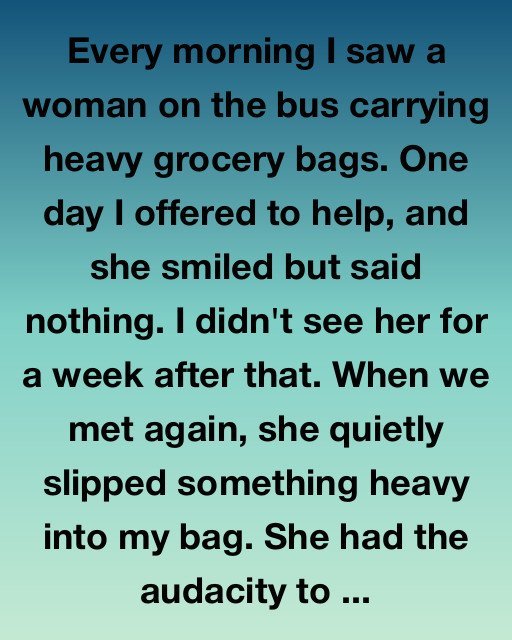
She didn’t take it. She just said, “Keep going.”
That was the first time she spoke to me. From then on, we didn’t talk much, but there was a quiet understanding.
I started looking forward to the mornings. To the bus. To seeing what little miracles would happen between the first and last stop.
But then, she stopped coming again. A week passed. Then two.
I asked the driver about her. He shrugged. “She’s here sometimes.
Then she’s not. That lady’s like smoke.”
Her absence started to bother me more than I expected. I wasn’t even sure I knew her name.
Then one rainy morning, I saw her again. But this time, she looked different. Paler.
Weaker. Her hands trembled as she held the bags, and for the first time, she let me take them without protest. We sat in silence.
She didn’t even look out the window like usual. Just stared at her lap, her fingers nervously tapping. “I’m not coming back after today,” she said quietly.
I turned to her. “Why?”
She gave a small smile. “Doesn’t matter.
But I wanted to thank you.”
“For what?”
“For looking.”
Then she stood up, handed me an envelope, and got off at the next stop without another word. Inside the envelope was a photo. An old one, black and white.
A younger version of her, holding the same journal. Standing in front of a small bookshop called Holloway’s Stories. On the back of the photo, she had written: “They always told me I saw too much.
I think I was just seeing enough.”
Below that, an address. I didn’t think. I just went.
The bookshop was still there, hidden between two larger buildings, almost invisible unless you were looking for it. Inside, it smelled like ink, wood, and time. An old man at the counter looked up.
“You must be here for her.”
I blinked. “How do you—”
“She said you’d come.”
He handed me a box. Inside were three more journals.
All filled. All hers. “She wanted someone to continue.
Said you’d know what to do.”
I spent the next week reading them. Stories of people, strangers, tiny joys and invisible griefs. It was like watching a city breathe through someone else’s eyes.
In one of the journals, I finally found her name: Marla. And in the final pages, her handwriting changed. Slower.
More fragile. “I don’t have long. But I hope someone picks up the thread.
The world needs more people who notice.”
I kept riding the bus. I kept writing. I started leaving notes.
Tucked into the seatbacks. Little messages for people to find. “You matter more than you know.”
“Someone noticed your kindness today.”
“Thank you for smiling at the driver.
He needed that.”
Sometimes, I’d see people read them. Sometimes, I’d see them cry. Or smile.
Or just hold the note for a long time. One morning, a girl with purple hair sat beside me. She pulled out a note from her pocket and whispered, “Was this you?”
I hesitated, then nodded.
She showed me her phone. A picture of the note. Posted online.
Thousands of likes. Hundreds of comments. “I thought I was invisible,” she said.
“This made me feel real.”
That day, I realized Marla had started something much bigger than herself. Soon, other people began leaving notes too. The bus became a little capsule of humanity.
The kind you didn’t see on news headlines or trending videos. And it didn’t stop there. One day, the driver waved me over before I got off.
“You should see this,” he said. He pulled out a folder. Inside were printed emails and letters from people who’d received the notes.
Stories of how a few words on a slip of paper had stopped someone from giving up. Had reminded someone to call their mom. Had made someone offer a sandwich to the man sleeping at the station.
Somehow, quietly, Marla had sparked a movement. Years passed. The bookshop closed.
The bus route changed. But the journal stayed with me. One afternoon, I got a call from the city library.
They were curating an exhibit on small acts of kindness. Someone had heard about the notes, the journal, the story. They wanted to include it.
I brought everything. The journals. The photos.
The notes. Even the duct tape from the mirror the artist girl had fixed. At the opening of the exhibit, I stood quietly in the back, watching people read her words.
Marla’s legacy. It felt like watching her walk through the room, unseen but deeply felt. A little boy pointed at a photo of her and asked his mom, “Who’s that?”
She smiled and said, “Someone who saw the world a little better than most.”
Later that evening, as I left, I found a folded piece of paper tucked into my coat pocket.
“You kept going. Thank you.”
No name. Just the words.
I laughed. Then cried. The story didn’t end with me.
And that was the point. Marla didn’t want recognition. She wanted a ripple.
And that ripple became a wave. Today, maybe someone’s reading this on their phone during a long commute. Maybe they’ve seen someone carrying heavy bags and wondered if they should offer help.
Here’s your answer: yes. Because every small act matters. Every look, every kind word, every gesture.
And sometimes, just sometimes, the universe rewards those who look up when others look away. I never saw Marla again. But I still carry the journal.
Still write in it. And if you ever ride the 7:15 bus, you might just find a note waiting for you. Not because you’re broken.
But because you’re seen. And being seen—truly seen—is one of the most healing things in the world. If this story touched you, share it.
Like it. Pass it on. You never know who needs a reminder that their small kindness matters.
Because it does.