
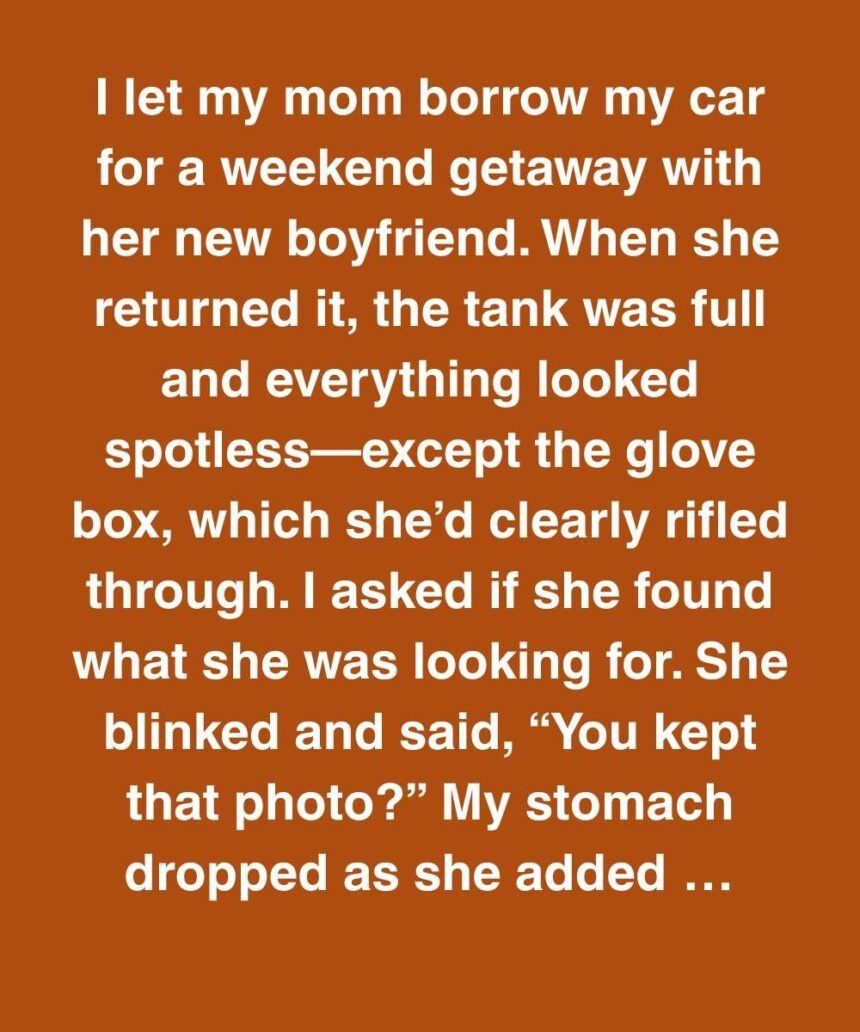
For years.” She didn’t sound angry, just tired. “And not just once. Not just with one person.
It broke something in me.”
I stopped walking.
“But why didn’t you tell me? Why let me think you were just bitter and cold?”
“Because I didn’t want to ruin your memories.
You were closer to him than me back then. You needed someone to believe in.” She rubbed her temple.
“And maybe I hoped one day you’d figure it out without me having to say it.”
I felt like I was twelve again, overhearing a fight through the wall, trying to decode the world with half-truths.
“So the photo…”
“That day at the lake? He left me at home, said he needed ‘father-daughter bonding time.’ He took you there after spending the night with someone else.”
Her voice cracked, and for the first time, I realized how lonely she must’ve felt. I’d always resented her silence, her brisk attitude, but now… it felt like grief.
I looked at the photo again.
Suddenly, it was harder to smile back at it. “I didn’t keep it to spite you,” I said.
“I just needed to hold on to something that made sense.”
“I know,” she said. “I shouldn’t have looked through your things.”
We walked back quietly, and I didn’t know what to do with everything she’d just dropped on me.
Part of me still didn’t want to believe it.
But I knew Mom wasn’t one for dramatics. Later that night, I found myself going through an old shoebox of Dad’s things I’d stashed years ago—ticket stubs, birthday cards, the watch he gave me at graduation. It hit differently now.
Like flipping through a book only to realize half the pages were lies.
A few days passed. I didn’t bring it up again, and Mom didn’t either.
But something had shifted. We weren’t as snippy with each other.
She started calling me more, even just to chat.
I thought maybe that would be the end of it. Then, a letter came. It was addressed to me, handwritten, no return address.
Inside was a single page.
I’ve been trying to reach you for a long time. I was with your father during his last months.
He wasn’t proud of everything he did, but he wanted you to know he loved you—deeply. I can answer your questions if you’re open to it.
— M.
I stared at the note, heart pounding.
“M”? No full name, no phone number—just a P.O. box scribbled at the bottom.
I showed it to Mom.
Her face paled. “That’s from Mara,” she said, almost spitting the name.
“She was the last one.”
“The last one?” I asked, confused. Mom nodded.
“The one he left me for.”
I sat down, overwhelmed.
“So why is she writing me now?”
“I don’t know. Maybe guilt. Maybe she wants to clear her conscience.”
I wanted to burn the letter.
But a small part of me—stubborn, curious—needed to know.
I wrote back. It was short.
I asked who she was, what she wanted, and why she thought I’d even care. A week later, another letter came.
This time, she included a photo.
My dad, thin and pale, lying in a hospice bed, smiling weakly with her by his side. He looked nothing like the man in the glove box photo. He asked me to keep you out of it.
He didn’t want you to see him like that.
But he talked about you constantly. The regrets, the missed birthdays.
He said you had your mother’s strength. And he cried every night for the last two weeks.
I didn’t know what to believe.
Part of me wanted to scream.
Another part just felt hollow. When I showed it to Mom, she didn’t speak for a long time. Finally, she said, “I didn’t know he was sick.”
“Would it have changed anything?” I asked.
She looked away.
“Maybe. Maybe not.”
Over the next few months, Mara and I wrote back and forth.
Slowly, the anger inside me started unraveling. I learned things I never expected: that Dad tried to call me on my 21st birthday but hung up before I picked up.
That he’d started therapy near the end.
That he left a small box of things for me, including a journal. Eventually, I met her. Mara was nothing like I expected.
She wasn’t glamorous or smug.
She looked tired. Sad, even.
She said she never wanted to break up our family—that it started as a stupid mistake that spiraled out of control. That Dad always talked about how badly he’d hurt my mom, and how he wished he’d done better.
“He was messy,” she said.
“But he loved you. That was never fake.”
It didn’t fix anything overnight. But it helped.
I brought the journal home and sat with it for days before opening it.
Some entries were confusing. Some made me angry.
Others made me cry. But through all of it, there was a thread of love—complicated, imperfect, real.
One entry stuck with me: “I wish I’d told Jules the truth sooner.
I was scared she’d hate me. But maybe she already does.”
I didn’t hate him. I hated the silence.
After reading the journal, I did something I never thought I would.
I asked Mom if she wanted to read it. She hesitated.
“I don’t know if I can.”
“You don’t have to forgive him,” I said. “But maybe it’ll help you understand why I kept the photo.”
She took the journal and read it over the course of a week.
When she gave it back, her eyes were red.
“I still don’t like the way he treated us,” she said. “But I see now… you needed your own version of him to hold onto.”
We hugged that day. Really hugged.
The photo from the glove box now sits in a frame in my living room—next to one of Mom and me, laughing over coffee.
I kept them both. Because life isn’t about perfect people.
It’s about learning to live with the broken pieces and still finding love in the cracks. People mess up.
Sometimes they hurt us deeply.
But that doesn’t erase the good, and it doesn’t mean healing can’t happen. Looking back, I think Mom and I both needed the same thing: to be seen. To have someone say, “What you went through mattered.”
I didn’t get a perfect dad.
She didn’t get a faithful husband.
But we both got something else in the end—truth. And truth, even when it stings, can be the beginning of something better.
If you’ve ever held onto a memory because it made you feel safe, even if it wasn’t the full story—know you’re not alone. Sometimes what we remember is more about who we needed them to be than who they really were.
And that’s okay.
That’s human. But when the full truth finally comes, if it ever does, face it. Because that’s where real healing begins.
If this story touched you, or reminded you of someone you need to talk to—share it.
Someone else might be waiting for the same kind of closure. And if you liked it, don’t forget to tap that like button and pass it along.