

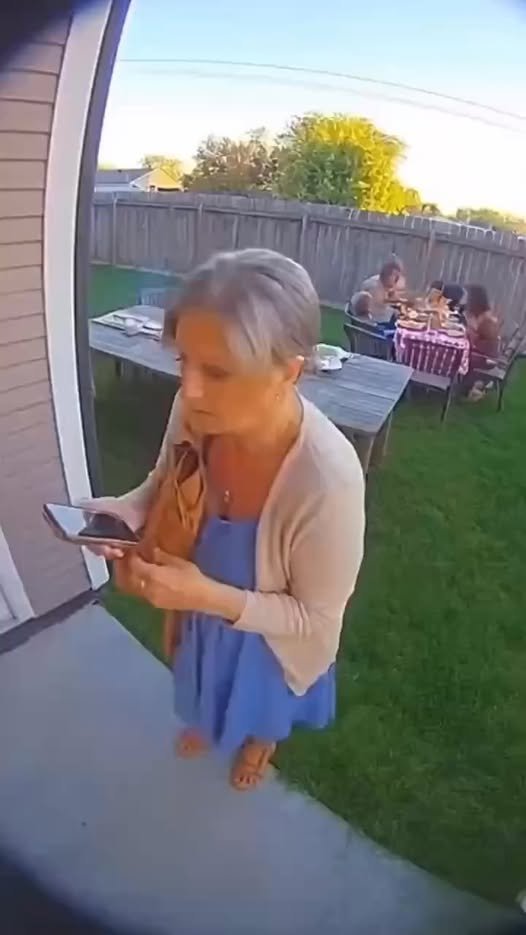
As she started the engine, she glanced in the mirror and saw Amanda step onto the porch, phone in hand, whispering into it. Then the first siren pierced the air. Lucia drove two blocks away and parked under a sycamore tree, hands gripping the steering wheel.
More sirens. Blue and red lights flickered behind her son’s house. Neighbors were gathering at their fences, pointing, whispering.
Her phone buzzed again. Are you safe? Don’t go back.
You were never the one they were after. She stared at the message, heart pounding. The one they were after?
Within minutes, police cruisers surrounded the house. Officers poured out, guns drawn. Lucia’s breath came shallow and quick.
Whatever was happening inside that home wasn’t about her lemon bars or Amanda’s criticism — this was something else entirely. She sat there frozen, watching the chaos unfold. Then her phone rang — a number she didn’t recognize.
Against her better judgment, she answered. “Mrs. Brown,” a calm male voice said.
“My name is Agent Nolan with the Department of Homeland Security. I need you to stay where you are. You’re safe, but we need to talk.”
Lucia’s voice trembled.
“What’s going on? My family — my grandchildren — what’s happening?”
“There’s been an ongoing investigation,” Nolan said carefully. “Your daughter-in-law has been under federal surveillance for over a year.
She’s suspected of laundering money through her company — and using your son’s business accounts to do it. Today, we intercepted communication suggesting she was planning to flee the country. You were never a target, but we believed she might try to involve you.”
Lucia’s mouth went dry.
“Involve me how?”
“She used your name on several financial documents,” he said. “But someone tipped us off before you could be implicated.”
Lucia’s mind spun. “Someone?”
“Yes,” Nolan replied.
“A confidential source — someone close to the family.”
She looked back toward the flashing lights. Her son was standing on the porch, hands raised, talking to an officer. Amanda was nowhere to be seen.
Hours later, after statements and questions and too many cups of bad coffee at the police station, Lucia finally learned the truth. Amanda had been running an illegal offshore scheme, funneling money through small charities and shell accounts — some in Lucia’s name. The anonymous text had come from one of Amanda’s former employees, a young accountant who’d discovered the fraud and feared for his safety.
He’d seen enough family photos online to recognize Lucia and realized she was an unknowing pawn in Amanda’s operation. That warning — those two short messages — had saved her from being arrested alongside her daughter-in-law. Amanda was taken into custody that night.
Daniel, shocked and devastated, could barely speak. He hadn’t known about the stolen money or the falsified accounts. He had trusted her completely.
Lucia spent the night at a friend’s house, too shaken to sleep. When dawn broke, she sat by the window with a cup of tea, watching the light creep across the floor. She thought about all the times she’d ignored her instincts — all the little moments when something had felt off but she’d brushed it aside for the sake of peace.
She realized how easily people mistake quiet for weakness. The next morning, Daniel called. His voice was hoarse.
“Mom… I’m so sorry.”
Lucia’s heart softened instantly. “None of this is your fault,” she said. “You’re a good man.
You just trusted the wrong person.”
“I don’t even know where to start,” he whispered. “You start,” she said gently, “by forgiving yourself. Then you rebuild.”
Weeks passed.
The investigation widened, and news of Amanda’s arrest spread quickly through the neighborhood. Lucia, once the quiet matriarch who kept to herself, became something unexpected — a pillar of calm for her shaken family. She helped Daniel get custody of the children, managed the paperwork, and even spoke with the young accountant who had risked everything to send that warning.
“You didn’t just save me,” she told him. “You saved my whole family.”
He smiled through the phone. “Sometimes the right thing isn’t loud,” he said.
“It’s just done quietly, at the right moment.”
Months later, Lucia returned to her son’s home for the first time. The air was still, the garden overgrown, the laughter of that long-ago barbecue now a distant echo. But as she stood there with her grandchildren playing in the yard, she realized the text that had once terrified her had done more than save her life — it had exposed the truth and given her family a second chance.
In the end, she deleted the messages, not because she wanted to forget, but because she didn’t need them anymore. She knew what they meant. A single act of courage — one anonymous warning — had pulled her from the edge of destruction.
Sometimes, salvation doesn’t come from faith or fate. It comes from a stranger who sees the storm before it hits — and sends a quiet message that changes everything.