

Inside, it smelled of ash and rot. Sunlight pierced through cracks in the boards, striping the walls. Dust floated like ghosts in the air.
“I shouldn’t be here,” I whispered. Victor chuckled. “Neither should I.”
He stopped in the hallway, right under a charred beam that looked one wrong breeze away from collapse.
He pointed at the floorboards. “Under there. That’s why I came back.”
I frowned.
“Under where?”
He crouched, prying up a plank with his hands. Dust puffed into the air, and beneath it was a metal box, scorched but intact. He lifted it out carefully, brushing away soot.
“What is that?” I asked. He didn’t answer. Just opened it.
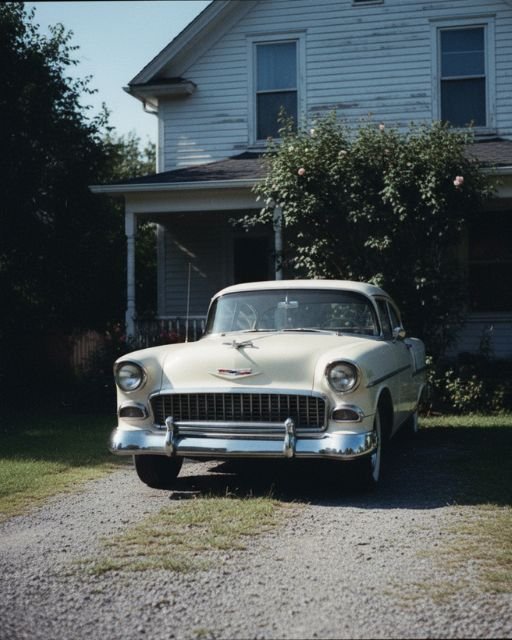
Inside were stacks of envelopes, thick with cash, and an old Polaroid photo on top. I leaned closer. The photo was of my dad and Victor, standing in front of that same Chevy, both grinning like they’d just pulled the greatest prank in the world.
My chest tightened. Dad had died in that fire. I looked at Victor.
“What… what is this?”
He didn’t look at me. “The truth.”
We carried the box outside and sat on the Chevy’s hood. He finally spoke.
“Your dad and I… we weren’t saints. We were running money for people we shouldn’t have been involved with. Thought we were clever, thought we could handle it.”
My head spun.
“You’re saying Dad was… a criminal?”
He flinched. “Not like that. He just got caught up in it.
I dragged him in, if I’m honest. I had debts. He helped me, because he was my brother.
That money was supposed to get us out clean.”
I stared at the box. “Then what happened?”
Victor’s jaw clenched. “The night of the fire, those people came to collect.
Your dad tried to stand his ground. He… he didn’t make it.” His voice cracked for the first time. “And I ran.”
I felt like the ground had tilted under me.
All those years, thinking Dad’s death was some tragic accident. All those years of Mom refusing to talk about it. And now this.
“You just left him?” My voice was sharp. Victor’s eyes filled with tears. “I thought I could come back for him.
But by the time I turned around… it was too late. The fire was everywhere.” He buried his face in his hands. “I’ve lived with that every single day.”
I wanted to hate him.
I wanted to scream. But watching him shake like that, I realized he hadn’t come back to clear his name. He’d come back because the guilt was eating him alive.
“Why now?” I asked again, softer this time. He lifted his head. “Because the people we ran from… they’re gone.
And you deserve to know who your father really was. Not the story they told you.”
We sat there in silence for a long time. The neighborhood was quiet, only the buzz of cicadas in the distance.
Finally, I asked, “What are you going to do with the money?”
He looked at the box. “Doesn’t feel like mine anymore. Doesn’t feel like his either.
Maybe it belongs to you.”
I shook my head. “I don’t want it. Not if it came from that.”
Victor smiled sadly.
“Then maybe we use it for something good. Something that actually honors him.”
That’s when the idea came. To rebuild.
Not the whole house, but the part that mattered. The porch where Dad used to sit, strumming his old guitar. The yard where he taught me to ride a bike.
Not as some haunted ruin, but as a place people could gather. The next weeks were a blur. Victor stayed in town, and we worked side by side.
We cleared weeds, patched wood, painted walls. At first, neighbors slowed their cars, whispering. But slowly, they started helping.
Someone brought tools. Another offered paint. The place that had been a scar for so long began to breathe again.
One evening, while fixing the porch railing, Victor said, “I don’t expect forgiveness. But I hope maybe one day you’ll see I tried to make it right.”
I looked at him, sweat on his brow, paint on his hands. “I don’t know if I can forgive you for leaving him.
But I see you’re here now.”
He nodded, and that was enough for both of us. The night we finished, we held a small gathering. Mom came, hesitant at first, but when she saw the porch lit up with string lights, she sat down and smiled in a way I hadn’t seen in years.
For the first time, the house didn’t look like a grave. It looked like home again. People told stories about Dad that night.
Not about debts or mistakes, but about his laugh, his stubborn kindness, his music. And for the first time, I felt like I had the whole picture of who he was — flawed, human, but deeply loved. When everyone left, Victor and I sat on the porch steps, looking out at the quiet street.
He handed me the Polaroid. “Keep it,” he said. “That’s the man I want you to remember.”
I slipped it into my pocket, the edges worn and warm.
We never spoke much again about the fire, or the money, or those seventeen missing years. But we didn’t need to. Some wounds don’t close with explanations — they close with actions.
And that house, once empty and rotting, was alive again. Not because we erased the past, but because we faced it. Sometimes the people who disappear return not to stay, but to give you the missing piece you’ve been carrying a hole for.
And sometimes the most broken places can become the ones that hold the most light. If there’s anything I learned, it’s this: we can’t choose the mistakes our family made, but we can choose what we do with the truth. We can let it bury us, or we can use it to build something better.
And maybe, just maybe, forgiveness isn’t about forgetting what happened. It’s about deciding the story doesn’t end there. If you’ve ever carried a secret, or lived with questions that haunted you, I hope this story reminds you — it’s never too late to face the past.
It’s never too late to rebuild. If this touched you, share it with someone who needs to hear it. And if you believe in second chances, leave a like.