

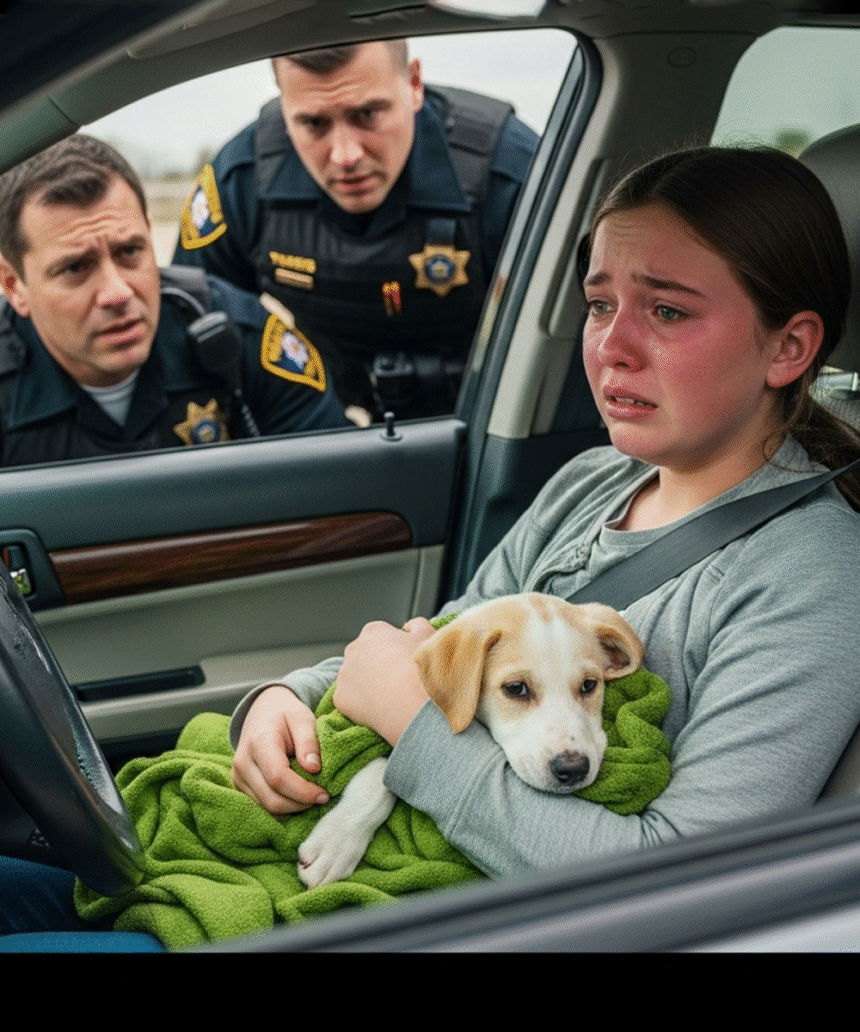
“You’re okay, buddy. Almost there.”
The clinic staff saw the lights and met them at the curb with a gurney.
Buddy went straight to the treatment room—oxygen line, temperature check, IV catheter deftly placed by practiced hands.
Emily stood just inside the doorway, every muscle pleading.
Minutes felt like hours. Then a veterinarian stepped out, calm stitched into her voice.
“Severe heat stress and dehydration, caught just in time,” she said. “He’s responding.”
Buddy lifted his head.
The tail thumped once, tentative, then again.
Emily cried the kind of tears that wash fear out of a body.
At the station, officers reached Emily’s parents. Her mother arrived still in her apron, her father in work boots dusted with drywall. There were apologies and hugs and a moment where the room breathed as one.
Officer Reyes knelt to Emily’s level.
“You made a dangerous choice,” he said gently, “but you did it to save a life.
Next time, call us sooner—we’ll help you get there safely.”
He turned to her parents with a half-smile. “When she’s old enough, I want her instructor to know she’s already a defensive driver under pressure.”
They all laughed; the sound released the last of the day’s tension.
News travels fast in places where people still wave from porches.
The department shared a short post:
“Today, a traffic stop became a rescue. A young neighbor used courage and quick thinking to save her puppy.
Our officers did what they’re sworn to do—protect life.
We’re proud of everyone involved.”
Comments poured in—gratitude for the officers’ judgment, admiration for a child’s devotion, reminders about summer heat and pet safety.
A week later, Buddy was himself again—chasing socks, falling asleep halfway off his bed, leaning into Emily like there was nowhere else in the world to be. The clinic sent home a care sheet and a new collar tag. Emily taped a checklist to the fridge:
- Walks only at cooler hours
- Fresh water in two bowls
- Never leave pets in cars, even with windows cracked
- If something seems wrong, call for help immediately
Not every emergency fits neatly into a rule book.
Sometimes a child’s love shoves the world into motion, and adults—officers, techs, parents, neighbors—choose to meet that love with wisdom instead of punishment.
Officer Reyes said it best when a local reporter asked what he’d remember: “We see hard things.
But now and then we see a moment that reminds us why we serve. A siren clearing traffic for a dog might look small.
It didn’t feel small inside that car.”
On the first cool morning of fall, Emily clipped on Buddy’s leash and walked past the red-brick clinic. She paused, looked at the door, and squeezed the handle of the leash gently.
“Thanks,” she whispered—to the officers, to the vet team, to the version of herself who didn’t freeze when fear hit.
Buddy wagged like he understood.
Maybe he did.
Practical Takeaways (Share This Part)
- Heat kills fast. On warm days, asphalt and cars heat quickly.
Keep pets indoors, shaded, and hydrated.
- Know your nearest vet. Save addresses and numbers; ask clinics about emergency hours.
- Teach kids the plan. If they’re ever alone in a crisis: call a parent, a neighbor, and local non-emergency or 911 for guidance.
Compassion + judgment. First responders balance safety with empathy every day—this story is a blueprint for how communities can work at their best.