

I couldn’t. Instead, I put the phone facedown on the mattress and focused on breathing—in for four counts, hold for four, out for four, just like Dr. Chen had taught me in that therapy office in Philadelphia with the humming air conditioner and the box of tissues that was always half-empty.
I looked around my bedroom, grounding myself in the present. The stack of books on my dresser, organized by author. The framed print of a gray-blue Atlantic Ocean I’d bought last year with my own money.
The heavy blackout curtains I’d installed myself. This was my space. They weren’t allowed here anymore.
The buzzing stopped. Blessed silence. Then a text notification popped up on the screen.
“Isabella, pick up. It’s an emergency. It’s your sister.”
Of course it was about Elina.
It was always about Elina. I stood up and walked to my kitchen, my bare feet cold against the hardwood floor. I poured myself a glass of water from the filtered pitcher and stood by the window, looking down at the empty street below.
A streetlight washed everything in pale orange. Somewhere in the distance, a siren wailed. Ten years ago, I had walked out of my parents’ house and never looked back.
I changed my number. I moved to a different city. I got a new job at a different firm.
I never told them where I went. For the first year, I’d been terrified they would find me, that every silver sedan was my mother’s car, that every unknown number was them calling to drag me back. But they never came.
That was what hurt most in the beginning—realizing they didn’t chase me to apologize or to see if I was safe. They just let me go. Because I was no longer useful.
I took a sip of water and let my mind drift back, not to the final confrontation, but to the slow accumulation of small betrayals that had built up over twenty-five years. My sister Elina is two years younger than me. From birth, she was the princess—delicate, pretty, with big blue eyes that filled with tears whenever she didn’t get her way.
I was different. Sturdy, quiet, brown-eyed with plain brown hair. I did my homework without being asked.
I brought home perfect grades. And I got the same response every time: “Isabella, you’re the strong one. Elina needs help.
You don’t.”
I thought it was a compliment. I didn’t realize it was a life sentence. Being “the strong one” just meant I was the one expected to carry everyone else’s weight.
It started small—giving Elina my allowance so she could buy a doll, doing her chores when she had a “headache,” letting her have the last cookie because “you don’t need it.” I always said yes, desperate to be seen, to be valued, to earn the kind of smiles my mother gave Elina so freely. When I was sixteen, I got my first job bagging groceries at ShopRite, working evenings and weekends. I saved every penny in a blue savings account booklet I kept hidden under my socks, dreaming of buying a used Honda Civic I’d seen on Craigslist.
Two weeks before I had enough, Elina crashed her scooter into a neighbor’s fence. She wasn’t hurt, but the repairs were expensive. My mother came into my room that night and sat on my bed with a sigh that carried the weight of the world.
“We need to use your car fund,” she said. Not asking. Telling.
“But Mom, I’ve been working for a year—”
“Family sacrifices, Isabella. Don’t be selfish.”
That word. Selfish.
The weapon she used every time I wanted to keep something for myself. I gave her the money. I cried myself to sleep.
Elina got a new scooter a month later, bought on a store credit card. I never got my car. I took the bus until I was twenty-two.
College was worse. I went to a state school on scholarship, commuting by train, waiting tables at a diner to pay for books. Elina went to a private art college in Manhattan—luxury apartment, used Volkswagen Beetle, designer clothes, all paid for by my parents.
When I came home for Thanksgiving my junior year, exhausted from working double shifts, my boots held together with duct tape, Elina was spinning in the kitchen showing off a designer handbag. “Mom got it for me for getting a B in painting class!” she squealed. “I made the dean’s list,” I said quietly.
“I have a 4.0.”
My mother didn’t even look up from chopping vegetables. “That’s nice, Isabella. You’ve always been book smart.
Elina is creative. It’s harder for her.”
I went to the bathroom and stared at myself in the mirror, pale and dark-circled, looking years older than I was. Why couldn’t they see me?
Why was my achievement invisible? The real extraction started when I graduated and became a junior accountant at a downtown firm. I thought, finally, I can build my life.
But my mother saw my salary as family property. It started with a phone call: “The roof is leaking. Send five hundred.
Just this once.”
I sent it. Then: “Elina needs a dress for a wedding. Send three hundred.”
Then: “We’re behind on the mortgage.
Two thousand. Just this once.”
I sent it. Every time, hoping this would be the payment that earned their love.
But I was trying to buy something that wasn’t for sale. A year before everything exploded, I paid off a credit card bill Elina had run up on a “healing trip” to Mexico—a resort I couldn’t dream of affording. When I went to Sunday lunch and mentioned it, asking her to please not use the card again because it had drained my savings, she rolled her eyes.
“God, Isabella, you’re so dramatic. It’s just money. You make plenty.
Why are you so stingy?”
I looked at my mother, waiting for her to defend me, to tell Elina to say thank you. Instead, Mom sighed. “Don’t start a fight, Isabella.
Don’t bring your stress in here.”
My stress. Caused entirely by them. That was the moment I felt the first crack inside my chest, small and sharp.
I realized they were mining me like I was a resource to be extracted until nothing remained. And still, I stayed, chained by habit and guilt, not knowing how to exist as anyone other than Isabella the provider, Isabella the strong one. The end came on a Tuesday evening in summer.
I’d worked a ten-hour day and was reheating Chinese takeout when my mother called. “Come for dinner. It’s important.”
Important usually meant expensive.
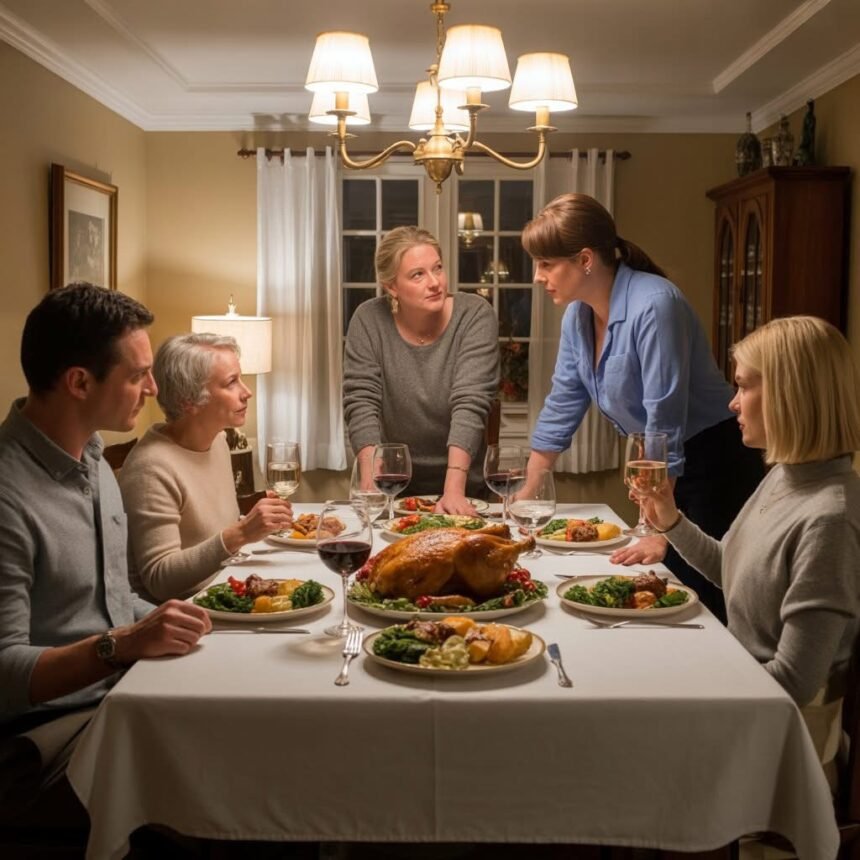
When I arrived at my childhood home, the dining room table was set like a holiday—good china, crystal glasses, roast chicken and wine I knew they couldn’t afford. My father sat at the head of the table staring at his plate, not greeting me. That should have been my warning.
We ate in awkward silence punctuated only by the scrape of silverware and the ticking of the wall clock. Finally, my mother set down her fork and looked at me with an expression I’d seen a thousand times—the one that meant she wanted something. “Isabella, we have an opportunity.
A huge opportunity for Elina.”
“What kind of opportunity?” I asked carefully. “A boutique,” Elina said, her eyes lighting up. “My own fashion line.
I have a vision, Isabella. It’s going to be huge.”
“Do you have a business plan?”
She scoffed. “Details.
Mom handles details.”
My mother leaned forward, her eyes locking onto mine. “She needs startup capital. Real capital.
Two hundred thousand dollars.”
The number hung in the air like smoke. “Two hundred thousand?” I laughed, a nervous, disbelieving sound. “Mom, I don’t have that.
I’m not a millionaire.”
“You have excellent credit,” she said calmly. “We checked. You can take out a business loan in your name.”
We checked.
They had run my credit without permission. “No,” I said. My mother’s eyes narrowed.
“What?”
“No. I can’t do that. If the business fails—and Elina has never run a business—I’m ruined.
I’ll be paying that debt for twenty years. I won’t do it.”
“You never believe in me!” Elina snapped. “It’s not about belief.
It’s math. It’s too risky.”
My mother stood so fast her chair scraped. “Isabella, this is your sister.
This is her dream. You’re going to ruin it because you’re scared? You’re selfish.”
“I’m not doing it,” I said, my voice shaking but firm.
“I’m done being the bank.”
“Give me your credit card,” my mother demanded, her face flushing red. “We need a deposit tonight. Give it to me.”
“No.”
The slap came so fast I didn’t see her hand move.
I only heard the crack, sharp as a gunshot. My head snapped to the side. The silverware rattled against the plates.
My cheek burned instantly, my ear ringing. I lifted my hand and touched my face. It felt hot and swollen.
I looked at my father. He stared at his plate. Silent.
Useless. I looked at Elina. She wasn’t shocked.
She was smirking, that small cruel curve of her mouth, looking triumphant. My mother stood over me, breathing hard. “You ungrateful girl.”
Something broke inside me.
Not a breakdown. A breakout. I stood slowly and picked up my purse.
“I’m leaving.”
“If you walk out that door,” my mother yelled, “don’t you come back. You are turning your back on this family.”
“No, Mom,” I said, meeting her eyes. “You turned your back on me a long time ago.”
I walked out through the hallway where our school photos still hung, out the front door, into the night.
I got in my car and drove to a roadside motel where I sat on a lumpy bed and stared at floral wallpaper. My face throbbed. I felt hollow.
But beneath the hollow was something else: lightness. For the first time in my life, I didn’t have to solve their problem. The next few weeks passed in a blur of silence.
I expected screaming calls and guilt-soaked texts. There was nothing. The silence confirmed what I’d known all along: I was only valuable when I was giving.
About a month later, I ran into my cousin Sarah at the grocery store. She looked startled to see me. “We haven’t seen you in a while,” she said carefully.
“I’ve been busy.”
“Well, it’s cool of you to help Elina anyway. She’s been bragging about the boutique.”
Cold washed over me. “Help her how?”
“The boutique.
She said you’re backing her. She’s signing the lease next week.”
I dropped my basket. A jar of pasta sauce shattered, red splattering across white tiles.
“I didn’t back her.”
“But she said the funding is secured. Under your name.”
I left the mess on the floor and ran to my car. Sitting in the parking lot with shaking hands, I pulled up my bank accounts.
Checking looked normal. Savings looked normal. I called the credit bureau.
“Verify recent inquiries,” I said when the automated system prompted me. Three inquiries in the last week. Two business loans.
One massive line of credit. All approved. They hadn’t just ignored my refusal.
When I said no, they’d taken it anyway. They’d used my social security number, my information, my name. My mother.
My sister. Criminals. And I was their victim.
I opened the car door and dry-heaved onto the asphalt. This wasn’t family drama. This was a felony.
I called my father. He met me at a diner, looking ten years older, shoulders slumped. I didn’t order food, just black coffee I couldn’t drink.
“Did they use my name?” I asked. He gave a tiny, pathetic nod. “How?”
“Your mother has your birth certificate.
She… she practiced your signature from old birthday cards.”
I stared at him. My mother had forged my signature to steal from me. “And you knew.”
“I told her not to,” he whispered.
“I said it was wrong.”
“Dad, this is fraud. This is prison time.”
He flinched. “It’s family, Isabella.
We just need time. The business will make money—”
“Mom has a plan to ruin me,” I said. “And you watched her do it.”
“You’re strong, Isabella,” he said, his voice breaking.
“You can handle things. Elina can’t. She needs us.”
There it was.
My strength was my punishment. I stood up and looked down at my father. I didn’t feel hate.
I felt pity. He was a weak man who’d let his wife turn him into a ghost. “I am strong, Dad,” I said.
“And I’m going to handle this. But you won’t like how.”
I put money on the table for the untouched coffee. “Goodbye, Dad.”
The sun was shining outside, but the world looked different—sharper, harder.
I felt cold clarity settle over me. I got in my car and searched for a lawyer on my phone. Not a family lawyer.
A fraud lawyer. “Mitchell & Associates,” I read. “Specializing in financial fraud and identity theft.”
I pressed call.
“My name is Isabella,” I said when someone answered. “I need to report a major theft. The perpetrators are my family.”
That lawyer, Mr.
Mitchell, a man in his sixties with wire-rimmed glasses, listened to my story without judgment. When I finished, he took off his glasses and cleaned them with a handkerchief. “Isabella, you have two choices,” he said calmly.
“Choice A: you accept this debt. You pay two hundred thousand plus interest over twenty years. Your credit is ruined.
And they will do it again, because fraud is habit-forming.”
I stared at my hands. “Choice B: you file an affidavit of identity theft. You report the loans as fraudulent.
The banks investigate. They pursue the perpetrators. You’re cleared.
But your family faces criminal charges.”
I looked up. “Choice B.”
“Are you sure? This isn’t something you can undo.”
“I’m sure.”
Over the next weeks, I became a surgeon removing a tumor.
No emotion, just precision. I closed every shared account. I opened new ones at a different bank.
I put fraud alerts on my credit. Mr. Mitchell and I built an airtight case—forged signatures, fake employment letters, false addresses.
Mountains of lies. When the banks froze the funds, my phone exploded with calls and texts swinging from begging to threatening. I didn’t read them.
I changed my number. I moved to a new city. New apartment.
New job. I needed complete separation. For the first year, I was terrified they’d find me.
But they never came. Tracking me down would have required effort and money they didn’t have. They simply let me go.
Over the next decade, I rebuilt my life. I paid off my student loans. I bought my apartment.
I traveled to Italy and ate pasta in Rome. I made friends who liked me for who I was, not what I could give them. But I never fully relaxed.
I kept every document from the case in a fireproof safe in my closet. I monitored my credit monthly. From a distance, I watched my family like a scientist observing bacteria.
I saw when Elina married and divorced six months later. I saw when my mother took a second mortgage on the house. I wasn’t angry anymore.
I was just prepared. Which brings me back to tonight, standing in my kitchen at two-thirty in the morning, staring at my phone. The silence was over.
The reckoning had come. I took a deep breath and walked back to the bedroom. I sat on the edge of the bed and slid my thumb across the screen.
I called her back. It rang once. “Isabella.” My mother’s voice was high, thin, terrified.
She sounded old. “Hello, Mother.”
“Oh, thank God. We didn’t know if you still had this number—”
“What do you want?”
“You have to come home.
To the house. Tonight. Now.”
“It’s two-thirty in the morning.
I’m not going anywhere.”
“You don’t understand,” she shrieked. “The police were here. Detectives.
They took Elina’s laptop. They froze her accounts. They’re talking about arrest warrants.”
Validation washed over me, cold and clean.
“What did she do?”
“Nothing! It’s a misunderstanding. She started a consulting business.
She just needed bridge loans.”
“Whose name did she use?”
Silence. Heavy, guilty silence. “She might have put your name down as a reference, but somehow the paperwork got mixed up—”
“She forged my signature again,” I said flatly.
“No, she just digitally signed it. It’s not a crime. But the police won’t listen.
They say it’s identity theft. Grand larceny.” My mother sobbed. “Fifty thousand dollars, Isabella.
Please, you have to tell them you authorized it. Just say you forgot. The investigation goes away.”
“You want me to lie to the police?”
“I want you to save your sister!
She can’t go to jail. She’s delicate. She won’t survive.”
I looked toward my closet where the safe sat bolted to the floor.
“Okay,” I said. “Okay, you’ll help?”
“I’ll meet you tomorrow morning. Nine a.m.
The café on Main Street.”
“Yes! Oh, Isabella, I knew you were a good girl—”
“Nine a.m.,” I repeated and hung up. I didn’t go back to sleep.
I went to the closet and opened the safe. Inside was the black binder containing everything from ten years ago. I turned to the back section.
My mother thought this was a surprise. But credit monitoring is very good these days. I’d received the alert three weeks ago: new inquiry, small business loan, applicant Isabella.
I hadn’t ignored it. I’d called Mitchell & Associates. We’d already filed the police report.
The detectives had shown up at my mother’s house tonight because I’d sent them there. The proof was absolute. Elina had used my social security number, my old address, a fake email.
She’d spent fifty thousand in two weeks on clothes, flights, online gambling. I closed the binder and showered, standing under hot water for a long time. I wanted to be clean.
When I stepped out, I dressed carefully in my navy blue suit—professional, sharp. Armor. I drove the three hours back to my hometown as the sky shifted from black to gray to brilliant cold blue.
I wasn’t going to save them. I was going to witness the end. The café was trendy now, exposed brick and hanging plants where the old bakery used to be.
I walked in at exactly nine o’clock. They sat in the back corner like refugees. My mother looked small, her hair gray and unkempt, wearing an oversized coat, shredding a napkin between her fingers.
Elina sat beside her in a faded hoodie, her face puffy from crying, looking like a teenager caught shoplifting instead of a thirty-two-year-old woman. When they saw me, my mother’s face lit with desperate hope. “Isabella,” she hissed, waving me over.
I walked to the table and sat down. I placed my black binder between us. “You look good,” my mother said, scanning my tailored suit.
“Successful.”
“I am.”
Elina kept her eyes on the table. “Thank you for coming,” my mother whispered, leaning in. “You just need to call the detective.
Tell him you knew about the loan. Tell him it was authorized.”
“And then what?”
“Then they drop the case. Then we figure out how to pay it back—”
“You don’t have the money.
Elina spent it all.”
My mother’s eyes flicked to her. “She made a mistake. She’s sorry.
Aren’t you?”
“I’m sorry,” Elina mumbled, sounding rehearsed. “See? Now please, make the call.
For family.”
I looked at them. For years, I’d been afraid of these women. I’d craved their love like oxygen.
But looking at them now, I felt nothing. They were strangers. Dangerous strangers who wanted to hurt me to save themselves.
“I can’t make that call,” I said. “Why not?” my mother demanded. “Are you that heartless?”
“I can’t make the call because I’m the one who called the police.”
The silence was crushing.
My mother’s mouth fell open. Elina’s head snapped up, eyes wide. “What?” my mother whispered.
I opened the binder and slid the police report across the table. “I got the alert three weeks ago. I didn’t wait.
I called my lawyer. We sent evidence to the fraud division. I gave them everything.”
My mother’s face turned purple.
“You did this? You sent the police to my house?”
“No. Elina sent the police.
Elina committed a felony. I reported it.”
“You traitor!” Elina screamed, slamming her hand on the table. Coffee cups rattled.
People stared. “You have so much money,” she spat. “You could have just paid it.
Why did you ruin me?”
“I didn’t ruin you. You stole from me. Twice.
The first time, I walked away. I gave you ten years to change. You didn’t.
You came after me again.”
“I’m your mother,” my mother hissed, grabbing my wrist. Her grip was tight, painful. “You will call them right now and retract this, or so help me God, you are dead to me.”
I looked at her hand on my wrist—spotted with age, the same hand that had slapped me at a dinner table, that had guided my pen as I wrote checks I couldn’t afford.
I pulled my arm back. Her hand fell away. “I was dead to you the moment I stopped paying,” I said.
I stood and buttoned my jacket. “The detective has everything he needs. I’m not pressing charges—the bank is.
It’s the state against Elina now. It’s out of my hands.”
“Isabella, please,” my mother sobbed, real tears streaming down her face. “We can’t handle this alone.”
“You removed me from the family the night you slapped me.
I’m just honoring your decision.”
I turned toward the door. “Isabella!” Elina screamed behind me. I walked out.
The bell above the door jingled. I stepped onto the sidewalk into crisp autumn air. I didn’t look back.
I drove home that afternoon with my phone off. When I got back to my apartment, I didn’t feel triumphant. Victory implies a battle.
This was just gravity—consequences following actions. Over the next months, the legal process unfolded without me. The amount was over fifty thousand dollars, making it a felony.
With Elina’s history of financial irregularities, they weren’t lenient. They froze her assets, seized her car. My mother drained her retirement and took a second mortgage trying to save her.
It wasn’t enough. The evidence was bulletproof. Elina took a plea deal: guilty to identity theft and bank fraud.
Two years in prison, five years probation, court-ordered restitution. I didn’t attend the sentencing. I read about it online.
“Local Woman Sentenced in Identity Theft Case.” There was a photo of Elina leaving the courthouse in a cheap coat, looking older, harder. She wasn’t smirking anymore. My mother lost the house after draining everything fighting for Elina.
She moved to a small apartment near a highway overpass. My father moved in with his brother in another state. The family was dismantled.
People might think this was revenge. It wasn’t. It was gravity.
When you jump off a cliff, gravity pulls you down. It doesn’t hate you. It just acts according to natural law.
My family had been jumping off cliffs for years, expecting me to be the safety net. I just moved the net. Six months after Elina went to prison, I received one letter from my mother, handwritten on cheap lined paper: “I hope you are happy.
You destroyed us. Your sister is in a cage. I have lost my home.
You did this. You are a cold, heartless girl. I pray you never have children so they don’t do to you what you did to me.”
I read it standing in my kitchen, sunlight pouring through the window.
I didn’t cry. I felt sadness for the mother I wished I’d had, for the family I never really had. But as I reread her words, I realized she still didn’t see me.
She still took no responsibility. In her mind, Elina stealing my identity wasn’t the crime—me reporting it was. I tore the letter in half, then in half again.
I dropped the pieces in recycling. I made Earl Grey tea. I sat by the window and watched people walking below—dog walkers, kids on scooters, a couple arguing over a parking ticket.
I was alone. But I wasn’t lonely. Loneliness is waiting for someone who will never come, sitting at a table with people who don’t care about you.
I wasn’t waiting anymore. The day Elina was released two years later, I didn’t know. I’d stopped monitoring them.
I was busy—promoted at work, managing my own team, dating a kind man named David who taught high school history and actually listened when I spoke, who wanted nothing from me except my company. One Sunday, David and I were walking in the park. The leaves were turning orange and gold, carpeting the path.
Kids threw footballs on the grass. The air smelled like autumn. My phone rang.
Unknown number. I answered. “Hello, Isabella.” Elina’s voice, raspy and rough.
“Hello, Elina.”
“I’m out. I have nothing. Mom’s living in a dump.
I can’t get a job with a record. I have nowhere to go.”
She paused, the expectation hanging in the silence. The old hook dangling.
“I’m sorry to hear that,” I said. And I meant it. I was sorry her life was hard.
But I wasn’t going to fix it. “Is that it?” she snapped. “You’re sorry?
You have a condo, a career. You owe me. You put me in there.”
“No, Elina.
You put yourself there.”
“I’m your sister. Doesn’t that mean anything?”
I glanced at David watching a dog chase a Frisbee, smiling, patient, kind. “It means we share DNA,” I said.
“But family is more than blood. Family is respect. Family is safety.
You were never safe for me.”
“So you’re just going to hang up? Let me starve?”
“You won’t starve. You’re smart.
You’ll figure it out. But you’ll do it without me.”
“I hate you,” she whispered. “I know,” I said softly.
“And I forgive you. Not for you. For me.
So I don’t have to carry the anger anymore. So I can put this phone down and never think about you again.”
“Isabella—”
I ended the call. I blocked the number.
Then I opened my settings and changed my number again. It took five minutes. David turned to me.
“Who was that?”
“Wrong number,” I said. He smiled. “Ready for lunch?”
“Yes.
I’m starving.”
We walked down the path, leaves crunching under our boots. I took a deep breath. The air was cold and clean.
I thought about the dining room table ten years ago. The slap. The smirks.
The silence. The credit card bills. The guilt.
The fear. It was all gone. I didn’t destroy them.
I just stopped saving them. And in doing so, I finally saved myself. I reached for David’s hand.
It was warm. I walked forward into my own future, finally free. The Greatest Investment
The sound of Derek’s pen scratching against paper filled the silent courtroom like nails on a chalkboard.
I watched from across the mahogany table as my husband of eight years signed our divorce papers with the same casual indifference he’d shown when signing grocery lists. “Well, that was easier than I thought,” Derek muttered to his high-priced attorney, loud enough for me and my court-appointed lawyer to hear. “I almost feel bad for her.
Almost.”
Judge Harrison, a stern woman in her sixties with silver hair pulled back in a tight bun, looked over her glasses at Derek with obvious disapproval. “Mr. Thompson, please show respect for these proceedings and your wife.”
“Soon-to-be ex-wife,” Derek corrected with a chuckle.
“And with all due respect, your honor, I think we can all agree this is long overdue.”
I kept my hands folded in my lap, digging my nails into my palms to keep from trembling. My simple black dress felt shabby compared to Derek’s polished appearance—exactly the image he wanted to project: successful businessman divorcing his struggling wife who couldn’t keep up with his ambitions. From the corner of my eye, I caught sight of her.
Candace sat in the back row, trying to look inconspicuous in her red dress and designer heels. My replacement. Derek’s secretary turned mistress, though she preferred to call herself his “business partner” now.
“Mrs. Thompson,” Judge Harrison addressed me directly. “Do you have anything you’d like to say before we finalize these proceedings?”
I opened my mouth, then closed it again.
What could I say? That my husband had cheated on me? That he’d manipulated our finances so everything was in his name?
That he’d made me financially dependent on him and then discarded me like yesterday’s newspaper? “No, your honor,” I finally managed. Derek’s smirk widened.
“See, even she knows this is for the best.”
My lawyer, Mrs. Patterson, a kind older woman who was working my case pro bono, shuffled through her papers nervously. According to the settlement, I would get the house—mortgaged to the hilt—our old Honda, and a small monthly alimony payment.
Derek would keep his successful consulting business, his BMW, his boat, and his substantial retirement accounts. “Before we conclude,” Mrs. Patterson said suddenly, standing up, “there is one matter we need to address regarding Mrs.
Thompson’s inheritance from her late father.”
Derek’s smile faltered slightly. “What inheritance? Her dad was a janitor who died five years ago.”
The dismissive way he said janitor made my blood boil.
My father, Robert, had worked multiple jobs to provide for our family after my mother passed away. “That’s what we’re here to clarify,” Mrs. Patterson replied calmly.
“It appears there are some legal documents that were never properly processed after Mr. Robert Mitchell’s passing.”
Judge Harrison leaned forward with interest. “What kind of documents?”
“His last will and testament, your honor.
Due to some administrative oversights at the probate court, it was never officially read or executed.”
Derek laughed outright. “This is ridiculous. We’re wasting the court’s time over some old man’s will.
What could he possibly have left her? His collection of work boots?”
Candace giggled from the back row, and Derek turned to wink at her. “Your honor,” Mrs.
Patterson continued, “I request that we postpone the finalization of this divorce until Mr. Mitchell’s will can be properly read and executed, as it may significantly impact the division of assets.”
Derek’s attorney jumped up. “Objection, your honor.
This is clearly a stall tactic.”
“Not necessarily,” Judge Harrison replied thoughtfully. “If there were administrative errors in the probate process, the will could still be legally valid and unexecuted. Mrs.
Patterson, do you have documentation to support this claim?”
Mrs. Patterson handed a thick folder to the bailiff. As Judge Harrison reviewed the documents, the courtroom fell silent except for Derek’s increasingly agitated breathing.
I watched my husband’s confident facade begin to crack. For the first time since this whole process began, Derek looked uncertain. “This is highly irregular,” Preston muttered, but his voice lacked its earlier confidence.
Judge Harrison finally looked up. “I’m going to need time to review these materials properly. This court will recess for one week to allow for proper examination of Mr.
Robert Mitchell’s estate and will.”
Derek shot to his feet. “Your honor, this is absurd!”
“Mr. Thompson, I suggest you lower your voice in my courtroom,” Judge Harrison replied sternly.
“And I suggest you take this week to consider that there might be more to your wife’s family than you assumed.”
As the judge’s gavel came down, I saw something I’d never seen before in Derek’s eyes. Fear. For eight years, he’d controlled every aspect of our relationship.
But now, for the first time, he didn’t know what was coming next. Neither did I. But for the first time in months, I felt a spark of something I’d almost forgotten.
Hope. Six Months Earlier
It was a Tuesday evening in March when everything changed—the day after our eighth wedding anniversary, which Derek had forgotten entirely. Derek’s consulting firm had been growing rapidly.
I was proud of his success, even though it meant longer hours and less time together. I’d quit my full-time marketing position three years earlier at Derek’s suggestion. “We don’t need the stress of two demanding careers,” he’d said.
“This way, you can focus on the creative work you love.”
At the time, it had seemed romantic. I didn’t realize then that financial independence and creative freedom were two very different things. That Tuesday evening, Derek called around five to say he’d be working late again.
Candace was helping him prepare for a big presentation, he explained. I decided to surprise him. I’d spent the afternoon making his favorite lasagna and drove to his office with dinner for both of them.
Derek’s office was in a converted warehouse downtown. The parking lot was nearly empty except for Derek’s BMW and Candace’s red Mercedes. I used my key to enter, balancing the warm casserole dish.
The elevator seemed to take forever. Most of the office lights were off. Only the glow from Derek’s corner office illuminated the workspace.
I was halfway across the main office when I heard Derek laugh—not his polite, professional laugh, but the deep, genuine laugh he used to reserve just for me. “You’re terrible,” Candace was saying, her tone playful and flirtatious. “What if someone comes in?”
“Nobody’s coming in,” Derek replied.
“Besides, I pay the rent on this place. I should be able to do whatever I want here.”
My hands started trembling. I knew I should announce myself, but something kept me frozen behind a partition wall.
“I love when you get all possessive and powerful,” Candace purred. “It’s so different from how you are at home.”
The casual way she referenced my home hit me like a physical blow. “Don’t talk about home,” Derek said.
“You know that situation is complicated.”
“Situation?” Candace laughed. “Is that what we’re calling your wife now?”
“Amara is… she’s a good person,” Derek said, “but she doesn’t understand what it takes to build something real. She doesn’t push me to be better like you do.”
I pressed my back against the partition wall, feeling like I might be sick.
“When are you going to tell her?” Candace asked. “Soon. I need to get the business restructured first.
Make sure all the assets are properly positioned. I can’t afford to lose half of everything I’ve built because I was careless about timing.”
“You mean half of everything we’ve built,” Candace corrected. “Of course, baby.
That’s why I need to be smart about the divorce. Amara thinks she’s entitled to half of everything, but she has no idea how much this business is really worth now.”
Divorce. The word hit me like a sledgehammer.
“She’s going to be so shocked,” Candace said with satisfaction. “She really has no clue, does she?”
“None at all. She still thinks I’m the same guy she married eight years ago.
She has no idea about the government contracts, the offshore accounts, any of it.”
They were both laughing now, and the sound was like glass breaking in my chest. I backed away slowly, made it to the elevator. Once the doors closed, I completely fell apart.
The drive home was a blur of tears and disbelief. When I got there, I threw the lasagna in the trash and sat at our kitchen table, staring at the wedding photos on the wall. Derek came home around midnight, whistling cheerfully.
“Sorry I’m so late. That presentation kicked my ass, but I think we nailed it.”
I wanted to confront him, but something held me back. Maybe it was shock, or maybe survival instinct telling me I needed to be smarter about this.
“That’s great, honey,” I managed to say. “I’m proud of you.”
As I listened to the water running upstairs, I realized the man I’d loved for eight years was essentially a stranger. That night was the beginning of the longest six months of my life, pretending everything was normal while secretly trying to figure out how to survive what was coming.
The Discovery
Two weeks after discovering Derek’s affair, I finally saw a lawyer. I found Mrs. Patterson through a women’s support group I discovered online.
“Tell me about your situation, Amara,” she said gently. I explained what I’d overheard—the affair, the hidden assets, Derek’s plan to divorce me while keeping most of the wealth. “How long have you been married?” she asked.
“Eight years. We were both pretty much starting from nothing when we married.”
“When did you quit your job?”
“Three years ago. Derek said it would be better for his business if I could be more flexible.
Since then, I’ve been financially dependent on him.”
Mrs. Patterson leaned forward. “Amara, I need to be honest.
If Derek has been planning this and positioning assets accordingly, he’s got a significant advantage. Hiding marital assets is illegal, but very difficult to prove.”
My heart sank. “So there’s nothing I can do?”
“I didn’t say that.
But you need realistic expectations. Derek has resources, time to prepare, and experience with complex financial transactions.”
She showed me documents I’d need to gather, explained what a typical settlement might look like. Even in the best case, I was looking at modest alimony and maybe half the equity in our house—which wasn’t much.
“What about property? Business interests? Even small investments can add up.”
I shook my head.
“Dad was a janitor and did handyman work on the side. He never owned property or had business investments that I knew of.”
“Sometimes people have assets their families don’t know about,” she said. “Do you have any of your father’s papers?”
“Some.
They’re in storage in our basement.”
“I’d recommend taking a look. Sometimes there are surprises.”
That evening, after Derek went to bed, I crept down to our basement storage room. Among the Christmas decorations and old furniture, I found boxes of my father’s belongings I’d packed away five years ago.
As I began sorting through papers, I started to notice things that didn’t fit my memory of my father’s “simple” life. Business cards for companies I’d never heard of. Receipts for expensive equipment.
Correspondence with lawyers and accountants. Maybe Mrs. Patterson was right.
Maybe there were surprises waiting to be discovered. The Letter
Sitting surrounded by dusty boxes, memories of Robert Mitchell came flooding back. My father had been the most dependable person in my life.
After my mother died when I was twelve, he’d stepped into both parental roles seamlessly. “Your mama always said you were special, Amara,” he used to tell me. “She made me promise to make sure you knew how smart and capable you are.”
Dad worked nights as a janitor at the big office complex downtown—the same building where Derek’s company was now located.
But there had always been other things going on. Weekend meetings with men in nice suits. “Business stuff, sweetheart,” he’d say when I asked.
“Nothing for you to worry about.”
Now, looking through his papers, I was seeing evidence of a much more complex business life. Contracts for construction projects. Invoices for equipment rentals.
Business cards with gold lettering: “Crawford Development Group, Commercial Real Estate.”
I found bank statements showing regular deposits of thousands, sometimes tens of thousands of dollars. The deposits came from various sources: Crawford Development Group, Mitchell & Associates Construction, Riverside Property Management. Mitchell & Associates Construction.
Dad’s name was part of the company name. I found incorporation papers confirming my suspicions. Robert Mitchell was listed as a founding partner in Mitchell & Associates Construction, a 25% owner of Crawford Development Group, and had significant stakes in four other companies.
My father hadn’t been just a janitor. He’d been a successful businessman who had built a substantial empire while maintaining his night job. But why had he hidden this from me?
I found the answer in a sealed envelope with my name written in Dad’s careful handwriting. My dearest Amara,
If you’re reading this, it means I’m gone and you’ve finally decided to go through these old boxes. I always wondered when curiosity would get the better of you.
I know this is going to come as a shock, sweetheart, but your old dad wasn’t quite as simple as he seemed. Over the years, I built something real, something substantial. But I want you to understand why I kept it from you.
Dad explained his philosophy about money and success. He’d wanted me to become the person I was meant to be based on my own talents and drive, not because I knew there was money waiting. He’d wanted me to choose my husband for love, not financial security.
By now, you’re probably wondering why I stayed in that little apartment and kept working as a janitor. The truth is, I loved that job. It kept me grounded.
And it was the perfect cover for my business activities. Nobody expects a night janitor to be closing million-dollar real estate deals. You’d be surprised how much you can learn about a company by emptying their trash and cleaning their offices.
People think janitors are invisible, so they talk freely around us. The most important part came near the end:
I’ve set everything up so that you’ll inherit my business interests, but only when you really need them. I’ve instructed my lawyers to wait until you’re facing a significant life challenge before revealing the extent of your inheritance.
I wanted to make sure you’d had the chance to prove yourself as an independent woman first. If you’re reading this letter, it probably means you’re going through something difficult. Whatever it is, sweetheart, I want you to know that you’re stronger than you think, but you don’t have to face it alone.
The letter included detailed instructions for contacting Harrison and Associates, safe deposit box keys, account numbers, and contact information for business partners. At the bottom, Dad had written:
You were always my greatest investment, Amara. Not because of what you might inherit someday, but because of who you are.
Don’t let anyone convince you that you’re worth less than everything. Sitting in that basement, I realized Derek’s betrayal hadn’t left me powerless. Dad had been planning for this possibility for years.
Derek thought he’d married a naive woman with no resources. He was about to discover just how wrong he’d been. The Revelation
The next morning, I called Harrison and Associates.
A professional voice answered immediately. “Harrison and Associates, this is Margaret. How may I help you?”
“My name is Amara Thompson, formerly Amara Mitchell.
I believe you have documents related to my father, Robert Mitchell.”
“Miss Mitchell, we’ve been waiting for your call. Let me connect you with Mr. Harrison immediately.”
A familiar voice came on the line.
“Amara, this is Judge Harrison. I’m so glad you finally reached out.”
Judge Harrison—the same name as the judge overseeing my divorce case. “I’m confused.
You’re the judge in my divorce case, aren’t you?”
He chuckled. “Actually, no. That’s my wife, Judge Patricia Harrison.
I’m retired from the bench now and work primarily with estate planning. Your father was one of my longest-standing clients.”
That afternoon, I drove to Harrison and Associates’ office in the financial district. Judge Harrison met me in the lobby personally, a distinguished man in his seventies with silver hair and kind eyes that reminded me of my father.
“You look just like your mother,” he said. “Your father talked about both of you constantly.”
In his office, he opened a thick file folder and spread documents across the table. “Let me show you what your father built.”
The first document was a comprehensive asset summary that made my head spin.
Robert Mitchell’s estate was worth just over eight million dollars. “Eight million?” I whispered. “Your father was particularly good at identifying undervalued properties and business opportunities,” Judge Harrison explained.
He showed me property deeds for twelve commercial buildings, including the office complex where Derek’s company was located. My father had been Derek’s landlord for three years. “But how did he manage all of this while working as a janitor?”
“Your father was a master of compartmentalization.
Most of his business partners knew him as Bob Mitchell, successful investor. They had no idea he also worked nights as a janitor.”
Then Harrison showed me something that made my breath catch: a surveillance report Dad had commissioned about Derek two years ago. “Your father was concerned about your husband’s business practices,” he said carefully.
The report detailed Derek’s business operations, including evidence of offshore accounts and documentation of questionable financial transactions. Dad had known about Derek’s hidden assets long before I discovered the affair. “Why didn’t he tell me?”
“He wanted you to make your own decisions about your marriage.
But he also wanted to make sure you’d have leverage if Derek ever tried to leave you financially vulnerable.”
He handed me another document—a detailed dossier on Derek’s affair with Candace, including photographs and financial records. “Your father made sure everything was obtained through proper channels,” Harrison said. Then he showed me the final piece: Dad’s will, which had never been properly probated due to administrative delays—intentional delays designed to ensure I’d inherit at exactly the right moment.
“There’s one more thing,” Harrison said, handing me a sealed envelope. Inside was a cashier’s check for $50,000 and a note:
For immediate expenses and legal fees. Don’t let anyone push you around, sweetheart.
You’re Robert Mitchell’s daughter, and that means something in this city. “What happens next?” I asked. Harrison smiled.
“Next, we make sure your divorce proceedings reflect your actual financial position. And we make sure Derek understands that cheating on Robert Mitchell’s daughter was the biggest mistake of his business career.”
For the first time in months, I felt powerful. The Courtroom
[Fast forward to the reconvened hearing one week later]
The morning of the court hearing, I dressed in the navy blue suit I’d bought specifically for this day.
I wanted to look professional and strong. Derek drove separately to the courthouse, looking like a man about to close the biggest deal of his life. “Ready for this to be over?” he asked over coffee that morning.
“More ready than you know,” I replied. At the courthouse, Mrs. Patterson was waiting with Judge Harrison, who carried a briefcase full of documents.
Inside the courtroom, Derek and his attorney Preston looked relaxed and confident. Candace slipped in through the back door in her red dress. Judge Patricia Harrison entered promptly at 9:00.
“We’re here today for the finalization of divorce proceedings in the matter of Thompson versus Thompson. Mr. Preston, I believe you’d like to present your client’s final settlement offer.”
Preston stood confidently and outlined Derek’s proposed division: I would get the mortgaged house, the old Honda, and $1,500 monthly alimony.
Derek would keep his business, BMW, boat, and retirement accounts. “Your honor,” Preston concluded, “my client has been more than fair.”
Judge Harrison looked at me. “Mrs.
Thompson, do you accept this settlement?”
I stood slowly. “No, your honor, I do not.”
Derek’s smile faltered. Mrs.
Patterson stood beside me. “Your honor, we have significant new information that materially affects the division of assets.”
Preston jumped up. “Objection!
This is clearly a delay tactic.”
“Actually,” Mrs. Patterson replied, “this information only became available yesterday due to administrative delays in the probate of her father’s estate.”
Judge Harrison leaned forward. “What kind of information?”
“Documentation showing that Mrs.
Thompson has substantial inherited assets that were not previously disclosed. Furthermore, we have evidence that Mr. Thompson has been concealing significant marital assets through offshore accounts.”
Derek’s face went white.
Preston was frantically whispering in his ear. Judge Harrison studied the papers. “This appears quite complex.
I think we need to examine this evidence carefully.”
That’s when Judge Harrison, the retired judge, stood up in the gallery. “Your honor, if I may approach the bench, I am the executor of Robert Mitchell’s estate and can provide clarification.”
Derek’s head snapped around in recognition. “Wait,” Derek said, his voice cracking.
“What’s going on here?”
Judge Patricia Harrison nodded for her husband to approach. After a brief conversation, she addressed the courtroom. “Mr.
Harrison will present information about Mrs. Thompson’s inheritance, which was delayed due to probate issues.”
Judge Harrison opened his briefcase. “Your honor, I have here the last will and testament of Robert Mitchell, which due to administrative delays was never properly probated following his death five years ago.”
Derek was leaning forward, straining to hear.
“Mr. Mitchell left explicit instructions about when his assets should be transferred to his daughter. He specified that the inheritance should only be revealed when she faced a significant life crisis.”
“What kind of assets?” Judge Patricia Harrison asked.
Judge Harrison smiled slightly. “Commercial real estate holdings valued at approximately five million dollars, partnership interests in six local businesses worth approximately two million, and liquid assets of approximately one million.”
The number—eight million dollars—seemed to echo through the silent courtroom. Derek’s mouth literally fell open.
Candace gasped. “Eight million?” Derek whispered, then louder: “That’s impossible. Her father was a janitor.”
Judge Harrison turned to look directly at Derek.
“Mr. Mitchell was indeed employed as a night janitor. He was also one of the most successful commercial real estate investors in this city.
In fact, Mr. Thompson, I believe your company leases office space in a building that Mrs. Thompson now owns.”
Derek looked like he might faint.
“Amara owns my building?”
“Among others,” Judge Harrison replied pleasantly. “Now, your honor, there’s one more document that Mr. Mitchell asked me to read aloud if his daughter ever faced someone trying to take advantage of her perceived financial vulnerability.”
He unfolded a letter and began reading:
“To anyone who thinks my daughter Amara can be pushed around or taken advantage of: You have made a serious error in judgment.
Amara is Robert Mitchell’s daughter, which means she comes from strength, intelligence, and determination. She is not a woman who can be dismissed, underestimated, or mistreated without consequences.“
By the time he finished, Derek was slumped in his chair, his face gray. “Your honor,” Mrs.
Patterson said, “we also have evidence that Mr. Thompson has been concealing marital assets through offshore accounts with the apparent intention of defrauding Mrs. Thompson.”
She presented the surveillance reports documenting Derek’s hidden accounts, his relationship with Candace, and his plans to minimize my settlement.
Judge Patricia Harrison reviewed the documents with obvious displeasure. “Mr. Thompson, are you aware that concealing assets during divorce proceedings constitutes fraud?”
Derek tried to speak, but only managed a strangled sound.
“Your honor,” Preston jumped up, “my client would like to request a recess.”
“I’m sure he would,” Judge Harrison replied dryly. “However, given the evidence of deliberate asset concealment and the revelation of Mrs. Thompson’s substantial independent wealth, I think we need to completely reconsider these proceedings.”
She turned to Derek.
“It appears you’ve been operating under some serious misconceptions about your wife’s financial position. And your own financial disclosures have been less than honest.”
Derek finally found his voice. “Amara, we need to talk.
This changes everything.”
For the first time that day, I spoke directly to my husband. “You’re right, Derek. This does change everything.
But we’re not working anything out. You made your choice when you decided to cheat on me and try to steal what was rightfully mine.”
“But I didn’t know—”
“You didn’t know I had money, so you thought it was okay to betray me. That just proves what you really thought of me all along.”
Judge Patricia Harrison banged her gavel.
“Mr. Thompson, I suggest you consult with your attorney about the criminal implications of asset concealment.”
During the recess, Derek and Preston looked like men who’d aged five years in thirty minutes. When we reconvened, Preston withdrew Derek’s previous settlement offer and requested time to prepare a revised proposal.
“However,” Judge Harrison said, “given the evidence of deliberate asset concealment and fraud, I’m not inclined to give Mr. Thompson additional time to manipulate the situation.”
Mrs. Patterson stood.
“Your honor, given that Mrs. Thompson has substantially greater assets than Mr. Thompson, and given his attempts to defraud her, we propose the following: Mrs.
Thompson retains all inherited assets. Mr. Thompson retains his legitimately disclosed business assets.
However, any assets Mr. Thompson concealed will be forfeited to Mrs. Thompson as compensation for his fraudulent behavior.”
Derek shot to his feet.
“That’s not fair!”
Judge Harrison fixed him with a withering stare. “Mr. Thompson, you will address this court properly.
And not mentioning hidden offshore accounts is called fraud, not an oversight.”
“Furthermore,” Mrs. Patterson continued, “Mrs. Thompson requests that Mr.
Thompson pay her legal fees and damages for emotional distress caused by his deception and adultery. Two hundred thousand dollars, your honor.”
Derek made a strangled noise. “Your honor,” Preston said desperately, “that’s excessive.”
“Your client committed fraud,” Judge Harrison interrupted.
“If Mr. Thompson agrees to the settlement as proposed and makes full disclosure of all concealed assets, I’m inclined to treat this as a civil matter rather than referring it for criminal prosecution.”
Derek looked frantically between his lawyer and me. “Amara, please.
We were married for eight years. Doesn’t that mean anything?”
I stood slowly. “Eight years during which I supported your career, managed your home, and gave up my own financial independence.
Eight years during which you were secretly moving money offshore and sleeping with your secretary while mocking me to her face. You called me a ‘situation’ that you needed to manage.”
Derek winced. “So no, Derek, those eight years don’t mean anything to me anymore.
They were eight years of lies.”
Judge Harrison nodded approvingly. “Mr. Thompson, do you accept the settlement as proposed?”
Derek looked at Preston, who whispered urgently.
After a moment, Derek slumped in defeat. “Yes,” he said quietly. “I accept.”
“Very well.
This court orders that Mr. Thompson will pay Mrs. Thompson $200,000 in damages, forfeit all concealed assets, and pay all legal fees.
Mrs. Thompson will retain all inherited assets and waives any claim to spousal support.”
Judge Harrison banged her gavel. “This divorce is granted.”
Epilogue: One Year Later
One year after my divorce, I stood in the conference room of Mitchell Marketing Group, looking out at the city skyline.
My company had grown to fifteen employees and was handling campaigns for major businesses. The charitable foundation I’d established in Dad’s honor had awarded scholarships to over one hundred students. But the most important change was how I felt about myself.
The insecure woman who had once defined herself through her husband’s success was gone. My afternoon appointment was with Nathan Cross, an architect designing a community center my foundation was funding. Over three months of working together, our professional meetings had gradually become more personal.
“Amara,” Nathan said as he spread blueprints across the table, “I think you’re going to love what we’ve done with the children’s library space.”
As he walked me through the design, I found myself watching his hands, noting how his face lit up when he talked about creating spaces where kids could feel safe and inspired. This was a man who cared about things that mattered. “Nathan,” I said as he finished, “this is beautiful.
My father would have loved this.”
“Tell me about him,” Nathan said, settling into a chair. So I told him about the man behind the empire, the father who worked nights to provide for his daughter, who built wealth to ensure his family would always be secure, who taught me that real success meant lifting up others. “He sounds remarkable,” Nathan said.
“I can see where you got your values.”
Nathan told me about his own journey—a marriage that ended when his ex-wife decided she wanted someone more ambitious. He’d spent two years rebuilding his life around projects that mattered. “I learned that the right person will appreciate who you really are,” Nathan said.
“And the wrong person will try to change you.”
“Amara,” Nathan said as he prepared to leave, “I know you’ve said you’re not ready to date, but I was wondering if you might make an exception for dinner tomorrow night. Not business, just us.”
I looked at this kind, talented man who had spent months showing me that not all relationships were about power and manipulation. “Yes,” I said.
“I think I’d like that very much.”
That evening, I walked through my new craftsman-style home in a historic neighborhood—warm and welcoming, filled with books and art that reflected my actual tastes. I thought about Derek, who I’d heard was struggling to rebuild his business and reputation. Candace had moved on to another wealthy businessman.
I felt no satisfaction in his downfall, just quiet relief that his attempts to destroy my life had failed. My phone rang. It was Nathan.
“I hope it’s not too late to call. But I wanted to tell you how happy I am that you said yes to dinner.”
“I’m happy too,” I said, and realized I meant it completely. After we hung up, I sat thinking about how far I’d come.
I’d gone from being financially dependent and trapped in a failing marriage to being a successful entrepreneur with a thriving business and a foundation making a real difference. More importantly, I’d rediscovered who I was beneath all the insecurity and self-doubt Derek had cultivated. I was Robert Mitchell’s daughter, and that meant something.
My father’s letter had been right. I was his greatest investment, not because of the money he’d left me, but because of the person he’d raised me to be. The inheritance had given me tools to fight Derek’s betrayal.
But my own strength and determination had won the battle. Derek had tried to reduce me to nothing. Instead, his betrayal had revealed just how much power I’d always had—power that came not from money or status, but from knowing my own worth and refusing to settle for less than I deserved.
As I turned off the lights in my beautiful home that was entirely mine, I smiled. The woman Derek dismissed as lacking ambition had built a more successful and meaningful life than he’d ever managed. Sometimes the best revenge isn’t about destroying your enemies.
Sometimes it’s about building something so beautiful and fulfilling that their attempts to hurt you become irrelevant. Robert Mitchell’s daughter was finally living up to her full potential. My father’s greatest investment had finally matured, and the dividends would last for the rest of my life.
The weight of the brass keys in my palm felt like vindication. After thirty-two years as a librarian at Oakridge Public Library, after decades of meticulous saving, after eight years of rebuilding my life following divorce, these small keys represented something I’d been told repeatedly I would never achieve. “You’ll never afford a beach house on a librarian’s salary,” Harold had said during our marriage, his tone patronizing rather than cruel.
“Be realistic, Dorothy.”
Yet here I stood on the weathered porch of my very own Cape Cod cottage at sixty-seven years old, the April breeze carrying salt and promise as it ruffled my silver-gray bob. The modest two-bedroom retreat with faded blue shutters and panoramic Atlantic views had finally become mine. I turned the key in the lock, savoring the satisfying click as the door swung open to reveal hardwood floors bathed in afternoon sunlight.
The simple furnishings I’d selected during previous visits were already arranged by the local delivery service. “My home,” I whispered, the words carrying reverence that echoed in the quiet rooms. I moved slowly through each space, trailing my fingers along countertops and doorframes, mentally placing the books I’d packed so carefully, envisioning mornings with coffee on the deck and evenings watching the sunset paint the water in shades of amber and rose.
Through the bedroom window, I could see the narrow path leading down to my private beach—another marvel that still seemed surreal. This beach house had been a dream born in my twenties, nurtured in secret during a marriage where my aspirations were secondary, and finally pursued with steely determination after the divorce. Eight years of working weekend shifts at a local bookstore in addition to my library position.
Eight years of no vacations, minimal dining out, and clothes purchased only when absolutely necessary. Eight years of Harold’s dismissive comments filtering through our son Bradley about my “beach house fantasy.”
The memory should have stung, but today it only deepened my satisfaction. I had learned that my dreams were worth pursuing, that my modest salary could indeed accomplish remarkable things when paired with discipline and patience.
I unpacked my small suitcase, hanging a few outfits in the cedar closet. Tomorrow, Bradley and his wife Brooke would drive down from Boston to help move the rest of my belongings. I looked forward to showing my son the culmination of years of planning, though I harbored mild apprehension about Brooke’s reaction.
Brooke Thompson Sullivan had entered our lives six years ago with her vibrant personality and ambitious drive. As marketing director for a luxury hospitality group, Brooke lived in a world of five-star resorts and celebrity clients where my simple tastes seemed hopelessly provincial. While never openly rude, Brooke had perfected the art of subtle dismissal—the slight eyebrow raise when I mentioned library work, the barely concealed impatience when I spoke too long about books, the theatrical sighs when family gatherings didn’t meet her exacting standards.
I tried to maintain perspective. Brooke made Bradley happy, and that mattered more than any discomfort I felt. Besides, with my new beach house two hours from Boston, I could control the frequency and duration of family visits in ways that had been impossible when I lived just twenty minutes from their upscale condominium.
My phone rang as I settled into the window seat that had been a non-negotiable feature in my house search. “Hello, dear. I was just thinking about you,” I answered, seeing Bradley’s name on the screen.
But it wasn’t Bradley’s voice that responded. “Dorothy, it’s Brooke.” Her clipped, efficient tone was unmistakable. “Change of plans.
We won’t be coming tomorrow to help you move.”
“Oh.” I tamped down disappointment. “Is everything all right?”
“Better than all right. Bradley landed the Westfield account, so we’re celebrating.
In fact, that’s why I’m calling. Since you’ve got that beach house now, we’re bringing the celebration to you. I’ve invited friends and family to join us for the weekend.”
I blinked, struggling to process this.
“This weekend? But I’ve only just arrived, and the house isn’t ready for guests.”
“That’s why I’m giving you advance notice,” Brooke continued, as if I’d expressed enthusiasm. “Organize everything.
I want rooms arranged, food on the table, and space for twenty-two people. We’re already on our way.”
“Twenty-two people?” My voice rose in disbelief. “Brooke, that’s not possible.
The house only has two bedrooms, and I haven’t even bought groceries yet.”
A dismissive laugh crackled through the phone. “Don’t be dramatic, Dorothy. People can sleep on air mattresses or whatever.
There’s got to be a grocery store nearby. Bradley says your place has a deck, so we’ll mostly be outside anyway. Just make it work.”
The presumption left me momentarily speechless.
This was my first day in my new home—a sanctuary purchased with years of sacrifice—and Brooke was treating it like a hotel she’d booked for a corporate retreat. “Look, I know this is short notice,” Brooke continued, interpreting my silence as acquiescence, “but this is important for Bradley’s career. The Westfields will be there along with senior partners.
It’s a big deal. You wouldn’t want to spoil this opportunity for your son, would you?”
There it was—the subtle manipulation that had characterized so many of our interactions, with Bradley’s success used as irrefutable justification. For a moment, I felt the familiar urge to accommodate, to apologize, to scramble to meet impossible expectations.
It was what I’d done throughout my marriage to Harold, throughout Bradley’s childhood, throughout my career when patrons expected miracles with limited resources. But something stopped me this time. Perhaps it was the brass key still clutched in my hand, tangible proof of what I could accomplish when I valued my own desires.
Perhaps it was simply that at sixty-seven, Dorothy Sullivan had finally reached the limit of her accommodation. “Of course, Brooke,” I heard myself say, my voice calm and pleasant. “I’ll make sure everything is ready for your arrival.”
“Perfect.
We’ll be there around noon tomorrow. Don’t worry about anything fancy—just make sure it’s clean and there’s plenty to drink.”
As the call ended, I sat very still, watching waves crash against the shore beyond my window. The sun was beginning its descent, painting the water in deepening shades of blue and gold.
Slowly, deliberately, I placed my phone beside me and took a deep breath. A lifetime of being the reliable one, the accommodating one, the one who could always be counted on to sacrifice my needs for others rose up to meet the newfound resolve crystallizing within me. “I’ll make sure everything is ready,” I repeated to the empty room, a smile spreading across my face that would have surprised anyone who knew only the agreeable librarian I had been for so many years.
“But not quite the way you’re expecting, Brooke.”
I stood, smoothing my cardigan with hands that had spent decades shelving books and quietly building a life on my own terms. Those same hands now reached for my phone again—not to call Bradley or order groceries for unwanted guests, but to set in motion a very different kind of preparation. I’ve always believed that working in a library for over three decades gives you certain underestimated skills.
The ability to research efficiently, to organize systematically, and most importantly, to understand people’s needs sometimes better than they understand them themselves. As I sat in my window seat watching the last light fade from the sky, I began formulating my plan with the same methodical approach I’d used to catalog thousands of books. Twenty-two people in my two-bedroom cottage with less than twenty-four hours’ notice.
The sheer audacity might have overwhelmed me in the past, sent me into anxious preparation trying to accommodate the impossible. But not today. Not in this house that represented my independence, my refusal to accept Harold’s limitations on my dreams.
First, I called my oldest friend Meredith Hansen, who had retired to Wellfleet three years earlier—one of the reasons I’d chosen this particular stretch of Cape Cod. “Meredith, it’s Dorothy. I hope I’m not calling too late.”
“Dot, not at all.
Are you finally at the beach house?”
“It’s perfect. Or it was until an hour ago.” I explained the situation, not hiding my frustration. “The nerve,” Meredith’s indignation was comforting.
“After everything you went through to get this place. What are you going to do?”
“That’s why I’m calling. I need your help.”
By midnight, I had made seven calls, sent twelve emails, and compiled a detailed schedule.
My years organizing library fundraisers and community events had given me a network of local contacts that would prove invaluable. People often underestimated librarians, assuming our expertise was limited to books. They failed to recognize that we were community hubs, information specialists, and masters of quiet influence.
My first stop the next morning was Greta’s Market, the only grocery store within fifteen miles. The owner, Greta Svenson, greeted me warmly. “Dorothy, everything’s arranged just as we discussed.”
“Thank you, Greta.
I can’t tell you how much I appreciate this.”
“Are you kidding? After what you did for my grandson’s college applications? This is nothing.”
I smiled, remembering the hours I’d spent helping her grandson navigate scholarship opportunities.
He was now in his second year at MIT on a full scholarship. Next was Coastal Rentals, where Marshall Turner had everything set aside for me, including the special requests. “Haven’t had this much fun since we pranked summer tourists with the fake shark sighting last year,” he grinned.
By ten a.m., I had visited seven businesses, confirmed arrangements with local service providers, and returned home for final preparations. As I placed fresh flowers on the dining table and made up the guest bedroom, I hummed to myself—an old habit from preparing for special library events. At eleven-thirty a.m., I changed into a simple blue sundress, applied a touch of lipstick, and stepped onto my porch to await my guests.
The ocean breeze ruffled my hair as I stood watching the road, hands clasped calmly before me, the picture of a welcoming hostess. Only I knew what awaited Brooke and her twenty-one guests. Only I understood that sometimes the quietest person in the room can orchestrate the loudest lesson.
At precisely 11:55 a.m., a caravan of luxury vehicles appeared, making their way down the narrow coastal road toward my little blue cottage. “Let the education begin,” I whispered as the first car pulled into my driveway. Brooke emerged from the passenger side of a gleaming black Range Rover, designer sunglasses perched on her nose, phone in hand, already speaking before her feet touched the ground.
“Dorothy, there you are. This is so quaint.” Her gaze swept over my cottage with barely concealed assessment. “Smaller than I expected from Bradley’s description.”
My son exited the driver’s side, looking slightly harried but genuinely pleased.
“Mom, the place looks great.” He embraced me warmly. “Sorry about the last-minute change.”
“Not at all,” I replied. “I’m so proud of your accomplishment.
Of course we should celebrate.”
Two more vehicles pulled in—a Mercedes sedan and an Audi SUV—disgorging well-dressed people who blinked in the coastal sunlight, their expressions ranging from curious to faintly dismayed. “Everyone, this is Bradley’s mother, Dorothy,” Brooke announced, gesturing toward me with casual introduction. “Dorothy, these are the Westfields, Jonathan and Diana.”
A distinguished couple in their fifties approached.
Jonathan Westfield had the confident bearing of old money, while Diana’s smile held practiced warmth. “Lovely to meet you, Mrs. Sullivan,” Diana said.
“What a charming cottage.”
“Please, call me Dorothy. And thank you. Just purchased it yesterday, in fact.”
“Yesterday?” Diana’s eyebrows rose.
“And you’re already hosting. How accommodating.”
Brooke continued introductions rapidly—her parents Richard and Elaine Thompson, her sister Tiffany and brother-in-law Patrick, three senior partners from Bradley’s firm with their wives, two couples described as dear friends, and finally a young woman named Alexa, Brooke’s assistant. Twenty-two people in total now stood in my small front yard, designer luggage at their feet, expectation written across their faces.
“Well,” I said brightly, “shall we go inside? I’ve prepared a light welcome refreshment.”
I led the procession through my front door, listening to murmurs behind me. The main living area, while charming with exposed beams and ocean views, clearly wasn’t designed for twenty-two people.
My furniture could comfortably seat perhaps eight. “It’s so cozy,” Elaine Thompson remarked, the word dripping with disdain. “Where should we put our bags?
Where are the guest suites?”
“I’ve made special arrangements,” I assured them, gesturing toward the dining table where I’d set out lemonade and cookies. “But first, please help yourselves while I explain the accommodations.”
They clustered awkwardly around the table as I poured lemonade into deliberately mismatched glasses. “As you can see, my cottage is rather intimate.
With only two bedrooms, I knew I wouldn’t be able to accommodate everyone comfortably here.” Brooke’s head snapped up, her expression sharpening. “But I told you—”
“So I’ve arranged alternative accommodations for most of you at various locations around town.”
A confused murmur rippled through the group. “Dorothy, that wasn’t necessary,” Brooke said tersely.
“We discussed this.”
“I couldn’t possibly allow that,” I replied warmly. “Not when there are so many lovely options nearby. Though I should mention, this being the start of spring season, availability was somewhat limited on such short notice.”
I retrieved a stack of envelopes from the side table and began distributing them.
“I’ve prepared individual accommodation details for each of you.”
Diana Westfield opened hers first, her expression shifting from confusion to dismay. “The Harborview Motel. On Route 6.”
“The only place that had a vacancy for tonight,” I explained apologetically.
“Reviews mentioned the traffic noise tapers off around midnight and the musty smell is only noticeable in the bathroom.”
Jonathan’s envelope contained a reservation for the Seabreeze Inn, a modest bed-and-breakfast five miles away. “They only had one room available, so Diana will need to take the motel. I hope that’s not too inconvenient.”
As each envelope opened, reactions grew increasingly strained.
The Thompson parents were assigned to separate establishments in neighboring towns. Tiffany and Patrick discovered they’d be staying at a campground with a rental tent already secured. “The manager assured me the raccoon problem has been largely resolved,” I added helpfully.
One senior partner read aloud, “A room above the… bait shop?”
“The proprietor described it as rustic but functional,” I said. “Very authentic to local fishing culture.”
“There must be some mistake,” Bradley said uncomfortably. “Surely there are better options.”
“On a spring weekend with less than twenty-four hours’ notice?” I shook my head sadly.
“I called everywhere within thirty miles. These were the only vacancies. The Cape gets quite busy this time of year.”
Brooke had turned an interesting shade of pink.
“This is unacceptable. The Westfields cannot stay at a roadside motel. Do you have any idea how important they are?”
“I’m sure they’re lovely people regardless of where they sleep,” I replied innocently.
“That’s not—” She stopped herself, struggling to maintain composure. “What about here? Surely some can stay here.”
“Oh, of course.
I’ve prepared my guest room for you and Bradley, and the Thompson parents can have my room. I’ll take the sofa. The rest will need to use the accommodations I’ve arranged.”
Diana cleared her throat delicately.
“Perhaps we should consider returning to Boston. It’s only a two-hour drive.”
“But we’ve planned dinner at the Coastal Club,” Brooke protested. “It’s the most exclusive restaurant in the area.”
This was the moment I’d been waiting for.
“About that,” I said. “I took the liberty of confirming your reservation this morning. They have no record of a booking under your name.”
“That’s impossible,” Brooke snapped.
“Thompson Sullivan, party of twenty-two, seven p.m.”
“I spoke with the manager directly. Marcel is an old friend—he used to visit the library for our French literature discussions. He checked thoroughly and found nothing.
Unfortunately, they’re fully booked tonight.”
The collective dismay was palpable. Brooke’s carefully orchestrated impression was crumbling before her eyes. “However,” I continued brightly, “I did manage to secure a group reservation at The Salty Dog down by the harbor.
They serve wonderful fresh catch, and their picnic tables have the most charming view of the fishing boats.”
“Picnic tables,” Elaine Thompson repeated faintly. “Communal seating,” I confirmed. “Very rustic and authentic.”
As the group stood in stunned silence, I caught a flicker of something unexpected on Diana Westfield’s face.
Not anger or disappointment, but the faintest trace of amused respect. Our eyes met briefly, and I could have sworn she gave me the slightest nod. The afternoon unfolded exactly as I’d orchestrated.
I led my unwanted guests down the narrow path to my beach, maintaining commentary about local wildlife that I knew would bore them to tears. “The horseshoe crab is actually more closely related to spiders than to true crabs,” I explained cheerfully, pointing to a specimen. “They’ve remained virtually unchanged for four hundred fifty million years.”
Tiffany visibly recoiled, her designer sandals sinking into wet sand.
“Is it dead?”
“Oh no, just resting. Would you like to hold it?”
The horror on her face was worth every penny I’d paid the local marine biology student to place it there. Back at the cottage, I’d arranged an elegant tea service—sandwiches and scones artfully displayed on tiered platters.
Diana Westfield was first to bite into a cucumber sandwich, her expression shifting imperceptibly. “What an… interesting flavor.”
“Seaweed butter,” I explained enthusiastically. “A local delicacy.
And the scones contain dried dulse—a type of red algae. Tremendously nutritious, though the texture takes getting used to.”
One by one they sampled the offerings, each face registering dismay. The tea itself—a specially ordered variety with notes of smoked fish—completed the sensory assault.
By mid-afternoon, a subtle shift had occurred. The initial excitement had given way to dawning realization that this wouldn’t be the sophisticated networking opportunity Brooke had promised. Brooke cornered me in the kitchen.
“What exactly do you think you’re doing?” she hissed. I arranged my features into innocent confusion. “I’m being a good hostess.
Is something wrong?”
“Everything is wrong. The sleeping arrangements, the reservation mix-up, and what in God’s name is in those sandwiches? The Westfields are talking about leaving.”
“I’ve done my very best with the limited notice I was given,” I replied calmly.
“Twenty-two people is quite a lot when one has owned a house for less than twenty-four hours.”
“You’re doing this deliberately.” Understanding dawned in her eyes. “You’re sabotaging my event.”
I met her gaze steadily. “I’m simply working with what I have, Brooke.
Just as I’ve always done when faced with other people’s expectations.”
Bradley entered, looking concerned. “Everything okay?”
“Fine,” we answered simultaneously. “The Westfields are asking about dinner,” he said.
“I told Dorothy,” Brooke began tightly, “that I had a reservation at the Coastal Club. Somehow it’s mysteriously disappeared.”
“Such a shame,” I agreed. “But The Salty Dog will be delightful.
Though I should mention they don’t serve alcohol. The owner has strong religious convictions, and tonight is their famous pickled herring buffet.”
Bradley’s face fell. “Pickled herring.”
“A local tradition,” I confirmed, knowing full well The Salty Dog was actually renowned for lobster rolls and had a full bar.
Meredith’s son owned it and had been happy to play along. As evening approached, guests dispersed to check into their various accommodations, each departure marked by thinly veiled displeasure. I stood on my porch waving cheerfully as luxury vehicles pulled away.
“We’ll meet at The Salty Dog at seven,” I called. “Don’t forget to bring cash—they don’t accept credit cards.”
Only Bradley, Brooke, and the Westfields remained, the latter insisting on staying to freshen up—a transparent attempt to discuss options privately. The moment the last car disappeared, Brooke rounded on me.
“I don’t know what game you’re playing, Dorothy, but you’re embarrassing Bradley in front of the most important clients of his career.”
I regarded her calmly. “Am I? Or did you embarrass him by promising an experience you couldn’t possibly deliver, based on presumptions about my home and my willingness?”
Bradley stood between us, uncomfortable.
“Can we please not do this now?”
“The Westfields,” I said quietly, “are currently reconsidering whether they want to do business with a firm whose representatives would treat family this way.”
I left them on the porch, stepping inside where Diana and Jonathan Westfield stood in hushed conversation. They fell silent as I entered. “Mr.
and Mrs. Westfield, can I offer you something to drink before dinner? I have a lovely local cranberry wine that doesn’t taste at all like the seaweed tea.
I promise.”
Diana laughed—a genuine sound. “I’d love some, Mrs. Sullivan.
And please, call me Diana.”
“Only if you’ll call me Dorothy.”
I poured three glasses of ruby-colored wine. Jonathan accepted his with a nod that seemed to hold new respect. “Your home is charming,” he said.
“How long have you been planning this purchase?”
“Eight years. Since my divorce. It took that long to save on a librarian’s salary.”
Diana sipped her wine, appraising me with new interest.
“That’s quite an accomplishment.”
“Thank you. It means a great deal to have achieved it on my own.”
“I imagine it does.” Jonathan nodded. “Independence is undervalued these days.”
The pointed remark hung in the air as Bradley and Brooke entered, their faces strained.
“Jonathan, Diana,” Bradley began with forced joviality, “I hope you’re comfortable. We should see about finding alternative accommodations—”
“Don’t trouble yourself,” Jonathan replied easily. “Diana and I have stayed in far worse during our early years building the business.
Sometimes the most memorable experiences come from unexpected circumstances.”
Brooke’s confusion was priceless. She’d clearly expected the Westfields to be outraged. Diana set down her wineglass decisively.
“Actually, I find this whole situation rather refreshing. When was the last time any of us had a genuine experience rather than carefully curated luxury? Jonathan and I were just saying we’ve become too predictable.”
I hid my smile.
My research had revealed something Brooke missed—beneath their wealth, the Westfields had built their empire from nothing. They’d earned success through grit, not inheritance. In other words, they were far more like me than like Brooke.
The drive to the harbor took fifteen minutes. The Salty Dog was exactly as I knew it would be—charming waterfront restaurant with weathered wood exterior and spectacular harbor views. Inside, rustic elegance replaced the picnic tables I’d described, with white tablecloths and the mouthwatering aroma of fresh seafood.
“Dorothy.” Meredith’s son Jack greeted me with a warm embrace. “Your table is ready. Best in the house.”
“You know the owner?” Brooke asked, unable to hide surprise.
“Dorothy’s practically family,” Jack assured her. “Without her letter of recommendation and assistance with paperwork, I’d never have qualified for my small business loan.”
As we were seated at a prime table overlooking water, I saw Bradley studying me with new eyes. The rest of our party began arriving, their relief evident as they discovered the restaurant was nothing like I’d described.
Dinner proceeded with remarkable smoothness, excellent food easing earlier tensions. The Westfields engaged me in conversation, asking thoughtful questions about my library career and community. Bradley’s colleagues, taking cues from the clients, showed newfound interest.
Even Tiffany occasionally directed remarks my way, though Brooke and her parents remained coolly distant. “A toast,” Jonathan proposed as dessert arrived. “To Dorothy and her new home.
May it bring you as much joy as our first property brought us.”
“To Dorothy,” the table echoed. I raised my glass in acknowledgment, catching Brooke’s gaze. Her smile remained fixed, but her eyes held dawning comprehension.
She was beginning to understand she’d severely underestimated her mother-in-law, and the weekend was far from over. “Thank you all,” I said simply. “I’m looking forward to tomorrow’s activities.”
The barely perceptible stiffening around the table told me they’d received my message.
The first day had been merely the opening act. The real lessons were yet to come. I awoke at dawn, savoring moments of solitude before the day’s events.
Brewing real coffee this time—not the seaweed blend from yesterday—I carried my mug to the deck. The morning light painted the water in shades of pink and gold. This view, this moment of peaceful contemplation, was exactly what I’d worked eight years to achieve.
Just me, the ocean, and the life I’d earned. “It’s beautiful,” came a voice behind me. Bradley stood in the doorway, hair rumpled from sleep, looking younger and more vulnerable than usual.
“It is,” I agreed, gesturing to the chair beside mine. “Coffee’s fresh.”
He returned with a steaming mug to settle beside me. For several minutes, we sat in companionable silence.
“I owe you an apology,” he said finally. “Several, actually. I should never have let Brooke plan this without consulting you first.
It was presumptuous and disrespectful.”
“Thank you,” I said simply. “That means a lot.”
“The thing is, Mom, I didn’t even recognize what was happening until I saw you with the Westfields last night. The way they responded to you, the respect in their voices—it made me realize how long it’s been since I really saw you.”
I nodded, understanding.
“We often stop seeing the people closest to us, Bradley.”
“Dad did that to you, didn’t he?”
“Yes. And eventually I stopped trying to be seen. Until it wasn’t enough anymore.”
Bradley was quiet, absorbing this.
“Is that why you’re doing all this? The terrible accommodations, the seaweed tea?”
I laughed softly. “That tea was truly terrible.
And yes, that’s part of it. I spent too many years being invisible, Bradley. I won’t do it anymore.”
“But the elaborate setup…”
“One advantage of being a librarian for thirty-two years is that you know everyone in town, and everyone owes you a favor or two.
People underestimate the influence of the woman who waived their late fees and helped their children with college applications.”
Bradley chuckled. “Remind me never to get on your bad side.”
“You’re my son. You could never truly be on my bad side.
But you can disappoint me. And you did.”
His smile faded. “I know.
I’m sorry.”
“The question is, what happens next time Brooke makes plans that don’t consider my feelings? Will you speak up then?”
He didn’t answer immediately. “I don’t know.
I want to say I’ll do better, but it’s complicated. Brooke isn’t easy to stand up to.”
“Few people worth loving are simple,” I observed. “The question is whether the relationship allows each person to be fully themselves, or whether one must constantly diminish to accommodate the other.”
Tears welled in his eyes.
“I haven’t thought about that version of myself in a long time.”
“He’s still there,” I assured him. “Just waiting for permission to exist again.”
The sliding door opened and Brooke appeared, already dressed immaculately despite the early hour. “There you are,” she said to Bradley.
“We need to figure out today’s plan. Half the group wants to drive back to Boston, and the Westfields are being strangely non-committal.”
Bradley glanced at me before turning to his wife. “Maybe we should consider scaling back, Brooke.”
“Scaling back isn’t an option, Bradley.
The Westfield contract depends on this.” She turned to me. “Dorothy, I need to know what you’ve planned for today.”
I took a leisurely sip of coffee. “I’ve arranged a whale-watching expedition.
The boat leaves at ten.”
“Whale watching?” Brooke repeated incredulously. “The Westfields are not going whale watching.”
“Actually, Jonathan seemed quite enthusiastic when I mentioned it last night.”
Brooke’s expression flickered. “Fine.
What about lunch?”
“A picnic on the boat. And dinner—I thought a bonfire on the beach. I could make my signature chili.”
The horror on Brooke’s face was almost comical.
“A bonfire? Chili? Dorothy, these are sophisticated people.”
“You suggested genuine experiences,” I reminded her.
“From my conversation with the Westfields, that seems to be exactly what they’re seeking.”
Bradley cleared his throat. “I think a bonfire sounds great, actually. Remember our bonfires when I was a kid, Mom?”
The unexpected support caught Brooke off guard.
“We’ll discuss this later,” she said tightly, retreating into the house. Bradley turned to me with a small smile. “Whale watching?
Really?”
“The tours are quite educational,” I replied innocently. “Though I may have neglected to mention that April is known for particularly choppy waters.”
Bradley’s laughter—free and genuine—carried across the water like a promise of things to come. The whale-watching expedition proceeded exactly as planned.
Captain Mike, whose children had grown up in my library’s reading corner, gave them the “full Cape Cod experience” with choppy seas and my detailed commentary on the less appealing aspects of whale biology. By the time we reached the rough waters, half the party had succumbed to seasickness, including Brooke. Diana Westfield, however, proved remarkably resilient.
Standing at the railing beside me, she commented quietly, “This has been the most entertaining business weekend I’ve experienced in years.”
“I’m glad someone’s enjoying it.”
“More than just me.” She nodded toward her husband and Bradley. “Jonathan is absolutely delighted. He’s been complaining for years about the artificial nature of these corporate events.
This is real.”
“And this is better?”
“Infinitely,” she assured me. “Do you know what Jonathan said last night? ‘That woman has backbone.
I like doing business with people who have backbone.’”
As the boat docked and our bedraggled party disembarked, Brooke announced weakly, “We’ll reconvene at six for cocktails—”
“Actually,” Jonathan interrupted, “Diana and I were looking forward to that beach bonfire Dorothy mentioned.”
Diana nodded enthusiastically. “It’s been ages since we’ve done anything so charmingly rustic.”
That evening’s bonfire became the turning point. As flames crackled and stars appeared above, I told local ghost stories while guests relaxed around the fire.
The Westfields drew me into conversation about community building and authentic experiences. Bradley’s colleagues showed genuine interest. Even the initially reluctant guests eventually relaxed.
When Brooke abruptly excused herself, walking stiffly away from the firelight, I felt a momentary pang of sympathy. But sympathy didn’t equal regret. Some lessons came at a cost.
The next morning, I found Brooke on my deck before anyone else was awake. She stood there, dressed simply, looking younger and strangely vulnerable. “May I join you?” she asked, lacking her usual commanding tone.
“Of course.”
She disappeared for coffee, returning to settle beside me in silence, watching the waves. “I couldn’t sleep,” she said finally. “I kept thinking about what Diana Westfield said.
She told me you reminded her of herself thirty years ago, before she learned that control is an illusion and the only real power comes from authenticity.”
Her fingers tightened around her mug. “I’ve been trying to decide if it was a compliment or criticism.”
“Perhaps just an observation from someone who’s traveled a path you’re still navigating.”
She looked at me directly, more open than I’d ever seen. “This whole weekend—you planned everything.
It was all deliberate.”
“Yes.”
To my surprise, she didn’t erupt. Instead, a reluctant smile appeared. “It was impressive.
Meticulous, actually. I didn’t think you had it in you.”
“Most people don’t. That’s the point.”
“You wanted to teach me a lesson.”
“I wanted to establish boundaries,” I corrected gently.
“To demonstrate that my home, my time, and my dignity aren’t commodities to be commandeered at your convenience.”
Brooke sipped her coffee. “You know, in my world, respect is taken, not given. It works… or at least, it always has.”
“And yet here we are,” I observed, “with the Westfields connecting more with me than with you and your carefully orchestrated luxury.”
Pain flashed across her face.
“Yes. Here we are.”
Something in her voice softened my approach. “Brooke, what did you hope to achieve this weekend?”
The question caught her off guard.
“Security,” she said quietly. “Bradley’s position isn’t as solid as everyone thinks. The Westfield account is make-or-break for his partnership.”
This was new information.
“I didn’t know that.”
“My parents struggled financially my entire childhood. We moved constantly, always downsizing. I swore I’d never live that way.” She looked up, unexpectedly vulnerable.
“So the designer clothes, the social climbing—it’s insurance.”
Understanding dawned. I saw beyond the polished surface to the anxious child who’d equated status with safety. “Security is important,” I acknowledged.
“But true security comes from within. From knowing who you are and standing in that truth regardless of circumstances.”
She studied me thoughtfully. “Like you did when Harold dismissed your dream.”
“Yes.
Though it took me far too long to learn. I don’t want the same for you or Bradley.”
“I don’t know how to be any other way.”
“It’s not who you have to be,” I said gently. “It’s who you’ve chosen to be.
There’s a difference.”
Bradley emerged, rumpled and sleep-deprived but somehow lighter. The three of us sat together watching the morning unfold, something tentative but promising passing between us. The final gathering at Harborview Café unfolded with surprising ease.
Our group had dwindled to just the Westfields, Bradley, Brooke, and me. The café owner greeted me warmly, seating us at the best table. “Dorothy’s practically royalty around here,” she told the group.
“People never forget someone who helped their children and never judged their reading preferences.”
Over Maggie’s famous blueberry pancakes, Jonathan cleared his throat. “I want to thank you all for a memorable weekend. Particularly you, Dorothy.”
He turned to Bradley.
“We’ve decided to move forward with your proposal, though with modifications. Your approach shows innovation, but I believe it would benefit from a more community-centered focus.”
Jonathan glanced at me. “Your mother’s insights about community building have been illuminating.”
I saw Bradley realize the Westfields had been more influenced by my authentic approach than by Brooke’s orchestrations.
To his credit, he adapted quickly, his genuine enthusiasm emerging. After the Westfields departed, promising a formal meeting the following week, the three of us lingered over coffee. “That went differently than expected,” Bradley said.
“Indeed,” I agreed mildly. “Jonathan basically redesigned our approach based on conversations with you around a bonfire,” he continued, shaking his head. “People connect through genuine experiences, Bradley, not staged ones,” I said.
“I’ve been approaching this all wrong,” Brooke said suddenly. “Not just this weekend, but everything. I’ve been so focused on creating the perfect impression that I’ve missed what actually matters.”
“To most people,” I corrected gently.
“Connection isn’t about impressing others. It’s about seeing them and allowing yourself to be seen in return.”
Bradley reached across to take my hand. “I’m sorry, Mom.
For taking you for granted. For not standing up for you. For forgetting who you really are.”
“And I’m sorry too,” Brooke added, the words unfamiliar but sincere.
“For treating your home like a hotel, your time like a commodity.”
“Thank you both,” I said. “That means a great deal.”
“Where do we go from here?” Bradley asked. “You two head back to Boston.
I have a house to settle into, books to unpack, and a community to reacquaint myself with.”
“And us?” Brooke gestured between herself and me. “Our relationship?”
“I think we start over, Brooke. Not forgetting what happened, but agreeing to approach each other with more honesty and respect.”
“I’d like that,” she said quietly.
“And perhaps next time we visit…”
“Perhaps next time,” I added with a small smile, “you might consider calling first—and bringing fewer than twenty-two people.”
They both laughed, the sound carrying promise. After they departed, I found a small package on the guest room bed with a note in Bradley’s handwriting: For new beginnings. Inside was a framed photograph of Bradley at five, sitting on my lap as I read to him, both completely absorbed.
Below, Bradley had written: To the woman who taught me the power of stories, boundaries, and second chances. I’m listening now. I placed the frame on my bedside table, then carried my favorite book and tea to the deck.
Settling into my chair, I watched the afternoon light play across the water. The weekend’s drama had concluded, but a new story was beginning—one where Dorothy Sullivan was finally the author of her own life rather than a secondary character in someone else’s narrative. Sitting there, surrounded by tangible results of my perseverance, I couldn’t help but think the timing had been perfect.
What better way to claim my space than by definitively showing others—and myself—exactly who Dorothy Sullivan had become? I raised my teacup in a private toast to the horizon. “To new chapters,” I whispered.
“May they be written entirely in my own hand.”
The ocean breeze carried my words away, mixing them with the eternal rhythm of waves against shore—a sound I would wake to every morning for the rest of my life, in the house I had earned, on terms I had set, living the dream I had refused to relinquish despite years of dismissal and doubt. Some dreams take longer than others to realize. Some boundaries require dramatic defense before they’re respected.
But as I opened my book, the salt air fresh and clean around me, I knew with absolute certainty that every sacrifice, every saved dollar, every quiet act of defiance had been worth it. This was my beginning. And it was glorious.
The fork was halfway to my mouth when I heard my father’s voice drop to that particular register—the one he reserved for business deals and strategic family decisions, the tone that meant someone was about to lose something they didn’t yet know was at stake. My name floated through the air from the adjoining room, and I froze, green bean casserole suspended in mid-air, suddenly hyperaware of every sound in my parents’ sprawling Charleston home. “Claire won’t fight back,” Thomas Whitmore said, his words carrying the casual certainty of a man who’d spent thirty-two years studying his eldest daughter’s patterns.
“She never does. We can have Savannah’s family moved in by New Year’s.”
The casserole dish slipped from my hands and hit my plate with a porcelain crack that seemed to echo through the dining room. For a moment, the only sound was Bing Crosby crooning “White Christmas” from the speakers in the living room, his voice syrupy and oblivious to the way my world had just tilted sideways.
My name is Claire Whitmore. I’m thirty-two years old, and until approximately thirty seconds ago, I thought I understood the rules of engagement in my family. Be quiet, be useful, don’t make waves, and eventually you’ll earn the love that comes so easily to everyone else.
I’d followed those rules religiously for three decades. I’d swallowed every slight, accepted every comparison to my golden-child sister, and built a life that required nothing from them so they’d have nothing to criticize. I bought my own condo at twenty-eight—a beautiful two-bedroom in downtown Charleston with exposed brick and floor-to-ceiling windows overlooking the harbor.
Three hundred thousand dollars of mortgage payments I’d made myself, of furniture I’d chosen without anyone’s input, of silence that belonged entirely to me. It was the first thing in my life that was completely, unquestionably mine. And apparently, my parents had just decided to give it to my sister.
“Margaret, are you sure she’ll go along with this?” My mother’s voice drifted through the doorway, concerned but not concerned enough to actually protect me. “Of course she will,” my father replied. “Claire’s always been the accommodating one.
Besides, Savannah needs it. Three kids in that tiny rental—it’s practically child abuse. Claire lives alone.
She doesn’t need all that space.”
I stood up slowly, my chair scraping against the hardwood floor, and carried my plate to the kitchen with movements that felt mechanical, disconnected. Through the arched doorway, I could see them—my father in his favorite leather armchair, my mother perched on the sofa’s edge, both of them blueprinting my life like I was a problem to be solved rather than a person to be consulted. The kitchen smelled like cinnamon and lies.
I set my plate in the sink and gripped the cold granite countertop, staring at my reflection in the window above. Outside, the historic Charleston streets glowed with Christmas lights, every house perfect, every family presumably functional. Inside, I was being erased with the same casual efficiency my mother used to reorganize her china cabinet.
My phone buzzed in my pocket. A text from Savannah: Can’t wait to see you tonight! The kids are so excited about Christmas at Grandma’s!
xoxo
I stared at the message, at the casual affection, the assumption that we were a family that actually cared about each other. My thumb hovered over the keyboard, then stopped. If I confronted them now, they’d gaslight me, tell me I’d misunderstood, that I was being dramatic and ungrateful.
They’d deploy every weapon in the southern woman’s arsenal—tears, Bible verses, reminders of family duty—until I doubted my own ears. Or I could do something smarter. Something they’d never see coming because they’d spent thirty-two years teaching me to be predictable.
I could let them think they’d won. And then I could disappear. The decision crystallized with a clarity that felt almost chemical, like my brain had been waiting years for permission to protect itself and finally received the signal.
I walked back into the dining room, picked up my wine glass, and took a long, steadying sip. “Everything okay, dear?” my mother called from the living room. “You’ve been so quiet tonight.”
“I’m fine, Mom,” I called back, my voice steady and pleasant.
“Just getting some water.”
“Claire’s always fine,” I heard my father murmur. “That’s what makes this so easy.”
I smiled then, a small, private expression that had nothing to do with happiness and everything to do with resolve. They wanted easy?
I’d give them easy. Right up until the moment I didn’t. I spent the rest of Christmas Eve playing the role they’d written for me.
I laughed at my father’s jokes, complimented my mother’s decorations, and admired the photos Savannah showed me of her kids opening presents that morning. When she hugged me goodbye and whispered, “You’re the best big sister ever,” I hugged her back and said nothing at all about the property theft I’d overheard our parents planning. The drive back to my condo took twenty minutes through Charleston’s lamp-lit streets.
I parked in my designated spot, rode the elevator to the third floor, and unlocked the door to my sanctuary—the place I’d painted sage green and furnished with pieces I’d saved for, the bookshelves I’d assembled myself, the kitchen where I’d learned to cook for one without apologizing for it. I didn’t turn on the lights. I walked to the window and looked out at the harbor, at the way the Christmas lights reflected off the dark water, and I let myself feel the full weight of what I’d heard.
Not just the words, but the assumptions underneath them. That I was too weak to defend what was mine. That my comfort mattered less than Savannah’s.
That I would accept being displaced from my own home because I’d never learned to say no. They were right about one thing: I had never fought back. But they were catastrophically wrong about what that meant.
I hadn’t been weak. I’d been gathering data, learning their patterns, waiting for the moment when resistance would actually matter. That moment had arrived.
I pulled out my laptop and opened my email. At the top of my inbox was a message from three months ago, one I’d flagged but never answered. Carmen Reyes, a real estate agent I’d met at a networking event, had reached out asking if I’d ever consider selling.
“The market’s hot right now,” she’d written. “Your place would move fast at the right price.”
At the time, I’d archived the email, unable to imagine leaving the first real home I’d ever had. Now I hit reply.
Carmen, are you still interested in listing my condo? I need to move quickly and quietly. Can we talk tomorrow?
I hit send before I could second-guess myself, then opened a new tab and started researching. Storage units. Short-term rentals in other cities.
Jobs in my field—marketing and brand strategy—in places where no one knew the Whitmore name or cared about Charleston society. My phone buzzed. Carmen, apparently awake despite the late hour: Absolutely.
How quickly do you need to close? Two weeks if possible. Done.
I’ll have comps ready by tomorrow afternoon. This is going to be smooth. I believed her.
Not because I was naive, but because I’d spent thirty-two years watching my family operate, and I’d learned that the smoothest operations were the ones your opponents never saw coming. The next morning, I woke early and drove across town to a coffee shop I’d never been to before—somewhere my mother and her book club friends would never accidentally appear. Carmen was already waiting, her laptop open, a folder of documents spread across the table.
“I pulled comps last night,” she said without preamble, sliding a paper toward me. “Your condo should list at $315,000, but in this market, if we price it right and move fast, you could see $325,000. Maybe more if we get a bidding war.”
I looked at the numbers, at the equity I’d built, at the freedom those figures represented.
“How fast can we close?”
“If you’re serious and the buyer’s pre-approved? Ten days. Maybe less.”
“I’m serious.”
She studied me with sharp eyes that had probably seen every kind of real estate drama Charleston had to offer.
“Can I ask what’s driving the urgency? You’re not in financial trouble, are you?”
“No,” I said. “I’m in family trouble.
Which is worse.”
She nodded slowly, understanding crossing her face. “Say no more. I’ve sold six properties in the last year because of family drama.
Let me guess—someone thinks they have a claim to your space?”
“Close enough.”
“Then let’s make sure they don’t get the chance.” She opened her laptop and pulled up a contract. “I’m going to list this as an investor special—estate sale, needs to close fast. We’ll skip the open house, go straight to pre-approved buyers only.
You’ll have offers by Monday.”
“What do I need to do?”
“Sign here, here, and here. Keep living your normal life. Don’t tell anyone you’re selling until after we close.
And Claire?” She looked up. “Whatever’s happening with your family, you’re doing the right thing. Never let anyone make you feel small in a space you paid for.”
I signed the papers with a hand that didn’t shake, then drove back to my condo and started the quiet work of preparing to vanish.
I didn’t pack boxes—that would be too obvious if anyone stopped by unexpectedly. Instead, I made lists. Important documents I’d need.
Furniture I actually cared about versus pieces I could leave behind. Photos worth keeping versus photos that just reminded me of being invisible. The weekend passed in a strange fog of normalcy.
My mother called to chat about nothing. Savannah texted asking if I wanted to grab lunch. I said yes to both, playing my part, giving them no reason to suspect that their accommodating daughter was planning an exit strategy.
On Monday, Carmen called. “We have four offers. All cash, all above asking.
There’s a couple from Virginia willing to go $330,000 if we can close in eight days.”
“Take it.”
“Done. I’ll send over the paperwork.”
Eight days. I had eight days to dismantle a life and disappear before my family realized what was happening.
I started staying late at the office, using the excuse of a big project deadline to explain my distraction. I opened a new bank account at a different institution, one where my parents had no connections. I researched cities I’d always wanted to visit—Austin, Portland, Asheville—places where the weather was different and the social currency wasn’t your last name.
On day five, Savannah called with barely contained excitement. “Claire, can I come over tonight? I want to measure your spare bedroom.”
My blood went cold.
“Measure it?”
“For the kids’ furniture! I’m thinking bunk beds, maybe a reading nook by the window. Don’t worry, we’ll make it really cute.”
She actually believed it.
She actually thought I’d already agreed to be displaced from my own home, that the conversation had happened and been settled without anyone needing to hear my voice. “Tonight’s not great,” I said carefully. “Big work deadline.
How about next week?”
“Perfect! I’ll bring fabric samples. This is so exciting, Claire.
The kids are going to love living downtown. And you’ll still visit all the time, right?”
“Of course,” I lied. That night, I couldn’t sleep.
I lay in bed staring at the ceiling, listening to the distant sounds of the harbor, and felt something that might have been grief if it wasn’t so thoroughly mixed with relief. I was losing my home, but I’d already lost my family years ago. I just hadn’t admitted it yet.
On day seven, the closing paperwork came through. Carmen hand-delivered it, sensing perhaps that this transaction was about more than real estate. “You’re sure?” she asked one last time.
“I’ve never been more sure of anything.”
I signed everything at the title company the next morning, accepted a cashier’s check that represented four years of mortgage payments and sacrifice, and walked out the owner of nothing but my own future. The buyers were taking possession in forty-eight hours. I had two days to empty my life and vanish.
I rented a storage unit across town and started moving things in the middle of the night—boxes of books, kitchen items, the art I’d collected, anything that mattered. I worked quickly and quietly, my car loaded and unloaded in the dark, making trips that left no trace. The furniture I left behind.
The dishes my mother had given me for my birthday. The throw pillows Savannah had insisted matched my aesthetic. All the things they’d touched, I abandoned.
On the final night, I stood in my empty condo and said goodbye to the first place I’d ever felt safe. The hardwood floors I’d refinished myself. The window seat where I’d read on Sunday mornings.
The kitchen where I’d learned that loneliness and solitude weren’t the same thing. I didn’t cry. I’d already grieved this loss when I heard my father say I wouldn’t fight back.
Now I was just closing a door that should have been locked years ago. I left my keys on the counter, took one last look at the space that had been mine, and walked out. The lock clicked behind me with a finality that felt appropriate.
I drove to the extended-stay hotel I’d booked under my own name, checked in, and turned off my phone. The next morning, I woke up to 98 missed calls. My phone had been off for exactly twelve hours, but apparently that was eleven hours and fifty-nine minutes too long for my family’s comfort.
The voicemails started concerned and escalated to frantic:
“Claire, honey, call me back. We need to talk about the living arrangements.” —Mom
“Where are you? Savannah’s trying to get into your condo and the locks are different.” —Dad
“Claire, this isn’t funny.
Call me immediately.” —Mom
“We’re at your building. The doorman says you moved out? What the hell is going on?” —Dad
“How could you do this?
How could you sell without telling us? The kids were counting on that room!” —Savannah
“You’ve humiliated this family. Call your mother.” —Dad
I listened to all of them with a detachment that felt like freedom.
Their panic, their outrage, their complete inability to comprehend that I’d had agency this whole time—it was almost funny. They’d been so certain I was controllable that they’d never considered I might simply remove myself from their control. I didn’t call back.
Instead, I got dressed, had breakfast at a café where no one knew me, and drove to the office to resign. My boss, a woman who’d always appreciated my quiet competence, took the news with grace. “Two weeks notice?” she asked.
“I can do one if you need it. But I’ve already packed.”
She studied me with the kind of intuition that comes from managing people for twenty years. “Family?”
“Yeah.”
“Good for you.
Whatever you’re running from, I hope you find something better on the other side.”
I worked that final week in a strange state of calm, fielding emails from my family that I read but didn’t answer. My mother tried guilt: “Your father’s blood pressure is through the roof. Do you want to kill him?” Savannah tried victimhood: “I don’t understand what I did wrong.
I thought we were close.” My father tried intimidation: “We can contest this sale. You can’t just abandon your responsibilities.”
But I’d done my homework. The sale was legal.
The condo had been in my name only. They had no claim, no leverage, no way to force me back into the cage they’d built with love and duty and southern manners. On my last day of work, Carmen texted: The new owners love the place.
They asked me to thank you for leaving it in such good condition. And Claire? I don’t know your whole story, but I know courage when I see it.
Good luck. I drove out of Charleston on a Friday afternoon, the city’s church steeples receding in my rearview mirror, the weight of thirty-two years lifting with every mile. I didn’t have a destination yet—just a direction.
West, toward mountains and possibilities and cities where nobody cared whose daughter I was. My phone rang one last time. My mother.
I answered. “Claire Elizabeth Whitmore, I don’t know what’s gotten into you, but this behavior is unacceptable. You get back here right now and fix this mess you’ve made.”
“No,” I said.
The word felt foreign and perfect. “Excuse me?”
“No, Mom. I’m not coming back.
I’m not fixing anything. I didn’t make this mess—you did, when you decided my home didn’t matter because I’ve never fought for myself before.”
“We were trying to help your sister—”
“By stealing from me. You were planning to move her family into my condo without asking, without offering to pay, without considering for one second that I might have a say in my own life.”
“It’s not stealing when it’s family—”
“Yes, it is.
And I’m done pretending it’s love.” I pulled over to the side of the highway, needing to say this with full attention. “I heard what Dad said at Christmas. That I wouldn’t fight back.
That I never do. And you know what? He was right.
I never fought back against the comments about being the plain daughter. I never fought back when you paid for Savannah’s wedding but told me I’d need to save for my own. I never fought back when you forgot my birthday three years running but threw Savannah a surprise party for her thirty-fifth.”
“Claire, you’re being dramatic—”
“I’m being honest.
For the first time in my life, I’m being completely honest. You treated me like furniture you could rearrange whenever Savannah needed more space. So I did what furniture can’t do—I left.”
“Where are you?”
“Somewhere you’ll never find me unless I want to be found.
And Mom? I don’t want to be found.”
I hung up and blocked her number. Then I blocked my father’s.
Then Savannah’s. One by one, I severed the connections that had never really connected us, that had only bound me to people who loved the version of me that served them. The road ahead was empty and full of light.
I turned the radio up and drove. Six months later, I’m sitting in a coffee shop in Asheville, North Carolina, watching the Blue Ridge Mountains turn purple in the evening light. I have a new job at a marketing firm that actually values my ideas.
I have a small apartment with a balcony where I grow herbs. I have friends who know me as Claire, just Claire, not the quiet Whitmore daughter or Savannah’s responsible sister. I haven’t spoken to my family since that highway conversation.
The first month was hard—I’d wake up feeling guilty, wondering if I’d overreacted, if I should reach out and smooth things over. But then I’d remember my father’s voice saying I wouldn’t fight back, and the guilt would evaporate. They finally stopped calling around month three.
I assume they’ve written me off as ungrateful, selfish, maybe even mentally unstable. In Charleston social circles, I’m probably a cautionary tale about daughters who don’t know their place. I don’t care.
Last week, I got a letter forwarded from my old address. Savannah’s handwriting. I stared at it for a long time before opening it, preparing myself for manipulation or vitriol.
Instead, I found something unexpected:
Claire, I’ve been in therapy for two months. My counselor asked me to write this letter, not to send necessarily, but to process. I’m sending it anyway because you deserve to know that I’m starting to understand what I—what we—did to you.
Mom and Dad trained me to expect everything to work out because you’d always handle it. They trained you to expect nothing because you were supposed to be strong enough not to need anything. I benefited from that system without questioning it.
I watched them erase you and said nothing because it made my life easier. I can’t undo it. I can’t give you back the years you spent invisible.
But I can tell you that you were right to leave. And I’m sorry it took losing you for me to see what we’d done. If you ever want to talk, I’m here.
If you don’t, I understand that too. — Savannah
I read it three times, looking for the trap, the manipulation, the inevitable request for something. It wasn’t there.
Just accountability and grief and the beginning of something that might eventually be forgiveness. I haven’t written back yet. Maybe I will someday.
Maybe I won’t. The beautiful thing about freedom is having the choice. This morning, I woke up to sunlight streaming through my bedroom window and realized I couldn’t remember the last time I’d had a stress dream about disappointing my family.
I made coffee, took it to the balcony, and watched the city wake up around me. Somewhere in Charleston, my family is probably still telling the story of how I betrayed them, sold my condo out from under my sister’s family, and vanished without a word. They’re not entirely wrong.
I did do those things. What they’ll never understand is that it wasn’t betrayal. It was self-preservation.
It was recognizing that you can’t set yourself on fire to keep people warm who don’t even notice you’re burning. I spent thirty-two years being the daughter who wouldn’t fight back. Then I learned that sometimes the bravest fight is the one where you simply walk away and lock the door behind you.
The condo is gone. The family is gone. The old Claire who apologized for taking up space is gone too.
What remains is this: a woman drinking coffee on a balcony in a city where no one expects her to be small. A phone that doesn’t ring with guilt trips. A future that belongs entirely to her.
I didn’t burn bridges. I sold them. Fair market value.
Cash deal. Clean closing. And I’d do it again without hesitation.
The 98 missed calls have become a punchline I share with new friends over wine. The story of how I disappeared has become a reminder that I can survive anything, even the loss of people I’d spent a lifetime trying to earn love from. Sometimes I still think about the condo—the window seat, the exposed brick, the kitchen where I learned to be alone without being lonely.
But I don’t miss it. Because that place was always meant to be temporary, a safe house between the person I was raised to be and the person I was always meant to become. I found that person in a storage unit filled with boxes, in a highway exit that led somewhere new, in a choice to value myself more than I valued their approval.
Charleston still glitters in my memory—beautiful and suffocating, gracious and cruel. But I’m done trying to fit into spaces that were never designed to hold me. These days, I build my own spaces.
And the only person who gets keys is me. The phone’s vibration cut through the predawn silence like a knife, pulling me from shallow sleep at exactly 5:03 a.m. I reached for it on the nightstand of my beach house bedroom, where the window stood open to let in the salt-tinged breeze and the rhythmic sound of waves breaking against the shore.
The caller ID showed Leo Martinez, the security guard at my building downtown—a good man who’d worked there since I’d moved in ten years ago, who always greeted me with genuine warmth and asked about my week. “Mrs. Rose?” His voice carried an edge of nervous uncertainty.
“I’m sorry to wake you, but your daughter-in-law is here. She has three men with her and a moving truck. She’s saying she’s the new owner of your apartment and they’re here to remove the furniture.”
I sat up slowly in bed, the cotton sheets pooling around my waist, and felt something unexpected bloom in my chest—not panic, not fear, but a cold, crystalline satisfaction that came from months of careful preparation finally reaching its inevitable conclusion.
“Don’t stop her, Leo,” I said, my voice calm and clear despite the early hour. “Let her in. Let her bring her men.
Just make sure she signs the entry log with her full legal name and shows her ID. That’s very important.”
There was a confused pause on the other end of the line. “You’re sure, Mrs.
Rose? She seems very determined. She has paperwork she says proves—”
“I’m completely sure.
Let her pass. She’s going to find something she doesn’t expect.”
I ended the call and immediately opened the security app on my phone—the one connected to the six small, high-definition cameras I’d installed throughout my tenth-floor apartment three weeks ago. Cameras no one knew about.
Not my son Elijah. Not his wife Rebecca. Not even my closest friend Clare.
Hidden cameras in the living room behind a picture frame, in the kitchen atop the refrigerator, in my bedroom on the bookshelf, at the entrance disguised in the smoke detector. All streaming live footage directly to the cloud, all programmed to send automatic alerts the moment motion was detected. The screen flickered to life, showing the lobby of my building in grainy black-and-white.
There she was—Rebecca Tiara Whitlock, my daughter-in-law of exactly four months as of yesterday’s lavish wedding reception, standing near the elevator in workout clothes as if she’d just come from an early morning gym session. But her face told a different story: tight with anxiety, sharp with determination, flushed with the kind of nervous energy that came from doing something you knew was wrong but had convinced yourself was necessary. Three large men in moving company uniforms stood behind her, one checking a clipboard, another already carrying empty boxes, the third looking vaguely uncomfortable as Rebecca gestured emphatically toward the elevator.
Even without audio at this distance, I recognized that impatient, commanding posture—I’d seen it enough times over the past four months, always wrapped in false concern, always delivered with a smile that never quite reached her eyes. I watched Rebecca speak to Leo, saw her pull papers from her expensive leather handbag and thrust them toward him, saw the way she pointed upward toward where my apartment sat on the tenth floor. Leo examined the documents, then asked her something.
She responded with what looked like irritation, then pulled out her driver’s license. Good. He was following my instructions.
Everything she did was being documented, recorded, timestamped. My heart was beating faster now, but not from fear. This was anticipation.
This was the feeling of watching dominos you’d carefully arranged finally begin to fall. As I watched Rebecca and her moving crew step into the elevator, I let my mind drift back to where this had all begun—four months ago, when my son called to tell me he’d met someone special and was getting married with almost unseemly haste. My name is Rose Katherine Brennan.
I’m sixty-two years old, a widow of thirteen years since my husband Thomas died suddenly of a heart attack when our son Elijah was only seventeen. I spent those thirteen years raising Elijah alone, working full-time as an accountant while putting him through college, buying him his first car, helping with the down payment on his first apartment. I’d built a good life for us on my late husband’s life insurance and my own careful savings and smart investments—a spacious tenth-floor apartment in a desirable downtown neighborhood, a small beach house on the coast where I could escape for peace and solitude, enough in the bank to feel secure in my retirement years.
I’d done everything right. I’d sacrificed everything willingly. I’d been a good mother.
And then, four months ago, Elijah had called to say he’d met a woman named Rebecca and they were getting married in three months. Not three years—three months. She was thirty-two to his forty-seven, beautiful and charming and apparently perfect.
He wanted me to meet her immediately, wanted my blessing, wanted me to love her as much as he clearly already did. I’d tried. God knows I’d tried.
That first dinner at Elijah’s apartment should have warned me. Rebecca had been almost aggressive in her affection—hugging me too long, complimenting me too effusively, asking pointed questions about my living situation with a concern that felt more like inventory than care. “Such a big apartment for just one person,” she’d said, her eyes moving over Elijah’s modest two-bedroom like she was calculating square footage.
“Don’t you get lonely, Rose? Aren’t you worried about managing all that space at your age?”
At your age. She’d said it so casually, as if sixty-two meant decrepit rather than active and independent.
I’d dismissed it then as awkward phrasing, but it had been the first of many small cuts disguised as concern. The visits had increased after that. Rebecca calling to “check on me” multiple times a week.
Dropping by unannounced with groceries I hadn’t asked for. Making that herbal tea she insisted was good for my circulation, my sleep, my nerves—tea that always left me dizzy and nauseous for hours afterward. And always, always the comments about my age, my capacity, my ability to manage my own life.
“You look tired, Rose. Are you sleeping well? At a certain age, rest is so important.”
“This apartment is so big.
So many stairs, so much to clean. Have you thought about something smaller? More manageable?”
“Elijah worries about you constantly.
He says it makes him anxious, thinking about you alone up here on the tenth floor. What if something happened and no one knew?”
The wedding had been expensive—too expensive for a couple just starting out. When Elijah had asked if I could “help a little with the costs,” I’d contributed five thousand dollars from my savings.
Five thousand dollars I’d earmarked for emergencies or travel, handed over because he was my son and you don’t say no to your only child’s happiness. The wedding reception had been beautiful—Rebecca in a three-thousand-dollar dress, flowers everywhere, live music, catered food that must have cost a fortune. I’d smiled in the photos, hugged my new daughter-in-law, welcomed her to our family with genuine warmth despite my growing unease.
And then, during the reception, I’d overheard something that changed everything. I’d been in the restroom touching up my makeup when I’d heard Rebecca’s voice from the other side of the door, talking to someone I couldn’t see. Her tone had been completely different from the sweet concern she always used with me—sharp, calculating, coldly amused.
“This marriage is the best investment I’ve ever made,” she’d said with a laugh. “Elijah is easy to handle, and the old woman has money. An apartment worth at least two hundred thousand, a beach house, savings, and the best part?
She has no one else. Just Elijah. Everything’s going to be ours eventually.”
My stomach had clenched as I’d gripped the bathroom sink, trying to process what I was hearing.
“And what if she doesn’t want to cooperate?” the other voice had asked. “That’s why I’m working on it,” Rebecca had replied, her voice going colder. “I already have her half-convinced she’s too old to manage her own affairs.
Give it a few more months and she’ll be begging us to take over. The tea helps—keeps her confused enough that she doubts herself. And if that doesn’t work, well, there are other options.”
They’d left the bathroom then, their laughter fading down the hallway, leaving me alone with the sound of my own ragged breathing and the terrible clarity of understanding that I’d been targeted, marked, hunted.
That night, I’d driven directly to my beach house without telling anyone where I was going. I’d needed space to think, to plan, to decide how to protect myself from my own daughter-in-law’s calculated assault. The next morning, I’d called Olivia Reed, my attorney and friend for fifteen years—a sharp woman in her mid-sixties who’d handled my husband’s estate and knew every detail of my financial life.
I’d told her everything: the comments, the tea that made me sick, the conversation I’d overheard. “Rose, you need to protect yourself legally,” Olivia had said immediately. “And you need evidence.
Because if this becomes a court battle, your word alone won’t be enough. She’s going to say you’re confused, that your age is affecting you, that you’re paranoid. You need proof.”
It had been Olivia’s idea to install the cameras—small, wireless, motion-activated, with high-quality audio and automatic cloud backup.
“Put them everywhere,” she’d instructed. “If she tries anything, you’ll have documentation. And that documentation will bury her.”
I’d also changed the locks on my apartment, but in a clever way.
I’d hired a locksmith to install a new lock beneath the old one, leaving the old lock in place but completely non-functional. From the outside, it looked like only one lock existed. The old key that Rebecca had somehow acquired—probably copied from Elijah’s set—would no longer work.
And then I’d left a spare key, the useless old one, in the fake rock by my building’s entrance where I knew Rebecca had once seen me retrieve a hidden key. I’d wanted her to think she still had access. Then I’d waited.
I hadn’t waited long. Two weeks after installing the cameras, I’d been at the grocery store when my phone had buzzed with a motion alert. I’d opened the app right there in the produce aisle to see Rebecca in my living room, alone, going through my drawers and photographing documents with her phone.
She’d spent nearly twenty minutes in my apartment, touching my belongings, examining my jewelry, acting like she already owned everything. When confronted later, Elijah had made excuses—Rebecca said I’d given her permission to pick up something I’d borrowed, she was just trying to help organize my papers, I must have forgotten. But I hadn’t forgotten.
And I had video proof. The final straw had come two days ago, at a “family lunch” Rebecca had organized. She’d invited her mother and brother, people I’d never met, and spent the entire meal building a case for my incompetence in front of witnesses.
How I forgot things. How I got confused about dates. How I’d fallen in the bathroom—a complete fabrication.
By dessert, she’d produced legal documents: a voluntary guardianship agreement that would give her and Elijah complete control over my assets. “If you don’t sign voluntarily, we’ll have to go to court,” Rebecca had said with false sympathy. “We have witnesses who can confirm you’re not capable of managing your own affairs.
It’s better this way, Rose. We just want to help you.”
I’d refused to sign. I’d walked out.
And I’d called Olivia immediately. Olivia had moved quickly. She’d arranged for me to undergo a comprehensive psychological evaluation with Dr.
Julian Hayes, a forensic psychologist specializing in mental capacity assessments. After three sessions of extensive testing, Dr. Hayes had concluded unequivocally that I was completely competent—no signs of cognitive decline, no confusion, no dementia.
He’d written a detailed report and agreed to testify if necessary. We’d also updated my will with iron-clad provisions ensuring no property could be transferred without my direct authorization before a notary. We’d opened new bank accounts at a different institution and transferred my savings to accounts only I could access.
We’d prepared for war. And then, yesterday, Rebecca had made her most brazen move yet. The cameras had captured her entering my apartment using what she thought was my spare key.
When it hadn’t worked in the old lock, she’d actually jimmied the door open—breaking and entering, captured in high-definition video. Once inside, she’d walked through my home like she owned it, opening cabinets, photographing valuables, even stealing a gold ring my late husband had given me for our twentieth anniversary. But the most damning footage had come from the bedroom camera, where Rebecca had made a phone call.
The audio was crystal clear. “I’m inside,” she’d said. “The tea thing didn’t work—she stopped drinking it.
But it doesn’t matter anymore. Once I get everything out of here, I’ll make Elijah sign the papers. With what’s here, we can sell at least twenty thousand.
And that’s not counting the apartment itself—that’s another two hundred thousand once we get the guardianship through.”
She’d been planning to liquidate my entire life. But she hadn’t known about the cameras. She hadn’t known that every word, every action, every theft was being recorded and automatically backed up to servers she’d never be able to touch.
And she definitely hadn’t known about the lab analysis. Because there was one more piece of evidence that would seal Rebecca’s fate. Two weeks ago, following Olivia’s advice, I’d taken a sample of the sugar from my kitchen cabinet—the sugar Rebecca had access to during her previous illegal entries.
I’d had it analyzed at a private laboratory. The results had come back positive for benzodiazepines in concentrations high enough to cause disorientation, dizziness, confusion, and short-term memory problems. Symptoms that could easily be mistaken for age-related cognitive decline.
Rebecca hadn’t just been stealing from me. She’d been poisoning me. Armed with all this evidence, Olivia had gone to the police three days ago.
She’d filed a formal complaint and provided documentation: the psychological evaluation proving my competence, the camera footage of illegal entries and theft, the lab results showing poisoning, the audio recordings of Rebecca’s admissions. The police had been skeptical at first—wealthy families fighting over money was hardly unusual. But the evidence had been overwhelming.
They’d opened an investigation immediately. And yesterday, at the wedding reception I’d attended despite everything, Olivia had texted me: “Arrest warrant approved. They’ll move once she makes her next attempt.
Be ready.”
So when Leo had called at 5 a.m. to say Rebecca was at my building with movers, I’d known exactly what was happening. This was Rebecca’s endgame—remove my belongings before I could stop her, sell everything, and disappear with the money before the legal system caught up.
But I’d been three steps ahead the entire time. Now, sitting in my beach house bedroom with my phone in my hand and the ocean breeze cooling my skin, I watched the elevator camera as Rebecca and her three accomplices rode up to the tenth floor. I saw her checking her watch repeatedly, saw her speaking to the men with sharp, impatient gestures.
She thought she was minutes away from a fortune. She had no idea she was minutes away from handcuffs. The elevator doors opened.
Rebecca emerged first, moving quickly down the hallway toward my apartment door. The cameras captured her trying her key—the old, useless one I’d left for her to find. It didn’t work.
She tried it again, jiggling the handle, her face flushing with frustration. One of the movers spoke. I couldn’t hear what he said, but his body language suggested discomfort.
Rebecca pulled out her phone, called someone—Elijah, probably—and when there was no answer, she shoved the phone back in her pocket. Then she did something that made my breath catch. She pulled out a thin metal tool and started working on the lock, actually attempting to pick it.
One of the movers stepped back, clearly unhappy. I saw him say something, saw Rebecca gesture angrily, saw her pull out what looked like a document and wave it at them. The door gave way.
It opened—I’d left it unlocked, though Rebecca didn’t know that. She’d think she’d successfully broken in. She’d think she was clever.
The living room camera showed her entering, flipping on the lights, the three men following reluctantly. She pointed at my leather sofa, at my antique dining table, at the art on the walls. “That one first,” she said, her voice clear on the audio feed.
“And those vases—be careful with those, they’re expensive. Everything valuable comes with us.”
One of the movers hesitated. “Ma’am, do you have paperwork showing you’re the owner?”
Rebecca pulled out the forged guardianship document she’d tried to make me sign.
“Right here. My mother-in-law signed everything over to me. She’s not capable of managing her affairs anymore.
I’m the legal owner now.”
“This isn’t signed,” the mover said, examining it more closely. “It is signed,” Rebecca snapped. “That’s her signature right there.”
“Ma’am, I’ve been doing this fifteen years.
That’s a forgery.”
Rebecca’s face hardened. “I’ll pay you triple if you just help me get this stuff out quickly. Three thousand cash, right now.”
Two of the movers exchanged glances.
Money won out over ethics. They nodded. The third man backed away toward the elevator, wanting no part of it.
They started moving my furniture. Rebecca walked through my apartment like a conqueror surveying newly claimed territory, opening drawers, checking closets, taking photos of everything. She went into my bedroom and opened my jewelry box, pulling out the pearl necklace my late husband had given me for our twentieth anniversary.
She held it up to the light, smiled, and slipped it into her pocket. “I’ll take this too,” she said to no one in particular. She pulled out her phone and made another call.
This time I heard every word clearly through the bedroom camera’s audio. “I’m inside,” she said. “She’s at the beach house like always, completely clueless.
This is going to be quick. No, the tea approach didn’t work—she stopped drinking it—but I put sedatives in her sugar two weeks ago and that should have kept her confused enough. It doesn’t matter now.
Once I have everything out of here, Elijah will sign whatever I need. He doesn’t suspect a thing.”
She laughed—a cold, triumphant sound. “With what’s here, we can clear at least twenty thousand immediately.
And once the guardianship goes through, we sell the apartment for two hundred thousand more. The beach house is another hundred thousand. She won’t even be able to fight us—by the time she realizes what’s happening, everything will already be in our names.”
I closed my eyes briefly, feeling the weight of that betrayal.
Not surprise—I’d known by then what she was—but the raw pain of hearing it spoken so casually, as if my entire life was just inventory to be liquidated. Then I heard something else. Distant sirens, growing louder.
On the camera feed, I saw Rebecca stiffen. She walked to the window, looked down, and her face went white. “No,” she whispered.
“No, no, no.”
She ran back to the movers. “Leave everything! We’re leaving now!”
But it was too late.
The hallway camera captured the moment the elevator doors opened and four uniformed police officers emerged, hands on their weapons, moving with the swift precision of a tactical team. “Police! Nobody move!”
Rebecca tried to run toward the back of the apartment.
One officer caught her, pressed her against the wall, pulled her arms behind her back. The metallic click of handcuffs was audible even through my phone’s speaker. “Let me go!” Rebecca screamed.
“You don’t understand! This is my property! I have a right to be here!”
“Ma’am, you’re under arrest for breaking and entering, attempted theft, forgery, and attempted poisoning,” the officer said calmly.
“The owner of this apartment, Mrs. Rose Brennan, filed a complaint. We have a warrant for your arrest.
You have the right to remain silent…”
Rebecca’s voice rose to a shriek. “This is insane! I’m her daughter-in-law!
She’s senile! She doesn’t know what she’s doing! Call my husband—call Elijah!
He’ll tell you she’s incompetent!”
But the officers weren’t listening. They cuffed the two movers who’d agreed to help her. The third man, the one who’d refused, was questioned briefly and released.
They carefully photographed everything—the forced lock, the furniture that had been moved, the papers Rebecca had been carrying, the jewelry in her pocket. I watched my daughter-in-law being led out of my apartment in handcuffs, still screaming, still insisting she was the victim of a confused old woman’s paranoid delusions. The cameras caught everything.
Every word. Every moment. My phone rang.
Olivia. “Did you see?” she asked. “Everything.”
“The DA has all the evidence we compiled.
The videos, the audio recordings, the lab analysis of the sugar, the psychological evaluation, the witnesses, everything. Rose, they’re going to charge her with attempted elder abuse, fraud, breaking and entering, theft, and attempted poisoning. This is serious prison time.”
I felt something release in my chest—not joy exactly, but relief.
Vindication. The proof that I hadn’t been paranoid, hadn’t been confused, hadn’t been too old to understand my own reality. “What about Elijah?” I asked quietly.
“Legally, he’s not culpable unless we can prove he knew about the poisoning and the illegal entries. Rebecca appears to have acted alone on those. But Rose, he enabled her.
He supported her campaign to make you seem incompetent. He’ll have to live with that.”
The bail hearing three days later was swift and decisive. I attended, dressed in a gray pantsuit, my posture straight, my mind clear.
I wanted the judge to see exactly how “incompetent” I was. Rebecca’s public defender tried to argue that she’d had permission to be in the apartment, that this was a family dispute blown out of proportion, that her elderly mother-in-law was confused and had misunderstood the situation. The prosecutor played the camera footage.
The audio of Rebecca confessing to poisoning. The lab results showing benzodiazepines in my sugar. Dr.
Hayes’s psychological evaluation confirming my complete mental competency. The judge—a woman in her mid-fifties with steel-gray hair and an expression of barely contained fury—denied bail immediately. “Ms.
Whitlock, you systematically attempted to make your mother-in-law appear mentally incompetent while simultaneously poisoning her, stealing from her, and planning to liquidate her assets,” the judge said coldly. “You represent a clear danger to the victim and to any other vulnerable person who might cross your path. Bail is denied.
You’ll remain in custody until trial.”
Rebecca screamed. She actually screamed in the courtroom, calling me a liar, calling the judge corrupt, calling Elijah to do something. Elijah was there, sitting in the back row.
When I caught his eye, I saw devastation—the look of a man watching his entire world collapse. He’d stood as Rebecca was led away, tried to approach me in the hallway afterward. “Mom, please,” he’d said.
“I didn’t know. I swear I didn’t know about the poison, about the stealing. She told me you were getting confused, that you needed help.
I believed her. You have to believe me.”
I’d looked at my son—my only child, the man I’d raised alone for thirteen years, who I’d sacrificed everything for—and felt a complicated mixture of love and disappointment and anger that would take years to untangle. “You believed her over me,” I’d said quietly.
“Every time I tried to tell you something was wrong, you told me I was being paranoid. You made me doubt my own mind, Elijah. Maybe you didn’t poison the sugar, but you poisoned our relationship.”
“I’m sorry,” he’d whispered.
“I’m so sorry.”
“I know you are. But sorry doesn’t undo what’s been done. Sorry doesn’t give me back the months I spent questioning my own sanity.
Sorry doesn’t erase the fact that you chose a woman you’d known for months over the mother who raised you.”
“So what do we do now?” he’d asked. “Now?” I’d taken a breath. “Now I rebuild my life.
And you figure out how you’re going to rebuild yours. We can talk again someday, Elijah. When you truly understand what you did.
But right now, I need distance. I need to heal.”
I’d walked away from him that day, leaving him in the courthouse hallway, and I hadn’t looked back. The trial came three months later.
By then, I’d sold my downtown apartment—too many dark memories—and bought a smaller, sun-filled condo near the beach. I’d resumed my consulting work, joined a yoga class, reconnected with old friends. I’d started living again instead of just surviving.
The trial lasted two weeks. The evidence was overwhelming. Rebecca was convicted on all counts and sentenced to eight years in federal prison—five for fraud and theft, three additional for the attempted poisoning.
When the verdict was read, I felt that same sense of closure I’d experienced watching her arrest. Not happiness at her suffering, but relief that justice had been served, that my truth had been validated. A reporter caught me outside the courthouse afterward.
“Mrs. Brennan, do you have anything to say to other people who might be facing similar situations with family members?”
I’d looked directly into the camera and spoken from my heart. “Trust yourself.
If something feels wrong, it probably is. Your age doesn’t make you incompetent. Your living situation doesn’t make you vulnerable.
You have the right to protect yourself, even from family. Especially from family. Don’t let anyone make you doubt your own reality.”
That sound bite went viral.
I received hundreds of messages from older adults—mostly women—who’d experienced similar manipulation from adult children or in-laws who saw them as obstacles rather than people, as resources rather than family. Two years have passed since that morning phone call at 5 a.m., since I sat in my beach house watching Rebecca try to steal my life. Elijah and I have slowly, carefully rebuilt a relationship based on honesty and boundaries rather than guilt and obligation.
He divorced Rebecca while she was in prison, went to therapy, and is learning to recognize manipulation. I’m sixty-four now. I still live in my beach condo.
I still work as a consultant. I travel when I want, paint for pleasure, spend time with friends who value me for who I am rather than what I own. And every morning, I wake up in my own home, in my own bed, making my own decisions about my own life.
Rebecca tried to erase me. Instead, she freed me. Because I learned the most important lesson of my life: protecting yourself isn’t selfishness.
It’s survival. It’s dignity. It’s the ultimate act of self-love.
I’m sixty-four years old. I’m exactly as competent as I was at forty, at thirty, at twenty. Age doesn’t diminish worth.
Experience doesn’t equal incompetence. And no one—not family, not friends, not anyone—has the right to take your autonomy simply because they’ve decided you’re too old to deserve it. That 5 a.m.
phone call was supposed to be the beginning of my end. Instead, it was the beginning of my freedom.