

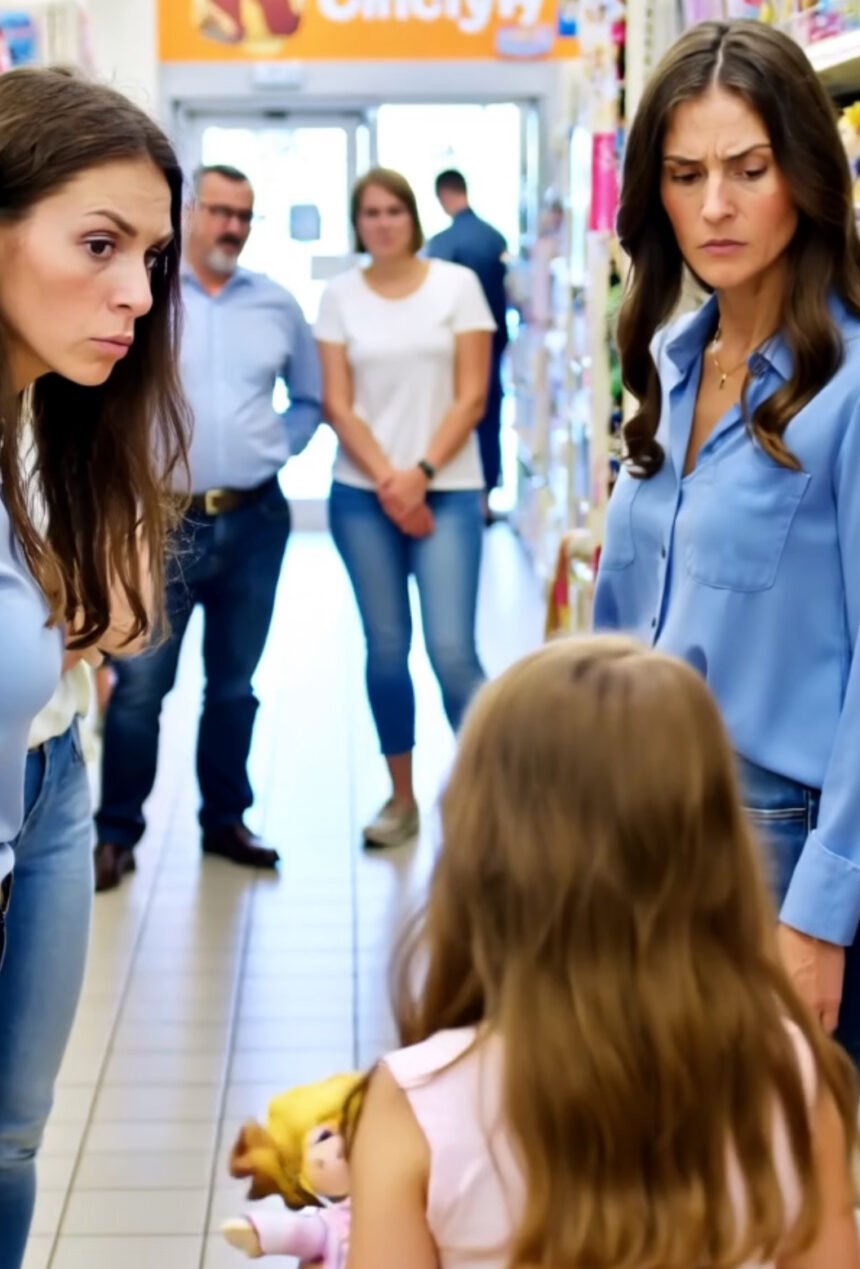
I stood there frozen, cheek burning, heart pounding, as Ava burst into tears.
Then, without warning, my mother ripped the doll from my grasp, bent down, and snatched it from Ava’s hands. The sound my daughter made—high-pitched, raw, breaking—was something I will never forget. My mother straightened up with a satisfied smile and handed the doll to Taylor, whose triumphant smirk didn’t belong on a nine-year-old’s face, but did anyway.
Brooke watched without blinking, her arms folded, a faint smile at the corner of her mouth as if cruelty was a family heirloom she was proud to pass down.
That should’ve been enough to shatter me. But the worst part came minutes later, after Brooke loaded a cart with expensive dresses and shoes for her daughters while my parents cooed and praised every choice she made. As if the world existed only to feed Brooke’s children.
As if Ava, sobbing into my shirt, didn’t even qualify as family.
When I dared to ask, “What about Ava?”, my father dragged me and my child out of the store like we were intruders. The sunlight outside was sharp, unforgiving, the kind that exposes everything. He shoved us into the parking lot and laughed—a short, bitter laugh I’d heard my whole life.
“Stop wasting money on that useless kid.
She’ll never be worth it.”
For the first time in my life, something deep inside me didn’t shrink. It broke. And through the break, something clearer emerged.
I looked at my daughter—her hair messy, cheeks streaked with tears, still trying to understand why her world had been yanked away in a supermarket aisle—and I felt the truth settle: if I stayed, I would lose her. Maybe not physically. But her sense of worth, of safety, of being loved—I would lose that piece of her forever.
So I buckled her into our car, whispered, “It’s okay, baby,” even though it wasn’t, and drove away.
Not just from the store. From them. From thirty-one years of being the family scapegoat.
That night, after Ava finally fell asleep with her head on my chest, I sat alone in the dark of our cramped apartment listening to her soft breaths, and I made a decision that had been waiting my entire life for me to be brave enough to choose it.
We were leaving.
I searched job boards until dawn, called lawyers, planned routes, researched schools. And two weeks later, I accepted a librarian position in Burlington, Vermont—a town that felt like the opposite of everything I’d grown up with: quiet, gentle, green. I packed our few belongings in cardboard boxes, ignored the stream of venomous messages from my family, and drove away before dawn, Ava asleep in the backseat surrounded by blankets and the soft hum of a new beginning.
Vermont gave us what we had never known: peace that didn’t require apology, routines that didn’t bruise, mornings without fear, nights without tears.
Ava flourished. She painted, explored the library halls like treasure caves, made friends who didn’t measure her worth against anyone else’s. I learned the quiet rituals of a life not built on survival: Sunday pancakes, evening walks, the soft glow of a small lamp instead of the sharp glare of always bracing for the next blow.
There were moments of doubt—old wounds echo loudly in new rooms—but therapy helped me understand that the violence and cruelty I thought were normal were anything but.
That loving my daughter meant breaking the cycle even if it broke my heart in the process.
Years passed. I built a life in shades of peace I didn’t know existed. Ava grew into a brilliant, gentle young woman, the kind who reads poetry on rainy evenings and laughs with her whole body.
One night, before she left for college, she asked me, “Mom, do you ever regret leaving them?”
And I told her the truth.
“No. I only regret staying as long as I did.”
Now, in this new apartment, three states away from the people who once taught me to hate myself, Ava sleeps in her room surrounded by the soft things she loves. I sit in the quiet and write this, letting the truth settle like dust in warm afternoon sunlight.
I didn’t forgive them—it was never my job to heal the wounds they carved. What I did instead was choose a life where they no longer had power.
And that choice, I’ve learned, is a kind of freedom I didn’t know existed.
I didn’t walk away empty-handed that day in the supermarket.
I walked away with everything that mattered:
my daughter,
my dignity,
and a future where love doesn’t hurt.