

He didn’t say much at family events, but when he did speak, it cut through the noise. Claire explained the rest. Ellie had secretly withdrawn from her high school.
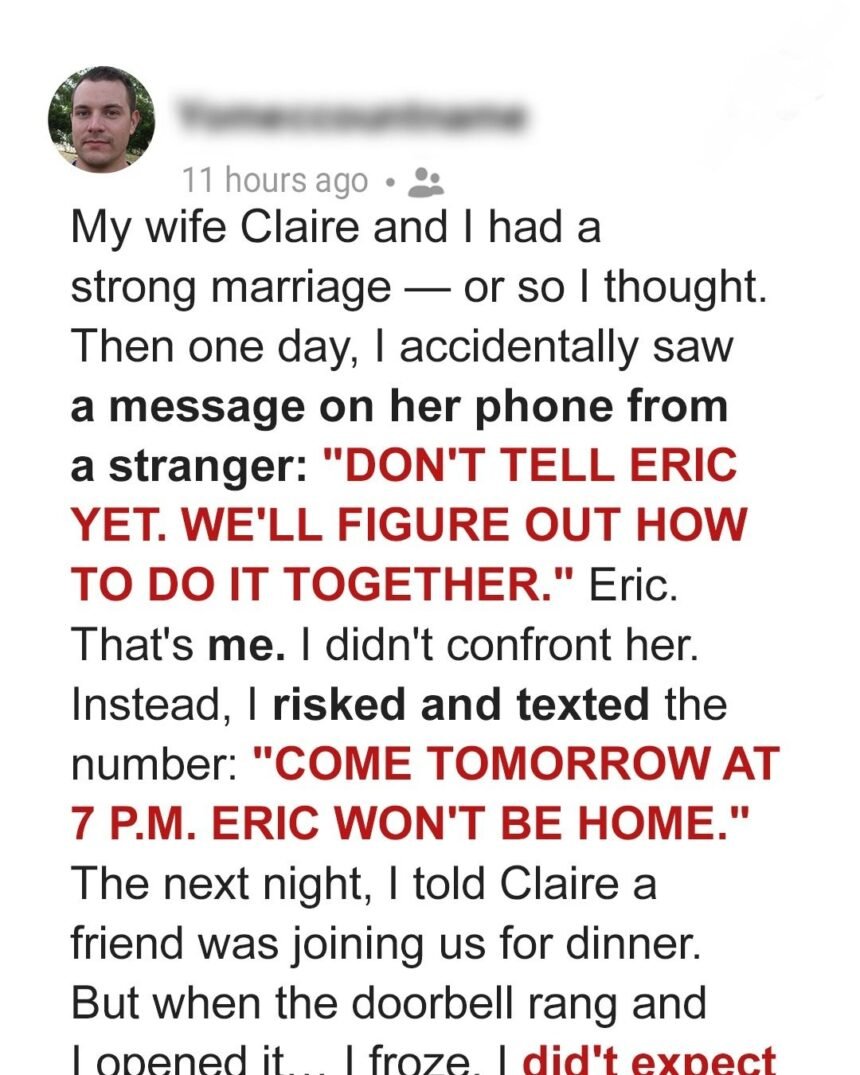
She’d saved some money working part-time and bought a bus ticket north. She and Claire had been texting for weeks, planning when and how she could come live with us and enroll in school here. The text I saw?
It was about Ellie’s arrival. She was coming that weekend.
I sat back, stunned. Not angry—just flooded.
“How long were you going to wait to tell me?” I finally asked. “Until we had a plan. Until she was actually safe here,” Claire whispered.
“I didn’t want to risk Vina finding out before Ellie got away.”
I didn’t know whether to feel betrayed or grateful. Both, maybe. That weekend, Ellie arrived—just as planned.
She looked thinner than I remembered. A little worn around the eyes. But when she hugged Claire before me, I knew something had shifted while I wasn’t paying attention.
They’d gotten close in ways I hadn’t even realized. We didn’t tell Vina right away. Ellie blocked her number, changed her phone.
Claire enrolled her in a local charter school and helped her apply for a part-time job at the café near our house. And slowly, she started opening up. It came out in fragments.
How Vina had let her new boyfriend scream at her. How the utilities got cut off for days at a time. How Ellie once slept in a friend’s garage because the house felt so unsafe.
I hated that I didn’t know. That she hadn’t called me. One night, I asked her why.
Just the two of us on the porch, mugs of mint tea in hand. “You’re good at being mad, Dad,” she said. “But not at listening.
Claire listens.”
It stung. But she wasn’t wrong. I’d always been the fixer.
The one who swoops in, makes phone calls, demands answers. But sometimes, people don’t want a bulldozer—they want a place to sit and breathe. Claire had become that for Ellie.
Things were peaceful for a while. School started. Ellie made a few new friends.
I started going on early morning walks with her before work. We didn’t talk much on those walks. Just moved together, quietly.
Then, in mid-March, a certified letter arrived from a California attorney. Vina had filed a missing persons report. And now she was threatening to sue for parental interference.
The letter was heavy with legal jargon, but the message was clear: she wanted Ellie back—or she’d take us to court. That night, after Ellie went to bed, I finally let the panic show. I paced around the kitchen, reading the letter over and over.
Claire sat at the counter, her hand on her chin, eerily calm. “You know what this means,” I said. “She’s going to make it ugly.”
Claire nodded.
“Then we make it clear.”
She pulled out a folder. Inside were notes, timelines, even screenshots of texts from Ellie describing what she went through. A typed list of dates and addresses.
Copies of emails between Claire and the charter school. “You’ve been documenting everything?” I asked, stunned. “I knew it might come to this,” she said.
“I didn’t want you to have to fight blind.”
She’d been preparing for war while I was still catching up. In court a month later, the judge heard both sides. Vina painted us as manipulators.
Said we’d brainwashed Ellie. Claimed she was “just going through a rebellious phase.”
Ellie took the stand herself. Calm, firm, and heartbreakingly adult.
“I left because I was scared,” she said. “I feel safe now. I want to stay.”
The judge ruled in our favor.
Legal custody was transferred to me, and Vina was ordered to seek counseling if she wanted future visitation. After the ruling, Vina stormed out without looking back. I sat there with my head in my hands, the relief crashing over me like waves.
Claire squeezed my shoulder. “You okay?”
“I should’ve trusted you from the start,” I said. We didn’t talk much about the court battle after that.
Ellie focused on school, got promoted to shift lead at the café, and even joined a local art club. She smiled more. Laughed more.
Let herself be seventeen. But the biggest twist came in May. I came home from work one day to find Claire and Ellie whispering in the backyard.
There were papers and a small envelope between them. When I stepped outside, Ellie beamed. “I got in,” she said.
“To what?”
“The summer mentorship at the Oregon Institute of Design. Full scholarship. Claire helped me apply months ago.”
I turned to Claire.
She just shrugged like it was no big deal. But it was. The mentorship meant Ellie would spend eight weeks working with professional artists, building a portfolio, even traveling to Portland twice a week for workshops.
It was a dream. That night, after we celebrated with takeout and sparkling cider, I pulled Claire aside. “You’re more of a mother to her than Vina ever was,” I said quietly.
Claire blinked back tears but didn’t say anything. Just hugged me. I know not everyone gets this kind of second chance.
Not every blended family finds its rhythm. Not every step-parent becomes a safe harbor. But sometimes, love isn’t loud.
It’s not fireworks or grand declarations. It’s quiet planning. Patient listening.
Protecting someone else’s child like they’re your own—without being asked. And sometimes, the people who keep secrets from you aren’t betraying you. They’re protecting the ones you both love.
So, if there’s one thing I learned from all this, it’s this: trust isn’t about knowing everything. It’s about believing the people you love have good reasons, even when they keep you in the dark. Because real love—the kind that lasts—isn’t just honest.
It’s strategic. And sometimes, the strongest marriages are the ones that bend around hard truths instead of breaking under them. Share if this reminded you that family is more than blood—it’s who shows up, plans ahead, and sticks through the mess.
💛