

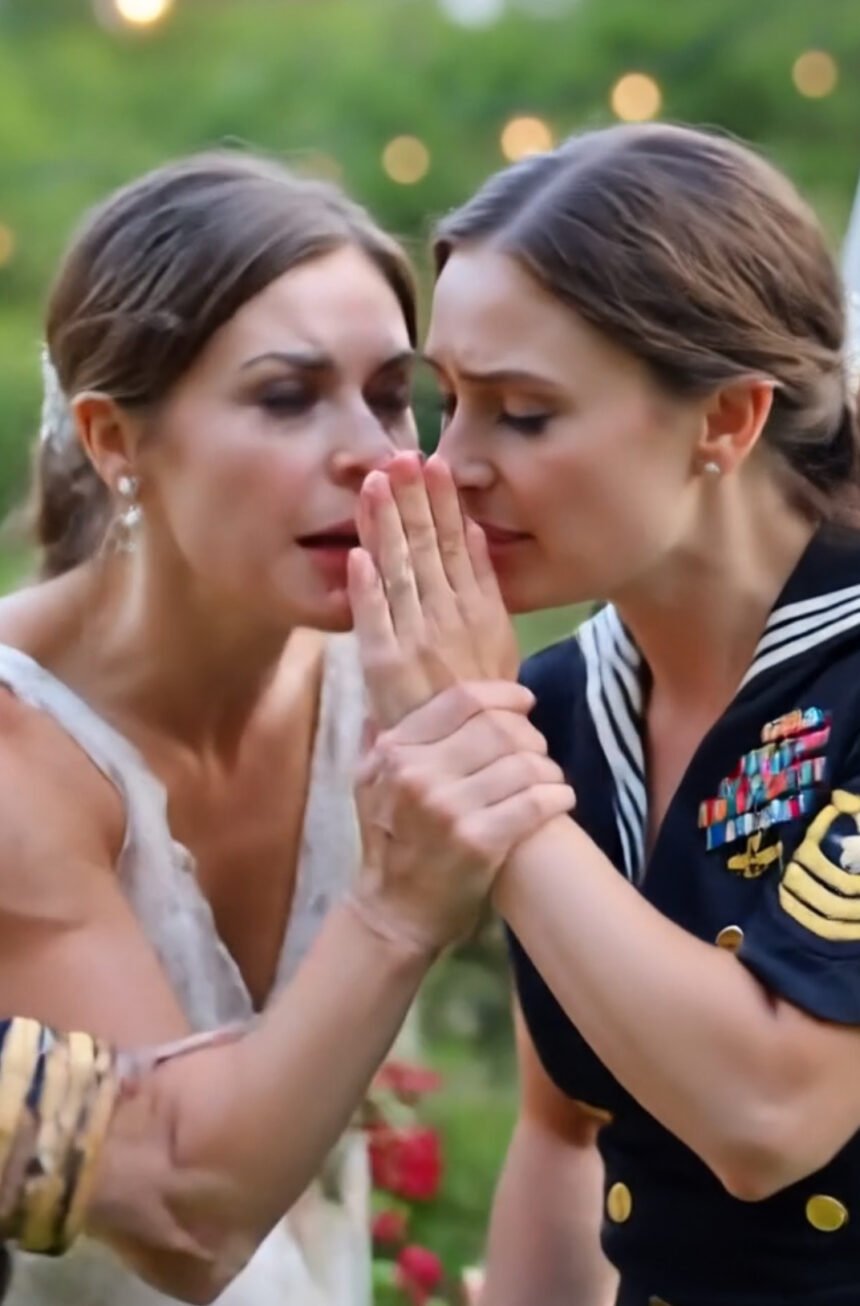
Her father had been one.
The lead Marine stepped forward—six-two, maybe one-ninety-five, shoulders like a linebacker, jaw cut from granite. Staff sergeant stripes on his sleeve.
His name tape read CRAWFORD. Master Chief Sullivan approached, hand extended.
“Master Chief Frank Sullivan.
Welcome to Coronado.”
Crawford shook his hand. Firm grip. Assessing eyes that swept the assembled SEALs like a general surveying troops.
His gaze lingered on Emma for exactly two seconds.
His lip curled. “Staff Sergeant Jake Crawford.
Force Recon.” His voice carried at parade-ground volume. “My team’s here for the joint training exercise.
Two weeks of cross-branch integration.”
“Outstanding.” Sullivan gestured toward the SEALs.
“My team’s ready to work with you. We’ll be running combined ops, sharing tactics, building cohesion.”
Crawford’s eyes found Emma again and held there. Something flickered across his face—disbelief, contempt, amusement.
“All of your team?”
The question dripped skepticism.
Emma knew what was coming. She’d heard variations of it her entire career—at basic, at BUD/S, during every training evolution and deployment workup.
The doubt never got old because it never went away. It just got louder.
Crawford turned to his Marines, raising his voice another notch.
“Looks like Naval Special Warfare has updated their standards, boys.”
A pause. Theatrical. “Wonder if they updated their coffee-making requirements too.”
Laughter from the Marines.
Uncertain silence from the SEALs.
Emma felt thirty pairs of eyes slide toward her. She didn’t move.
Didn’t react. She just maintained her position of attention, gaze fixed on the middle distance—a technique her father had taught her at twelve years old.
When they try to get under your skin, baby girl, you become stone.
You become water. You become air. Anything but what they expect.
Crawford walked closer, boots crunching on gravel.
He stopped three feet from Emma—close enough to invade personal space, far enough to maintain plausible deniability. “What’s your rate, sailor?”
Not “Lieutenant.” Not “ma’am.” Just the deliberate disrespect of ignoring her rank entirely.
Emma met his eyes—level, calm. “Lieutenant Emma Hayes.
SEAL Team Five.”
“SEAL.” He dragged the word out, turned it into something obscene.
“And how long you been playing SEAL, Lieutenant?”
“Two years, Staff Sergeant.”
“Two whole years.” Crawford whistled low, shook his head. “Boys, we got ourselves a seasoned veteran here. Two years.”
He turned back to her and smiled—the kind of smile that wasn’t friendly at all.
“Tell me, Lieutenant.
They make BUD/S easier for you? Lower that obstacle wall?
Maybe let you skip the cold-water evolution?”
Emma’s jaw tightened—the only visible reaction she allowed herself. “Same course.
Same standards.
Same Hell Week.”
“Sure.” Crawford’s smile widened. “I believe that. I really do.”
He raised his voice again, addressing the entire formation.
“Now, I’m sure the Navy gave you the exact same standards as the men.
Exact same. No political pressure, no diversity quotas, no senators making phone calls.”
He leaned in close enough that only Emma and the nearest SEALs could hear his next words.
“Try not to cry, princess. It’s only two weeks.”
The words hit like a physical blow.
Emma’s hands curled into fists at her sides.
Every muscle in her body screamed to move, to respond, to wipe that smug expression off his face. But she was stone. She was water.
She was air.
“Aye, Staff Sergeant.” Flat, emotionless. Giving him nothing.
Crawford held her gaze another three seconds. Then he turned, dismissing her entirely, and addressed Master Chief Sullivan.
“My Marines are ready to train, Master Chief—assuming we’re actually here to train and not to babysit.”
Sullivan’s face had gone carefully blank—the kind of blank that came from thirty-two years of military service and learning when to fight your battles.
“We’re here to train, Staff Sergeant. Let’s get your team squared away.”
The formation broke. Marines moved toward their assigned barracks.
SEALs dispersed for pre-breakfast personal time.
Emma held her position until everyone else had moved. Then she walked—not toward the barracks, but toward the beach.
She needed to run. The next twelve days unfolded like a master class in psychological warfare.
Crawford and his Marines integrated into every training evolution, every briefing, every meal.
And at every opportunity, the comments came. Day Two. Small-arms range.
Emma was firing rifle qualifications—forty rounds at three hundred yards, iron sights, wind gusting at fifteen knots from the northwest.
She called her shots, controlled her breathing, squeezed the trigger between heartbeats like her father had taught her before she could write in cursive. Forty rounds, forty hits, dead center mass.
Perfect score. Crawford watched from the observation booth.
His voice carried through the open window.
“Must be nice having adjustable targets. Bet they set hers ten yards closer.”
Laughter from his Marines. Emma ejected her magazine, cleared her weapon, said nothing.
Day Five.
Combat water survival training. Full gear.
Fifty-pound ruck. Weapons.
Two-mile ocean swim in sixty-two-degree water.
The cold didn’t bother Emma. She’d grown up swimming in these waters, had learned to love the Pacific’s icy embrace during Hell Week. The cold was familiar, almost comforting.
She finished the swim eight minutes ahead of the next fastest time.
She emerged from the surf breathing hard but controlled—no shivering, no signs of hypothermia. Crawford was waiting on the beach.
“Lucky current today. Probably had it easier being so small.
Less body mass to drag.”
Emma wrung water from her hair.
“Aye, Staff Sergeant.”
Day Eight. Close-quarters battle drills in the kill house. Live-fire exercises.
Real ammunition.
The most dangerous training the SEALs conducted—where one mistake, one lapse in discipline meant someone went home in a box. Emma’s team breached six rooms, engaged forty-two targets.
Zero civilian casualties. Zero friendly-fire incidents.
Completion time: ninety-three seconds.
Textbook perfect. Crawford reviewed the video footage and shook his head. “Anybody can shoot paper.
Combat’s different.
When real bullets come back, we’ll see who freezes.”
His corporal—a man named Mitchell, with Taekwondo black belt patches on his gym bag—nodded in agreement. “Women aren’t wired for violence.
It’s biology. When it gets real, instinct takes over.”
Emma was cleaning her weapon fifteen feet away.
She heard every word.
She said nothing. Day Eleven. Hand-to-hand combat refresher training.
The gym was packed with operators from both services.
Crash mats covered the floor. The smell of sweat and determination hung thick in the air.
The SEAL instructor, a grizzled chief petty officer who’d taught combatives for twenty years, called for demonstration volunteers. “I need two people—one experienced grappler, one striker.
We’re going to show integrated technique.”
Before Emma could process what was happening, Crawford’s voice boomed across the gym.
“I volunteer Lieutenant Hayes.”
The gym went quiet. Emma turned. Crawford was smiling—that same not-friendly smile from day one.
“Come on, Lieutenant.
Show us what female SEAL standards really mean. I’m curious.”
The instructor frowned.
“Staff Sergeant, I don’t think—”
“No disrespect, Chief, but we’re supposed to be training together, right? Cross-branch integration.
Let’s integrate.”
Crawford gestured to his team.
“Corporal Mitchell here has a Taekwondo black belt. Third degree. He’ll be gentle.”
Mitchell stepped forward.
Five-nine, maybe one-seventy.
Lean and flexible. His grin matched Crawford’s.
“I’ll go easy, ma’am. Wouldn’t want you getting hurt.”
Emma looked at the instructor.
The chief’s expression said he knew exactly what was happening here—political theater, a setup designed to humiliate.
He gave her a barely perceptible nod. “Your call.”
Emma stepped onto the mat. No ceremony, no warming up—just movement.
“Okay,” the instructor said slowly.
“We’ll do a light demonstration. Twenty percent speed, just showing technique—”
“Nah.” Crawford’s voice cut in again.
“Let’s make it real. Full speed, full contact.
Let’s see what a SEAL can actually do.”
The gym had gone completely silent now.
Sixty operators watched, waiting. This was about more than training. This was about proving a point Crawford had been making for twelve straight days.
Women didn’t belong here.
The instructor looked at Emma. “Lieutenant, you comfortable with that?”
Emma faced Mitchell, analyzing his stance—the weight distribution, the slight forward lean of a kicker, the loose shoulders of someone confident in their striking.
Her father’s voice whispered through her memory. Every opponent tells you how to beat them, baby girl.
You just have to listen.
“Yes, Chief,” she said. “Full contact is fine.”
Mitchell’s grin widened. He bounced on the balls of his feet, loose, relaxed, already planning his spinning-kick highlight reel.
The instructor sighed.
“All right. Standard sparring rules.
No strikes to groin or throat. No fish-hooking or eye-gouging.
Match continues until one person taps, says ‘stop,’ or I call it.”
He looked between them.
“Touch gloves. Keep it professional.”
They touched gloves. Emma’s hands looked tiny against Mitchell’s.
“Ready?” The instructor raised his hand.
“Fight.”
Mitchell exploded forward immediately—a feinting jab followed by a spinning back kick. Textbook Taekwondo.
The kick was fast, well executed. It would have looked spectacular.
Emma wasn’t there.
She’d read the setup the moment Mitchell shifted his weight, had seen the telegraphed rotation of his hips. The spin was committed—no way to adjust mid-motion. She stepped inside the arc of his kick, letting his momentum carry him past her.
Mitchell completed his spin slightly off-balance, searching for a target that had moved.
Emma was behind him now. She hooked his lead leg with her foot—a simple sweep, using his own forward momentum against him.
Mitchell’s eyes widened as his balance disappeared. He went down hard, back slamming into the mat.
Emma followed him down, dropping into side control.
Mitchell was good. He immediately tried to bridge, to create space, but Emma had already trapped his arm, her legs locking around his neck and shoulder in a perfect arm-triangle choke. Mitchell’s other arm came up, trying to push her off—the obvious defense, the expected response.
Emma used that momentum, rolled them both, and ended up mounted on his chest.
The arm triangle locked deeper—her shoulder pressing into his neck, his own shoulder pressing into the other side. The carotid arteries compressed.
Blood flow to the brain cut off. Mitchell’s eyes got wide.
He tried to buck her off, tried to push, tried to escape.
Nothing worked. His face started turning red, then purple. He tapped—three quick slaps against the mat.
Emma released immediately, rolled off him, and rose to her feet while Mitchell gasped and coughed.
Eighteen seconds. Start to finish.
The gym stayed silent. You could have heard a pin drop.
Emma extended her hand to Mitchell.
After a moment, he took it. She pulled him to his feet. “Good match, Corporal.”
Mitchell rubbed his throat, staring at her.
Something like respect flickered in his eyes.
“Where’d you learn that?”
“My father. He taught me to grapple before I could ride a bike.”
Crawford’s voice shattered the moment.
“Lucky shot. Anyone can get lucky once.”
The silence broke.
Murmurs swept through the crowd.
The instructor moved between Emma and Mitchell, ready to call things done. But Master Chief Sullivan stepped forward. Emma hadn’t seen him enter the gym.
She didn’t know how long he’d been watching.
Sullivan’s weathered face was carved from stone, his eyes sharp and intelligent despite his sixty-two years. They fixed on Crawford with an intensity that could melt steel.
“You’re right, Staff Sergeant,” Sullivan said quietly. “Once is luck.
Anyone can get lucky once.”
Crawford’s smile returned.
“Exactly what I—”
“How about six times?”
The gym went silent again. A different silence this time—anticipatory, dangerous. Sullivan walked to the center of the mat.
Every operator in the room knew who he was: Master Chief Frank Sullivan, legend, a man who had earned his trident in 1982, who’d fought in Grenada, Panama, Desert Storm, Somalia, Afghanistan.
He’d trained three generations of SEALs. When Sullivan spoke, people listened.
“You have six Marines, Staff Sergeant Crawford. Lieutenant Hayes is one SEAL.” Sullivan’s voice carried to every corner of the gym.
“Seems like uneven odds to me.”
Crawford’s expression shifted—uncertain now.
“Master Chief, I don’t think—”
“Here’s what I think.” Sullivan turned, addressing the entire gym. “We’ve got two weeks of joint training left. We’re supposed to be building unit cohesion, but it seems to me there’s some doubt about standards, about capability, about whether everyone here earned their place.”
He turned back to Crawford.
“So let’s settle it.
Exhibition match. Lieutenant Hayes versus your entire squad.
One-on-one matches. Six consecutive fights.
Full contact.
No time limit per fight except exhaustion.”
The gym erupted. Voices overlapped. SEALs looked stunned.
Marines looked eager.
Emma’s heart hammered in her chest. Six fights back-to-back.
She’d never done that. Never even trained for it specifically.
Crawford recovered quickly.
Too quickly—like he’d been waiting for something like this. “What are the stakes?”
Master Chief Sullivan smiled—the kind of smile that made Emma nervous. “Lieutenant Hayes wins, you issue a formal apology to every female service member on this base.
Written, public, documented in your permanent file.”
Crawford’s jaw tightened.
“And if she loses?”
“She requests a transfer off SEAL Team Five and out of Naval Special Warfare entirely.”
Emma’s blood went cold. Her career—everything she’d worked for since she was thirteen years old—on the line.
She wanted to speak, to object, to say something, but another voice cut through the chaos. “Master Chief Sullivan.”
Captain Richard Morrison, base commander and former SEAL himself, pushed through the crowd.
His expression was unreadable.
“That’s a significant proposition.”
“Yes, sir,” Sullivan said. Morrison looked at Emma. Really looked at her, measuring, assessing.
“Lieutenant Hayes, do you accept these terms?”
Every eye in the gym turned to Emma—Crawford smiling, Mitchell still rubbing his throat, the SEALs uncertain, the Marines eager.
And Master Chief Sullivan, her father’s best friend, the man who’d helped raise her after her dad died, who’d trained her, pushed her, never doubted her. Sullivan’s eyes said, I believe in you.
I always have. Emma straightened to attention.
“Yes, sir.
I accept.”
Morrison nodded slowly. “Very well. One week to prepare.
Next Saturday, twenty hundred hours, this gymnasium.
Mandatory attendance, base-wide.”
He looked at Crawford. “Staff Sergeant, do you agree to these terms?”
Crawford glanced at his Marines.
All six nodded—eager, confident. This would be over in thirty minutes, maybe less.
“We agree, sir.”
“Then it’s settled.” Morrison’s gaze swept the room.
“One week. Make it count.”
The gym cleared slowly. Marines joked and laughed, planning their victory.
SEALs were quieter—worried, supportive, but uncertain.
Emma stayed on the mat alone, processing. Six men, each seventy to a hundred pounds heavier than she was.
All trained fighters. All combat veterans.
All convinced they couldn’t lose to a woman.
Master Chief Sullivan approached and waited until everyone else had left. “Walk with me, Emma.”
They walked in silence out of the gym, across the base, toward the memorial wall where the names of fallen SEALs were engraved in bronze. Sullivan stopped in front of one name and ran his fingers across the letters.
MASTER CHIEF JAMES HAYES, SEAL TEAM THREE, KILLED IN ACTION, HELMAND PROVINCE, AFGHANISTAN, MARCH 15, 2011.
Emma’s father. “He knew this day would come,” Sullivan said quietly.
“That’s why he created Phantom Protocol.”
Emma stared at her father’s name, the letters she’d traced a thousand times. “What if I can’t do this, Master Chief?
Six fights.
I’ve never—”
“Your dad did four.”
Emma’s head snapped up. “What?”
Sullivan’s eyes went distant, remembering. “Mogadishu.
October 1993.
We were with Task Force Ranger—Black Hawk Down. Your dad and I got separated from the main force, ended up trapped in a building with two Army Rangers.”
He paused, collecting the memory.
“Four Somali militia fighters came through the door. Your dad’s weapon had jammed.
Mine was dry.
The Rangers were reloading.”
“What did he do?” Emma whispered. “He fought them hand-to-hand. All four.
One after another.
Took him eleven minutes. He was covered in blood by the end.
Three broken ribs, dislocated shoulder, concussion.”
Sullivan’s voice dropped. “But he saved four lives that day, including mine.”
Emma felt tears threatening.
She pushed them back.
“I’m not him.”
“No. You’re better.”
Sullivan turned to face her. “Your dad was a great operator, but he was strong, fast, trained in the basics.
You—he designed an entire system specifically for you.
Based on your size, your speed, your flexibility, everything you could become.”
He reached into his pocket and pulled out a worn notebook—brown leather, water-stained, the pages yellowed. “He started writing this when you were born.
Kept adding to it as you grew. Every technique, every principle, every lesson he wanted to teach you.”
Sullivan pressed the notebook into her hands.
“He called it Phantom Protocol.
Said you’d be like a ghost. There one second, gone the next. Impossible to pin down.
Impossible to predict.”
Emma opened the notebook with trembling fingers.
Her father’s handwriting. Neat, precise—the script of an engineer and a warrior.
Page One. For Emma.
My ghost.
My warrior. When you’re big enough to read this, I’ll be teaching you in person. If you’re reading this without me, it means Sullivan kept his promise.
He’ll train you.
Trust him. But remember: size is never a disadvantage.
It’s only a disadvantage if you let them think it is. The words blurred.
Emma blinked hard.
“One week,” Sullivan said. “We train eighteen hours a day. I’ll teach you everything your father wanted you to know.
Everything I’ve learned in thirty-two years.
Everything that’ll help you survive Saturday night.”
Emma closed the notebook and clutched it to her chest. “What if it’s not enough?”
Sullivan smiled—sad, proud.
“Then you go out like a Hayes, fighting until the end. But Emma…” He gripped her shoulder.
“It’ll be enough.
Your father made sure of that.”
The week that followed redefined Emma’s understanding of exhaustion. Sullivan waited outside her barracks room with coffee and a grim expression that said, Today will be worse than yesterday. He was always right.
Day One was conditioning.
Not normal conditioning. Not SEAL conditioning.
Something beyond that. Five-minute grappling rounds against rotating opponents.
Fresh SEALs cycling in every round.
Emma had thirty seconds between rounds to catch her breath, drink water, reset. Ten rounds. Fifty minutes of continuous combat.
Emma’s lungs burned.
Her muscles screamed. Her brain fogged from oxygen debt.
“Again,” Sullivan barked. “You’re fighting six men back-to-back.
Two-minute rest between each.
You need to learn to fight exhausted.”
Ten more rounds. Emma made it through seven before she vomited. Sullivan handed her water and waited exactly sixty seconds.
“Again.”
Day Two: technical work.
Sullivan opened her father’s notebook to page fifteen. Small joints break before large muscles tear.
Target fingers, wrists, elbows, knees. Quick, devastating.
Move on.
No wasted motion. No showing off. They drilled for fourteen hours—just joint manipulation.
Sullivan’s hands became targets.
Emma learned to see every finger, every wrist, every elbow as a lever, a fulcrum, a mechanical system designed to fail under the right pressure, applied at the right angle. “Your dad was an engineer before he was a SEAL,” Sullivan explained.
“He understood that bodies are just machines. Machines break when you exceed their tolerances.”
Day Three: reconnaissance.
Sullivan made Emma observe Crawford’s Marines during normal training.
“Your father’s second rule,” Sullivan said, pointing to the notebook. “Every warrior has a tell. Find it in ten seconds.
Exploit it in one move.”
Emma watched—really watched.
Sergeant Williams, the one they called Tiny—six-four, two-forty. Massive but slow.
And when he got tired, he dropped his left hand consistently. A habit carved into muscle memory from years of heavy-weapons training, where the support hand did most of the work.
Corporal Thompson, the sniper.
Lean, flexible, cocky. He used his reach advantage, but exposed his neck when transitioning between strikes—a poor defensive habit that probably looked cool in the dojo and would be fatal against someone who noticed. Corporal Stevens, the corpsman.
Wrestler, college level by the look of his stance.
Strong, good pressure—but predictable. Every takedown came from the same setup, the same level change, the same penetration step.
Mitchell—she’d already fought him. He’d be angry, reckless, wanting revenge.
That made him predictable too.
Jackson, they called him Hound. Pure brawler, street fighter, no formal training. Big windup on every punch, telegraphing everything three moves in advance.
And Crawford, the leader.
The champion. Twelve years of boxing.
Golden Gloves winner. Technical, smart, disciplined.
But there was something else.
Emma watched him throw punches during pad work. His right cross was devastating. His left jab was sharp and fast.
But if you watched long enough, you saw it.
The right shoulder. When he fully extended his right hand, just for a split second, his face tightened.
Pain. Old injury.
Probably a rotator cuff tear that never healed properly.
He favored that shoulder subtly. But it was there. Emma recorded everything in a small notebook—her father’s notes on one side, her observations on the other.
Day Four: speed work.
Sullivan brought in a timer. “Your dad used to say, ‘Fast beats strong.
Smart beats fast. But fast and smart?
That’s unstoppable.’”
They drilled transitions.
Guard passes, sweeps, submissions. But everything had to flow—no pause, no reset. One technique into the next, into the next.
Emma’s body learned to move without thinking.
Muscle memory carved into place through repetition. Thousands of repetitions.
“When your opponent moves left, you’ve already moved right,” Sullivan said. “When they push, you’ve already pulled.
When they think they have you, you’re already gone.”
Phantom.
Day Five: mental game. Sullivan sat Emma down and made her close her eyes. “Visualize each fight, beginning to end.
See yourself winning.
Feel yourself winning. Your mind can’t tell the difference between vivid visualization and real experience.
So we give your mind six victories before you step on that mat.”
Emma visualized Mitchell’s overconfident spinning kick, Thompson’s exposed neck, Stevens’s predictable shot, Jackson’s telegraphed haymaker, Williams’s dropped left hand, Crawford’s weak shoulder. She saw herself win six times, six different ways.
Day Six: recovery.
Barely. Sullivan made her swim easy distance—twenty laps. Let the cold Pacific water leach the soreness from her muscles.
Ice baths for twenty minutes.
Massage therapy. Nutrition.
Sleep. “Tomorrow’s the fight,” Sullivan said that evening.
“Your body needs to be fresh, but your mind needs to be sharp.
So tonight you read.”
He handed her the notebook. “Page eighty-three. Your dad’s last entry.
He wrote it the week before he deployed to Afghanistan.”
Emma turned to the page.
Her father’s handwriting was slightly shakier than in earlier entries. He’d known, somehow, that this might be his last.
Emma, if you’re reading this, I’m probably gone. I’m sorry I won’t be there to see you become what I know you’ll be—the strongest, smartest, most capable warrior I could imagine.
But here’s what I need you to remember.
Being strong isn’t about never falling. It’s about standing back up. Being brave isn’t about never being scared.
It’s about fighting anyway.
And being a warrior isn’t about never crying. It’s about crying, wiping your eyes, and getting back to work.
I love you, baby girl. Make them remember your name.
Dad.
Emma read the words three times, then closed the notebook and hugged it to her chest. Tomorrow, six Marines would try to break her. Tomorrow, she’d show them what a Hayes really was.
Saturday arrived with cruel cheerfulness.
Bright sunshine. Seventy-two degrees.
Light breeze from the ocean. Perfect Southern California weather.
Emma’s stomach felt like lead.
Eighteen hundred hours. Two hours before the fight, she sat alone in her room, her father’s notebook open on her lap, his trident pin on the desk, the worn black belt he’d earned in Krav Maga hanging on the wall. A knock sounded on her door.
“Come in.”
Master Chief Sullivan entered carrying a small bag.
His face was serious, professional, but Emma saw the warmth in his eyes. “How you feeling?”
“Terrified.”
“Good.
Your dad was terrified before every mission. Said fear kept you sharp, made you careful.
Only idiots weren’t scared.”
Emma managed a small smile.
“He used to tell me that.”
Sullivan sat and pulled something from the bag: black cloth, worn and faded. “Your dad wanted you to have this. Made me promise years ago.
Said to give it to you when you faced your biggest challenge.”
He unfolded the cloth.
It was a belt—black, the edges frayed from years of use, the black faded to gray in places. “This was his.
He earned it in 1990. Wore it for fifteen years.
Every training session, every deployment.
Said it carried his spirit, his technique, everything he’d learned.”
Sullivan held it out. “Time to pass it on.”
Emma took the belt with trembling fingers. The material was soft, worn.
She could almost feel her father’s hands on it—his sweat, his determination, his love.
“Thank you, Master Chief.”
“Don’t thank me yet. You still have to fight.” Sullivan stood.
“Twenty hundred hours. Don’t be late.
And Emma?”
“Yes, Master Chief?”
“Your dad used to say one more thing before missions.”
“Pain is just weakness leaving the body.
You’re about to lose a lot of weakness tonight.”
Twenty hundred hours. The gymnasium was packed. Every SEAL on base.
Every Marine.
Support personnel. Officers, enlisted.
Maybe four hundred people jammed into a space meant for two hundred. In the center, a regulation boxing ring—ropes, canvas, proper lighting.
The base commander had made this official.
Sanctioned. Legal. Emma entered through the side door.
She wore standard PT gear: black shorts, gray NAVY T-shirt.
No jewelry. No distractions.
Her father’s black belt was tied around her waist. The crowd saw her.
Noise dropped by half.
Whispers. Pointing. Speculation.
Master Chief Sullivan waited in her corner.
He’d assembled a proper team—two SEALs to work her corner, water, towels, medical supplies if needed. Emma climbed through the ropes.
The canvas felt solid under her feet. Real.
This was happening.
Across the ring, Crawford and his Marines were laughing—loose, confident. Mitchell shadowboxed. Thompson stretched.
Stevens and Jackson bumped fists.
Williams—Tiny—cracked his massive knuckles. Crawford caught Emma’s eye and smiled, mouthing two words.
Try crying. Emma stared back.
Stone.
Water. Air. Captain Morrison climbed into the ring, microphone in hand.
“Good evening.
What we’re about to witness is an exhibition match sanctioned under regulations governing hand-to-hand combat training. Medical personnel are standing by.
Rules are simple: standard MMA regulations. No strikes to groin or throat, no eye-gouging or fish-hooking.
Match continues until submission, knockout, or referee stoppage.”
He paused, letting the gravity settle.
“Lieutenant Hayes will face six opponents consecutively. Two-minute rest between each match. Fight order has been determined by rank, lowest to highest.”
Morrison looked at Emma.
“Lieutenant, do you accept these terms?”
“Yes, sir.”
“Staff Sergeant Crawford, do your Marines accept these terms?”
“Yes, sir.
Can’t wait, sir.”
“Then let’s begin. First match: Lieutenant Emma Hayes versus Corporal Derek Mitchell.”
The crowd roared.
Emma walked to her corner. Sullivan grabbed her shoulders.
“Remember everything.
Fast beats strong. Technique beats size. And you’ve already beaten him once.
He’ll be angry this time.
Good. Angry makes mistakes.
You stay calm. Stay technical.
End it quick.
Five more after him.”
Emma nodded, breathed, felt her heartbeat slow despite the adrenaline. Corporal Mitchell entered the ring. He’d removed his shirt—lean muscle, a Taekwondo tattoo on his ribs.
He bounced on his toes, eager.
The referee, a senior SEAL instructor, called them to center. “I want a clean fight.
Protect yourselves at all times. Touch gloves.”
They touched gloves.
Emma’s hands looked tiny.
“Ready?” The referee raised his arm. “Fight.”
Mitchell came forward fast. Feint jab, feint low kick, setting up his spinning back kick.
Emma knew it was coming.
She’d visualized this exact sequence a hundred times. The spin started.
Beautiful technique—fast, powerful. Emma stepped inside the arc, letting his momentum carry him past.
Mitchell completed the spin slightly off-balance.
Emma hooked his lead leg. Simple sweep, using his forward motion. Mitchell crashed hard.
Emma dropped into side control.
Mitchell bridged immediately, trying to create space, but Emma had already trapped his near arm, her legs wrapped around his neck and shoulder. Arm-triangle choke.
Exactly like their first match, but tighter this time. Faster.
No hesitation.
Mitchell’s eyes widened. His free hand pushed against her shoulder, trying to create space. Emma used that push, rolled them, and ended up mounted on his chest.
The choke locked deeper.
Mitchell’s face turned red. Then purple.
He tapped—three quick slaps against the canvas. Emma released and stood.
Mitchell gasped and coughed.
The crowd erupted. Fifteen seconds. First fight done.
Five more to go.
Mitchell left the ring holding his throat. His teammates helped him to a bench.
Emma watched him go. One down.
Five to go.
Her breathing was controlled. Her heart rate was already dropping back to normal. Master Chief Sullivan handed her water.
“Drink.
Small sips. Two minutes goes fast.”
Emma drank.
The water was cold. Perfect.
She glanced at the crowd—four hundred faces.
Some stunned, some excited. The SEALs were cheering. The Marines were quieter now, less certain.
Crawford stood with his remaining fighters.
His expression had shifted—not quite worried yet, but the easy confidence had cracked. The referee called time.
“Two minutes’ rest complete. Next match: Lieutenant Hayes versus Lance Corporal David Jackson.”
Jackson entered the ring.
They called him Hound for good reason—six-one, two hundred pounds of muscle and bad intentions.
Tattoos covered both arms. His nose had been broken and healed crooked. Street fighter written all over him.
He didn’t bounce or showboat like Mitchell.
He just walked to center ring with a predator’s focus. “Ain’t nothing personal, ma’am,” he said as they touched gloves.
“Just doing my job.”
“I understand, Corporal.”
The referee stepped back. “Fight.”
Jackson charged immediately.
No technique, no setup—just raw aggression.
A wild right hook aimed at Emma’s head. The kind of punch that would end the fight if it landed. Emma had watched him train all week.
She knew this was coming.
Every punch Jackson threw started the same way—big windup, telegraphed from three moves away. Powerful, but predictable.
She stepped inside the arc of his swing, letting his fist pass over her shoulder close enough to feel the wind. Jackson’s momentum carried him forward—off-balance, committed.
Emma moved with him, used his own force.
Classic judo hip throw. Her hip became a fulcrum. His body mass became leverage—physics and timing instead of strength.
Jackson went airborne.
His eyes widened in surprise. Then he hit the canvas hard—two hundred pounds of Marine slamming into mat from four feet up.
The impact drove the air from his lungs. Emma heard the wheeze.
But Jackson was tough.
He started to push up immediately, trying to get back to his feet, back to his comfortable striking range. Emma didn’t let him. She dropped onto his back as he rose to hands and knees, wrapping her legs around his waist, arms snaking around his throat before he could defend.
Rear naked choke.
One arm across the throat, the other hand gripping her own bicep. Jackson’s neck was trapped in the V.
The carotid arteries compressed. Blood flow to the brain cut off.
Jackson’s hands came up, grabbing her forearm, trying to pull it away.
He was strong—much stronger than Emma. His grip felt like iron. But strength didn’t matter here.
The choke was locked.
Proper technique, perfect angles. No amount of pulling would break it.
Jackson tried to stand. Emma’s legs locked tighter around his waist.
He managed to get one foot under him, then the other, actually standing up with Emma on his back like a backpack.
The crowd gasped. Jackson stumbled forward, trying to ram Emma into the corner post, trying to crush her, trying anything. Emma squeezed tighter, feeling his pulse hammering against her forearm—fast at first, then slower.
His steps grew unsteady.
“Tap, Corporal,” she whispered. “It’s over.”
Jackson shook his head—stubborn, proud, refusing to submit to a woman even as consciousness slipped away.
His legs wobbled, then buckled. They went down together.
Emma held the choke, held it tight—professional, controlled, knowing exactly how much pressure to apply, exactly how long to maintain it.
Jackson’s arms went slack. His body went limp. The referee rushed in, checked his eyes, waved frantically.
“Stop!
Stop! He’s out!”
Emma released immediately and rolled away, kneeling while the medical team rushed the ring.
Jackson lay unconscious—face purple, breathing but gone. The crowd had gone silent.
This wasn’t sport anymore.
This was something else. Something dangerous. Something real.
Medical personnel worked on Jackson.
Thirty seconds later, his eyes fluttered open—confusion, disorientation, then awareness. He looked at Emma.
Something like respect flickered across his face before embarrassment replaced it. They helped him from the ring.
Emma stood.
Her legs felt heavy now. Two fights, two submissions—but she’d had to hold that choke longer than expected, had to work harder than in the first match. Sullivan grabbed her shoulders.
“Good.
Perfect technique. But you’re breathing harder.
Drink more. Sit down.”
Emma sat on the corner stool and drank.
Her arms tingled—adrenaline and lactic acid.
She had four more fights. Four more men. Each one bigger, stronger, more skilled.
“Stay focused,” Sullivan said.
“Don’t think about the next four—just the next one.”
“Next match: Lieutenant Hayes versus Corporal Brian Stevens.”
Stevens entered the ring—the corpsman. Six feet even, one-eighty-five, broad shoulders and thick legs.
Emma had watched him wrestle during training—college level, maybe Division One. His takedowns were powerful.
His top pressure was suffocating.
But wrestlers had patterns. Predictable sequences carved into muscle memory through thousands of hours on the mat. Stevens would shoot.
He’d try to take her down, try to use his weight and strength to pin her, to grind her out.
Emma stood. Her legs protested, already tired.
They touched gloves. Stevens’s grip was firm but respectful.
“Good fight so far, ma’am.
But this one’s mine.”
“We’ll see, Corporal.”
Stevens circled, cautious. He’d watched the first two matches. He knew Emma was dangerous.
He knew rushing in was a mistake.
He worked angles, probed with his hands, looking for an opening, a moment to shoot. Emma circled opposite, maintaining distance, watching his level, his hips—the telltale signs of a takedown attempt.
Thirty seconds passed. Neither committed.
The crowd grew restless, wanting action.
Stevens feinted a jab, then dropped his level and shot in low—a perfect double-leg takedown attempt. Fast, explosive, his shoulder aimed at Emma’s hips, his hands reaching for her legs. Emma had seen it coming—the slight weight shift, the drop in elevation.
Half a second of warning.
She sprawled, hip pressure driving down on his shoulders, legs shooting back, making herself heavy—dead weight. Stevens’s takedown stalled.
His hands grabbed at air. Emma circled behind him, taking his back while he was still on hands and knees.
Exactly where she’d been with Jackson.
But Stevens was better than Jackson. Technical. He sat to his hip, tried to turn into her, tried to get back to guard position.
Emma read the movement and wrapped her legs around his waist, locking a body triangle—her foot hooked behind her opposite knee, creating a figure-four that couldn’t be broken.
Stevens tried to hand-fight, tried to prevent her from getting to his neck. His defensive wrestling was good—hands protecting his throat, elbows tight so Emma couldn’t slide in the choke.
She controlled his posture instead. One hand on his forehead, pulling back, exposing his face.
Her other hand came over his shoulder.
Short punches—controlled but firm—striking from back mount. The punches weren’t meant to knock him out, weren’t meant to hurt badly, but they were legal and they were effective. One, two, three, four—accurate strikes to the side of his head, his temple, his jaw.
Stevens tried to defend, tried to cover up, but doing so exposed his neck.
Emma felt the moment, the opening. Her arms snaked in, but Stevens pulled his chin down—good defense.
The choke wasn’t there yet. More strikes.
Five, six, seven.
Stevens’s arms were tiring—defending punches, trying to escape, burning energy at a rate he couldn’t sustain. The referee watched closely, looking for signs—for safety, for the moment when defense became just survival. Emma’s strikes kept coming—rhythm, pressure, relentless.
Stevens’s guard dropped.
Just a fraction. Just enough.
The referee stepped in. “Stop.
Stop.
TKO. Two minutes and eight seconds.”
Stevens was conscious, unhurt except for his pride and a ringing in his ears, but he’d been unable to defend, unable to improve position. The referee’s job was to protect fighters.
He’d done it.
Stevens looked frustrated, angry at himself. He’d known better—should have defended better, should have turned faster.
Emma helped him up. “Good match, Corporal.
Your wrestling is solid.”
“Not solid enough.” Stevens shook his head and left the ring.
Emma returned to her corner. Sullivan waited with water and a towel. “Three down.
Halfway.
How you feeling?”
“Tired.” No point lying. “Good.
Embrace it. They’re tired watching.
You’re tired doing—but you’re winning.
Keep winning.”
Emma sat. Her shoulders burned. Her legs felt like concrete.
Three fights.
Maybe eight minutes of actual combat. But eight minutes of maximum output, of technique, of control, of violence.
She’d never done this before—never fought three trained opponents back-to-back. Her preparation had included the concept, the training.
But training wasn’t reality.
Reality was sitting here breathing hard, knowing three more men waited to hurt her. She thought about her father. About Mogadishu.
Four fighters, eleven minutes, three broken ribs, dislocated shoulder, concussion.
He’d done it for eleven minutes. She could do it for maybe fifteen total.
Maybe twenty. She had to.
“Next match: Lieutenant Hayes versus Corporal Ryan Thompson.”
Thompson entered carefully—the sniper.
Five-eleven, one-eighty, lean and flexible. Muay Thai trained. Emma had watched him the most during recon week.
He was technical, smart—the best pure striker in Crawford’s squad.
This would be a real fight, not a mismatch, not an easy submission. Thompson was close to her weight.
His training was legitimate. And he’d watched three teammates lose.
He knew what Emma could do.
They met at center ring and touched gloves. Thompson’s expression was serious, focused. “Respect, ma’am,” he said.
“But I’m not going out like they did.”
“I understand.”
Thompson started orthodox.
Traditional Muay Thai stance—hands high, elbows tight, weight distributed evenly. He didn’t rush.
Didn’t showboat. He just moved.
Professional.
Emma circled, stayed in her stance, hands protecting her head, watching his eyes, his shoulders, his hips. Thompson threw a low kick. Testing.
Emma checked it—shin to shin.
The impact echoed through the gym. Another low kick.
Another check. Thompson was working—building rhythm, setting patterns, making Emma react to his strikes so she wouldn’t see the real attack.
Forty seconds of careful exchange.
Low kicks, teeps. Both fighters technical, both measuring distance. The crowd leaned forward.
This looked like an actual fight between trained martial artists.
Thompson threw an elbow—fast, well disguised. Emma slipped it.
Barely. She felt the wind.
She countered with a cross.
Thompson blocked. They separated. More circling.
More measuring.
A minute had passed. Both still fresh enough.
Still dangerous. Thompson threw a combination—jab, cross, low kick.
Proper mechanics.
Proper form. Emma blocked the first two, checked the kick. Then Thompson threw a knee, aimed at her midsection.
Fast, committed.
Emma caught it—both hands on his shin. Thompson’s eyes widened.
He’d committed to the technique, balanced on one leg. Emma twisted, used his momentum, off-balanced him.
Thompson tried to recover, tried to hop back, tried to pull free.
Emma jumped—a flying technique she’d drilled a thousand times with Sullivan—wrapping her legs around Thompson’s neck and arm while airborne. Flying triangle choke. They crashed to the canvas together.
Emma’s legs locked around Thompson’s neck.
One leg across his throat, the other hooked behind his head, his own arm trapped against his neck by her leg—the classic triangle configuration. Thompson was good.
He immediately started working defense—posture, pressure, trying to stand, trying to slam her, trying anything to create space. But Emma had the angle, had the position.
She grabbed her own shin, pulled down, tightened the triangle.
The choke compressed Thompson’s carotids from multiple directions. Thompson fought for thirty seconds. Forty.
Fifty.
His face turned red, sweat dripping, breathing labored. Finally, he tapped.
One minute and forty-four seconds. Emma released.
Thompson rolled away, gasping.
He stayed on the canvas for a moment, hands on his throat. Then he stood, walked to Emma, and extended his fist. “That was textbook, ma’am.
Respect.”
Emma bumped his fist.
“You’re a good fighter, Corporal. Best I’ve faced tonight.”
“Not good enough.” But he smiled—slight, genuine—and left the ring with his dignity intact.
The crowd was roaring now—SEALs on their feet, even some Marines applauding. Emma had beaten four men—four trained combat Marines, back-to-back—and made it look inevitable.
But Emma knew the truth.
She was exhausted. Her arms shook. Her legs felt distant, disconnected.
Four fights in maybe fourteen minutes.
Her body was approaching its limit. Sullivan knew it too.
“Two left,” he said. “The biggest and the best.
This is where champions are made, Emma.
This is where Hayeses don’t quit.”
Emma nodded. She couldn’t speak. She just drank water and breathed, trying to recover in two minutes what her body needed two hours to restore.
Across the ring, the two remaining Marines were talking—Sergeant Williams, the giant, and Staff Sergeant Crawford, the champion.
Williams looked nervous. He’d just watched four teammates lose—all bigger than Emma, all trained fighters, all confident.
All beaten. Crawford’s expression was unreadable.
Stone.
He was measuring, calculating, adjusting his assessment. “Next match: Lieutenant Hayes versus Sergeant Tyler Williams.”
Williams stood six-four, two-forty—the biggest man Emma would face tonight. The biggest she’d ever fought.
Period.
A hundred and fifteen pounds heavier than she was. Thirteen inches taller.
Reach like a gorilla. He climbed through the ropes.
The ring shook slightly under his weight.
Emma stood. Her legs barely cooperated. She locked her knees, willed herself upright.
They met at center.
Williams looked down at her, almost apologetic. “Ma’am, I don’t want to hurt you.”
“Then don’t, Sergeant.
Just fight.”
They touched gloves. Williams’s hands were enormous, making Emma’s look like a child’s.
Williams stalked forward slowly, careful.
He’d learned from watching. He knew rushing was death. His reach advantage was massive.
He could control the center, control the distance, make Emma come to him.
Emma circled. Her footwork felt sluggish—four fights of lactic acid accumulation, of microtrauma, of exhaustion eating at her speed.
Williams threw a jab—long, snapping. Emma pulled back.
The fist passed an inch from her face.
Another jab. She slipped. Williams was testing range, establishing control.
Thirty seconds.
Williams had barely moved—just worked his jab. Patient, smart, using his size exactly right.
Emma needed to get inside, needed to close distance. But she was tired.
Williams was fresh.
He could keep her at range forever, pick her apart from distance, wait for her to make a mistake. Forty-five seconds. Williams threw another jab.
Emma slipped outside and tried to close.
Williams circled away, maintaining distance. One minute.
The crowd was getting restless. This was slower, more technical, less explosive than the previous fights.
But Emma was thinking.
Watching. Williams was big, strong. But he was slow.
And when he got tired, when his arms got heavy from holding them up, he dropped his left hand.
She’d seen it during training. The habit was there.
She just had to make him tired. Emma pressed forward, more aggressive now, forcing Williams to work—to jab more, to move more, to keep his hands up.
Williams obliged.
He threw combinations—nothing fancy, just basic boxing, but effective when you had an eighty-inch reach. One minute thirty. Williams was breathing harder.
His arms had been up for ninety seconds.
Holding up two hundred and forty pounds of muscle required energy, required oxygen. Emma watched his left hand.
Still up. Still protecting his jaw.
Still disciplined.
One minute forty-five. Williams threw a right cross. Big, powerful.
Emma ducked under it, feeling it pass over her head.
And there it was—just for a second. Williams’s left hand dropped six inches, maybe eight, recovering from the big right, the habit asserting itself through fatigue.
Emma moved. She didn’t think.
She just reacted.
Years of training took over. She stepped inside Williams’s guard, got past his reach, and jumped. A flying armbar—one of the most spectacular techniques in submission grappling, one of the most difficult to execute.
Emma’s body went horizontal in midair, her legs wrapping around Williams’s extended right arm, all her weight falling backward.
Williams’s eyes went wide. He tried to pull back, but his arm was trapped.
Emma’s legs locked around it. Her hips pressed against his elbow joint.
They crashed to the canvas.
Emma’s momentum and body weight pulled Williams forward. He fell to his knees, his arm hyperextended. The elbow joint bent the wrong way.
The pop was audible.
Williams screamed and tapped frantically with his free hand, slapping the canvas over and over. Emma released instantly and rolled away.
Williams clutched his elbow, his face twisted in pain. The medical team rushed the ring.
Two minutes, seventeen seconds.
David beats Goliath. Physics beats strength. The crowd erupted.
The noise was deafening.
Emma couldn’t hear herself think, couldn’t hear anything except the ringing in her ears and her own heartbeat. Sullivan pulled her to the corner, sat her down, shoved water into her hands.
“Drink. Breathe.
You’ve got two minutes and one more fight.”
Emma drank.
Her hands were shaking—adrenaline, exhaustion, emotion. Five men. Five victories.
Fifteen minutes of combat.
Every technique her father had taught her. Every principle he’d written.
Every drill she’d run with Sullivan. It had worked.
All of it.
Phantom Protocol had worked. But she had one fight left—the hardest fight, against the best fighter. Staff Sergeant Jake Crawford.
Six-two, one-ninety-five.
Golden Gloves boxer. Twelve years of competition experience.
Undefeated in military tournaments. And he was fresh.
He hadn’t fought yet.
He’d spent the last twenty minutes watching, learning, adjusting his game plan. Emma looked across the ring. Crawford was doing arm circles, loosening up.
His face was focused, all the arrogance gone, replaced by professional assessment.
He’d underestimated her. All of them had.
But Crawford was smart enough to learn from mistakes. He wouldn’t rush.
Wouldn’t be predictable.
Wouldn’t give her the easy openings the others had provided. This would be a war. The medical team helped Williams from the ring.
His elbow would need X-rays, maybe surgery.
But he’d recover. Emma had controlled the submission, had released the moment he tapped.
Professional. Precise.
Williams looked at her as they passed and nodded—respect from one warrior to another.
The referee checked with Emma. “Lieutenant, you able to continue?”
“Yes, sir. Last match.
Standard rules apply?”
“This one’s three-minute rounds with one-minute rest.
If neither fighter finishes, judges score it. You understand?”
Emma nodded.
Three-minute rounds with one-minute rest. But she knew Crawford wouldn’t let it go to the judges.
Neither would she.
The referee waved Crawford forward. “Final match: Lieutenant Emma Hayes versus Staff Sergeant Jake Crawford. Touch gloves.
Keep it clean.”
Crawford met Emma at center ring.
Up close, he looked bigger. His reach advantage was significant.
His shoulders were thick, his stance perfect. They touched gloves.
Crawford’s expression was neutral.
Professional. “You’ve earned my respect tonight, Lieutenant,” he said quietly. “But this ends now.”
“We’ll see, Staff Sergeant.”
The referee stepped back and raised his hand.
Crawford didn’t rush, didn’t charge, didn’t make the mistakes his Marines had made.
He started in a textbook boxing stance—orthodox, left foot forward, hands protecting his head, weight balanced. He threw a jab.
Fast. Snapping.
Emma slipped it.
He threw another. She slipped that one too. He was working—establishing rhythm, testing range, building combinations.
This was technical boxing, not brawling, not wild swinging.
This was skill versus skill. Emma circled, trying to stay outside, trying to conserve energy.
Her body was screaming. Five fights, seventeen minutes, maybe thirty seconds of actual rest.
Crawford pressed forward, throwing a one-two combination—jab, cross.
Emma blocked the jab. The cross glanced off her shoulder. It stung.
There was real power behind it.
He threw a hook. Emma ducked and came up inside his guard, trying to clinch, trying to take him down.
Crawford sprawled—good wrestling defense for a boxer. He pushed her away and reset to striking range.
Thirty seconds.
Crawford was controlling the pace, controlling the distance, making Emma react to him. Another combination—jab, jab, cross, hook. The last hook caught Emma on the ear.
Her head snapped sideways.
Stars burst across her vision. Crawford pressed, smelling blood.
Another combination. Emma covered up, blocking most of it, but a jab slipped through and split her lip.
She tasted copper.
Crawford was winning—landing the cleaner shots. Emma was tired, slow, her reactions a half-step behind. Crawford threw a straight right.
Emma slipped outside and countered with a low kick, catching his lead leg.
Crawford absorbed it. He didn’t check, just ate the kick and fired a cross that snapped Emma’s head back.
The round felt endless. Emma backpedaled, circled, tried to survive, tried to find an opening.
But Crawford was technical, disciplined, not giving her anything.
Two minutes. Another combination caught Emma clean. Her right eye swelled.
Her lip bled.
Her vision blurred. Sullivan’s voice echoed in her head.
When you’re hurt, when you’re tired, when you can’t go on—that’s when Hayeses show what they’re made of. Two minutes thirty.
Crawford threw a long jab.
Emma slipped it and saw an opening—Crawford’s right shoulder. For just a split second, his guard dropped as he extended. The old injury.
The weakness she’d identified.
But she was too tired. Too slow.
The moment passed before she could capitalize. The bell rang.
Three minutes.
Round One complete. Emma stumbled to her corner and collapsed onto the stool. Sullivan was there with water, a towel, ice for her eye.
“He’s winning,” Emma gasped.
“I can’t touch him.”
“Yes, you can. He’s favoring that right shoulder.
I saw it twice. He winced.
You saw it too.
Stop trying to outbox him. You can’t. You’re a grappler.
Get inside.
Take him down. Make it your fight.”
“I’m too tired.”
“Then be tired on top of him,” Sullivan snapped.
“Be tired while you’re choking him. But don’t be tired while he’s punching you in the face.”
He grabbed her chin and made her look at him.
“Your father fought for eleven minutes.
You’ve fought for twenty. But this is the fight that matters. This is the one people will remember.
Give them something to remember.”
“One minute.
Rest complete.”
Emma stood. Her legs barely held her.
She walked to center ring. Crawford looked fresh, confident, not even breathing hard.
He’d controlled the first round completely.
“Round Two. Fight.”
Crawford came forward immediately—same technical boxing, same discipline. He threw a jab.
Emma slipped.
He threw another. She slipped again.
But this time, instead of circling away, Emma pressed forward, getting inside his reach. Crawford tried to tie her up, to push her away like before.
Emma grabbed his right arm and pulled, using his own push against him.
Simple judo principle. When they push, you pull. Crawford’s balance shifted just slightly—just enough.
Emma hooked his leg and dropped her weight.
Basic trip. Nothing fancy.
They went down together. Crawford tried to land in guard, tried to control her from the bottom, but Emma passed immediately.
Years of grappling experience took over.
She slid to side control. Crawford bucked, tried to create space, tried to stand. Emma moved with him, flowed like water, taking his back as he turned.
Now she had the position she wanted.
Crawford face down. Emma on his back, her legs wrapped around his waist, her hooks in.
Crawford was a good boxer, but he was not a good grappler. He tried to stand, pushing up with his hands.
Emma went with him, staying glued to his back.
They got to their knees. Crawford still tried to shake her, but Emma’s legs were locked. Body triangle.
Unbreakable.
Her arms worked for his neck. Crawford defended well—chin down, hands protecting his throat.
Boxing fundamentals saved him, for now. But Emma was patient.
She could feel his heart hammering.
Could feel his breathing growing labored. He was working hard to defend, to escape—burning energy he didn’t have. She threw short punches to his ribs—legal strikes from back mount.
Not hard enough to hurt badly, just annoying, making him uncomfortable, making him react.
Crawford tried to hand-fight, grabbing her wrists. That opened his neck slightly.
Emma’s arms snaked in, getting under his chin. Her other hand grabbed her own bicep.
The same submission that had finished Jackson.
But Crawford’s chin was down. Good defense. The choke wasn’t fully locked.
Emma squeezed anyway, compressing his jaw, making it hurt, making him miserable.
Thirty seconds of battle. Crawford defending, Emma attacking, neither willing to give.
Then Crawford made a mistake. Tired, frustrated, hurt, he tried to pull Emma’s arm away from his throat—used both hands, committed fully to breaking the choke.
That removed his hands from his neck defense.
Emma adjusted immediately, sliding her forearm deeper, across his throat now, not his jaw. The choke locked properly. Crawford felt it.
He knew.
His eyes went wide. He tried to tuck his chin again.
Too late. The choke was in.
He had maybe ten seconds before he went unconscious.
Maybe less. Emma could feel his pulse against her forearm—fast, desperate. Crawford didn’t tap.
Stubborn.
Proud. The same pride that had started this entire confrontation.
The same arrogance that had made him say, Try not to cry, princess. Five seconds.
Crawford’s movements grew sluggish, uncoordinated.
Three seconds. His arms went slack. The referee rushed in, checked Crawford’s eyes, and waved frantically.
“Stop.
Stop. He’s out.”
Emma released and rolled away.
Crawford collapsed face-first onto the canvas—unconscious. Beaten.
The gymnasium exploded.
Four hundred people on their feet, screaming, cheering. The noise was physical, a wave of sound that washed over everything. Emma knelt on the canvas.
She couldn’t stand yet.
Her body had nothing left. She’d given everything—every technique, every principle, every ounce of strength and will.
Six men. Six victories.
Twenty-two minutes of combat against bigger, stronger, experienced fighters.
And she’d won them all. Medical teams revived Crawford. It took longer this time—thirty seconds of unconsciousness.
His eyes fluttered open—confusion, disorientation, then awareness, then shame.
He looked at Emma, still kneeling ten feet away. Their eyes met.
And in that moment, something passed between them—understanding, recognition, respect. Emma stood, legs shaking, and walked over, extending her hand.
Crawford stared at it, pride warring with honor.
Finally, he took it and let her help him up. The crowd’s roar intensified. SEALs chanted, “Phantom!
Phantom!
Phantom!”
Emma raised Crawford’s hand alongside her own—warrior recognizing warrior. The gesture quieted the crowd slightly.
Crawford leaned close and spoke so only Emma could hear. “I was wrong about everything.”
Emma nodded.
“I know.”
“How?”
“Because you’re still here.
Still standing. Most men would have tapped. You fought until you went unconscious.
That’s a warrior, Staff Sergeant.
Gender doesn’t change that.”
Crawford’s eyes were wet. Not quite crying.
Not quite able to hold it back. “‘Try not to cry, princess.’ That’s what I said.”
Emma smiled—blood on her teeth from her split lip, swelling closing her right eye.
“And here I am.
Not crying. Just winning.”
The referee raised Emma’s hand—official, documented, witnessed by four hundred personnel. She’d done what everyone said was impossible—proven what her father always knew.
Technique beats strength.
Intelligence beats size. And heart beats everything.
Master Chief Sullivan climbed into the ring and grabbed Emma in a fierce hug. “Your dad is watching, kiddo, and he is so damn proud.”
Emma finally let herself feel it—the exhaustion, the pain, the emotion.
But not tears.
Not yet. Warriors didn’t cry during the mission. And this mission wasn’t quite over.
The gymnasium slowly emptied over the next thirty minutes.
Medical personnel checked Emma and Crawford thoroughly—vitals, pupils, coordination. Standard protocol for any match that ended in unconsciousness.
Emma sat on the ring apron, an ice pack pressed against her swollen right eye. Her lip was split but shallow.
Her body felt like it had been through an industrial shredder.
Every muscle screamed. Her hands trembled from adrenaline crash and exhaustion. But she’d won.
Six fights.
Six victories. The impossible made real.
Crawford sat across the ring, his own ice pack against his throat where the choke had compressed. Emma could see the weight in his posture—the crushing realization of being wrong, of having his worldview shattered in front of four hundred witnesses.
Captain Morrison approached.
His expression was carefully neutral, but Emma caught the hint of pride at the corners of his mouth. “Lieutenant Hayes, impressive performance. Medical says you’re cleared.
No serious injuries.”
“Thank you, sir.”
“Staff Sergeant Crawford has agreed to honor the terms of your wager.
Monday morning, zero-eight hundred, full base formation—he’ll issue his apology then.” Morrison paused. “You’ve proven something tonight that goes beyond physical capability.
You’ve proven that excellence transcends preconceptions.”
After Morrison left, Emma and Crawford sat in the emptying gymnasium. The silence between them wasn’t hostile anymore—just heavy, weighted with everything that had happened.
Finally, Crawford spoke without looking at her.
“You could have tapped me. Let me save face. You chose the choke over the armbar.
Made me go unconscious instead of just hurting my arm like you did to Williams.”
Emma considered this.
“You wouldn’t have learned anything from an armbar. You needed to wake up on that canvas.
Needed to understand what it feels like to lose completely. No excuses.
No luck.
Just better technique winning.”
Crawford nodded slowly. “Emily would have liked you.”
Emma waited. “My sister,” he said.
“She wanted to be a Marine.
I told her she was too weak, too small, that she’d get people killed.” His voice cracked. “She died before I could apologize.
Before I could tell her I was wrong. I’ve spent eight years making sure no woman proved me wrong about her.
Because if they could do it, it meant she could have too.
And I destroyed her dream for nothing.”
Emma let the confession settle before responding. “Your sister didn’t die because of your words. But every day you spend trying to prevent capable women from serving?
That dishonors her memory more than anything.”
“I know.” He swallowed.
“I know that now.”
Crawford finally looked at her. “Teach me your system.
Phantom Protocol. Let me pass it on.
Let me make sure the next Emily doesn’t face what mine did.
What you did.”
Emma extended her hand. Crawford took it. Not a handshake—a pact.
“Tuesday morning.
Zero-six hundred. Bring your squad.”
The weekend passed in recovery—ice baths, massage therapy, sleep.
Emma’s body needed time to heal from twenty-two minutes of maximum violence. By Monday morning, she could walk without limping, could see through both eyes, could face what came next.
Zero-eight hundred hours.
Main parade ground. Five hundred personnel in dress uniforms. The entire base assembled—officers and enlisted, SEALs and support staff, six Marines standing behind their squad leader.
Emma stood at parade rest beside Captain Morrison, Master Chief Sullivan behind her.
The morning sun was already warm. Crawford marched to the podium in immaculate dress blues.
Every ribbon perfectly aligned. But his face showed the strain of what he was about to do.
“Good morning.
I’m Staff Sergeant Jake Crawford, United States Marine Corps, Force Recon. I stand before you to issue a formal apology.”
His voice carried across the parade ground—strong, clear, no hesitation. “Lieutenant Emma Hayes.
Every female service member on this base.
Every woman who has ever worn the uniform of the United States Armed Forces. I was wrong.”
He paused, letting the words settle.
“I was completely, utterly, inexcusably wrong. I dismissed a fellow warrior based solely on gender.
I allowed personal demons to become professional judgment.
I said things designed to humiliate rather than evaluate.”
Crawford’s hands trembled slightly. “Saturday night, Lieutenant Hayes defeated my entire squad. Six trained Marines, back-to-back, while exhausted.
She did it with technique, discipline, and warrior spirit that humbles me.
She proved that capability has nothing to do with gender and everything to do with dedication and skill.”
He turned and faced Emma directly. “Lieutenant Hayes, you are everything a warrior should be.
I’m sorry for doubting you. I’m sorry for trying to break you.
You have my deepest apology and my highest respect.”
Crawford saluted—perfect, crisp.
Emma returned it. The applause started with the SEALs, then spread through the formation. Even some Marines joined in.
As the formation dispersed, Crawford approached Emma near the memorial wall.
“That wasn’t easy,” Emma said. “No.
But it was necessary.”
Crawford looked at the engraved names. “I can’t undo what I did.
But maybe I can make sure no other capable warrior faces what you faced.”
“Tuesday morning,” Emma said.
“We start making that happen.”
Eight weeks transformed Crawford’s squad. Emma taught them Phantom Protocol every morning, showing them how technique could overcome size disadvantages, how intelligence could defeat raw strength. Crawford became her best student.
He approached training with obsessive focus, wanting to understand not just the techniques but the principles—why they worked, how they worked.
They became something unexpected: friends. The kind forged through conflict and resolution, through respect earned in blood and sweat.
Emma discovered she enjoyed teaching—breaking down her father’s system, explaining the physics, watching understanding dawn in students’ eyes. Then came the Tuesday morning that changed everything.
Emma was running the obstacle course with Crawford’s squad when Captain Morrison found her.
“Lieutenant Hayes. Conference room. Immediately.
Bring Staff Sergeant Crawford.”
They jogged to the admin building, sweat still drying on their shirts.
The conference room held senior officers and a civilian whose suit practically screamed CIA. Charts and satellite images were spread across the table.
“Sit,” Morrison said. His tone was clipped, professional.
“We have a situation.”
The room went quiet.
“Yemen. Eight American contractors taken hostage three days ago by a terrorist cell. Intelligence puts them in a compound outside Sana’a.
We’re assembling a rescue force.
SEAL Team Five leads. Marine Force Recon supports.”
Morrison’s eyes locked on Emma.
“Lieutenant Hayes, you’ll command the CQB element. Twelve operators—mixed SEAL and Marine.
Your mission: get those hostages out alive.”
Emma’s heart hammered.
A real mission. Real lives depending on her decisions. “Staff Sergeant Crawford,” Morrison continued, “your squad will be part of Lieutenant Hayes’s element, under her command.
Problems?”
Crawford didn’t hesitate.
“No, sir. It’s an honor.”
Seventy-two hours of controlled chaos followed.
Intelligence updates. Equipment checks.
Rehearsals.
Emma designed the assault plan using everything she’d learned—everything her father had written, everything Sullivan had drilled into her, everything Phantom Protocol demanded. Mission night. Emma stood on the deck of USS Winston Churchill as the sun painted the sky orange and red.
The sea rolled beneath the destroyer, steady and indifferent.
Master Chief Sullivan found her at the rail. He’d pulled strings to be there.
He wasn’t about to let her do this without him watching. “Your dad stood on a deck like this before Mogadishu,” Sullivan said.
“Same sunset.
Same nervous energy.”
“I’m scared, Master Chief. What if someone dies because of my call?”
“Then you live with it,” Sullivan said softly. “Like every commander in history.
But Emma, your plan is solid.
Your team is ready. Trust yourself.
Trust your training. Trust that your dad knew what he was doing when he created Phantom Protocol for you.”
At 2100 hours, twelve operators gathered in the hangar bay—full combat gear, weapons, night vision, ready.
Emma stood before them.
Twelve sets of eyes waited for her to lead. “Gentlemen, eight Americans are in enemy hands. Four days of captivity.
Every hour increases execution risk.
Our job is simple: get in, get them out, get everyone home alive.”
She activated the briefing screen. Satellite imagery flickered into view.
“Three buildings. Hostages here—central structure, second floor.
Minimum six guards.
We insert via RHIBs here.” She pointed. “Two-mile overland approach. Hit time zero-three hundred, when circadian rhythms are lowest, when guards are tired.”
Emma walked them through every phase, every contingency.
Crawford asked sharp questions.
The SEALs offered refinements. By the end, everyone knew their role.
“Rules of engagement,” Emma said. “Deadly force authorized.
But hostage safety is priority one.
If you must choose between taking a shot and risking a hostage, you hold fire. We accept risk to ourselves. Never to them.”
She paused.
“Questions?”
None.
“Gear up. We launch in thirty.”
The insertion was flawless.
Two RHIBs knifed through dark water and hit the beach at 0215. No contact.
The team moved inland—fast, silent.
Two miles in forty minutes through rough terrain and darkness. Emma led point, Crawford behind her, the stack flowing like a single organism. They reached the compound perimeter at 0255.
Through her night vision, Emma studied the compound.
Three sentries—bored, smoking and talking, completely unaware. She hand-signaled them.
Three SEAL snipers moved into position. Emma counted down on her fingers.
Three.
Two. One. Three suppressed shots.
Three sentries dropped silently.
The guards never knew. Emma moved forward.
The stack flowed behind her. They reached the building.
Crawford placed a breaching charge on the door.
Silent count. The charge detonated—shaped, precise. The door blew inward.
Emma was first through.
HK416 up. Night vision painted the world green and white.
Hallway clear. She moved.
The stack flowed.
Twelve operators. One machine. “Contact,” someone whispered.
Three hostiles in the next room—armed, reacting to the breach.
Emma’s weapon spoke. Controlled bursts.
Two rounds, center mass. Target down.
Crawford engaged the second.
A SEAL took the third. Seven seconds. Three threats neutralized.
They kept moving.
Stairs. Emma led the ascent.
Slow. Careful.
The fatal funnel—but necessary.
Top of the stairs. Another hallway. Arabic voices.
Angry.
Confused. They had maybe sixty seconds before the whole compound woke up.
She moved faster now. Cleared the hallway.
Found the right door.
Locked. “Breacher,” she whispered. Crawford’s shotgun spoke once, blasting the lock.
The door crashed open.
Eight Americans inside. Bound.
Frightened. Alive.
Emma’s team flooded in—cutting zip ties, checking injuries, moving them toward the exit.
Then gunfire erupted from below. More hostiles. The compound was awake.
“Move, move!” Emma shouted.
The hostages were mobile—scared, but able to run. The team hustled them toward the stairs.
Crawford and three Marines held rear guard—laying down controlled bursts, suppressing the enemy, buying time. They reached the stairwell and started down.
Halfway, Emma saw movement—a hostile rounding the corner, weapon rising.
Emma fired first. Two shots. Threat down.
“Keep moving!” she ordered.
Ground floor. Front door sixty feet away.
But the courtyard was lit up—muzzle flashes everywhere. At least fifteen hostiles, heavy weapons covering the main exit.
Going out the front was suicide.
“Back door,” Emma snapped. “Crawford, find it.”
Crawford and his Marines peeled off. Emma and the SEALs held position—methodical fire, making every round count.
“Back door located,” Crawford’s voice came over comms.
“Clear path to exfil.”
“Move!” Emma commanded. They executed a fighting withdrawal—hostages in the center, operators forming a moving perimeter—toward Crawford’s position.
They burst out the back and into darkness beyond the compound lights. The night swallowed them.
Emma’s team was trained for this.
The enemy wasn’t. They ran. Two miles to the beach.
The hostages struggled—out of shape, traumatized—but fear gave them speed.
One mile out, the ambush hit. Muzzle flashes erupted from a ridgeline.
Fifteen hostiles with heavy weapons opened up, a PKM machine gun chewing the ground in front of them. “Contact left!” someone shouted.
Emma’s team went prone, returning fire.
But they were pinned—couldn’t advance with hostages in the open. They were stuck. “Hayes, we’re flanking,” Crawford’s voice cut in.
“We’ll hit them from the side.
Suppress for thirty.”
“Roger,” Emma replied. She went full auto.
The SEALs followed—maximum firepower, tracers stitching the ridgeline, covering Crawford’s movement. Crawford and four Marines moved like ghosts—fast, low, using terrain to their advantage.
They slipped around the ambush position.
Emma saw the muzzle flashes shift direction. Crawford’s team was engaging from the rear. The ambush collapsed.
Caught between two forces, the enemy broke.
Crawford’s team eliminated the threats—professional, efficient. Then Emma heard it.
“I’m hit,” Crawford grunted. “Right leg.
Can’t walk.”
Emma made the decision instantly.
“Team, secure hostages. Move them to exfil. I’m going back for Crawford.”
“Negative,” Sullivan’s voice snapped in her ear from the ship.
“You’re the commander.
Send someone else.”
“Not happening, Master Chief,” Emma said. She was already moving—sprinting toward Crawford, sixty yards under sporadic fire, rounds snapping past her head.
She found him behind a rock. His right leg was bleeding, but a tourniquet was already in place.
Good training.
He was stable—but he couldn’t walk. “What are you doing?” Crawford gasped. “You’re supposed to—”
“Shut up,” Emma said.
She grabbed his vest and deadlifted him—fireman’s carry.
One hundred and ninety-five pounds of Marine on her one-hundred-and-twenty-five-pound frame. Physics.
Leverage. Technique.
She ran.
Crawford’s weight drove into her shoulders, compressing her lungs. Her legs burned. Her vision tunneled.
Behind them, the enemy regrouped and fired.
Crawford returned fire from his awkward position, bursts over her shoulder. Fifty yards.
Forty. Thirty.
Emma’s legs shook.
Her lungs screamed. Every step felt impossible. Twenty yards.
Her team laid down covering fire, creating a corridor of safety.
Ten yards. Her legs gave out.
She collapsed. Crawford rolled free.
SEAL medics grabbed him, dragging him the last ten yards to cover.
Emma lay in the dirt, gasping, unable to move. “Air support inbound,” Sullivan’s voice said in her ear. “Thirty seconds.
Hold position.”
She pressed her cheek into the sand.
“Copy,” she rasped. “Holding.”
F/A-18 Hornets screamed overhead.
Thirty-millimeter cannons shredded the enemy positions. The incoming fire stopped—instantly, permanently.
Exfil helicopters—MH-60s—thundered in and set down on the beach.
Emma forced herself upright. She helped load the hostages, counting as they climbed aboard. All eight accounted for.
Then her team.
Twelve operators. All alive.
Crawford came last—medics supporting him, his leg bandaged, blood seeping through. He grabbed Emma’s hand as they loaded him.
“You saved my life,” he said, voice rough.
“After everything I did to you.”
“You’re my Marine now, Staff Sergeant,” Emma said. “Warriors don’t leave anyone behind.”
She squeezed his hand. “Besides, we’ve got training Tuesday.
You’re not getting out of it.”
Crawford actually laughed, then winced.
“Yes, ma’am.”
The helicopters lifted off. Yemen fell away beneath them.
Mission success. Eight hostages rescued.
Zero American KIA.
One WIA. He’d recover. Emma sat against the bulkhead and closed her eyes, letting exhaustion wash over her.
She’d done it—led a real mission, saved lives, and proven her father’s system worked not just in training, but in actual combat where it mattered.
Six months later, Lieutenant Commander Emma Hayes stood in a DEVGRU training facility at Dam Neck Annex, Virginia Beach. The promotion had come with the assignment—SEAL Team Six, the most elite unit in Naval Special Warfare.
The Yemen mission had made her career. The Navy recognized her leadership, her tactical acumen, her ability to unite diverse elements and make them work.
Crawford had recovered fully.
The Navy offered him a position as Marine liaison to DEVGRU. He’d accepted immediately. Now Emma taught advanced hand-to-hand combat—thirty-two students from every special operations branch.
SEALs, Rangers, Marine Raiders, Air Force Pararescue.
Thirty men, two women. Crawford assisted.
He’d mastered Phantom Protocol during his recovery and could teach it almost as well as Emma now. Today’s lesson focused on size disadvantages.
Emma called for a volunteer.
A massive Ranger stepped forward—six-five, two-thirty. “Size matters in combat,” Emma told the class, “but not the way most people think. This Ranger has eighty pounds on me, seven inches of reach, every physical advantage.
But watch.”
She demonstrated techniques—speed overcoming strength, flexibility defeating rigidity, intelligence trumping power.
The Ranger was a good sport. He took the falls, made her look good.
After class, one of the female Rangers raised her hand. “Ma’am, how do you overcome the mental aspect?
Everyone saying you’re too small, too weak?”
Emma smiled.
“You don’t overcome it,” she said. “You make it irrelevant. You become so undeniably good that capability speaks louder than doubt.
You earn respect through excellence that can’t be ignored.”
Crawford added, “And for those of us who doubted, we eventually learn.
Sometimes the hard way. I got choked unconscious in front of four hundred people.
Best lesson I ever received.”
The class laughed. Training continued.
After the students left, Crawford approached Emma.
“Lieutenant Commander, your sixteen-hundred meeting is in ten.”
Emma checked her watch. “Right. The meeting I’ve been thinking about all week.
Thanks.
Secure the gear?”
“Already done, ma’am.”
Emma changed into dress blues and walked across the DEVGRU compound toward the memorial garden—black granite, engraved names, a place for remembering. Master Chief Sullivan waited there.
He’d retired from active duty, but still consulted, still taught occasionally, still showed up when his operators needed him. He looked older—more gray, more lines—but his eyes remained sharp.
“Master Chief,” Emma said.
“Emma,” he replied. Not the professional greeting. The genuine warmth of family.
“How’s teaching?” he asked.
“Good,” Emma said. “Really good.
Breaking down Dad’s system, seeing it click for students—it feels right.”
“Your dad would love this,” Sullivan said. “He always said Phantom Protocol should outlive him.” He gestured at the building behind them.
“Looks like it will.”
They stood in comfortable silence, looking at the names—so many names.
Brothers lost. Friends gone. The price of being the tip of the spear.
Emma found her father’s name and touched the engraved letters.
MASTER CHIEF JAMES HAYES. The same ritual.
The same connection across thirteen years. “I got the call today,” Emma said quietly.
“Task force command.
Afghanistan. High-value targets. Six months minimum.”
“You taking it?” Sullivan asked.
“I don’t know,” Emma admitted.
“Part of me wants to keep proving myself. Show Saturday night wasn’t luck.
Yemen wasn’t a fluke.”
Sullivan was quiet for a long moment. “Your father told me something the night before he died,” he said at last.
“Before the op where he didn’t come back.”
Emma waited.
She couldn’t speak. “He said being a warrior wasn’t about the fighting,” Sullivan continued. “Not about winning.
Not about proving.
He said it was about crying for the brothers you lost, wiping your eyes, and getting back to work because the mission continues—because someone has to stand on the wall.”
Sullivan’s voice thickened. “He said, ‘Warriors cry because they’re strong enough to feel everything and fight anyway.
Strong enough to break and still stand.’”
Emma felt tears coming. She didn’t fight them this time.
They came—hot, unstoppable—for her father, for thirteen years without him, for the weight of his legacy, for everything she’d carried alone.
Sullivan gripped her shoulder. “You’ve been fighting so hard not to cry since you were thirteen,” he said. “Since those officers came with that flag.
You’ve been stone and water and air—everything except human.”
“Crawford told me, ‘Try not to cry, princess,’ that first day,” Emma said.
“Like crying made me weak.”
“And what did you learn?” Sullivan asked. “That he was wrong,” Emma said.
“Crying doesn’t make you weak. Not crying when you need to—that’s weakness.
Because you’re not processing, not healing, not being honest about the pain.”
Sullivan nodded.
“Your dad cried after every mission where we lost someone,” he said. “He’d go somewhere private, let it out, then wipe his face and get back to work. Best operator I ever served with.
Strongest man I ever knew.
And he cried.”
Crawford appeared at the garden entrance. He hesitated when he saw them.
Emma waved him over. He approached slowly, respectful.
“Sorry to interrupt, ma’am,” he said.
“Just wanted to update you. The Afghanistan task force brief is postponed forty-eight hours. Command wants to review your input on team composition first.”
Emma looked at Sullivan, then Crawford, then back to her father’s name.
“Tell them seventy-two hours,” she said.
“I need time to think.”
Crawford nodded and started to leave, then stopped. “Ma’am?” he said.
“You are what warriors should be. Your father would be beyond proud.”
After he left, Emma turned to Sullivan.
“I’m taking the deployment,” she said.
“Not to prove anything, but because it’s the mission. Because terrorists need stopping. Someone has to do it.”
“Your dad would agree,” Sullivan said.
“But Master Chief,” Emma continued, “when I get back, I want leave.
Real leave. Go home.
Visit Mom. Stand at Dad’s grave and tell him everything.
Process this.
Feel it. Let myself be human.”
Sullivan pulled her into a hug—the kind a father gives. “That’s the smartest thing you’ve said in years,” he said.
“Your dad would approve.”
They stood there—two warriors in a garden of names—remembering, honoring, preparing for what came next.
Emma pulled back, wiped her eyes, and straightened her uniform. “Time to brief the team,” she said.
“What will you tell them?” Sullivan asked. “That the mission continues,” Emma said.
“That we have work to do.
That there are people who need us. And that we’re ready.”
Sullivan smiled. “Your dad used to say one more thing before missions,” he said.
“What?” Emma asked.
“‘Try not to cry, baby girl. But if you do cry, make sure it’s after the mission.
Tears come after the fight. Then you wipe your face and get back to work, because that’s what warriors do.’”
Emma walked toward the briefing room.
Crawford fell in beside her.
“Staff Sergeant,” she said, “thanks for learning, for changing, for being willing to admit you were wrong.”
“Thank you for showing me what right looks like,” Crawford said. “For saving my life in Yemen. I owe you everything.”
“You don’t owe me anything,” Emma replied.
“But if you want to repay a debt, help me train the next generation.
Make sure capability is the only standard that matters.”
“Deal,” Crawford said. They reached the briefing room.
Twelve operators waited inside—the team Emma would lead into Afghanistan, into danger. Warriors ready to follow because she’d proven herself.
Not once.
Not twice. But over and over, until doubt became impossible. Emma stood before them and thought about her father, about Sullivan, about Crawford’s transformation, about everything that had led to this moment.
“Gentlemen,” she said, “we have six months of work ahead.
Let’s talk about how we’re going to make a difference.”
The briefing began—plans developed, questions asked, contingencies explored. The work of warriors preparing for war.
That night, in her quarters, Emma sat at her desk. Her father’s notebook.
His trident pin.
The worn black belt. Artifacts of a legacy she carried forward. She thought about everything—the six fights, Crawford’s transformation, Yemen, teaching, the upcoming deployment.
All of it connected by a single thread: her father’s vision of what she could become.
Emma picked up a pen and opened her own notebook. “Dad,” she wrote, “thirteen years ago, you left me Phantom Protocol.
Tonight, I’m adding to it, because the system isn’t just techniques. It’s principles.
And the most important principle you taught me was this: warriors aren’t defined by never falling.
We’re defined by standing back up. We’re not defined by never crying. We’re defined by wiping our eyes and continuing the mission.
You told me to try not to cry, but you also showed me that crying doesn’t make us weak.
It makes us human. And humans who choose to fight anyway?
Those are warriors. “I’m taking a team to Afghanistan.
We’ll hunt terrorists, save hostages, do the work that needs doing.
And when I come home, I’ll stand at your grave and tell you everything. “Until then, know this: you created something bigger than yourself. Phantom Protocol isn’t just mine now.
It’s Crawford’s.
It’s every student I teach. It’s every warrior who learns that technique beats strength, intelligence beats size, and heart beats everything.
“Thank you for preparing me, for believing in me, for creating a system that proves capability has no gender. “I love you.
I miss you.
And I’ll make you proud. “Emma.”
She closed the notebook and set it beside her father’s—two generations of warriors, two books of knowledge, both teaching the same lesson. True strength isn’t about never breaking.
It’s about breaking and choosing to heal, choosing to stand, choosing to fight.
Three weeks later, Emma boarded a C-17. Crawford and her team sat around her—ready for six months of operations.
As the plane lifted off from Virginia Beach, Emma touched her father’s dog tags, worn smooth from thirteen years. A reminder of legacy, of standard, of love.
A young Ranger across from her noticed.
“Those your dad’s, ma’am?” he asked. “Yes,” Emma said. “He was a SEAL.
Killed in Afghanistan, 2011.”
“I’m sorry,” the Ranger said.
“Don’t be,” Emma replied. “He died doing what he loved.
Protecting his team. Serving his country.”
She smiled faintly.
“He taught me everything about being a warrior.
The most important lesson? That ‘try not to cry’ isn’t about being tough. It’s about timing.”
“Ma’am?” the Ranger asked.
“Warriors cry,” Emma said.
“We just choose when. We cry after the mission, after the work is done, after we’ve earned the right to feel everything we held back.”
She looked at her team.
“Then we wipe our faces and prepare for the next mission, because the work is never done. The fight continues.
And someone has to stand on the wall.”
The Ranger nodded, understanding.
Emma closed her eyes. In six months, she’d come home, take that leave, visit her mother, stand at her father’s grave, cry as much as she needed, process the weight of everything. But for now, she had a mission.
She had warriors depending on her, enemies who needed stopping, hostages who needed saving.
For now, she was Lieutenant Commander Emma Hayes—DEVGRU operator, Phantom, warrior, her father’s daughter. She’d learned the truth.
Warriors do cry. They cry for the fallen.
They cry for the pain.
They cry because the work breaks pieces of you and only the broken understand what it takes to keep going. They cry. They wipe their eyes.
They get back to work.
Not because they’re told to try not to cry. But because they’re warriors.
They Mocked Her Scars At Boot Camp — Then The General Whispered Black Ops Survivor
The sound of a metal tray hitting the floor echoed through the packed mess hall at Fort Bragg. Two hundred pairs of eyes turned toward a small female recruit, bent over, picking up the scattered utensils.
She stood, maybe five foot four, thin in her stiff new uniform, brown hair pulled back in a regulation bun.
But it wasn’t her size that made everyone stare. It was the scars. They ran from her neck down her right arm.
Long trails of pale pink and silver white, some thick as rope, others branching like tree roots.
Under the harsh fluorescent lights of the mess hall, they seemed to glow against her skin. “Yo, check it out.” A voice boomed from the corner table where the elite male recruits sat.
“Frankenstein’s bride just joined the Army.”
Laughter erupted. Not quiet chuckles—loud, brash, rolling laughter that filled the entire cafeteria.
The girl, her name tag reading REEVES, didn’t look up, just set the tray on the counter, hands trembling slightly.
The server behind the line avoided eye contact, quickly spooning food onto her plate. “Seriously, what happened?” another recruit called out. “You lose a fight with a lawn mower?”
More laughter.
A few people shook their heads, uncomfortable, but nobody spoke up.
Reeves took her tray and turned around. Her shoulders were small, head bowed low.
Everything in her body language screamed, Don’t look at me. Don’t notice me.
A drill sergeant, three tables away, glanced up from his meal, observed, but didn’t intervene.
And nobody, not one person in that room of two hundred, knew that in the next twenty minutes, this cafeteria would become the starting point of a story told and retold at Fort Bragg for years to come.
Nobody knew that those scars told a tale even the hardest drill sergeants had never lived through. They were about to understand how wrong they’d been. Reeves found a table in the far corner and sat alone.
The fluorescent lights hummed above her.
Around the mess hall, conversations resumed, but glances kept sliding her way, whispers pointing. She kept her eyes down, methodically eating, every movement precise despite the attention.
At the corner table, Marcus Caldwell—six foot two, with a quarterback’s build—leaned back in his chair. Son of a colonel, he carried himself like he owned the place.
“I give her three days before she drops out,” he said.
“She looks like she’d cry if you yelled at her.”
His crew laughed. David Park, the tech-genius type with wire-rimmed glasses, nodded. “Bet she’s only here because of some diversity quota.
No way she makes it through the full eight weeks.”
Jessica “JJ” Torres, athletic and sharp-featured from a West Point family, added with a smirk, “Girl looks like she survived a blender accident.
What makes anyone think she can handle combat?”
Rodriguez, stocky and aggressive, pounded the table. “Fifty bucks says she quits by Friday.”
Marcus stood, his chair scraping loud against the floor.
“Let’s find out.”
He walked toward Reeves’s table, his crew following. The mess hall quieted, sensing confrontation.
Drill Sergeant Haynes, a hardened infantry veteran in his mid-thirties, watched from his position but made no move to intervene.
Marcus stopped in front of Reeves’s table, towering over her. “This section’s for real soldiers, sweetheart. Maybe try the kids’ table.”
Reeves looked up for exactly one second.
Her eyes were a cold, clear blue, completely empty of emotion.
Then she looked back down at her plate. The lack of response seemed to irritate Marcus more than any comeback would have.
David Park stepped forward. “He’s talking to you.
It’s rude not to answer.”
Still nothing.
JJ Torres laughed, a sharp sound. “Maybe she doesn’t speak English. Or maybe those scars go deeper than skin.
Brain damage.”
A few recruits at nearby tables shifted uncomfortably.
Private Tommy Chen, barely eighteen with a baby face, half rose from his seat. “Yo, leave her alone, man.”
Marcus wheeled on him.
“You her boyfriend? Both of you look like you need mommy to fight your battles.”
Tommy’s face flushed red, but he sat back down.
Reeves set down her fork slowly, deliberately.
Her movements had an odd quality—controlled in a way that didn’t match her apparent vulnerability. She folded her napkin into a perfect square, four corners exactly ninety degrees. The kind of precision that came from muscle memory.
Military precision.
Marcus leaned down, hands on the table. “Seriously, what’s the story?
Car crash? Meth lab explosion?
We’re all dying to know what made you look like a horror movie extra.”
Reeves stood, picked up her tray.
She was tiny compared to Marcus, barely reaching his shoulder. For a moment, everyone expected her to run. Instead, she met his eyes again, held his gaze for three full seconds.
Then she spoke, voice low and even.
“Tomorrow. 0600.
Shooting range.”
Marcus blinked, surprised. “What?”
“You want to know if I belong here?
Tomorrow.
Shooting range. 0600.”
Her voice had no emotion, just a statement of fact. A grin spread across Marcus’s face.
“Oh, she talks all right.
Boys, spread the word. Tomorrow we get a show.”
He turned to the mess hall, raising his voice.
“Everyone hear that? Scarface here thinks she can shoot.”
Laughter and whistles filled the room.
Phones came out.
Texts flew. Within minutes, the entire company would know. Reeves walked past Marcus toward the exit.
Despite the mockery, her posture was perfect: shoulders back, head high, stride measured.
She didn’t rush, didn’t shrink, just moved with an economy of motion that seemed almost practiced. Private Sarah Mitchell, quiet and observant at a middle table, watched Reeves leave.
Sarah had been an EMT before enlisting. She knew trauma when she saw it, and something about those scars—the pattern of them—didn’t look like an accident.
She narrowed her eyes, thoughtful.
Rodriguez slapped Marcus on the back. “Dude, fifty bucks says she doesn’t even show up tomorrow.”
David pulled out his phone. “I’m in.
This is going to be hilarious.”
Drill Sergeant Haynes shook his head, muttering to Sergeant Ko Tanaka, who had just entered.
“Going to be a long eight weeks for that one.”
Tanaka, a sharp-eyed female drill sergeant in her early thirties, watched Reeves’s retreating back. “Maybe.
Maybe not.”
“You see something I don’t?” Haynes asked. “Did you notice how she moved?
How she stood?” Tanaka’s voice was quiet.
“That’s not civilian bearing.”
Haynes shrugged. “Probably watched too many military movies.”
But Tanaka kept watching the door where Reeves had disappeared, a crease forming between her brows. Something about the way that recruit carried herself triggered recognition.
The automatic straightening of shoulders when attention was drawn.
The measured, efficient movements. The way her eyes had scanned the room in systematic sweeps, cataloging exits and potential threats.
These weren’t learned behaviors from boot camp preparation courses. These were deeply ingrained responses that came from somewhere else entirely.
The evening stretched into night.
In the female barracks, Reeves lay on her bunk in the darkness, staring at the ceiling. Around her, other recruits whispered and gossiped. She heard her name mentioned repeatedly, accompanied by speculation and cruel jokes.
She didn’t react, just controlled her breathing.
In for four counts. Hold for four.
Out for four. A technique she’d learned long ago for managing stress and staying present.
Sarah Mitchell occupied the bunk two spaces down.
She watched Reeves in the dim light filtering through the windows, noted the rigid control, the absolute stillness. That wasn’t the posture of someone sleeping. That was the alertness of someone on watch.
Sarah had seen it before in trauma patients who couldn’t fully relax even in safe environments.
The body remembering danger long after the mind tried to forget. “Hey,” Sarah whispered, quiet enough that only Reeves could hear.
“You okay?”
A pause. Then: “Fine.”
“Look, I don’t know your story and I’m not asking, but if you need someone to talk to, I’m here.
I was an EMT before this.
Seen a lot of stuff. Nothing shocks me.”
Reeves turned her head slightly, acknowledging the offer. “Thanks.
I’m good.”
Sarah nodded and let it drop, but she filed away the interaction for future reference.
Sometimes people needed help before they knew how to ask for it. Across the base in the male barracks, Marcus lay awake as well.
His conscience, which he’d successfully ignored during the mess hall confrontation, now gnawed at him. His father had raised him better than that.
Colonel Caldwell had always emphasized respect, discipline, treating fellow soldiers as brothers and sisters in arms regardless of circumstance.
But Marcus had been performing, playing to his audience, establishing dominance in the social hierarchy of basic training. He’d chosen an easy target, someone who seemed weak and isolated, and exploited that weakness for social capital. The realization made him uncomfortable.
He pushed it away.
She’d accepted the challenge. Tomorrow he’d prove his point on the range and this whole thing would blow over.
Except a small voice in the back of his mind whispered, What if she doesn’t fail? What if you’re wrong about her?
He rolled over, pulled his pillow over his head, and tried to sleep.
Before we see how this plays out, if you’re already hooked by Maya’s story and want to see how these cocky recruits learn their lesson the hard way, smash that like button right now.
And here’s the thing—this story gets wild. We’re talking about reveals that’ll make your jaw drop, skills that seem impossible, and a twist that’ll completely flip everything you think you know. So, subscribe and hit that notification bell, because you do not want to miss what happens next.
Trust me, the next fifteen minutes will be worth every second.
The next morning arrived cold and misty. 0545 hours.
The shooting range at Fort Bragg sat at the eastern edge of the training grounds, surrounded by berms and safety barriers. By 0550, over thirty recruits had gathered, word having spread like wildfire through the barracks.
Marcus and his crew arrived at 0555, confident and laughing.
Rodriguez carried a thermos of coffee. “This is better than Netflix.”
David had his phone out, ready to record. “This is going viral.
Watch.”
JJ stretched, athletic and assured.
“I almost feel bad. She’s going to embarrass herself in front of everyone.”
“Don’t feel bad,” Marcus said.
“She accepted the challenge. Maybe this will teach her to know her limits.”
“Told you,” Rodriguez crowed.
“She chickened out.”
Then a voice came from behind them.
“I’m here.”
They spun. Reeves stood ten feet away. Nobody had heard her approach.
She wore standard BDUs, hair pulled back tight, face clean of makeup.
In the early morning light, the scars looked even more pronounced, creating a map of violence across her visible skin. But her stance was what caught Corporal James’s attention.
James was the range instructor, a veteran with two deployments under his belt. He’d been briefed on the challenge and had come to supervise, expecting to send everyone home after a quick demonstration of incompetence.
Except Reeves wasn’t standing like an incompetent recruit.
Her feet were shoulder-width apart, hands clasped behind her back in parade rest, weight slightly forward. That was a stance you learned after months of service, not something a fresh recruit just picked up. “All right,” James called out.
“Everyone behind the safety line.
Reeves, front and center.”
The recruits formed a gallery behind the red line, phones out, anticipatory grins on faces. Marcus made a show of taking the front position.
James gestured to the weapon table. “Standard M4 carbine.
You know the drill.
Load, aim, fire. We’ll start with stationary targets at fifty meters.”
Reeves approached the table. On it lay a disassembled M4, standard Army rifle broken down into its component parts for cleaning.
It was supposed to be already assembled, but James had left it disassembled—a small test.
“You’ll need to—” James started. Reeves’s hands moved.
Fast. Fluid.
Automatic.
Her fingers found the pieces, clicking them together with practiced precision. Bolt carrier group into upper receiver. Charging handle.
Lower receiver attached.
Pin seated. Magazine well checked.
Twelve seconds. The entire weapon assembled in twelve seconds.
James’s mouth was half open.
“Hold up. Do that again.”
Reeves broke down the weapon without being asked. Disassembly was even faster, muscle memory on full display.
Then she reassembled it.
Eighteen seconds this time, eyes never looking down, working purely by touch. A murmur ran through the watching recruits.
That wasn’t beginner speed. That was veteran speed.
That was the speed of someone who’d assembled weapons in complete darkness, under fire, with hands shaking from adrenaline and cold.
David Park lowered his phone slightly. “Okay, that’s—that’s faster than regulation time. Who taught you that?”
Reeves didn’t answer.
She loaded the magazine with the same fluid precision, thumb pressing rounds in with a practiced rhythm that spoke of having loaded thousands of magazines.
The brass cartridges slid home with mechanical efficiency, each one seated perfectly without fumbling or hesitation. “Range is live,” James called, still watching Reeves with a puzzled expression.
“Commence firing.”
Reeves brought the weapon up. Her stance shifted slightly forward, elbows in, stock seated firm in the pocket of her shoulder.
Breathing steadied, the barrel didn’t waver.
Her cheek weld was perfect, eye aligned with the sight picture, finger resting on the trigger guard until the moment of firing. She fired forty rounds in controlled pairs. The sound echoed across the range, sharp cracks that made some of the watching recruits flinch.
But Reeves didn’t flinch, didn’t blink, just maintained her breathing rhythm, firing on the exhale, resetting between shots with minimal movement.
When the magazine was empty, Reeves safed the weapon, set it down, and stepped back. The entire process had been textbook perfect.
No wasted motion, no hesitation, just pure practiced efficiency. James walked downrange to check the target.
His pace slowed as he got closer.
When he pulled the target down, his expression showed something between disbelief and respect. Two-inch grouping, center mass. Every single round within a circle the size of a baseball at fifty meters with iron sights under the pressure of thirty-plus spectators.
A perfect score.
James carried the target back. He keyed his radio.
“Uh, Sergeant Tanaka, you need to see this.”
Marcus’s confidence had developed its first crack. His grin faltered.
“Beginner’s luck.
Let’s see her do it under pressure.”
JJ nodded quickly, defensive energy creeping into her voice. “Yeah, moving targets. Let’s make this interesting.”
James looked at Reeves.
“You up for moving targets?”
Reeves nodded once.
No boasting, no celebration of her performance, just quiet acceptance of the next challenge. Sergeant Tanaka arrived as the moving target system was being set up.
She took the target sheet from James and studied it in silence. Her eyes flicked to Reeves, then back to the grouping.
Perfect score
Not “good for a recruit.” Perfect.
The kind of perfect that came from hundreds of hours on the range, from training that went beyond qualification into the realm of combat preparation. The moving target drill used pop-up silhouettes that appeared at random intervals and distances. Standard qualification required hitting at least ten out of fifteen.
Good shooters hit twelve or thirteen.
Expert marksmen hit fourteen. “Ready on the line,” James called.
“Targets will pop at random. Engage as they appear.”
Reeves took her position.
Breathing steady.
Stance perfect. Feet shoulder-width apart. Slight forward lean—a combat stance that Tanaka immediately recognized.
That wasn’t recreational range stance.
That wasn’t even standard military qualification stance. That was the stance of someone who’d fired under pressure, expecting to be fired upon, ready to move and shoot simultaneously.
The first target popped at thirty meters, left side. Reeves’s reaction time was under 0.8 seconds.
Her weapon came up.
Sight picture acquired. Double tap. Target dropped.
The entire sequence was liquid smooth.
Pop. Forty-five meters, right side.
She pivoted smooth. No wasted movement, hips and shoulders rotating together.
Double tap.
Down. Pop. Pop.
Two targets, different distances, simultaneous appearance designed to stress the shooter’s decision-making.
Reeves engaged the near target first—textbook. Correct tactical priority.
Double tap. Transition to far target.
Double tap.
Both down in under two seconds. Her transitions between targets were what caught the attention of everyone watching. There was no jerking motion, no overcorrection, just smooth, flowing movement from one threat to the next, like a dancer moving through choreographed steps performed ten thousand times.
Pop.
Twenty meters, sudden close threat. Most recruits would panic, rush the shot.
Reeves maintained her rhythm. Double tap, center mass.
Pop.
Three targets in rapid succession spread across the engagement area. She took them left to right, methodical, precise. Six shots, three targets, all down.
The gallery of watching recruits had gone silent.
This wasn’t entertainment anymore. This was a demonstration of mastery that none of them could match.
Fifteen targets. Fifteen hits.
Reaction time averaging under 0.8 seconds.
No misses, no hesitation, no stress indicators. Sergeant Tanaka spoke quietly to Corporal James. “That’s not basic training shooting.
Those are combat reflexes.
She’s firing like someone’s shooting back.”
James nodded slowly. “Yeah, I noticed.
She’s engaging threats in tactical priority order. Close before far.
Multiple threats assessed and prioritized in real time.
That’s not range training. That’s combat experience. Who the heck is she?”
“I don’t know,” Tanaka said, “but I’m going to find out.”
Tommy Chen, watching from the gallery, whispered in awe.
“Holy cow.
Who is she?”
David Park was still recording, but his expression had changed from mockery to confusion. The smug anticipation of watching someone fail had transformed into genuine puzzlement.
This didn’t fit the narrative he’d constructed. Marcus said nothing, jaw tight.
His world had just tilted sideways.
The weak target he’d chosen to establish dominance had just demonstrated skills that exceeded his own by an order of magnitude. Rodriguez leaned toward Marcus, voice low and uncertain. “Dude, maybe we should just drop this.”
Marcus’s ego wouldn’t let him.
Pride, stubbornness, and the social pressure of thirty witnesses watching for his reaction combined into toxic determination.
“No way. Range is one thing.
Anyone can get lucky with a gun. Let’s see her in the pit, hand-to-hand.
That’s where real soldiers are made.”
JJ seized on it, desperate to regain narrative control.
“Exactly. Shooting is just mechanics. Let’s see if she can actually fight.”
The challenge spread through the watching crowd.
By 0700 hours, word would reach every corner of the base.
The freak show was escalating. Reeves heard the challenge, showed no reaction, just safed her weapon, set it on the table, and walked away.
Her gait was measured, controlled, economical. Everything about her movements suggested training so deep it had become instinct.
Sarah Mitchell, who’d joined the gallery to watch, fell into step beside Reeves as she left the range.
“That was impressive.”
“It was adequate.”
“Adequate?” Sarah said. “You just shot expert-level scores with thirty people watching and trying to make you fail. That’s more than adequate.”
Reeves kept walking.
“They’ll escalate.
They need to prove I’m not what I appeared to be.”
“And what’s that?”
“Weak. Vulnerable.
An acceptable target.”
Reeves paused and looked at Sarah directly for the first time. “I’ve been through worse than mockery.
I’ll get through this.”
“I believe you,” Sarah said.
“But you don’t have to do it alone. Not everyone here is like Marcus and his crew.”
A flicker of something passed across Reeves’s face. Appreciation, maybe, or surprise that kindness still existed.
“Thank you.”
Sarah watched her walk away, more convinced than ever that Maya Reeves carried secrets that ran deeper than anyone imagined.
You know what’s fascinating about modern military medical technology? The same advanced wound treatment systems that helped soldiers like Maya survive catastrophic injuries are now being adapted for civilian use.
We’re talking about portable diagnostic devices that can assess tissue damage in seconds, emergency response equipment that fits in a backpack, and telemedicine platforms that connect patients to specialists anywhere in the world. These innovations literally save lives every single day, bringing battlefield-tested medical technology to emergency rooms and remote clinics worldwide.
The gap between military and civilian medical care is shrinking fast, and that’s changing everything about emergency response.
By 1400 hours, word had spread further. The hand-to-hand combat training pit—a square of packed dirt surrounded by safety mats—had over sixty spectators. This wasn’t official training.
This was entertainment.
Drill sergeants should have shut it down, but even they were curious now. The mysterious recruit who shot like a special operations soldier was about to be tested in physical combat.
Reeves entered the pit and removed her jacket methodically. More scars became visible on her forearms.
Some looked like burn patterns, the distinctive marking of fire or chemical exposure.
Others were clean surgical lines, suggesting metal fragments removed by skilled hands. A few were ragged, poorly healed—the kind that came from field medicine in austere conditions. Sarah Mitchell, standing near the front of the growing crowd, whispered to Tommy, “Those aren’t accident scars.
Look at the pattern.
That’s shrapnel. Multiple wounds from explosive fragmentation.
I’ve seen it in the ER.”
Tommy’s eyes widened. “You mean like combat injuries?
Like real war?”
“Exactly like combat injuries.
IED blast patterns, artillery shrapnel, maybe grenade fragments. Those scars are from violence, not accidents.”
The whispers spread through the crowd, speculation building. A few recruits pulled out phones, trying to search for information, finding nothing that matched.
Marcus was already in the pit, rolling his shoulders, shadowboxing to warm up.
He had sixty pounds on Reeves and a wrestling background from high school—state champion, two years running. This should be over in seconds.
He needed it to be over in seconds to restore the social hierarchy that had been disrupted on the shooting range. Drill Sergeant Haynes stepped in to referee, still skeptical despite the shooting demonstration.
“Keep it clean.
Reeves, you can tap out anytime. No shame in knowing your limits.”
The condescension in his voice was clear. He expected her to fold, expected Marcus to demonstrate the natural order of things where size and strength determined outcomes.
“Ready,” Haynes said, looking between them.
“Begin.”
Marcus lunged forward fast for his size, going for a double-leg tackle. Standard wrestling approach—use weight and strength to overwhelm the opponent, take them to the ground where size advantage multiplied.
Reeves sidestepped. Minimal movement.
Just enough.
No panic, no wild scrambling, just pure efficiency. Her feet moved in small, precise steps that kept her balanced and mobile. Marcus grabbed for her arm, trying to establish control.
She flowed out of the grip like water, using his momentum against him.
Aikido principles—redirecting force rather than opposing it, turning an attacker’s strength into their weakness. He spun, frustrated by the lack of contact, and came in again with hands reaching.
This time she didn’t evade. She moved inside his reach, fast as a striking snake.
Elbow strike to the solar plexus, controlled but firm enough to make impact.
Marcus’s breath whooshed out in a surprised grunt. Before he could recover, her knee came up into his thigh, targeting the nerve cluster that would temporarily deaden the leg. Textbook Krav Maga, the Israeli combat system designed for quick neutralization of threats.
Marcus went down on one knee, gasping, his leg buckled from the nerve strike.
Eight seconds. The entire exchange had taken eight seconds from “begin” to “opponent on the ground.”
The crowd erupted.
Phones were everywhere. Dozens of angles capturing the moment.
Shouting, disbelief, chaos rippling through the sixty-plus spectators.
This wasn’t supposed to happen. The natural order had been violated. Sergeant Haynes stared, his certainty shattered.
“Where the heck did you learn that?”
Reeves extended a hand to Marcus and helped him up.
Respectful. No gloating, no triumph in her expression.
Just the calm professionalism of someone who’d done this a thousand times and understood that defeating an opponent didn’t require humiliating them. Marcus took her hand, face burning red.
Pride wounded deeper than his body.
The nerve strike pain would fade in minutes. The social damage would last much longer. Private Diaz, who’d been Marcus’s friend since day one of basic training, stepped forward hesitantly.
“Hey, that was really impressive.
I’m sorry about the mess hall thing yesterday.”
Reeves nodded but didn’t speak. She picked up her jacket and started to walk away, maintaining the silence that had become her signature.
JJ Torres, defensive and desperate to regain social footing, called out, her voice carrying an edge of desperation. “Okay, fine.
She can fight.
Doesn’t mean she can lead or think tactically. Fighting is just muscle memory. Any trained monkey can throw punches.
Strategy takes actual brains.”
David seized on it, analytical mind searching for a metric where they could still claim superiority.
“Tomorrow. Tactical planning exercise in the classroom.
Let’s see if she’s got the intelligence to match the reflexes. Real soldiers need to think, not just react.”
The crowd murmured agreement, already looking forward to the next test.
The spectacle had become addictive.
What other secrets did the scarred recruit hide? Reeves paused at the edge of the pit and looked back over her shoulder. For just a moment, something flickered in those blue eyes.
Not anger, not triumph—something colder.
Calculation. Assessment.
Like a chess player seeing ten moves ahead and realizing the opponent didn’t even understand the game being played. She walked away without responding, leaving the crowd to speculate and plan.
Sergeant Tanaka followed at a distance and caught up to her out of earshot of the others.
“Reeves. Medical bay. Now.
Mandatory check after combat training.”
It was policy—and also an opportunity.
Tanaka had questions that needed answers. The pieces weren’t fitting together: fresh recruit with combat-level shooting and hand-to-hand skills, extensive scarring consistent with battlefield injuries, military bearing that came from years of service, not weeks of basic training.
Something was very wrong with the official story. The medical bay was quiet, sterile, smelling of antiseptic and bandages.
Medic Stevens, a calm man in his thirties with the patient demeanor of someone who’d seen everything, gestured for Reeves to sit on the examination table.
“Just routine. Any injuries from the match?”
“No, sir.”
Stevens began the standard post-combat check—pulse, blood pressure, range of motion in all joints—but his eyes kept returning to the scars, the extensive pattern of them covering her arms, neck, and, based on what little he could see at the collar, likely much more beneath the uniform. “These are old injuries,” he said carefully, professionally.
“May I ask how you received them?”
“Rather not talk about it, sir.”
“I’m not asking for gossip.
Medical record purposes.”
He examined a particularly nasty scar on her forearm, tracing the pattern with experienced eyes. The wound had healed in layers, suggesting deep penetration.
“These are military-grade injuries,” he murmured. “IED blast pattern.
Shrapnel wounds causing radial scarring.
What unit were you with?”
Reeves’s face remained neutral, but something shuddered behind her eyes. A door closing. “I wasn’t in a unit, sir.”
Stevens made notes in her file, clearly not believing her but not pushing.
Years of military medicine had taught him that some soldiers carried burdens they couldn’t share—information locked behind classification levels and trauma too deep for casual conversation.
He flagged the file with a note: Injury patterns consistent with combat trauma. Recommend further evaluation.
Possible prior service record discrepancy.
When Reeves left, Stevens immediately copied the file and sent it to Sergeant Tanaka with a message: You need to see this. Something’s not right.
Sergeant Tanaka went straight to her office, closed the door, and logged into the military personnel database.
She typed in the search parameters: Maya Reeves, female, age 27.
Multiple results appeared, the system pulling from the vast database of current and former military personnel.
A “Maya Reeves” in logistics at Fort Hood. A “Maya Reeves” in signals at Fort Gordon. A “Maya Reeves” in administrative services at the Pentagon.
And one result flagged in red with restricted access indicators.
Classified. Special access required.
Tanaka tried to open the file. Permission denied.
She needed higher clearance than a drill sergeant security level.
The classification coding suggested special operations or intelligence compartmentalization. She picked up her phone and dialed the personnel security office at division headquarters. “Yeah, I need clearance verification on a recruit in my company.
Maya Reeves, currently in basic training, company B-3 battalion.
Her file’s showing classified restriction and I need to know why.”
The voice on the other end was bureaucratic, bored. “I’ll have to submit a formal request.
Could take forty-eight to seventy-two hours for review and approval.”
“Make it faster. Something’s not right here.
This recruit has skills and injuries inconsistent with her official record.
I need to know what I’m dealing with.”
“I’ll mark it priority, but I can’t promise anything faster than forty-eight hours. You know how these things work.”
Tanaka hung up, frustrated. She opened the restricted file screen again and stared at the red classification banner.
What was a special access program doing hiding in her basic training company?
That night in the barracks common area, the atmosphere was strange. Recruits kept glancing at Reeves, who sat alone in a corner, methodically cleaning a training rifle that didn’t need cleaning.
The movements were meditative, practiced—the kind of ritual that came from doing something so many times it became therapy. Strip the bolt carrier group.
Wipe each surface.
Inspect for wear. Reassemble with mechanical precision. Tommy Chen approached cautiously, drawn by curiosity and genuine respect.
“So, where’d you serve before this?” he asked.
Reeves didn’t look up from the rifle. “I didn’t.”
“Come on.
Those moves, that shooting—you had to have trained somewhere. That’s not beginner-level anything.”
“No prior service.”
Her tone was flat, allowing no further questions, shutting down the conversation with finality.
Tommy retreated, confused and unsatisfied, but not wanting to push someone who could clearly handle herself.
Sarah Mitchell, listening from across the room where she pretended to read a field manual, didn’t believe it for a second. She’d seen enough trauma patients to recognize the signs: the hyperawareness, the way Reeves’s eyes tracked every person who entered the room, constantly updating threat assessments; the controlled breathing, measured and deliberate, suggesting anxiety management techniques; the ritual cleaning, a form of meditation that kept hands busy and mind focused on controllable tasks. Those were PTSD management techniques—military-grade coping mechanisms taught by therapists who specialized in combat trauma.
Sarah made a mental note to keep watching, to offer support when the moment was right.
Sometimes the strongest people were the ones closest to breaking, held together only by discipline and determination. As lights-out approached and the barracks settled into quiet, Reeves lay on her bunk, fully dressed, boots beside her bed, ready for rapid deployment if needed.
Old habits from a life nobody in this building understood. She stared at the ceiling, controlling her breathing, managing the memories that threatened to surface in the darkness.
Somewhere in the building, Marcus lay awake as well, wrestling with shame and confusion.
Tomorrow would bring another challenge, another test. But for the first time, he wondered if he was the one being tested rather than conducting the test. The base settled into night routines—guard patrols, security lights casting long shadows—and in the heart of it all, a soldier with secrets prepared for whatever came next.
The next morning brought the tactical planning exercise.
0700 hours. Captain Reynolds, the company commander, a stern man in his early forties with the bearing of someone who’d seen combat and come back changed, supervised the classroom portion of training.
“Today’s scenario: defensive perimeter establishment in hostile territory.” His voice carried authority earned through experience. “Real-world application of principles that could mean the difference between life and death.
Downrange.
Teams of five. You’ll be given a map showing terrain features, a threat assessment, and a resource list. Your mission: design a patrol base that can withstand enemy contact for seventy-two hours while waiting for extraction.
You have ninety minutes.
Begin.”
The teams were assigned. Whether by coincidence or deliberate design from an instructor who had heard about the mess hall incident, Reeves ended up grouped with Marcus, David, JJ, and Rodriguez—forced cooperation with her antagonists.
An exercise in both tactical planning and interpersonal dynamics. David immediately took charge, spreading the map on the table with the confidence of someone who’d studied military tactics theoretically but never applied them practically.
“Okay.
Standard patrol base setup according to the field manual. Machine gun position here for overwatch of the main approach. Observation posts on these two high points to provide early warning.
Ammunition cache in the center for equal access from all fighting positions.
Sleeping areas arranged in shifts for twenty-four-hour security coverage.”
It was textbook, competent enough for a training exercise. Exactly what the field manual would suggest for a conventional patrol base.
The kind of answer that would earn a passing grade and demonstrate that the student had studied the material. But it was also predictable, conventional, and filled with vulnerabilities that a competent enemy would exploit ruthlessly.
Reeves studied the map in silence for thirty seconds, her eyes tracing contour lines, elevation markers, terrain features that others glanced at but didn’t truly see.
Her finger moved across the map, but she didn’t speak yet, allowing David his moment of leadership while she assessed. Then she pointed to a specific terrain feature. “That ridgeline.
It’s a problem.”
David looked where she pointed, saw nothing concerning.
JJ dismissed it immediately. “It’s six hundred meters out.
Standard doctrine says we’d see anyone approaching from that distance. We’d have plenty of time to respond.”
“Not with thermals.
Not at night.” Reeves’s voice was quiet but carried absolute certainty born from experience.
“High ground advantage combined with thermal optics at night would give perfect overwatch of your entire position. They could identify every fighting position, count your personnel, track your movement patterns, and pick off anyone who stepped outside cover. You’d be compromised before you knew they were there.”
David frowned, defensive about his plan being criticized.
“How would you know about thermal capability and night operations doctrine?”
Reeves ignored the question entirely, her finger moving to another feature on the map.
“And this wadi, this dry riverbed here—it looks safe on the map, presents as a natural defensive barrier. But it’s a flash flood risk in this region during monsoon season.
One rainstorm and your primary escape route becomes a death trap. You’d be cut off, pinned against high ground with no way to maneuver.”
She paused, letting them absorb that, then continued.
“Current wind patterns from the west mean dust and sand accumulation in this depression here.
Looks like solid ground on the map, but it’s probably loose sand. Try to move vehicles through there and you’ll bog down, become stationary targets.”
Marcus, still smarting from yesterday’s defeat in the pit, challenged her directly. “How do you know about thermal scopes and wadi flooding and desert terrain analysis?
Those aren’t things they teach in basic.”
Reeves’s finger moved to another point on the map, still not addressing his question.
“Ammunition cache placement—center position seems logical for equal access, but it’s actually a critical vulnerability. If you take indirect fire, mortar or rocket attack, a central ammo cache becomes a secondary explosion hazard.
One hit and you lose not just the ammunition but potentially everyone nearby. Creates a catastrophic single point of failure.”
The analysis was surgical, precise, detailed—far beyond basic training level.
This was the kind of thinking that came from actual combat experience; from having made these mistakes or seen them made; from operations where poor planning resulted in casualties rather than low grades.
Captain Reynolds, who’d been circulating through the teams checking progress, stopped at their table. He leaned forward, genuinely interested now. The earlier teams had given him variations on the same basic plan.
This was different.
“Reeves, front and center.”
The classroom went silent. All eyes turned to their table.
Reeves stood and moved to the front of the room, coming to attention with parade-ground precision. Her bearing was perfect, automatic, suggesting years of conditioning.
Reynolds studied her face, searching his memory.
“That analysis of thermal threats and terrain vulnerabilities—where did you learn to think like that?”
“Just makes sense, sir. Basic tactical principles applied to the specific terrain.”
“No. That’s not beginner intuition.
That’s not even advanced tactical training for conventional forces.
That’s special operations level analysis, the kind of thinking that keeps teams alive in contested territory.”
His eyes narrowed, recognition tickling at the edges of his memory. “You look familiar.
Have we met before? Perhaps at another post?”
A pause—barely perceptible to anyone not watching carefully.
But Sarah Mitchell, sitting three rows back, saw the microexpression.
Fear, controlled instantly, but present for a fraction of a second. “No, sir. I’m certain I would remember meeting a company commander.”
Reynolds held her gaze, clearly unconvinced.
His instincts, honed through multiple combat deployments, screamed that something didn’t add up.
But without evidence, he let it drop. “Return to your team.
Incorporate her suggestions into your plan. All of them.”
As Reeves walked back, Rodriguez whispered urgently to David, “Dude, what if she’s like CIA or something?
Undercover, testing how we’d react to someone with her background.”
David shook his head slowly, but the same thought had occurred to him.
“Or military intelligence. Or she could be from an investigative unit checking for problems in basic training. I posted that video of the mess hall.
What if we’re being evaluated?”
JJ’s face paled.
“Oh God, what if this is some kind of test and we’re failing?”
Marcus said nothing, but wheels turned in his head. His father was a colonel with access to personnel databases.
Maybe it was time to ask some questions through unofficial channels. They reworked the plan, incorporating Reeves’s suggestions: moved the machine gun position to cover the thermal-threat avenue, adjusted the ammunition storage to distributed caches, identified alternate escape routes that avoided the wadi.
When they presented to Captain Reynolds, he nodded approvingly.
“Now that’s a patrol base with a chance of surviving contact. Good work incorporating multiple perspectives.”
He paused. “Reeves, did you make all these corrections?”
“The team made the corrections, sir.
I just identified potential issues.”
Reynolds smiled slightly.
“Leadership through influence rather than command. Well done.”
He moved to the next team.
Okay. If you’re starting to suspect Maya isn’t what she seems, you’re not alone.
But what you’re thinking right now?
You’re not even close to the truth. The real reveal is going to blow your mind. So, if you haven’t liked this video yet, do it now, because what’s coming in the next few minutes is absolutely insane.
You’ll want to remember exactly where you were when you heard this.
That afternoon, the entire company was ordered to the obstacle course for final weekly evaluation. It was a formal event, important enough that visiting officers would be present to observe recruit progress and assess training effectiveness.
Among the visitors: General Frank Morrison, a two-star general on an inspection tour of Fort Bragg training facilities, accompanied by his aide and several staff officers. He stood near the viewing platform, discussing training methodology with the battalion commander, but his attention was partially on the recruits forming up.
He’d started his career as a lieutenant in special operations.
He knew what trained soldiers looked like, and he enjoyed watching the transformation from civilian to warrior. Two hundred recruits formed up at the start of the course. The obstacle course at Fort Bragg was legendary, notorious for breaking spirits and bodies.
Thirty-foot cargo net requiring upper-body strength and courage.
Balance beams over water pits testing coordination and nerve. Walls requiring teamwork and problem-solving.
Rope swings over muddy pits testing grip strength and commitment. Average completion time: ten to twelve minutes.
Fast time: under nine.
Only the most athletic and determined recruits broke eight minutes. Marcus, desperate to regain his status after two days of humiliation, made a show of stretching elaborately. His crew gathered around him, offering encouragement, building him up.
“One more chance, Reeves,” he called out, loud enough for the entire company to hear.
“Beat my time on the O-course and we’re done. We’ll leave you alone.
Admit you’ve earned your place. But if you lose, you admit you don’t belong here.
Public admission in front of everyone.
Deal.”
The challenge was public, issued in front of two hundred witnesses and multiple officers. Reeves, who’d been silent through most of the gathering, looked at him steadily. Fatigue showed around her eyes.
A week of being tested, challenged, isolated, and harassed was wearing even on her considerable resilience.
The constant vigilance required to maintain her cover story was exhausting. But she nodded once, one short, sharp nod of acceptance.
Marcus ran first. He was athletic, strong, fast, motivated by the need to reclaim dominance.
Wall climbs were easy with his reach and upper-body strength.
Balance beams crossed with the confidence of someone who’d never seriously doubted his physical abilities. The rope swing executed with raw power rather than technique. He pushed hard, breath coming in gasps by the end, but crossed the finish line at eight minutes and forty-five seconds.
Excellent time.
The crowd cheered. Marcus jogged back, barely winded after a minute of recovery.
“Your turn, Scarface. Try not to cry when you fall off the cargo net.”
Reeves approached the start line and drew one deep breath.
Held it for four counts.
Released it slowly for four counts. Centering technique, preparing mentally as much as physically. “Begin,” Drill Sergeant Haynes called, stopwatch clicking.
She ran.
Not rushed, not frantic—smooth, efficient, professional pace that suggested energy conservation and long-term planning. At the first wall, she pulled herself up one-armed while securing the rope with her other hand, simultaneously.
An advanced technique that showed core strength and training far beyond basic level. Rope swing next.
She caught the rope, swung across, and landed in a rolling motion—but not an athletic roll designed to dissipate momentum.
A tactical roll, shoulder to opposite hip, coming up on her feet in a fighting stance with hands ready. The kind of roll you did when you expected to come up shooting, when landing meant immediate action rather than celebration. Several of the watching officers noticed.
General Morrison’s attention sharpened.
He’d seen that roll before in special operations training and combat footage. That was a tactical movement, not an obstacle course technique.
Balance beam over water. Most recruits crossed carefully, arms out for balance, testing each step.
Reeves crossed at near-run speed, arms barely moving, core control perfect—the balance of someone who’d crossed worse obstacles under worse conditions.
Someone who’d moved across damaged structures, collapsed bridges, narrow ledges where falling meant death rather than wet clothes. At six minutes, she was ahead of Marcus’s pace. The crowd noise increased, a mixture of excitement and disbelief.
Phones came out everywhere, everyone wanting to capture the moment.
Then the cargo net. Thirty feet of rope mesh, wet from earlier rain, usually climbed slowly for safety.
Reeves attacked it aggressively, climbing fast, hand over hand, feet finding purchase automatically. Two-thirds up, her foot slipped on the wet rope.
She caught herself immediately—professional reflexes preventing the fall—but the stumble cost her momentum and rhythm.
Her arms shook, muscles fatigued from a week of constant physical challenges and inadequate recovery time. Marcus, watching from below with his crew, saw his chance to break her. “Choke.
Just like you’ll choke in real combat.
You’re not built for this.”
Rodriguez joined in, voice carrying across the field. “Give up, Scarface.
You don’t belong here. Go home to mommy.”
JJ added her voice.
“You’re embarrassing yourself.
Everyone can see you’re about to fail.”
Reeves hung there for a moment, arms trembling from fatigue in the awkward position. For the first time all week, genuine uncertainty crossed her face. Exhaustion.
The accumulated weight of constantly proving herself against those who’d decided she was less before knowing anything about her.
The isolation, the harassment, the never-ending need to maintain perfect control. But she climbed.
Reached the top through pure determination. Started down the far side, movement slower now, mechanical rather than fluid.
Marcus positioned himself at the bottom exit point, physically blocking her path with his larger body.
“Too slow. You’re done. Admit it.”
Reeves dropped the last six feet, landed in a crouch, knees absorbing impact, and came up standing.
Eight minutes, fifty-eight seconds.
She’d matched his time almost exactly, missing by only thirteen seconds despite the slip and the fatigue. But Marcus wasn’t interested in close calls.
He grabbed her shoulder hard, using his size and strength to spin her around with force meant to intimidate and physically dominate. “Admit it.
You’re not cut out for—”
The sound of fabric tearing echoed across the field like a gunshot in the sudden silence that fell.
Every conversation stopped. Every movement ceased. Two hundred people frozen in the moment.
Marcus’s grip had caught the shoulder seam of Reeves’s BDU shirt.
The fabric, already stressed from the obstacle course, tore clean across the shoulder blade in a ragged line that exposed skin beneath. And revealed the tattoo.
Black ink, professional military work, impossible to fake. A skull with crossed rifles beneath it—the symbol recognized by anyone who’d studied special operations iconography.
Text above, in sharp military stencil font: GHOST 7.
Text below, in the same font: NIGHTFALL.
And underneath both, a series of numbers in smaller text.
Coordinates. Specific latitude and longitude marking a place, a moment, a memory carved in skin and blood. Three seconds of absolute silence across the entire field.
Two hundred people frozen.
Even the wind seemed to stop. Time itself paused as brains processed what eyes were seeing.
Then Private Diaz, whose father had been a Marine and who’d grown up on military bases hearing the stories that weren’t in official histories, gasped audibly. His voice broke the silence.
“Oh my God.”
General Morrison, fifty yards away in mid-conversation with the battalion commander, froze mid-sentence.
His head snapped toward the obstacle course like he’d heard a gunshot. Toward Maya Reeves. Toward the tattoo now visible to everyone.
His face went pale.
He knew that insignia. Knew what Ghost 7 meant.
Knew what Operation Nightfall had cost. Sergeant Tanaka’s eyes went wide, her hand coming up to cover her mouth in shock.
“No.
No way. That unit was—” She couldn’t finish the sentence. The implications were too enormous.
Marcus still gripped Reeves’s shoulder, confused by the sudden silence, by the way every face had turned toward them with expressions of shock and horror.
“What? What is it?”
General Morrison started walking.
His stride was purposeful, measured, command presence radiating from every movement. The crowd parted without being asked, creating a corridor.
Officers came to attention as he passed.
Even recruits who didn’t know his rank recognized authority when they saw it. He stopped three feet from Reeves. His face was unreadable, carved from stone, decades of military discipline controlling whatever emotions churned beneath.
Sarah Mitchell whispered urgently to someone nearby, her EMT knowledge combining with military history.
“Ghost Unit 7. That’s—that’s the Kandahar mission.
Operation Nightfall, 2023. The massacre.”
Tommy Chen frantically searched on his phone, fingers shaking, finding the Wikipedia entry, the news articles, the sanitized official reports that told only the surface of the story.
General Morrison came to attention with parade-ground precision and raised his hand in the slowest, most deliberate salute of his career.
Every eye watched that hand rise, understanding that something monumental was happening. “Staff Sergeant Maya Reeves, Ghost Unit 7, Operation Nightfall.”
His voice carried across the silent field like a pronouncement from on high, each word dropping like a hammer blow. “Sole survivor.
Fourteen KIA.
Seventy-two hours behind enemy lines, surrounded by hostile forces. Two magazines remaining.
Extracted with critical injuries. Silver Star for conspicuous gallantry.
Purple Heart for wounds received in action.
Bronze Star with Valor device for heroic achievement.”
The silence shattered into chaos. Marcus’s hand dropped from Maya’s shoulder like he’d touched an electrified fence. He stumbled backward, face draining from red to white in seconds.
His mouth opened and closed repeatedly, no sound emerging.
The arrogant quarterback confidence, the entitled son-of-a-colonel superiority, crumbled into something like existential horror. He’d mocked a decorated war hero.
He’d harassed a combat veteran whose achievements exceeded his father’s career. JJ Torres covered her mouth with both hands, tears forming instantly and spilling down her cheeks.
She understood now.
Every scar. Every line of damage across Maya’s skin: battle. Real battle.
The kind that killed fourteen people and left one person standing through a combination of skill, luck, and refusal to surrender.
The kind that shaped someone into something harder than normal people could understand. David Park lowered his phone, hands shaking violently.
“I recorded… I posted… Oh God, I mocked a—” He couldn’t finish the sentence. Bile rose in his throat.
He’d turned someone’s trauma into entertainment, spread it across social media for likes and laughs.
Rodriguez simply collapsed to a sitting position where he stood, head dropping into his hands. All week he’d taunted someone who’d survived hell he couldn’t imagine. He’d harassed a soldier who’d done things he’d only seen in movies.
The shame was crushing.
Drill Sergeant Haynes snapped to attention with such force his heels cracked together audibly. He rendered a salute with parade-ground precision, but his face showed deep shame.
He’d dismissed her. Assumed she was weak based on appearance.
Let the harassment happen under his watch.
Failed his duty to protect all soldiers regardless of circumstance. Sergeant Tanaka saluted, tears streaming freely down her face. “Ma’am, we didn’t know, ma’am.
We had no idea who you were.” Her voice broke on the last words.
Captain Reynolds moved forward quickly, came to attention, and saluted with rigid formality. “Staff Sergeant, it’s an honor to share this field with you.”
Two hundred recruits reacted in waves.
Some snapped to attention immediately, military instinct overriding shock. Others stood frozen, unable to process the reversal.
Still others raised phones—fifty-plus cameras now pointing at the tattoo, at Maya, at the general’s salute.
The viral moment crystallized, spreading before it even ended, already being texted and posted and shared across every platform. Tommy Chen stared at his phone screen, voice shaking as he read aloud to those nearby. “Operation Nightfall, August 12, 2023.
Ghost Unit 7 deployed for high-value target extraction in Kandahar Province.
Ambushed by superior forces. Sustained combat for nine hours.
Fourteen killed in action. One survivor.
Multiple decorations for valor.
Details classified.”
He looked up, eyes wide. “She’s—she’s a legend. This is real.”
Sarah Mitchell allowed herself a small, knowing smile, tinged with sadness.
“I knew something was different.
The way she moved, the scars, the hyperawareness. Nobody gets those from an accident.
Nobody carries themselves that way without reason.”
Corporal James spoke to another range instructor nearby, voice hushed with awe and regret. “We’ve been testing a combat veteran like she’s a basic recruit.
We put her through standard drills when she’s done things we’ll never see in our entire careers.
We failed her.”
Medic Stevens, standing at the back of the crowd, suddenly connected every piece of the medical puzzle—the scars, seventy-two hours of sustained combat, IED blast patterns, the torture marks he’d seen on her back during the exam. “She survived that for three days while her team died around her. And we let them mock her for it.”
Private Anderson, a young female recruit with wide eyes and dreams of serving, stared at Maya like seeing a superhero materialize from a comic book.
This was possible.
A woman could do this. Could survive this.
Could be this. The impossible became real in that moment.
Sergeant Major Price, a senior NCO in his fifties, standing at the far edge of the crowd, came to attention with slow, profound respect.
He’d been at Fort Bragg when news of Operation Nightfall came through the classified channels. He remembered the casualty report: fifteen sent in, one came out; fourteen flag-draped coffins; one survivor so broken she spent eighteen months in medical rehabilitation. The worst loss Ghost Unit had taken in a decade of covert operations.
The atmosphere of the training field transformed completely.
What had been an evaluation ground—a place of competition and hierarchy and proving oneself—became something else entirely. Sacred space.
Memorial ground. The place where truth finally broke through layers of deception and assumption.
Phones everywhere captured the moment from every conceivable angle: General Morrison holding his salute, face grave and respectful; Maya standing with torn shirt, exposing the tattoo, face neutral but eyes showing the first crack of emotion after days of perfect control; the circle of recruits half at attention, half frozen in shock, all understanding that they were witnessing something they’d tell their grandchildren about.
This footage would be viewed millions of times within forty-eight hours, dissected frame by frame, analyzed by military experts, shared across every social media platform and military forum, discussed in leadership courses and ethics classes. The legend of Maya Reeves—the soldier they mocked—was born in that instant and would grow with each retelling. Here’s something interesting about military veterans returning to service or training: there’s a whole field of legal and educational support specifically designed for them.
We’re talking about programs that help veterans navigate complex regulations about re-entry, medical discharge appeals, and educational benefits; professional certification courses that teach advocates how to represent veterans in disability claims; and specialized legal clinics that focus exclusively on military justice and benefits law.
These services help people understand their rights, access their benefits, and get the support they earned through service. Because knowing what you’re entitled to—and how to get it—shouldn’t require a law degree.
General Morrison finally lowered his salute after a full ten seconds—longer than regulation required—making a statement through the extended gesture. “At ease.”
Staff Sergeant Maya’s shoulders relaxed fractionally, but her bearing remained sharp, military discipline so deeply ingrained it operated automatically even in crisis moments.
“Why are you here?” Morrison’s voice was gentle now, private despite the audience of two hundred.
“In basic training, after everything you’ve been through, after everything you’ve accomplished?”
Maya’s voice, when she spoke, was quiet but steady—the first time most of the recruits had heard her say more than a handful of words. “Medical discharge after the mission, sir. PTSD diagnosis.
Eighteen months of intensive recovery and therapy.
Requested reinstatement last month when I was cleared by the medical board.”
“And they made you redo basic training?” Morrison’s voice carried disbelief. “After your service record, after your decorations?”
“Regulations, sir.
Medical discharge exceeding twelve months requires re-qualification at basic training level, regardless of prior service or rank.” No bitterness in her tone, just acceptance of facts. “The system doesn’t have provisions for my specific circumstances.”
Morrison turned to face Marcus and his crew, his expression hardening from respectful to condemnatory.
“Do you understand what you’ve been doing?” he demanded.
“This soldier lost fourteen brothers and sisters in a single day. Spent three days fighting for her life against impossible odds while wounded and alone. Earned decorations for valor that most service members will never even see awarded.
And you mocked her scars, made jokes about injuries received defending this nation.”
Marcus tried to speak.
His mouth moved, but no words came. Tears started down his face.
The full weight of his cruelty, magnified by knowledge of who she really was, crushed him. He fell to his knees in the dirt, unable to support himself against the shame.
JJ was openly sobbing now, unable to control the emotion.
“I’m so sorry. We didn’t know. We couldn’t have known.
But that’s not an excuse.
We should have been kind regardless. We failed every principle we came here to learn.”
“That’s exactly the point,” Morrison cut her off, his command voice emerging.
“You didn’t know, but you treated her with contempt anyway, based purely on appearance, on assumptions. Every scar you mocked tells a story of survival and sacrifice.
Every mark on her skin represents a moment she could have died but chose to keep fighting.”
Sergeant Tanaka stepped forward, holding a file folder retrieved from her office when she’d seen the general approaching.
“Sir, I ran her clearance check this week when her skills seemed inconsistent with her file. It came back classified, with special access restrictions. I couldn’t access her full service record.”
Morrison nodded slowly.
“Ghost Unit operations are compartmented at the highest levels—above top secret, with special access protocols.
She couldn’t have told you even if she wanted to. The mission details remain classified.
The methods remain classified. Even her presence on that operation is technically classified information.”
Maya pulled her torn shirt back over the tattoo, trying to return to anonymity, to hide the truth that had been forcibly exposed.
But that ship had sailed.
Two hundred people had seen. Hundreds of phones had recorded it. There was no going back to quiet obscurity.
The secret was out, irretrievable, spreading across the digital landscape even as she stood there.
“Staff Sergeant Reeves,” Morrison said. “Walk with me.”
His tone made it clear this wasn’t a request, but also wasn’t harsh.
“Everyone else, dismissed. Return to your duties.
Now.”
They moved away from the crowd toward the edge of the field where they could have relative privacy.
His aide maintained a respectful distance, ensuring no one approached or overheard. When they were sufficiently isolated, Morrison’s formal bearing softened slightly—enough to show the human beneath the stars. “You don’t have to be here,” he said.
“I can make calls right now, have you assigned to advanced instruction, leadership development courses, special operations preparation, instructor positions at any of a dozen schools.
You’ve already proven everything a hundred times over.”
Maya shook her head firmly. “No, sir.
I need to do this right. Start fresh.
Prove to myself I can still…” Her voice broke slightly—the first real vulnerability she’d shown in days of perfect control.
“That I can still be a soldier, not just a survivor. Not just the one who made it out. I need to know I’m still capable of serving, not just existing.”
Morrison studied her face, saw the determination beneath the exhaustion and trauma, recognized the look of someone who needed purpose more than safety.
“Then finish your eight weeks,” he said.
“Complete basic training the right way. But know this, and I want you to hear me clearly: anyone gives you trouble from this point forward, they answer directly to me.
My personal cell number is being added to your emergency contact list. You call if you need support.”
“Thank you, sir.
But I think the trouble just ended.”
“Maybe,” he said.
“But the attention is just beginning. This is going to spread. National news, probably.
You’ll be famous whether you want it or not.
Can you handle that?”
“I handled seventy-two hours in hell, sir,” she said. “I can handle being famous.”
Morrison smiled slightly—the first warmth he’d shown.
“Fair point.”
He paused, choosing his next words carefully. “And Maya, your team would be proud.
You survived when they didn’t.
You kept fighting when most would have surrendered. You’re still fighting. That’s what they died for—so you could have a future.
Don’t waste it by giving up now.”
A single tear tracked down Maya’s cheek, cutting through dust and sweat—the first emotion she’d allowed herself to show publicly in the entire week of harassment and testing.
“I hope so, sir. I hope they’d be proud.
It’s the only thing that keeps me going some days.”
Morrison saluted again, crisp and formal. “It’s an honor to serve in the same Army as you, Staff Sergeant.
Welcome home.”
She returned the salute, parade-ground perfect, the gesture carrying weight and meaning beyond the mechanical movement.
He walked away, leaving her standing alone at the edge of the field—but not alone for long. Tommy Chen approached first, hesitant but determined, driven by genuine respect and the need to acknowledge his earlier failure to defend her. “Ma’am, I just wanted to say… you’re incredible.
Thank you for your service.
And I’m sorry for not standing up for you more forcefully when they were harassing you.”
Sarah Mitchell came next, medical knowledge combining with empathy. “I was an EMT before this.
I recognized trauma signs. Recognized that your scars weren’t from accidents.
I should have said something, should have offered support more directly.
I’m sorry I waited.”
Private Anderson, the young female recruit who’d watched the entire week with growing fascination, could barely speak through her emotion. “You’re my hero. Everything I thought was impossible, you’ve proven is real.
I want to be like you someday.
Strong like you.”
One by one, recruits came. Some offered apologies for their silence during the harassment.
Some simply wanted to shake her hand, to touch someone who’d done impossible things. Some stood silent, rendering respect through presence rather than words, understanding that some moments transcended language.
Maya accepted each one with quiet grace, saying little, conserving emotional energy, but her eyes showed appreciation for the gestures, for the acknowledgment, for the recognition that came too late to prevent the pain but arrived nonetheless.
Marcus approached last, after everyone else had gone. When Maya stood alone again, watching the sun set over Fort Bragg, he came to attention and rendered a proper salute, despite them being the same rank nominally. “Ma’am, there’s nothing I can say that makes this right.
No apology sufficient for what I did, what I said, how I treated you.”
Maya returned the salute, studied his face, saw genuine remorse—not just fear of consequences.
“You were ignorant. Cruel from ignorance combined with the need to establish social dominance.
It’s a common pattern in group dynamics. That doesn’t excuse it.”
“No,” he said.
“But it explains it.”
“Explanation isn’t justification,” she said, “but it’s a starting point for change.
The question is whether you learn from this, whether you become better. That’s what determines if your cruelty was meaningless or became a catalyst for growth.”
“I want to learn. I want to be better.
Would you—would you consider teaching me real tactics, combat skills, the things they don’t teach in basic?
I know I don’t deserve it, but—”
“Report 0500 tomorrow,” she said. “Bring your crew.
We train together.”
Relief flooded Marcus’s face, so intense it was almost painful to witness. “Thank you, ma’am.
You won’t regret this.
I swear.”
“I better not.”
He left, and Maya was finally alone. She walked to the cargo net, the obstacle that had triggered everything, and stared up at the thirty feet of rope mesh that had torn her shirt and exposed her secret. She should feel angry, should feel violated by the forced revelation.
But instead, she felt lighter.
The weight of secrecy, of pretending to be someone she wasn’t, lifted slightly. The hiding was over.
She could stop performing weakness and just exist. Sergeant Tanaka found her there as darkness fell.
“You did good today, Reeves.
Better than good. You handled an impossible situation with grace.”
“I didn’t have much choice.”
“You always have choices. You chose not to retaliate when they harassed you.
Chose not to report them formally.
Chose to teach instead of punish. Those were all choices, and they were the right ones.”
“Will there be consequences for the security breach?
For the classified information exposure?”
“General Morrison is handling it. The classification is being reviewed.
Given the circumstances, I doubt anyone faces serious repercussions.
Sometimes the truth needs to come out, regulations or not.”
They stood in comfortable silence, watching stars emerge in the darkening sky. Finally, Tanaka spoke again. “I looked up Operation Nightfall.
Not the classified parts, just what’s public record.
It’s… I can’t imagine what you went through, what you survived.”
Maya said nothing, staring into the darkness. “But I’m glad you’re still here.
Still fighting. Still teaching.
The Army needs people like you.
People who understand the cost.”
“Some days I wonder if I should be still here,” Maya said quietly. “Those days are exactly why you need to be,” Tanaka replied. “Because you understand how precious this is, how easily it can be lost.
That wisdom matters.
That perspective saves lives.”
Tanaka headed back toward the office building, leaving Maya alone with the night and her thoughts. That evening, word spread beyond Fort Bragg.
The videos hit social media, spread virally, jumped from platform to platform. Military forums exploded with discussion.
News outlets picked up the story.
By midnight, Ghost Unit 7 was trending nationally. Maya’s phone, which she’d left in her locker, filled with missed calls and messages—some from former teammates’ families reaching out to connect with the sole survivor, some from media outlets requesting interviews, some from military leadership extending support and offers. She ignored all of it.
Instead, she lay on her bunk in the quiet barracks, finally allowed some peace.
Around her, other recruits gave her space, understanding that heroes needed solitude sometimes more than celebration. Tomorrow would bring new challenges—media attention, official inquiries, the complexities of being suddenly famous.
But tonight, she just breathed, controlled and steady, and allowed herself to exist without performing. All right, we’re about to get to the moment that changes everything.
Before we do, hit that subscribe button if you haven’t already, because stories like this—real military mysteries, incredible reveals, hidden identities—this is what we do here.
And what you’re about to witness? This is the kind of scene that gets talked about for years. Let’s get into it.
The next four weeks transformed everything.
Maya became a legend at Fort Bragg, but more importantly, she became a teacher. Starting the next morning at 0500, an unofficial training group formed.
Marcus, JJ, David, Rodriguez, and a handful of other motivated recruits met with Maya an hour before official PT. She taught them CQB principles—how to move through structures, clearing rooms, covering angles, tactical movement that kept you alive when bullets flew.
How to read terrain, not just for observation, but for cover, concealment, avenues of approach and escape.
She was demanding, accepting no excuses, pushing them harder than the drill sergeants did. But she was also patient, explaining the why behind every technique—the lessons paid for in blood by soldiers who had learned the hard way. “In combat, you don’t have time to think,” she told them during one session, her voice carrying the weight of experience.
“Your training has to be so deep, it’s automatic.
When bullets fly, you fall back on what’s been drilled into muscle memory. So we drill until it’s unconscious.”
JJ asked during a water break, “How do you stay calm when everything’s chaos and people are dying?”
Maya paused, choosing words carefully.
“You accept that you might die. Once you truly accept that—really make peace with it—fear becomes manageable.
Not gone, never gone, but managed, controlled.
You can function through it instead of being paralyzed by it.”
The training built camaraderie faster than any official program could. They covered each other’s weaknesses, pushed each other’s strengths, and slowly, organically, forgiveness replaced resentment. Shared purpose erased old conflicts.
By week six, the group functioned as a genuine team.
They moved together, thought together, anticipated each other. Marcus, who’d started as Maya’s primary antagonist, became one of her strongest advocates, defending her fiercely whenever anyone questioned why a decorated veteran was in basic training.
Sergeant Tanaka observed these sessions from a distance, reported to Captain Reynolds regularly. “She’s turning them into a cohesive unit,” Tanaka said.
“Real leadership emerging.
Not the kind you can teach, the kind that comes from within.”
Reynolds nodded, impressed. “Natural teacher. Combat veteran who survived the impossible and came back to serve.
We need more people like her in instructor roles.”
Week eight arrived.
Final evaluations. The entire company would be tested on every skill learned during basic: physical fitness tests, weapons qualification, tactical knowledge, land navigation, first aid—the culmination of two months of transformation from civilian to soldier.
Maya scored highest in company history across every metric. Perfect weapons qualification.
Fastest obstacle course time by a full minute.
Highest written test scores. Maximum physical fitness scores. But she took no satisfaction in individual achievement.
That wasn’t the point.
Marcus’s group scored in the top ten percent collectively—remarkable improvement from where they’d started, a transformation from antagonists to competent soldiers. When the results were posted, Marcus found Maya during evening formation.
“We couldn’t have done it without you,” he said. “You changed everything for us.”
“You did the work,” she replied.
“I just pointed the direction.”
“No,” Marcus said.
“You showed us what real strength looks like. What leadership actually means. We came here thinking we knew, but we were children playing soldier.
You showed us the reality.”
Graduation day arrived with ceremony and formality.
General Morrison returned specifically to present awards, accompanied this time by several other high-ranking officers who’d heard about the legendary recruit. The entire company formed up in dress uniforms, families filling the stands, cameras rolling for official record and proud relatives.
Morrison took the podium, his voice carrying across the field with command presence. “Today we recognize those who’ve completed basic training.
But more than that, we recognize growth, change, the transformation from civilian to soldier.
Some transformations are more dramatic than others.”
He called names, presented certificates, offered congratulations. When he reached Maya, he paused deliberately, letting anticipation build. “Staff Sergeant Maya Reeves—” he said, “not only highest scores in company history across every evaluation metric, but also recipient of the Distinguished Graduate Award for leadership, character, and extraordinary contribution to unit cohesion.”
Applause erupted, sustained and genuine.
Maya stepped forward, accepted the certificate and the handshake, and started to step back.
But then she did something unexpected, unscripted, unauthorized. She gestured for Marcus, JJ, David, and Rodriguez to join her on stage.
Morrison raised an eyebrow but allowed it, curious about her intent. Maya spoke, her voice carrying clearly to every corner of the field.
“These four made serious mistakes at the beginning of training.
They were cruel. They harassed. They failed to live up to military values.
But they learned.
They changed. They worked harder than anyone to transform themselves.
That growth—that willingness to acknowledge failure and become better—deserves recognition. Growth matters more than perfection.”
She insisted they stand with her for the photo—the official graduation photo that would hang in company headquarters.
Four former antagonists and the person they had tormented, united now in mutual respect and shared purpose.
The ultimate representation of redemption and transformation. After the ceremony, Morrison pulled Maya aside privately. “That was generous,” he said.
“More than they deserved.”
“Growth deserves recognition, sir,” she replied.
“Otherwise, what’s the point of learning from mistakes? If we only celebrate people who never failed, we discourage honesty about failure.”
“Spoken like a true leader.” He reached into his pocket and pulled out a small case.
“This is for you.”
Maya opened it. An instructor badge—official authorization to teach at Fort Bragg.
Gold metal insignia that granted formal recognition of her skills and qualifications.
“You’ve proven you have something invaluable to offer the next generation,” Morrison said. “We need voices like yours. Perspectives born from real experience.
Will you accept?”
Maya looked at the badge for a long moment, thoughts racing.
She thought about the eighteen months of hell after Operation Nightfall—the therapy sessions, the nightmares, the medication, the question of whether she could ever be a soldier again or if she’d always just be a survivor haunted by ghosts. “Yes, sir.
I’ll accept.”
“Outstanding. Report Monday to the Advanced Combat Training Center.
You’ll be working with special operations candidates, teaching them the skills that kept you alive.
Making sure the next generation survives what you survived.”
Maya felt something shift inside. Purpose. Direction.
A reason to keep moving forward that wasn’t just survival or obligation.
She had something to give that mattered—knowledge paid for in blood that could save future lives. The graduation reception filled the base community center.
Families mingled with soldiers, pride and relief mixing with exhaustion and celebration. Tommy introduced Maya to his parents, who thanked her earnestly for watching out for their son.
Sarah’s girlfriend drove down from Virginia specifically to meet the woman Sarah had talked about non-stop for eight weeks.
Private Anderson brought her mother over, a small woman with fierce eyes. “Mom, this is Staff Sergeant Reeves. She’s the reason I’m applying for Ranger School next year.”
Anderson’s mother hugged Maya without asking permission, tears streaming.
“Thank you for showing my daughter what’s possible.
Thank you for being proof that women can do anything. Thank you for surviving when so many didn’t.”
Marcus’s father, the colonel, approached with considerably less enthusiasm initially.
He had heard in detail what his son had done—the harassment and cruelty. “Staff Sergeant, my son tells me you showed him more grace than he deserved,” the colonel said.
“He learned, sir.
That’s what matters. The Army needs soldiers who can learn from mistakes, not soldiers who never make them.”
The colonel studied her, then extended his hand. “The Army needs more like you.
Thank you for your service, and thank you for teaching my son something I apparently failed to instill properly.”
As the evening wound down and families departed, Maya stepped outside for air.
The North Carolina night was warm, humid, crickets singing in the trees beyond the parking lot. She stood alone, finally allowing herself to relax, to feel the weight of eight weeks settle and lift simultaneously.
Sergeant Tanaka found her there, two beers in hand. “Thought you might need this.
Non-alcoholic, since you’re technically still in training status, but cold at least.”
Maya accepted with a small smile.
“Thanks.”
“You did good, Reeves. Better than good. You changed lives this cycle.
Marcus and his crew will be better soldiers because of you.
Better people.”
“They changed themselves. I just didn’t quit on them.”
“That’s leadership,” Tanaka said.
“Not quitting on people even when they give you every reason to.”
She paused and sipped her own beer. “I looked up Operation Nightfall—as much as I could without classified access.
The public record is limited, but enough to understand the basics.
I can’t imagine what you went through.”
Maya said nothing, staring into the darkness beyond the lights. “But I’m glad you’re still here,” Tanaka continued. “Still fighting.
Still teaching.
Some days I wonder if I’m making a difference as a drill sergeant, if I’m preparing them for reality or just going through the motions. And then someone like you comes through and reminds me why this matters.”
“You make a difference,” Maya said.
“Every drill sergeant shapes the next generation. You just don’t always see the results immediately.”
They stood in comfortable silence for several minutes.
Finally, Tanaka raised her bottle.
“To survival. To growth. To second chances.”
Maya clinked bottles with her.
“To moving forward.”
Tanaka headed back inside, leaving Maya alone with the night.
She tilted her head back, looked at the stars emerging in the darkening sky, and allowed herself a moment of peace. Monday would bring new challenges.
Teaching special operations candidates meant facing her own trauma directly, revisiting the tactics and decisions that had kept her alive while fourteen others died. But tonight, she’d earned rest.
She thought about her team.
Fourteen faces she’d never forget. Fourteen voices silenced. Fourteen families shattered.
The weight of being the sole survivor would never fully lift.
But maybe, just maybe, she could transform that weight into something useful—turn survival guilt into teaching excellence, make sure their sacrifice resulted in future soldiers coming home alive. That night, Maya moved into instructor quarters, a small apartment on base, private and quiet.
She unpacked methodically, placing her few belongings with military precision. Photos on the desk.
One in particular she studied for long minutes, fingers tracing faces she’d never see again except in dreams and memories.
Ghost Unit 7. Fifteen people in full combat gear, smiling at the camera before deployment. Taken three days before Operation Nightfall.
Three days before everything went wrong.
Three days before fourteen of them died and one survived to carry their memory. She whispered names quietly.
Private ritual, remembrance. “Ghost 7 Alpha, Jordan Martinez.
You made the best coffee in any war zone.
You’d be proud of what I’m doing.”
“G7 Bravo, Sarah Kim. You wanted to be a teacher after the Army. I’m teaching now—for both of us.”
She continued through all fourteen, honoring each one, promising to live fully enough for all of them.
Her phone vibrated on the desk.
Unknown number. She stared at the notification, hand hovering over it uncertainly.
Then answered. “Reeves.”
The voice on the line was digitally masked, gender indeterminate, carrying authority.
“Ghost 7, secure line active.
We have a situation.”
Maya’s breath caught. Her grip tightened on the phone. “I’m not active.
I’m teaching now.
Medical discharge status.”
“Remember the asset from Nightfall? He’s alive, and he’s talking.
Claims he has evidence of what really happened. Who set you up.
Why fourteen soldiers died.
We need Ghost Unit expertise to verify his claims and extract him safely. You’re the only one left who knows the protocols. The only one he’ll trust.”
Maya’s jaw clenched.
Her free hand gripped the edge of the desk until her knuckles went white.
“When and where?”
“0600 tomorrow. Helicopter pickup from Fort Bragg airfield.
Briefing en route. This is voluntary, but—”
“I’ll be there,” she said, her voice steel wrapped in ice.
“For my team.
They deserve justice. They deserve the truth about why they died.”
“Acknowledged, Ghost 7. Transmission ends.
Stay safe.”
The line went dead.
Maya set the phone down carefully and stared at the photo of her team. Fifteen faces smiling, unaware of the betrayal that would kill fourteen of them.
Unaware that someone had sent them into a kill zone deliberately. She stood, walked to her closet, and pulled out gear she hadn’t touched in eighteen months: combat boots, tactical pants, jacket with Ghost Unit patches, the skull and crossed rifles insignia that had been hidden beneath torn fabric but now represented her publicly.
Tomorrow would bring answers.
Or more questions. Or death. But she’d face it standing, fighting, refusing to surrender—because that’s what soldiers did.
That’s what her team deserved.
She looked at her reflection in the window. Behind her reflection, in the interplay of light and shadow, she could almost see them—ghost images of her fourteen teammates, always there, always watching, always reminding her why she kept fighting.
Some missions never end. Some soldiers never quit.
Some stories are still being written.
And Maya Reeves’ story, forged in fire and blood and impossible survival, was far from over. If this story got you hooked, we’ve got dozens more like it—warriors who were underestimated, secrets that came to light, and justice served ice cold. Check the playlist in the description for more military stories that’ll keep you glued to your screen.
And hey, drop a comment telling us what you thought of Maya’s reveal.
Did you see it coming? Let us know below.
During the school lesson, everyone laughed at the boy, but no one could have imagined what would soon happen to them. The 11-year-old boy became the target of ridicule from the teacher and classmates – they called him an “inventor.”
The classmates knew almost nothing about him: his clothes were always old, and even during breaks, he remained alone.
That day, the teacher entered the classroom and, instead of the lesson, decided to talk to the children about their parents’ professions.
One said: “My mom is a lawyer,” another:
Laughter immediately spread throughout the classroom. Everyone began mocking the boy, even the teacher laughed, adding: “That’s why you always come to school in old and worn-out clothes.”
The boy began to cry because of the teacher’s words and the classmates’ laughter, and they laughed even louder. But soon the classroom door opened, a man entered, saw the scene, and what happened in the next minute shocked everyone.
The classroom door opened abruptly, and a tall man in a strict uniform entered.
His gaze quickly swept over all the students, and silence fell immediately. He approached the boy and, without paying attention to the laughter, said in a calm, even voice: “Marcus, I came to get your notebook that you left in the car.”
The teacher froze, not understanding what was happening.
Some classmates could not hide their surprise; their laughter suddenly vanished. The man placed his hand on the boy’s shoulder and nodded, as if confirming what he had said earlier.
Marcus looked up – for the first time in a long while, his voice did not tremble, and his gaze met his father’s.
The teacher quickly stepped back, struggling to find words. “Of course, Commander Jenkins… we were just talking about… our parents’ professions,” she said quietly. Commander Jenkins smiled slightly and nodded briefly to the classroom audience.
“It is important for children to be proud of those who raise them,” he added, taking the notebook and turning toward the door.
Marcus stood still, feeling that something in the classroom had changed forever. The laughter was gone, and the curious glances of his classmates were full of respect and silent amazement.
That first Vermont Thanksgiving didn’t magically erase three decades of being overlooked. It didn’t turn my parents into different people overnight or make Brandon suddenly see me as more than the convenient older sister who cleaned up his messes.
What it did was something quieter, but just as powerful.
It proved that the world didn’t end when I stopped centering them. The morning after they showed up on my porch, after the conversation in my grandfather’s study and the long, stunned silence that followed, my parents checked into a small inn in town. I knew because I watched their car disappear down the drive, taillights bleeding red through the snow flurries, and felt a strange mix of grief and relief in my chest.
They didn’t slam doors.
They didn’t scream. They just left with their shoulders squared in that particular Reed family way that meant, “We don’t know what to do, so we’ll pretend this doesn’t hurt.” I let them go.
For once, I didn’t chase. Inside, the house hummed with a different kind of energy.
Monica and Ethan were at the sink, elbow to elbow, tackling the stack of dishes from the night before.
Jazz still played low from someone’s forgotten playlist. Ellie and Amanda were at the dining room table, carefully flattening Ellie’s crayon drawing under a heavy cookbook so it wouldn’t curl at the edges. Dean sat on the hearth, the small block of wood he’d been carving now starting to look like the outline of a house.
My house, I realized.
“You okay?” Monica called over the running water without turning around. She always did that—offered a way to answer honestly without having to meet anyone’s eyes.
I leaned against the doorframe and took a breath that didn’t have to be small. “I think so,” I said.
Then, after a beat, “Actually, yeah.
I am.”
Dean looked up, studying my face like he was comparing what he saw to whatever he’d been afraid of. He set the carving down on the stone ledge and stood. “Walk?” he asked.
Outside, the cold bit at any skin we hadn’t covered.
The sky hung low and gray, the kind of Vermont morning my grandfather used to call a “snow painter”—the world stripped down to bare branches and stone so you could see the shapes that would hold the white when it came. We followed the narrow path that wrapped around the house and down toward the frozen edge of the lake.
The surface was only partly iced over, cloudy panes of ice surrounded by dark water that rippled when the wind moved. For a while, we said nothing.
“You did it,” Dean said eventually, hands tucked into his coat pockets.
“You actually told them.”
I let out a breath that clouded in front of me. “I kept waiting for the world to crack open,” I admitted. “For the ground to swallow me or for someone to burst in and tell me I went too far.”
“And instead?” he asked.
“Instead, they just… left,” I said.
“They were shocked, sure. But the house didn’t fall down.
Nobody died. Ellie still wanted pancakes for breakfast.
Monica still complained about the coffee filters.
The world just… kept going.”
He smiled a little at that. “That’s the thing about boundaries,” he said. “They feel like earthquakes when you’ve never had them.
From the outside, they look like you finally standing still.”
We walked to the small wooden dock my grandfather had built years ago.
It creaked under our weight as we stepped onto it. I remembered being thirteen, sitting here while Grandpa Harold talked about his days in the service, his years working as a machinist, the way he saved every spare dollar because he wanted something solid to leave behind.
“Do you ever think about how different everything would be if he hadn’t given you this place?” Dean asked, as if he’d followed my memory. I let my gaze track the thin line where the ice gave way to water.
“All the time,” I said quietly.
“Which is why I need to tell you something I never told my parents. Or Brandon. Or anyone, really.”
I sat down on the edge of the dock, legs dangling above the icy water.
Dean lowered himself beside me, close enough that our shoulders brushed.
“The last summer before Grandpa died,” I began, “my parents were “too busy” to bring me out here. Brandon had a tournament, and there was some neighborhood barbecue Mom didn’t want to miss.
So I took a bus.”
I could still smell the vaguely sour scent of vinyl seats and overheated air, could still feel the way my stomach had twisted with a mix of fear and stubbornness. “I was eighteen, just finished my first year of college,” I said.
“I figured out the route, transferred twice, walked the last two miles from town with my backpack digging into my shoulders.
When I got here, Grandpa was sitting on the porch, waiting. He said he’d had a feeling I’d come.”
Dean went very still next to me, listening. “We spent three days together,” I said.
“He told me stories he’d never told anyone else.
About growing up poor. About watching his brothers go off to war and not come back.
About buying this land when Linda—my mom—was ten and promising himself he’d give her a childhood that felt bigger than the one he’d had.”
A wave lapped softly against the dock, nudging it. “He also told me he was disappointed in her,” I continued.
“Not because she wasn’t successful or put together—she was both—but because somewhere along the way, she forgot that love isn’t supposed to be auditioned for.” My throat tightened.
“He said he saw me cleaning up after everyone, just like he’d watched his own mother do, and he didn’t want that to swallow my whole life.”
Dean was quiet for a moment. “Is that when he decided to leave you the house?” he asked. I nodded.
“He took me into his study after dinner the second night,” I said.
“Laid out the papers. He’d already talked to his lawyer.
“Your mother and brother will be fine,” he told me. “They know how to ask for things.
You don’t.
So I’m giving you something you never have to ask permission to use.””
The memory of his hand—veined, calloused, steady—as he guided my fingers to the line where I was supposed to sign made my chest ache. “I wanted to protest,” I admitted. “I told him it wasn’t fair, that the house should be for everyone.
He said, “Fair isn’t everyone getting the same thing, Anna.
Fair is everyone getting what they need.””
Dean exhaled, the sound a cloud in the air. “He asked me not to tell them yet,” I said.
“He said they’d fight it, that they’d make me feel guilty for taking what he was freely giving. He wanted me to have time to build a relationship with this place before it became a battleground.
So I didn’t tell them.
Not when he died. Not when the will was read. The lawyer simply said the estate was handled, and they assumed they knew what that meant.”
“They assumed it was theirs,” Dean said softly.
I shrugged.
“They assumed a lot of things about what I owed them,” I said. “It was just one more.”
Dean was quiet for a long moment.
“You know,” he said eventually, “if they’d asked—really asked—you probably would have shared it.”
“I would have,” I said. “I still might.
Someday.
But not like this. Not because they’re throwing tantrums in their sixties, demanding the toy they ignored until someone else picked it up.”
He huffed a laugh at that, then sobered. “I’m proud of you,” he said.
The words landed in a place inside me that had always been hungry.
“Thank you,” I said, my voice rough. We sat there until our fingers went numb and our toes started to ache in our boots.
When we finally went back inside, cheeks red and noses stinging, the house greeted us with warmth and the smell of cinnamon oatmeal. Amanda had started a pot on the stove.
Ellie sat at the table, coloring a new picture of the house, this one with tiny figures in the windows.
“That’s you,” she said matter-of-factly, pointing at a little stick figure at the door. “And that’s me. And that’s Mom.” She added a smaller figure beside Amanda.
“And that’s Uncle Dean.”
Something fluttered low in my chest at that.
“Where are Grandma and Grandpa?” I asked gently, bracing myself. Ellie shrugged.
“I don’t know yet,” she said. “They haven’t decided if they’re being nice.”
Her honesty was a knife wrapped in cotton.
Dean glanced at me over her head, his eyes soft.
We made it through the rest of the long weekend in a kind of suspended truce. My parents didn’t come back to the house. They didn’t call again.
But they didn’t leave Vermont, either.
I saw the charge from the inn when I checked my email later, the reservation extending one more night, then another. On Sunday, as everyone packed up to leave, the weight of what we’d built here settled over me.
Aunt Helen hugged me so tightly my ribs creaked. “Don’t you dare wait for another holiday to invite us,” she said into my hair.
“I like this version of our family.”
Ethan loaded his duffel into the back of his car and then leaned one arm on the roof, looking at me over it.
“You know this won’t be easy, right?” he said. “They’re going to thrash around for a while.”
“I know,” I said. “Okay,” he replied.
“Then call me when they do.
You’re not doing this alone.”
Monica refused to say goodbye. “See you soon,” she insisted, planting a kiss on my cheek and shoving a list into my hand.
“These are all the snacks and ingredients we’re going to need for our next non-traditional Thanksgiving. I am not waiting a whole year.”
Amanda and Ellie were last.
Ellie cried, which made me cry, which made Amanda wrap both of us up in the kind of hug that made the front of my sweater damp.
“You’re good for her,” Amanda said quietly when Ellie ran ahead to the car. “She talks about you like you’re this… safe place she can climb into.”
“I want to be that,” I said. “Then you need to stay solid,” Amanda replied gently.
“Boundaries and all.
Even when her dad makes it complicated.”
We both knew “her dad” meant Brandon. “Has he called?” I asked.
Amanda’s mouth twisted. “Not me,” she said.
“But my phone’s been buzzing with messages from your parents.
They used a lot of words like “ungrateful” and “influencing” and “siding.””
I winced. “I’m sorry.”
“Don’t be,” she said firmly. “You didn’t create this.
You just stopped covering it up.
There’s a difference.”
After everyone left, the house felt too big. The echo returned, but it wasn’t the same hollow I’d known as a kid.
It was more like the quiet after a concert, when your ears still ring with the memory of sound. Dean stayed.
He didn’t announce it or make a grand gesture.
He just… didn’t pack. When I came downstairs from waving the last car down the driveway, his backpack was still by the couch, his boots still by the door. “Your flight?” I asked.
“Tomorrow,” he said.
“I pushed it. Thought you might not want to be alone tonight.”
The way he said it—matter-of-fact, not pitying—made my eyes sting.
We spent that last night in Vermont sitting in front of the fire, sharing stories we’d never had the courage or time to tell in the rush of our regular lives. He told me about his father walking out when he was twelve, about how he’d grown up learning to fix things because broken chairs and leaky faucets were cheaper to repair than replace.
“Maybe that’s why I stayed so long,” he said, staring into the flames.
“With my ex. With jobs I hated. I thought if I just kept sanding down the rough edges, everything would eventually fit.”
“How’d that work out?” I asked softly.
He smiled crookedly.
“I’m here, aren’t I?” he said. “In a house in Vermont I never expected to see in real life, with a woman who’s finally learning she doesn’t have to earn her place.” He glanced at me.
“I’d say it’s working out better.”
My heart stuttered. “Dean,” I began, but he held up a hand.
“You don’t owe me anything,” he said quietly.
“Not gratitude, not a relationship, not some big declaration because I showed up when a kid wrote my name on a piece of paper. I wanted to be here. That’s it.
If all this ever is is me cheering you on from the sidelines while you build the life you want, I can live with that.”
It was such a clean, gentle offering that I felt something tremble inside me.
“What if,” I said slowly, “I don’t want you on the sidelines?”
He turned to look at me fully then, eyes searching. “Then,” he said, voice low, “we take it one step at a time.
No grand gestures. No saving.
Just… staying.”
When he kissed me, it wasn’t the sweeping, dramatic thing movies promised.
It was careful, warm, anchored. The kind of kiss that said, I’m here. The kind that tasted like cinnamon and smoke and the possibility of something that didn’t require me to disappear.
We flew back to Seattle the next day on different flights but landed within an hour of each other.
He drove me home, carried my suitcase up the three flights of stairs to my apartment, and kissed my forehead in the doorway. “Text me when you’re ready to talk about Christmas,” he said.
“Christmas?” I repeated, slightly dazed. “You didn’t think Thanksgiving was the only holiday you get to reclaim, did you?” he asked, smiling.
I laughed, surprising myself.
“I’ll text you,” I promised. After he left, the silence of my Seattle apartment felt different, too. Less like a punishment.
More like a blank page.
Two days later, my mother called. I let it go to voicemail.
Her voice, when I finally played it, was tightly controlled in that way that told me she’d rehearsed. “Anna,” she said.
“Your father and I are back home.
We’d like to have you over for dinner this Sunday. Just us. We need to… clear the air.
Call me back.”
Old habits flared.
The urge to rush over, to smooth everything, to prove I wasn’t the problem. I sat with it.
I let it fidget and claw and whine for almost an hour while I folded laundry and watered plants and stared out at the steady Seattle drizzle. Then I called my therapist.
I’d started seeing her after Julian left—quiet sessions once a week where I mostly listed things that “weren’t a big deal” and watched her eyebrows rise higher toward her hairline.
“So,” she said when I told her about Vermont, “you finally said the things we theorized about you saying in here. How did it feel?”
“Like my chest was going to crack open,” I admitted. “And then, weirdly, like it had more room.”
“That’s what happens when you stop carrying other people’s denial,” she said.
“Now.
About this dinner. Do you want to go?
Not “should.” Want.”
Want. Such a small word for such a big question.
“I think so,” I said slowly.
“But I don’t want it to be a trap. Or a performance.”
“Then you set the terms,” she said. “Call your mother back and tell her you’ll come for exactly two hours.
That you’ll leave if the conversation becomes blaming or dismissive.
You’re not a child waiting for a ride, Anna. You can drive yourself home.”
The thought was both terrifying and exhilarating.
Sunday, I parked in front of the house I grew up in and sat in my car with the engine running for a full five minutes. The porch was still spotless.
The wreath on the door was perfectly centered, color-coordinated with the doormat.
Through the front window, I could see the edge of the dining room table, the same table I’d cleared a thousand times while Brandon sprawled on the couch. I turned off the ignition and went inside. My mother met me in the hallway, smoothing invisible wrinkles from her blouse.
She looked smaller somehow, or maybe it was that I was finally seeing her without the filter of needing her to be anything other than what she was.
“Anna,” she said. “You’re here.”
“You invited me,” I replied.
“I said I’d come.”
My father appeared behind her, hands in his pockets. “Let’s sit,” he said gruffly.
We sat at the dining table.
No food on it, just three glasses of water and a box of tissues placed neatly in the center like a prop. For a moment, no one spoke. “We were blindsided,” my mother said finally, her voice already trembling.
“Seeing everyone in Vermont.
At the house. Our house.”
“It was never your house,” I said quietly.
“It was Grandpa’s. Then it was mine.”
She flinched, as if I’d thrown something.
“He left a letter,” I added, reaching into my bag.
“I didn’t show it to you before because I knew you’d say he was confused, or manipulated, or that I took advantage. He wasn’t. He was very clear.”
I slid the photocopy across the table.
The original was in a safe deposit box, but this copy had his handwriting, his tone.
My father picked it up, adjusted his glasses, and began to read out loud. “To my granddaughter Anna,” he read.
“If you’re holding this, it means I’m gone, and there’s a good chance your mother is furious with you. Before that happens, I want to be very clear about something.
You did not take anything from anyone.
I gave this house to you. Not because I love you more. Because you needed it more.”
My mother’s hand flew to her mouth.
“”Your mother has always been able to ask for what she wants,”” my father continued, his voice tightening as he read.
“”Your brother has never met a spotlight he didn’t step into. You, on the other hand, apologize for standing in doorways.
I’ve watched you clean up messes you didn’t make and sit in corners at tables you set. This house is my way of saying: no more.
You deserve somewhere you don’t have to earn your stay.””
The room went very still.
“He… he never showed us this,” my mother whispered. “He didn’t have to,” I said. “It wasn’t for you.
It was for me.”
Tears spilled over her lashes, tracking lines through the careful makeup.
“Do you have any idea,” she said, her voice breaking, “what it was like for me growing up? I had three brothers.
I was invisible in my own home. My mother never came to one of my recitals.
My father only talked to me when I messed up.
When I finally got out, I swore my child would never feel like she had to fight for attention.”
“And then you had Brandon,” I said softly. Her shoulders slumped. “He needed so much,” she said.
“From the minute he was born.
He was colicky. He got sick all the time.
He struggled in school, picked the wrong friends, made mistake after mistake. I kept thinking, if I just pour more into him, if I just keep him afloat, it’ll be worth it.”
“Worth what?” I asked.
Her eyes met mine, and for the first time, I saw something there that looked uncomfortably like shame.
“Worth what I did to you,” she whispered. My father cleared his throat, but his eyes were wet, too. “I told myself you were fine,” he said.
“You were so capable.
So quiet. Never caused trouble.
I thought… she doesn’t need as much. And I was tired.
Your mother was always wound tight over Brandon.
It felt easier to just… go along.”
The honesty hurt more than their denial ever had. “I did need things,” I said, my voice shaking now. “I needed you to notice when I was drowning, not just when Brandon was.
I needed you to celebrate me when I got into college, not bake banana bread and call it “quiet.” I needed you not to seat me at the kid’s table when I brought someone I loved to a holiday you insisted was all about family.”
Tears blurred my vision.
I didn’t wipe them away. “I needed,” I said, “to not read a text message at thirty-three years old telling me I wasn’t invited to a holiday because it was just my “sister’s family,” when I don’t even have a sister.
You rewrote reality just to erase me.”
My mother’s shoulders shook. “I didn’t mean it like that,” she said.
“I just… your aunt was bringing her daughter and her grandkids, and I didn’t know how to say it without making it sound like you were alone.
I thought you’d be busy. You always say you’re busy.”
“You didn’t ask,” I said. She closed her eyes.
“You’re right,” she whispered.
“I didn’t.”
We sat in the thick, painful quiet that followed. “So what now?” my father asked finally.
“You have the house. You’ve made your point.
Do we just… stop being a family?”
I took a long breath.
“I don’t want to stop,” I said. “If I did, I wouldn’t be here. But I’m not going back to the way things were.
I won’t sit at a side table while Brandon holds court.
I won’t have my accomplishments brushed aside so you can discuss his latest disaster. I won’t be your emotional airbag every time he crashes his life again.”
“He’s your brother,” my mother said reflexively.
“He’s also a grown man,” I replied. “He can choose to get help.
Or not.
But either way, I’m not cleaning up his messes anymore.”
A flicker of anger crossed her face, then fizzled into exhaustion. “He called us,” she said quietly. “After Vermont.
Screamed, actually.
Said we’d let you steal what was his. Said you brainwashed everyone.”
I swallowed hard.
“What did you say?”
My father answered. “I told him the house was never promised to him,” he said.
“That it wasn’t about him.
That if he wanted a place at your table, he was going to have to show up like everyone else—on time, sober, and without expecting a parade.” He looked at me steadily. “He hung up on me.”
Something in my chest unclenched at that. “You defended me?” I asked before I could stop myself.
He nodded.
“We didn’t before,” he said. “We should have.
I’m not pretending one conversation fixes that. But I’m… trying.”
My mother dabbed at her eyes.
“I don’t know how to do this,” she admitted.
“How to not rush to Brandon every time he calls, how to not treat you like the backup generator I plug into when everything else blows. I’m going to mess up.”
“Probably,” I said. She huffed out a wet laugh.
“Probably,” she agreed.
“So here’s what I can offer,” I said, hands folded tightly in my lap so I wouldn’t reach for theirs out of habit. “You can be in my life.
You can visit Haven House when I’m there, if you ask, and if we plan it together. You can come to dinners where everyone sits at the same table and no one is the default star.
You can have a relationship with me that isn’t built on crisis or guilt.
”
I paused. “Or,” I continued, “you can keep pretending everything is fine and I’m overreacting. You can keep chasing Brandon from one meltdown to the next and expect me to tag along as your emotional support.
But you can’t have both.”
They stared at me, the weight of the choice settling in the space between us.
“I want the first one,” my mother said finally, her voice very small. My father nodded.
“Me too,” he said. I believed them, and I didn’t.
I knew change that deep didn’t happen in a single Sunday afternoon.
But for the first time in my life, I wasn’t hungry enough to take crumbs and call it a feast. “Okay,” I said. “Then we start there.”
We talked for another hour.
We didn’t solve everything.
There were still landmines we didn’t step on. But when my timer buzzed on my phone—two hours, just like I’d promised myself—I stood.
“I have to go,” I said. “Already?” my mother asked, panic flickering.
“Yes,” I replied.
“I’ll call you later this week. We can talk about Christmas.” I smiled a little. “But I won’t be available for any last-minute uninvites.”
To my surprise, she smiled back, watery but real.
“Fair,” she said.
On the drive home, my phone buzzed with a text from Dean. How’d it go?
Still want to reclaim Christmas, or shall we burn the calendar and start a new holiday system entirely? I laughed out loud in my car.
Still reclaiming, I typed back.
But maybe with more backup. Always, he replied. Christmas ended up being smaller and stranger than any we’d ever had, and somehow better.
My parents came to my Seattle apartment with a store-bought pie and a tentative willingness to follow my lead.
Dean brought over a tiny, crooked tree he’d rescued from the clearance section and a set of mismatched ornaments he’d collected over the years. We didn’t talk about Brandon much.
When we did, it was in the context of choices and consequences, not fate and obligation. My mother slipped a few times, starting sentences with, “Your brother needs…” and catching herself halfway through.
“Your brother has decided,” she’d correct, “to spend Christmas in Tahoe with his friends.”
“Then I hope he enjoys it,” I would say, and leave it there.
In January, I started spending one long weekend a month at Haven House. Sometimes I went alone, just me and the quiet and the creak of old floorboards settling at night. Sometimes Monica or Ethan or Aunt Helen joined.
Once, Amanda and Ellie flew out for a snowstorm, and we spent three days baking cookies and building lopsided snowmen in the yard.
Dean came when he could, between job sites and commitments. He fixed a loose railing on the stairs, reinforced the dock, oiled the hinges on the front door so it no longer screamed every time the wind jostled it.
“You’re nesting,” Monica observed one weekend as we spread paint chips across the dining room table. “I’m… deciding,” I corrected.
“About what this place is going to be.”
In the end, it was Ellie who gave me the answer without realizing it.
We were walking along the edge of the lake, boots crunching over old snow, when she said, “You know how my class did that project about animals that lost their homes?”
“I remember,” I said. “My teacher said sometimes,” she continued, “the animals find better homes than the one they had before. Like, safer ones.
With more food.
Places they can stay forever.”
She kicked at a chunk of ice. “I think people need that, too,” she said.
“Not just animals.”
The word lodged in my mind: home. By the time we got back to the house, the idea had rooted.
Six months after that first Thanksgiving, Haven House had a new website—simple, clean, designed on weekends between freelance projects.
The tagline at the top read: “A place to rest when home doesn’t feel like home.”
It wasn’t a hotel. It wasn’t a formal retreat center. It was something in between.
A place where people like me—people who had been the invisible ones, the fixers, the scapegoats—could come for a long weekend and remember what it felt like to take up space.
I started small. A handful of rooms, a suggested donation to cover utilities and groceries, a simple application that asked questions like, “What do you need a break from?” and “What would feel restorative to you?” Instead of references or resumes, I asked for stories.
The first group arrived the following fall, right as the leaves were starting to burn red and gold. There was a woman in her fifties who’d spent twenty-five years caring for a husband who now swore he “never asked” for her sacrifices.
A man in his thirties whose parents only called when they needed tech support and whose siblings referred to him as “the reliable one” like it was a job title, not a person.
A nonbinary college student whose family refused to use their correct name but still expected them home for every holiday. They stepped into the house carrying duffel bags and invisible loads, eyes darting like they were waiting for someone to tell them they’d overstayed a welcome that hadn’t even been fully offered yet. “Welcome to Haven House,” I said at the door, the words feeling both familiar and brand new.
“You don’t have to earn your stay here.”
By the time that second Thanksgiving came around, the dining room table was full again.
This time, my parents were there. So were Monica and Ethan and Aunt Helen, laughing as they arranged place cards not by seniority or status but by who might enjoy whose company.
Dean carried in the turkey, apron tied haphazardly around his waist, grinning when Ellie declared him “Head Chef” and insisted he wear a paper crown. Brandon didn’t come.
He’d been invited—once, clearly, with no strings attached and no drama.
I’d texted him in October: We’re having Thanksgiving at Haven House again. You’re welcome if you can show up sober and kind. If not, maybe next year.
He replied a week later with a single word: Busy.
It stung. Of course it did.
But it didn’t gut me the way it once would have. My worth wasn’t hanging on whether he decided to be a brother that year.
Midway through dinner, my mother reached for the bowl of mashed potatoes, then paused.
“Before we pass this,” she said, voice wavering slightly, “I’d like to say something.”
The room quieted. Every muscle in my body tensed out of old instinct. “Last year,” she began, looking down at her hands, “I sent a text message I thought was practical, even considerate.
I told my daughter that Thanksgiving would just be for “her sister’s family,” a family that doesn’t even exist.
I did it to avoid a harder conversation: that I didn’t know how to fit her into the version of “family” I’d built around someone else.”
She looked up, meeting my eyes. “I was wrong,” she said simply.
“I was cruel. Not just then, but in a thousand small ways over thirty years.
I favored one child so openly I might as well have hung a sign on the door saying “Golden Boy” and “Spare.” I can’t fix that.
But I can stop pretending it didn’t happen. And I can spend the rest of my life trying to love my daughter the way she should have been loved all along.”
A hush settled over the table. My throat closed up.
“Mom,” I started, but she shook her head.
“No,” she said. “You don’t have to say anything.
I just needed you to hear me say it. Here.
At your table.”
My father cleared his throat, clearly uncomfortable, but he nodded.
“I second that,” he said roughly. The room exhaled. Later, as the sun slid down behind the trees and the lake caught the last light like molten metal, I stood on the porch with a mug of tea in my hands and watched my chosen family move through the house I’d once thought of as a secret.
Monica was teaching Ellie and the college student how to play some ridiculous card game her cousins had invented.
Ethan and Aunt Helen were arguing affectionately over the best way to store leftovers. My parents were in the kitchen, quietly washing dishes side by side like two people learning a new dance.
Dean stepped out beside me, hands in his pockets. “Penny for your thoughts?” he asked.
I smiled, watching my breath fog.
“I’m thinking,” I said, “about how I used to stand at that window”—I nodded toward the dining room—”waiting to see if there would be a chair for me. And now, I get to decide how many chairs we add.”
He bumped his shoulder lightly against mine. “And I’m thinking,” I added, “that Grandpa knew exactly what he was doing.”
Dean’s smile softened.
“He trusted you to build something he couldn’t,” he said.
“Maybe,” I replied. “Or maybe he just gave me the one thing no one else ever thought to give me.”
“What’s that?” Dean asked.
“A place where I never have to ask, “Do I belong here?”” I said. We stood in comfortable silence for a while.
“You know,” Dean said eventually, “when Ellie wrote me that note—you know, the one that dragged me across the country—I thought I was just coming to make sure you didn’t drown in your family’s mess.”
“You did a little,” I said lightly.
“Maybe,” he conceded. “But somewhere between the airport and the lake and you telling your parents the truth, I realized I wasn’t just here to save you. I was here because this felt like somewhere I could belong, too.”
I looked at him, the porch light catching in his hair, his face familiar in a way that made the world feel less sharp.
“Good,” I said.
“Because I’m not building this table just for me.”
He slid his hand into mine, fingers lacing through like they’d always been meant to. As the house behind us glowed warm against the gathering dark and laughter spilled out into the cold air, I thought about all the people still sitting at side tables in their own lives.
The ones waiting for an invitation that might never come. The ones carrying casseroles and quiet competence into rooms where no one bothered to pull out a chair for them.
If I could have reached through the glass and across the miles to them, I would have.
Instead, I did the next best thing. I went back inside, picked up my phone, and opened the social media account I’d made for Haven House. My fingers hovered over the screen for a second, then began to type.
“Last year,” I wrote, “my parents disinvited me from Thanksgiving with a text message.
This year, I’m standing in a dining room at a house my grandfather left me, watching people who once thought they weren’t worth a seat at any table laugh and pass plates to one another. If you’ve ever been the one doing dishes alone while everyone else clinks glasses, if you’ve ever been told you’re “too sensitive” for wanting the same warmth you freely give—know this: you are not asking for too much.
You’re just asking the wrong people.”
I hesitated, then added,
“Sometimes, the bravest thing you’ll ever do is stop knocking on a door that never opens and start building your own doorway. That’s what Haven House is for me.
Maybe you don’t have a cabin in Vermont.
But maybe you have a friend with a couch, or a tiny apartment with mismatched chairs, or a backyard big enough for one extra folding table. Start there. Invite the people who see you.
The ones who ask how you’re really doing and stay long enough to hear the answer.”
I tagged the post with a handful of words: #foundfamily, #holidayboundaries, #havenhouse.
When I hit “share,” it felt less like shouting into the void and more like sending up a flare. Within an hour, the post had comments from strangers.
“I thought I was the only one,” one read. “My mom chose my brother over and over.
I’m thirty-five and haven’t had a holiday that didn’t end in tears,” another said.
“Do you have room for one more next year?” someone asked. I looked around at the full table, at the extra chairs we’d squeezed in, at the way people were already shifting to make space for one more person to sit. “Maybe,” I whispered to myself.
“Maybe we always will.”
I didn’t know, that night, how many messages would eventually flood my inbox.
How many people would drive hours or fly states away to step through the door of a house in Vermont because a stranger on the internet told them it was okay to want more from their families—or to build new families when the old ones refused to change. All I knew was that for the first time in my life, I wasn’t waiting for someone else to decide whether I had a place at the table.
I had one. And I had enough chairs to start inviting everyone else who’d ever been told they didn’t.
In the years that followed, the story of that first disinvited Thanksgiving turned into something bigger than my family drama.
Podcasts asked me to talk about it. Articles quoted bits of my posts. People called Haven House a “sanctuary,” a “retreat for the emotionally displaced,” a “holiday for the heartbreakingly hopeful.”
Titles never mattered as much to me as the moments I saw with my own eyes: someone sitting on the porch steps at dawn, shoulders relaxing for the first time in months; two strangers who met over coffee in the kitchen returning the next year as friends; my mother, standing in front of the stove teaching a twenty-something how to make her famous pecan pie while quietly apologizing for calling them “dramatic” when they were teenagers.
Once, about three years after that first Vermont Thanksgiving, Brandon showed up.
He didn’t call ahead. One September afternoon, I looked out the front window and saw a familiar car parked crooked in the drive, engine idling like it wasn’t sure whether to stay or flee.
My heart thudded. Dean appeared at my shoulder, following my gaze.
“Want me to answer the door?” he asked.
“No,” I said, surprising myself. “I can handle it.”
When I opened the door, Brandon stood there with his hands shoved deep into his jacket pockets, eyes bloodshot but clear. “Hey,” he said.
“Hey,” I echoed.
He looked past me into the house, at the polished wood floors and the framed photos on the walls and the faint hum of someone laughing in the kitchen. “So this is it,” he said.
“The famous Haven House.”
“Grandpa’s house,” I corrected gently. “Then mine.”
He flinched but didn’t argue.
“I was driving through,” he said.
“Figured I’d… I don’t know. See it. See you.”
“Are you sober?” I asked.
He blinked.
“Right now? Yeah.
For the last six months, actually.”
That surprised me. “Rehab?” I asked.
“Again,” he said, a humorless smile twitching.
“This time I stayed. Been doing meetings. Got a sponsor and everything.”
“That’s good,” I said.
And I meant it.
An awkward silence stretched. “Look,” he said, shifting his weight, “I’m not here to make some big speech.
I don’t even know how to apologize for the…” He gestured vaguely, encompassing decades in one flick of his fingers. “But I saw one of your videos online.
The one where you’re talking about being the “family fixer.” And I realized you were talking about me.
And Mom. And all the times I let you be the net I fell into.”
I swallowed. “I let them make you the villain in my story when you wouldn’t save me the way I wanted,” he said.
“That wasn’t fair.”
He met my eyes then, really met them.
“I’m not asking for a room,” he said. “Or a key.
I just… wanted you to know I see it now. And if you ever decide there’s a version of your life where I’m not just a tornado ripping through it, I’d like to be in that version.”
My chest ached.
“I don’t know what that looks like,” I said honest.
“I don’t know if I’m ready.”
“That’s okay,” he said quickly. “I didn’t come to take anything from you this time. Just to say… I’m trying not to be the guy everyone has to clean up after.”
Behind me, in the hall, Ellie hovered, now tall and lanky, a teenager with her father’s eyes and her mother’s steady presence.
“Dad?” she said softly.
Brandon’s face crumpled. “Hey, Bug,” he said.
I stepped aside. “You two should talk,” I said.
“On the porch.
I’ll be inside. If you need me.”
I meant it. Not as a fixer.
Not as an airbag.
As a sister who could choose when and how to show up. As I closed the door behind them, I caught a glimpse of them sitting on the steps—Brandon with his head in his hands, Ellie staring out at the trees, both of them so painfully human it made my throat tight.
Dean slipped an arm around my waist. “You okay?” he murmured.
I leaned into him.
“Yeah,” I said. “For the first time, I think we all might be.”
Later that night, after Brandon had driven off again with a promise to call his sponsor and “not mess this up,” after Ellie had gone to bed with her headphones in and my parents had texted to ask, gently, how I was holding up, I sat at the long dining table under the soft kitchen light. The wood was worn smooth from years of elbows and plates and hands resting on it.
I thought about the girl I’d been at seventeen, packing boxes for college while my brother’s “Welcome Home” banner still drooped across the backyard.
I thought about the woman who’d once believed that if she bought the perfect wine and wore the right dress and laughed at all the right jokes, maybe her family would save her a seat at the main table. If I could sit across from her now, in this house, at this table, I’d tell her this:
You don’t have to wait for permission to belong.
You don’t have to shrink to keep someone else comfortable. You are allowed to build a life—and a family and a table—where the only requirement for sitting down is that you show up as yourself.
I don’t know what disinvitation you’re holding right now.
Maybe it’s a text like the one I got. Maybe it’s a pattern so old no one even remembers when it started. Maybe it’s the quiet understanding that your presence is optional unless someone needs something.
What I know is this: sometimes, the sharpest “no” you will ever receive becomes the doorway to the life you were meant to build.
Mine arrived on a gray Seattle morning while I was pouring coffee. It stung.
And then, slowly, it set me free. Winter bled into spring before I realized how much my internal calendar had shifted.
For most of my life, the year had been measured in other people’s milestones—Brandon’s birthdays, my parents’ anniversaries, holidays I was either grudgingly invited to or quietly excluded from.
Now, my sense of time began to wrap itself around Haven House weekends, therapy sessions, and the slow, strange work of building traditions that didn’t hurt. By March, the snow in Vermont started to melt in irregular patches, revealing stubborn tufts of brown grass and rocks that had spent months buried. The lake thawed reluctantly, ice breaking at the edges first, then in sudden, dramatic cracks that echoed across the trees.
It felt, in a way, like watching my own defenses shift—nothing visible for a long stretch, then a loud snap as some old, frozen thing finally gave way.
It was on one of those damp March afternoons that I hosted the first “Spring Reset” weekend. The name sounded a little like a corporate workshop, and Monica made fun of me for it.
“You sound like a productivity app,” she said over FaceTime as I stood in the kitchen with my laptop open on the counter. “Next you’ll be selling color-coded planners and affirmation mugs.”
“Shut up,” I said, laughing.
“I panicked when I made the flyer.
I can rename it later.”
But the name stuck, mostly because people knew exactly what it meant without me having to explain it. The group that arrived that Friday was different from the holiday crowd. There were no wreaths on the door, no turkey slowly roasting in the oven.
Instead, the house smelled like strong coffee and lemon cleaner.
The air held a slightly restless energy, the way it always does at the edge of a season. There was Dana, a nurse from Boston who’d spent the last decade working overnight shifts and taking every holiday slot so her colleagues with “real families” could have time off.
There was Marcos, a software engineer who’d moved to the U.S. from Brazil and found himself stuck in a loop of Zoom calls and lonely, microwave-lit dinners.
There was Kelsey, a single mom from Ohio whose teenage sons now preferred to spend breaks with their father and his new wife “because they have a pool.”
“I’m not mad,” Kelsey said in the kitchen that first night, hands wrapped around a mug of tea.
“Okay, I’m a little mad. I’m mostly… lost. I don’t know who I am when I’m not “Mom, where are my cleats?” or “Mom, can you sign this permission slip?””
I recognized that hollow place in her voice.
“I didn’t know who I was when I wasn’t “Brandon’s sister” for a long time,” I said.
“It’s weird, right? Grieving a role you never should have had in the first place.”
She gave me a crooked smile.
“Exactly.”
That weekend, we did small, unremarkable things that somehow felt revolutionary. We slept in.
We cooked breakfast slowly, without glancing at clocks or school schedules.
We took long, muddy walks around the property, boots squelching in thawing earth. We sat at the dining room table with notebooks and wrote lists—not of goals or obligations, but of things we were curious about, things we wanted to try simply because they sounded interesting. “I used to paint,” Dana said on Saturday morning, surprising herself.
“Like, real painting.
Not just “sip and paint” with coworkers. I haven’t picked up a brush in years.”
“Then we go to town and buy you some paints,” I said.
“The hardware store has a little art aisle.”
Her eyes widened as if I’d suggested something outrageous. “I can’t just…” she began.
“Why not?” I asked.
She didn’t have an answer. By Sunday afternoon, there were three canvases propped on the mantle, still drying. None of them would ever hang in a gallery.
That wasn’t the point.
The point was the way Dana’s shoulders relaxed when she mixed colors, the way she hummed under her breath, the way she looked ten years younger when she stepped back from her work and said, softly, “I remember this feeling.”
After everyone left, the house settled into its now-familiar quiet. I walked through each room, straightening blankets, plumping pillows, collecting abandoned coffee mugs from nightstands.
In the upstairs bathroom, I found a small note taped to the mirror in unfamiliar handwriting. “Thank you for giving me a place to hear my own thoughts,” it read.
I pressed my fingers lightly against the paper, then left it there.
Not every weekend was transformative. Some were messy. Once, a guest stormed out after an argument at the dinner table about whether going no-contact with parents was “cruel” or “necessary.” Another time, two siblings booked separately without realizing the other had applied.
“Oh, hell no,” the younger sister said when she walked into the living room and saw her brother on the couch.
“You have got to be kidding me,” he groaned. I braced for impact.
But over the next three days, with a lot of awkward silences and one particularly intense conversation on the porch at midnight, they managed to talk about things their family had never allowed. “We were always triangulated,” the brother said on the last day, using a word he’d clearly picked up in therapy.
“Mom would tell you one thing and me another so we’d be mad at each other instead of her.”
“Yeah,” his sister said, rubbing at her eyes.
“I don’t want to do that anymore.”
Neither did I. The more stories I heard, the more I realized my family wasn’t uniquely broken. We were painfully average in our dysfunction.
Favoritism.
Silence. Unspoken rules about who was allowed to express anger and who had to swallow it.
It was weirdly comforting, in a way. Not because it excused anything, but because it meant I wasn’t alone.
One rainy Tuesday in April, my mother called and, for the first time in recorded history, opened with a question that wasn’t logistical.
“How are you, honey?” she asked. I was sitting at my kitchen table in Seattle, invoices spread out in front of me, a half-eaten bagel shedding crumbs onto my laptop. “I’m okay,” I said slowly.
“Tired.
We had a group over the weekend, and I just got back.”
“Any… interesting people?” she asked. The hesitation in her voice told me she was trying hard not to say “crazy” or “dramatic” or any of the other words she used to dismiss other people’s pain.
“All of them,” I said. “There was a woman whose mother used to throw away her birthday cakes if they weren’t perfect.
A guy whose dad would only hug him when he won something.”
My mother was quiet.
“Do you… talk about us?” she asked finally. I could have lied. I didn’t.
“Sometimes,” I said.
“In general terms. I don’t use names.
But yeah. I tell them about the “side table.” About the text message.
About how hard it is to stop chasing the approval you’re never going to get.”
She exhaled, the sound thin and shaky.
“Do they hate me?” she whispered. “They don’t know you,” I said gently. “And this isn’t about hating anyone.
It’s about not lying to ourselves anymore.”
“Lying,” she repeated.
“About what hurt,” I said. “About what we needed and didn’t get.
About what we did to survive.”
There was a long silence. “I’ve been… reading,” she said eventually, as if confessing a crime.
“Articles.
Books. Your father says I’m going to “therapy” through the internet.” She tried to make it a joke, but it fell flat. “They talk a lot about “parentification” and “emotional incest” and other words that make me sick to my stomach because I see pieces of myself in them.”
I stared at the crumbs on my keyboard.
“I don’t know how to live with that,” she continued.
“With the knowledge that in trying to fix my own childhood, I broke parts of yours.”
“By not pretending it didn’t happen,” I said quietly. “By letting yourself feel awful about it without making me responsible for comforting you.”
She let out a choked laugh.
“Look at you,” she said. “Sounding like one of those therapists.”
“Occupational hazard,” I replied.
We talked for almost an hour.
Nothing earth-shattering. No dramatic promises. Just… two women, one older, one younger, both finally saying things that had been trapped for years.
After we hung up, I sat at the table for a long time, staring at the rain on the window.
I realized that somewhere between that first disinvited Thanksgiving and this damp Tuesday, my parents had shifted in my mind from immovable monuments to complicated, fallible humans. It didn’t erase what they’d done.
It didn’t erase what I had to do to protect myself. But it made it easier to stop waiting for them to turn into entirely different people.
“They’re doing the best they can with what they have,” my therapist had said once.
“The question is: is that enough for you, and under what conditions?”
For the first time, I felt like I could answer that. By summer, Haven House had a rhythm. Spring was for resets.
Fall was for holidays and nostalgia.
Summer, I decided, would be for joy. “You’re allowed to have that, you know,” Monica said when I pitched the idea.
“Joy for its own sake. Not as a reward for suffering.”
So we hosted “Found Family Barbecues” in July and “Quiet Creativity” weekends in August.
We put fairy lights in the trees and dragged a portable speaker out to the yard and taught people how to make s’mores without setting themselves on fire.
One night, as fireflies blinked in the tall grass and someone played an acoustic guitar badly on the porch, Dean wrapped an arm around my shoulders and said, “You realize you’ve accidentally started a movement, right?”
“It’s not a movement,” I protested, even as my phone buzzed in my back pocket with another notification. “It’s… a house. With snacks.”
“And a waitlist three months long,” he pointed out.
He wasn’t wrong.
The more I posted about Haven House—carefully, always protecting guests’ privacy, focusing on my own experience—the more people reached out. Some couldn’t afford to travel.
Some didn’t have the time. Some were too scared to step that far out of their old patterns.
“I can’t just skip Christmas with my family,” one woman messaged me.
“They’d never forgive me.”
“You might not be able to this year,” I wrote back. “But maybe you can leave earlier. Maybe you can stay at a hotel nearby instead of in your childhood bedroom.
Maybe you can have a “Friendsgiving” the week before with people who make you feel like yourself.
Boundaries don’t have to be all or nothing. They can be small experiments.”
I believed that because I’d lived it.
The first Thanksgiving I hosted without my parents had been a clean break. I needed that.
The ones after were more layered.
Some years they came. Some years they didn’t. Sometimes Brandon called.
Sometimes he ghosted all of us.
Through it all, the table in Vermont remained. One particularly bright October afternoon, as red leaves fluttered past the windows like confetti, Aunt Helen pulled me aside in the kitchen.
“You know,” she said, poking a spoon into a pot of cranberry sauce, “when your grandfather told me what he was planning, I thought he was going to start a war.”
I blinked. “He told you?”
“Of course he did,” she said.
“He needed someone to double-check the paperwork.
He always pretended he didn’t trust lawyers.” She smiled faintly. “I told him Linda would lose her mind. He said, “Maybe.
But maybe she’ll learn something.
Or maybe Anna will.””
I leaned against the counter, suddenly desperate. “Did he ever… feel guilty?” I asked.
“About giving it to me and not to her?”
Aunt Helen paused, tasting the sauce. “All parents feel guilty,” she said.
“All grandparents, too.
We all screw up our kids in ways we never intended. But Harold”—she shook her head fondly—”Harold knew favoritism when he saw it. He grew up in a house where his older brother could do no wrong and he could do no right.
He spent most of his childhood trying to earn a pat on the head that never came.”
She set the spoon down and turned to face me fully.
“When he watched you cleaning up after everyone at family gatherings,” she said, “he saw himself. He didn’t want you to spend your whole life waiting for someone else to hand you a chair.
So he gave you a table instead.”
The metaphor—so simple, so on the nose—should have made me roll my eyes. Instead, it made my throat close.
“He trusted you,” she added.
“To share it the way he couldn’t. To build something bigger than what he left you. I’d say you did okay.”
I thought about the people who’d sat at that table since.
The stories spilled over mashed potatoes and pie.
The tears that had landed on cloth napkins. The laughter that had shaken the walls.
“I hope so,” I said. That night, after everyone had gone to bed and the house was lit only by the glow from the fireplace, I sat alone at the dining room table and opened my grandfather’s letter again.
The paper was soft at the folds now, the ink faded in spots where my fingers had traced it too many times.
“Fair isn’t everyone getting the same thing,” he’d written. “Fair is everyone getting what they need.”
For a long time, I’d thought fairness meant pretending I didn’t need anything. That if I kept my needs small enough, maybe no one would resent me for having them.
Now, I understood better.
I needed this house, yes. But I also needed what it represented: the audacity to believe I was worth more than the crumbs of attention I’d been handed.
As the fire crackled low and the old clock in the hallway ticked toward midnight, my phone buzzed on the table. A new message.
From an unknown number.
“Hi,” it read. “You don’t know me. My cousin stayed at your place last month and said it was the first time in years she didn’t feel like “the family disappointment.” She sent me your post about building your own table instead of begging for a seat.
I’ve read it about twenty times.
I don’t know if I can ever do something that big. But I called my mom today and told her I won’t be hosting Thanksgiving for the whole extended family this year.
I thought the world would end. It didn’t.
I just wanted you to know that your “no” made room for my “no,” too.”
I let the tears come then, hot and grateful and full of something that felt like relief.
Because that was the thing no one ever told me about boundaries: they aren’t just walls. They’re also doors. Every time one person says, “I won’t do this anymore,” they crack open a little more space for someone else to say, “Maybe I don’t have to, either.”
My story started with a text that told me I wasn’t invited.
It had become, somehow, an invitation—to myself, to others, to anyone who needed to hear that they were allowed to choose peace over permission.
The next morning, as the sun rose over the trees and lit up the lake like glass, I set another place at the table. Just in case.
Because if there was one thing I had learned since that first lonely Seattle morning, it was this: there will always be someone standing on a metaphorical porch, holding a casserole and a lifetime of swallowed hurt, wondering if there’s a table somewhere with a chair that has their name on it. I couldn’t fix their families.
I couldn’t rewrite their histories.
But I could keep adding chairs. And I could keep saying, over and over, in a hundred different ways:
“You are not too much. You are not asking for too much.
You were just asking the wrong people.
Come in. Sit down.
We’ll make room.”