
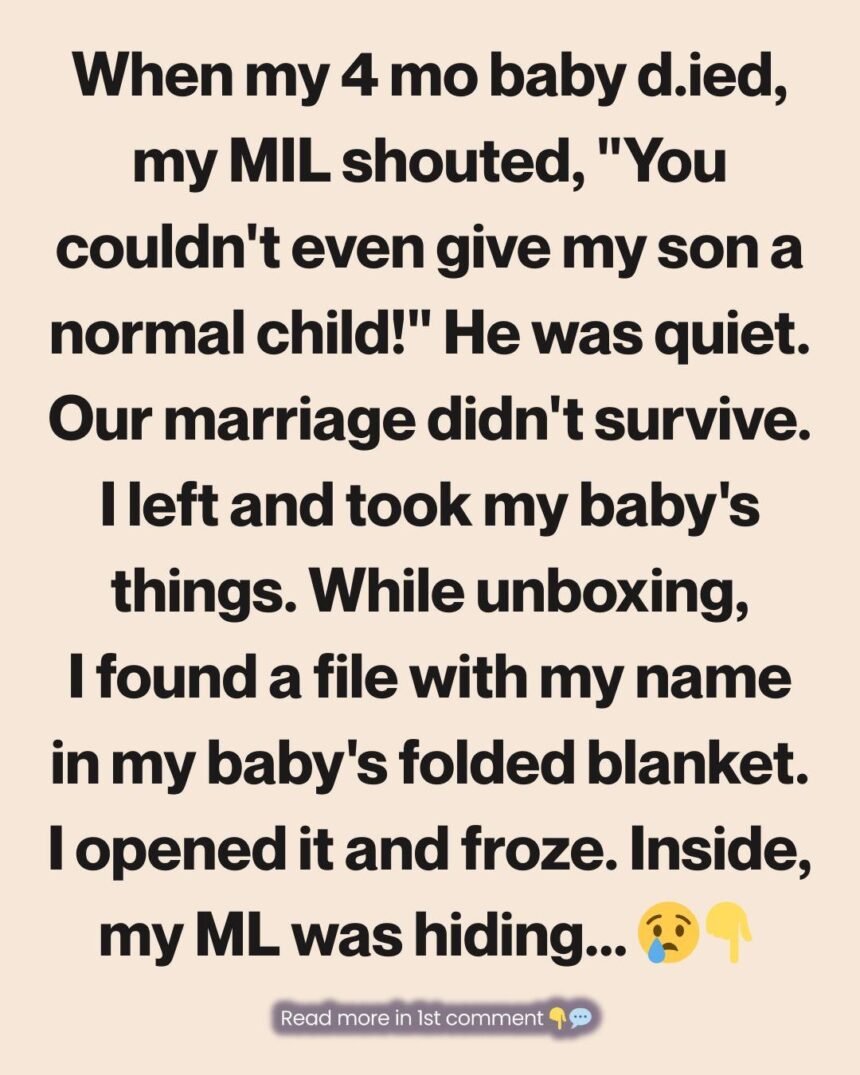
Something slipped out and landed on the floor.
A folder.
My name was written on it in neat, familiar handwriting.
My blood ran cold.
I sat down slowly, my heart pounding so hard I thought I might faint. Inside the folder was a handwritten note.
“It wasn’t your fault. Sorry.”
That was all.
Underneath the note were medical documents—genetic test results, doctor reports, consultations I’d never seen. I read them once. Then again. Then a third time, as the meaning finally sank in.
My husband carried a genetic mutation linked to a severe condition. A condition that could shorten a child’s life. A condition with a high risk of fatal outcomes in infancy.
It wasn’t me.
It had never been me.
For years, I had believed my body was broken. I had accepted the silent blame, the side glances, the pity. All the while, the truth had been sitting in someone else’s hands.
My husband had known.
And my mother-in-law had known too.
I sat on the floor for a long time, holding those papers, crying in a way that felt different from before—not just grief, but release. Anger mixed with relief. Betrayal tangled with something softer, something I wasn’t ready to name yet.
When I finally called her, my voice was steady in a way that surprised me.
“I found the file.”
She didn’t pretend. She didn’t deny it.
“He didn’t want you to know,” she said quietly. “He was afraid you’d leave. He lived in denial. He thought… maybe it wouldn’t happen.”
“And you let me believe it was my fault,” I said.
There was a long pause.
“Yes,” she admitted. “I protected my son. But I couldn’t protect that lie forever.”
She told me she’d watched me deteriorate—how I blamed myself, how I shrank, how I lost pieces of who I was with every miscarriage and every silent accusation.
“When your baby died,” she said, her voice breaking, “I said something unforgivable. And I knew… if I stayed silent, you’d destroy yourself with guilt.”
She sighed. “I may have been harsh. I may have failed you. But I always knew you deserved happiness.”
“I hope you can forgive me,” she added. “For not telling you sooner.”
I didn’t forgive her that day. Maybe not even now, fully.
But something shifted.
She broke her own silence when it mattered most. She chose truth over pride. In a strange, painful way, it felt like mercy—her final gift to me.
The truth didn’t bring my baby back. It didn’t save my marriage. But it freed me from a lie I had been living inside for years.
Now, when I think of my son, I no longer think of myself as a failure. I think of him as a life that mattered, even briefly. A love that was real.
And when I think of my mother-in-law, I remember the cruelty—but also the one moment of real kindness she gave me.
Truth.
At the worst time.
When I needed it most.
Note: This story is a work of fiction inspired by real events. Names, characters, and details have been altered. Any resemblance is coincidental. The author and publisher disclaim accuracy, liability, and responsibility for interpretations or reliance. All images are for illustration purposes only.