

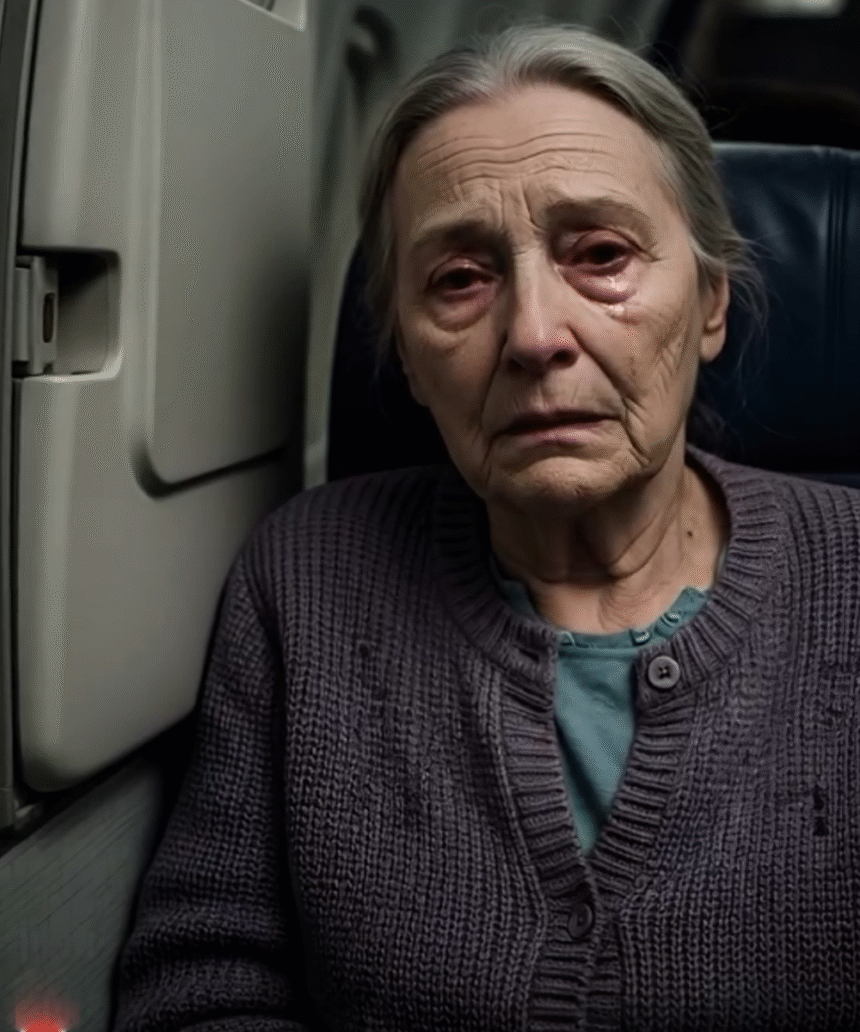
“It is,” she said.
“We can place a monitoring flag and escalate anomalies—especially travel-related—immediately.”
“Do that,” I replied. “And note I will be calling the airline.”
I left the branch lighter than I’d felt in years—not triumphant, not vengeful. Clear.
I arrived at the airport early, navy suitcase humming behind me like a discreet accomplice.
“Good morning,” I told the agent.
“I’d like to change my seat.”
She frowned at her screen. “Coach is full. I can move you to an aisle—still toward the back.”
“What about first?” I asked.
She blinked.
“That’s a paid upgrade.”
“I’ll cover it.” I handed my card—the quiet account my late husband and I had promised we’d always keep, no matter how loudly life shouted for our savings.
Five minutes later, I was holding Seat 2A and a glass of fresh orange juice. Before I walked away, I added, almost conversationally, “The original booking was made with a card I’ve flagged for unauthorized activity. You may be contacted by your billing team.”
Her gaze sharpened; she nodded.
“We’ll handle it, Ms. Merritt.”
First class boarded. The cabin felt like a library—quiet, deliberate, full of space for a person to exist.
Group Two shuffled past.
Dana stopped, squinted, tilted her head. I raised my glass a fraction, not gloating, just visible.
She moved on, expression stunned, to Row 8—business class, comfortable but not next to me, not above me, not over me. Separate stories, same plane.
Ten minutes later she returned, crouched by my seat, voice thin and bright.
“Mom. What are you doing in first?”
“Flying,” I said, softly.
“But how—”
“I used my own card,” I replied, turning back to the window. “Turns out your mother can book a seat.”
She studied me a long beat, searching for the old version of me—the apologetic fixer who offered explanations like snacks.
Finding none, she stood and left.
For the first time in years, I didn’t feel small. I felt remembered—by myself.
Fifteen minutes after takeoff, Dana reappeared, panic replacing polish. Carl hovered behind her, jaw tight.
“Mom,” she hissed, “we just got a message.
The airline flagged the card for possible fraud. They’re…reviewing.”
I folded my napkin. “That makes sense.”
Carl leaned in.
“What did you do?”
“I told the truth,” I said. “That the account wasn’t authorized by me.”
“It was for convenience,” he protested.
“For whom?” I asked, evenly.
Dana’s whisper frayed. “You’re really going to do this—here?”
“You did this,” I said, still gentle.
“I simply chose a different seat.”
A flight attendant approached with a steady smile. “Ma’am, we’ll need the aisle clear.” Dana and Carl retreated, carrying their urgency back up the cabin.
A while later, the attendant returned, crouching respectfully. “Ms.
Merritt,” she murmured, “our billing team has suspended the other reservation pending verification. They’ll be asked for new payment on landing. I thought you’d want to know.”
“Thank you,” I said.
She added, almost conspiratorially, “Good for you.”
I looked out at the thin blue horizon line, the curve of the world. For once, the altitude matched my perspective.
We reached California under a soft gold sky that made strangers kinder. On the boardwalk, Dana tried one more time: “Mom, you’re overreacting.
We meant to pay it back. We just—”
“Spent what you didn’t ask for,” I finished. “On seats you didn’t earn.
With miles you didn’t own.”
Tears brightened her eyes. “We invited you.”
“You placed me,” I said. “There’s a difference.”
She swallowed.
“So what happens now?”
“I make a report,” I said. “You make restitution. And until trust is restored, we take a pause.”
She looked at the ocean, wind tangling her hair the way childhood used to.
“You’re really doing this.”
“I’m really choosing me,” I answered.
The investigation was unglamorous. Forms. Statements.
Screenshots. A tidy stack of “kindly confirm” emails. In the end, the bank acknowledged the unauthorized nature of the application and the misuse.
The airline rerouted reimbursements. Consequences were the kind that don’t trend—but they teach: damaged credit, fees, the slow repair work of trust.
I didn’t post about it. I didn’t gossip.
I made soup. I watered plants. I booked a trip to Charleston, then Savannah, then a solo cruise through the Norwegian fjords—with my own card and a small, private ceremony each time I pressed “Confirm”: You matter.
Six months later, a plain box arrived with no return address.
Inside: a navy throw, soft as forgiveness, and a card with three shaky words:
I see you.
I didn’t cry. I draped the blanket over the arm of my chair, brewed tea, and sat by the window—Seat 2A of my own living room.
Seeing is a beginning. Boundaries are the rest.
People think upgrades are about legroom and champagne.
Sometimes they are. Mostly, they’re about permission—who grants it, who withholds it, who finally claims it.
Here’s what I learned at seventy-two, halfway between a paper towel napkin and a linen one:
- You are not the seat someone assigns you.
- Convenience is often code for your silence.
- A boundary is not a punishment; it’s a map back to respect.
- You can choose a different row without raising your voice.
- The first-class part is not the cabin. It’s the self-respect.
Dana and I are not restored, not yet.
We exchange holiday cards and, sometimes, difficult truths. The grandchildren call often; they tell me about school projects and ask for my lemon-square recipe. I give it freely.
Recipes are for sharing. Credit is for earning. Seats are for choosing.
If you’re reading this with a 34B feeling in your chest, hear me: you don’t have to stay there.
You can stand. You can ask. You can move.
And if the people who love you have forgotten how to honor you, let your next booking be a gentle reminder—to them, and to yourself.
I didn’t shout.
I didn’t starve or dramatize or disappear. I simply bought a new seat and let the truth do what truth does.
They thought I’d be grateful for the worst row on the plane.
I was grateful for the moment I remembered I had options.
Sometimes the most powerful upgrade isn’t in the cabin.
It’s in the quiet, steady way you carry your name all the way to the front.