
You marry for strategy, not for feelings. Do you understand?”
I nodded because when Richard asked if you understood, there was only one acceptable answer. “Yes, Dad.”
Inside, something small and stubborn whispered no.
For twelve years, I buried that voice under designer clothes and perfect grades and polite smiles at charity galas. I got the Columbia MBA he wanted. I joined the marketing division at Ashford Properties like a good little heir apparent.
I learned how to read a pro forma, how to present to a board, how to make myself “an asset.”
I also learned I was never enough. My ideas in meetings were “adequate.” My promotions were “expected.” My existence was a line item on his legacy plan. The only thing that ever earned real warmth from my father was a spreadsheet with the right numbers.
So of course the man I fell in love with didn’t come from his world. He came from a coffee shop in Brooklyn. Eight months before the gala, I escaped a board meeting that felt like being peeled alive.
I had spent three weeks developing a marketing campaign for a mixed‑use tower downtown. I’d stayed in the office past midnight, eaten dinner from vending machines, rehearsed every slide. When I finally presented it to the executive team, my father sat at the head of the table in a navy suit that probably cost more than my yearly rent and listened without a single expression.
When I finished, the COO smiled and said, “Strong work, Fiona.”
My father took off his glasses, set them on the table, and said, “Adequate.”
Just that. “Adequate for someone still learning,” he added when the silence stretched. “We’ll have the agency polish it.”
Translation: we’ll pay someone else real money to do what you just did for free.
My face burned. No one spoke. No one ever contradicted Richard.
Ten minutes later I was out on Lexington Avenue, heels clicking too fast on the pavement, lungs tight. I walked until the glass towers thinned and the buildings got shorter and older and real, until the scaffolding gave way to brownstones and hand‑painted storefronts. I ducked into the first coffee shop that didn’t have a finance bro in a suit already camped at every table.
It smelled like espresso and cinnamon. Mismatched wooden chairs. A chalkboard menu with crooked letters.
A girl with blue hair behind the counter drawing tiny hearts in the milk foam. No one looked up when I walked in. No one cared that my last name could move markets.
I ordered a black coffee I didn’t actually want and took it to a corner table. I sat there stirring it until the surface went cold and my hand cramped around the spoon. “Rough day?”
The voice was warm, male, amused.
I looked up. He was tall, maybe six‑two, in a faded flannel shirt with oil stains on the sleeves and jeans that had seen actual work. Dark hair, a little too long.
Kind brown eyes that crinkled when he smiled. He had calloused hands. I could see them because he wrapped them casually around his own mug, big blunt fingers nicked and scarred in a way I’d only ever seen on construction crews.
“That obvious?” I asked. “You’ve been stirring that coffee for ten minutes and haven’t taken a single sip,” he said, sliding into the chair across from me without asking. In my father’s world, people asked permission with calendar invites and gatekeepers.
In this little corner of Brooklyn, a stranger just sat down because it felt natural. I should have bristled. I should have guarded my space.
Instead, for the first time all day, I breathed. We talked. It started with small things: the weather, the coffee, how the subway would probably break again the second we needed it.
I told him, vaguely, that I worked in real estate marketing. He told me he was a mechanic. “Own a small shop in Queens,” he said, like he was confessing a misdemeanor.
“Carter’s Custom Garage. Nothing fancy.”
“Is that why your shirt looks like it lost a fight with an engine?” I lifted a brow. He laughed, a real laugh, unpolished and soft around the edges.
“Guilty.”
He didn’t ask what my father did, or which building I lived in, or whether my last name was on any of the glass towers hovering over the city. He asked what made me laugh. He asked what I did for fun when I wasn’t working.
He asked what my dream job would be if money didn’t matter. No one had ever asked me that, not once. We talked for three hours.
When I finally checked my phone, I had twelve missed emails and a text from my assistant asking if I’d be back for the 4PM meeting. James—he’d told me his name somewhere in hour two—walked me to the subway. “I don’t care what your last name is,” he said as we stood at the top of the stairs.
“I just want to know what makes you show up for yourself when nobody’s watching.”
The train roared below us. Trust can be weaponized, I would learn later. That day, it felt like a lifeline.
Six months later, that mechanic from Queens would stand across from my father at my wedding and say, in front of three hundred people, “We don’t need your money.”
But I’m getting ahead of myself. Back then, we were still a secret. James paid for everything in cash.
Thick folds of bills pulled from a worn leather wallet, held together with a plain rubber band. He liked diners and hole‑in‑the‑wall places where the food came on chipped plates and nobody cared if you wore last season’s shoes. I thought he was careful because his budget was tight.
I didn’t know he was hiding in plain sight. Three days after I first said his name at dinner, my father made sure I understood exactly how little he approved. That Thursday night, the Ashford penthouse sat glittering over Central Park like a glass ship.
Floor‑to‑ceiling windows. A twelve‑seat walnut dining table my mother liked to remind people had been imported from Italy. Hermès place settings lined up like soldiers.
A bottle of 2010 Château Margaux breathing on the sideboard, worth more than most people’s monthly rent. My father’s Patek Philippe watch caught the light every time he lifted his glass. My mother had a new diamond bracelet on; she twisted it the way some women twist cheap hair ties.
“I’ve arranged a meeting for you this Saturday,” my father said without looking up from his filet mignon. “Harrison Wells III. His father and I are finalizing the merger.
It would be beneficial for you two to get acquainted.”
Beneficial. That was how he said engaged. I put my fork down.
“I can’t make Saturday.”
He finally looked at me, the way a surgeon might look at an unexplained growth. “I have someone I want you to meet,” I continued, my heart hammering. “Someone I’ve been seeing for six months.”
The air thinned.
“His name is James, and I—”
“Who?”
One syllable, sharp as broken glass. “What family? Wells?
Montgomery? Don’t tell me you’ve entangled yourself with one of the Hartley boys.”
“You don’t know him,” I said, forcing myself not to shrink. “He’s not from that circle.”
The silence that followed was suffocating.
“You’ve been seeing someone for six months,” my father said slowly, “that I haven’t vetted. That I haven’t approved.”
“I don’t need your approval to date someone, Dad.”
He leaned back, jaw clenched. “In this family, Fiona, love is a luxury.
Marriage is strategy. Who is this person who thinks he can approach my daughter without going through me first?”
He said it like my heart was a business opportunity someone had tried to poach. At the time, I told myself I was being brave when I held his gaze.
The truth is, I was already tired of being for sale. The summons to his office came three days later. Ashford Properties headquarters sat in a glass tower in the Financial District, all steel lines and polished stone.
My father’s corner office on the forty‑second floor was designed to intimidate: expensive abstract art, a desk big enough to land a small plane, a view that made even Wall Street look small. A manila folder sat in the center of the desk. “James Carter,” my father read aloud, flipping through pages as I sat in the leather chair opposite him.
“Age thirty‑two. Owns a one‑bedroom in Queens, assessed under four hundred thousand. Operates a small automotive repair shop, Carter’s Custom Garage.
Estimated annual revenue under two hundred thousand. No significant assets. No notable family connections.
No investments beyond a basic retirement account.”
He closed the folder like he was closing a deal. “This is who you’ve chosen?” he asked, looking at me with something between disgust and pity. “A grease monkey from Queens?”
“He’s a good man,” I said quietly.
“Good men don’t build empires, Fiona.” He stood, moving to the window. “Good men get swallowed by them.”
He rested his hands on the glass, looking out over the city he believed he owned. “I had the best private investigator in the city dig into this James Carter.
Do you know what he found?”
My heart thudded. “Nothing,” my father said. “No debts.
No scandals. No skeletons. Just…nothing.
A completely unremarkable man.”
“Maybe that’s exactly what I want,” I said. “Someone who doesn’t see me as an asset.”
He turned, eyes cold. “You’re an Ashford.
You don’t get to be unremarkable.”
“He doesn’t want anything from me,” I pushed. “He doesn’t care about the money or the name or any of it. That’s what you can’t understand.”
My father laughed, sharp and humorless.
“Everyone wants something. The only question is when they reveal it.”
He slid the folder toward me. “End this now,” he said.
“Before you embarrass this family further.”
I left the folder on the desk. His investigator hadn’t found anything suspicious because James had made sure there was nothing to find. Very, very carefully.
James proposed on a Sunday morning in Queens. His apartment was small but spotless, sunlight pouring through windows he’d cleaned himself. He made pancakes that came out slightly burned at the edges and handed me a mug of coffee just the way I liked it.
Then he slid a velvet box across the counter. The ring inside wasn’t enormous, not by Ashford standards. A single diamond on a thin gold band, elegant and understated.
When I turned it, it caught the light like a tiny star. “I know I’m not what your family expected,” he said quietly. “I know I can’t give you penthouses or private jets.
But I can give you this. I will never try to control you. I will never make you feel small.
And I will spend every day trying to make you happy.”
I said yes before he finished the sentence. That night, I called my mother. “We’re getting married in two months,” I told her.
“I wanted you to hear it from me first.”
The silence on the other end of the line stretched so long I checked to make sure the call hadn’t dropped. “You are killing me, Fiona,” she finally breathed, in that practiced, brittle way she used when she was performing for an invisible audience. “You are absolutely killing me.
Do you have any idea what this will do to your father? To our reputation?”
“I’m getting married, Mom,” I said. “To someone I love.”
“Love,” she repeated like it was a vulgar word.
“You think love pays for your lifestyle? You think love maintains your social standing?”
An hour later, my brother Derek texted. Heard you’re marrying some broke mechanic.
Bold move, sis. Can’t wait to see you slumming it in Queens. I didn’t answer.
My father called last. “You want a wedding?” he said, voice like ice. “Fine.
I’ll give you a wedding.”
There was a pause, just long enough that my stomach dropped. “One you’ll remember for the rest of your life.”
I should have heard the threat in it. I was too busy staring at the ring on my hand and imagining a future where I belonged to myself.
The first strike hit at Kleinfeld Bridal. I’d booked an appointment for a classic Vera Wang—expensive, but not ridiculous by Ashford standards. I told myself it was the last indulgence from that world before I built a new one.
The consultant, a woman who had been fitting dresses for my mother’s friends for years, greeted me with a tight smile. “I’m so sorry, Miss Ashford,” she said. “There seems to be an issue with your account.”
My primary credit card declined.
Then the backup. Then the “emergency” card my mother had given me for “special occasions.”
“Run it again,” I said, heat climbing my neck. She did.
Three times. Same result. I ended up sitting on the fitting room floor in my slip, surrounded by tulle and silk I suddenly couldn’t afford, listening to tinny hold music while I called the bank.
“I apologize, Ms. Ashford,” the representative said finally. “But your accounts have been deactivated.
The primary account holder removed your authorized user status yesterday.”
The primary account holder. Richard Ashford. My father hadn’t just threatened to cut me off.
He’d launched a financial siege. James found me an hour later, still on the fitting room floor, my phone limp in my hand. He crouched in front of me.
“Let me help,” he said, reaching for his wallet. “No.” The word came out sharper than I meant. Pride is loud when you’re scared.
“I can’t. I need to figure this out myself.”
He pulled out a stack of cash anyway. Hundred‑dollar bills, crisp and thick, at least two thousand dollars wrapped in a plain rubber band.
“I want to,” he said simply. “Let me.”
I stared at that stack. Too much money for a guy who supposedly ran a modest auto shop.
Too casual for someone barely scraping by. Something flickered in the back of my mind. I was too numb to reach for it.
For the first time in twenty‑eight years, I was standing in a store I could not afford. Without my father’s credit limit to hide behind, I had no idea who I was. But I was about to find out.
The social fallout was surgical. Within a week, my phone went quiet. Friends I’d known since kindergarten suddenly had “crazy weeks” and “family things” anytime I suggested meeting up.
Group chats went silent. Lunch plans dissolved into vaguely worded cancellations. Then came the texts.
So sorry babe, but my mom says we shouldn’t be seen together right now. You know how business works. Xo.
Hey Fee, this is awkward, but my dad does a lot of deals with Ashford Properties and…you get it, right? Nothing personal, but I can’t risk my family’s relationship with yours. Good luck though.
Twenty‑eight years of friendship, and every single one came with a price tag. Once I stopped being profitable, my value disappeared. At Ashford Properties, where I’d worked in marketing for three years, people stopped making eye contact.
Conversations died when I walked into a room. The corner office I’d hustled for suddenly needed to be “repurposed for restructuring.”
HR’s email came on a Friday afternoon. Your position is being evaluated.
Please refrain from client‑facing activities until further notice. They didn’t fire me. They just made sure I knew I was disposable.
Through all of it, one person kept reaching out. Margaret Smith, my grandmother’s attorney. Her voicemail was polite and steady.
“Miss Ashford, there’s a matter regarding your grandmother’s estate that requires your attention. Please call at your earliest convenience.”
I saved the message. I didn’t call back.
I was too busy drowning to notice the life raft being thrown at my head. We moved to Brooklyn because James insisted on it. He found a two‑bedroom in a brownstone on a quiet block, with creaky hardwood floors and a balcony barely big enough for two chairs.
“It’s not much,” he said, watching my face as I stepped into the empty living room. “But it’s ours. Nobody else’s name is on it.”
Sunlight spilled across the floor.
No marble. No doorman. No Central Park.
Just a little patch of sky and a community garden down below where someone had planted tomatoes in old paint buckets. I started crying. Not because I missed the penthouse.
Because for the first time in my life, my father’s shadow couldn’t reach me here. James held me while years of pressure slipped out in messy, hiccuping sobs. He didn’t promise to fix everything or march into Ashford Properties to demand my job back.
He just held me. Sometimes that’s the loudest kind of love. For the next six weeks, I treated finding a job like a full‑time job.
I sent out résumés to every marketing firm in the city. Big agencies, small agencies, in‑house roles at startups, contract work. If a listing mentioned “brand strategy” or “digital campaigns,” my application was in their inbox.
I had an MBA from Columbia, three years of experience, and a portfolio full of campaigns that had made Ashford Properties a lot of money. I didn’t get a single interview. The Ashford name, which had once opened every door, now quietly shut them.
Nobody wanted to risk offending Richard by hiring the daughter he’d publicly disowned. “Maybe I should look outside the city,” I said one night, staring at yet another rejection email. “Or,” James said, leaning against the kitchen counter, “maybe you shouldn’t work for anyone else.”
“I can’t exactly start my own company,” I said, gesturing at our secondhand table and mismatched chairs.
“I have, like, three thousand dollars to my name.”
“Sometimes that’s enough,” he said. “In what world?”
He only smiled, that small, private smile that always made me feel like I was missing half the joke. Our savings dwindled.
I insisted on paying half the bills—rent, utilities, groceries—even when it hurt. Some stubborn, wounded part of me needed proof that I wasn’t just trading one kind of dependence for another. James never pushed.
He let me split every check, even when I watched him slip thick stacks of cash into his desk drawer like it was nothing. At three a.m., when I lay awake listening to the city breathe and my thoughts spiral, my father’s voice slithered in. You’ll have nothing.
No inheritance, no trust fund, no shares, no name. You’ll be nobody, just like him. What if he was right?
What if I’d stepped off a cliff with no parachute, all for a man I was only just beginning to truly know? One night, I padded out to the living room for water and found James on the couch, laptop open, a second phone pressed to his ear. “The quarterly projections need to be finalized before the board meeting,” he was saying.
“No, don’t push it to Williams. I’ll handle the technical review myself.”
I froze. Board meeting.
Not staff meeting. Not shop meeting. Board.
He must have heard the floor creak because he turned, saw me, and ended the call. “I’ll call you back,” he said quickly, then hung up. “Work stuff,” he said, smiling like nothing was off.
“Go back to sleep.”
I nodded. I lay awake until dawn. Since when did mechanics have boards?
One week before the wedding, my father showed up at our Brooklyn apartment. He looked wrong without the armor of his office behind him—just a man in a too‑sharp Tom Ford suit standing in a hallway that smelled faintly of onions and someone’s incense. “I’m here to make you an offer,” he said when I opened the door.
No hello. No how are you. James joined me in the doorway, silent and steady.
My father stepped inside like the air offended him. He pulled out a checkbook. “Five million dollars,” he said.
“Cancel the wedding. Come home. We’ll pretend this little rebellion never happened.”
Five million.
A number big enough to fix a lot of problems. My heart did a small, treacherous flicker. “No,” I said.
“Ten,” he said immediately, pen hovering. “Ten million. Final offer.”
My throat dried.
“I’m not for sale, Dad.”
His jaw twisted into something ugly. “Then you’re a fool. When this marriage fails—and it will—don’t come crawling back.
There will be nothing for you. No inheritance. No trust fund.
No shares in the company. No Ashford name to protect you. You will be nobody.”
He stepped closer, voice dropping.
“Just. Like. Him.”
He jerked his chin at James like he was a stain on the wall.
James didn’t move. “Mr. Ashford,” he said quietly, “I think you should leave.”
“Oh, the mechanic speaks.” My father barked a laugh.
“Enjoy her while you can, son. When the shine wears off and she realizes what she’s given up, she’ll resent you for it.”
“I don’t think she will,” James said. For a second, something passed between them.
A flicker of…recognition? Fear? I couldn’t read it.
My father’s smirk faltered. He left without another word. “He’ll make the wedding hell,” I whispered after the door closed.
James laced our fingers together. “Let him try,” he said. Our wedding was supposed to be small.
We’d booked a cozy restaurant in Brooklyn, the kind with exposed brick and string lights and a back patio that felt like a secret garden. Fifty guests. People who had stayed when the Ashford money disappeared.
A few of James’s friends from the garage. Some coworkers from my early days at the company who’d quietly reached out to say they were proud of me. We showed up to find two hundred and fifty extra guests already seated.
Women in Chanel and Oscar de la Renta. Men in bespoke suits worth more than our annual rent. Society columnists clutching phones.
Influencers sliding into front‑row seats. My mother sat in the front, dabbing her eyes with a linen handkerchief that matched her pale pink dress. Derek scrolled Instagram like he was bored at a dentist appointment.
At the center of it all stood my father, in a three‑piece bronze suit, holding a glass of champagne and smiling like he’d just cut the ribbon on a new tower. “Surprise, sweetheart.” He kissed my cheek before I could pull away. “What did you do?” I hissed.
“I promised you a wedding you’d remember.” His smile never touched his eyes. “Consider this my gift.”
I looked around. This wasn’t a wedding.
It was an arena. James leaned in. “We can leave,” he murmured.
“Say the word and we walk out, find a judge, get married at City Hall.”
I looked at the altar we had chosen, now flanked by people who’d come to watch me fall. “No,” I said, straightening my shoulders. “We’re getting married today.
Whatever he’s planning, we’ll face it together.”
I had no idea how brutal it would be. The ceremony itself was perfect. James’s vows were simple and steady.
Mine shook, but I got them out. When the officiant pronounced us husband and wife, there was a beat where the world went quiet. For that one breath, I was happy.
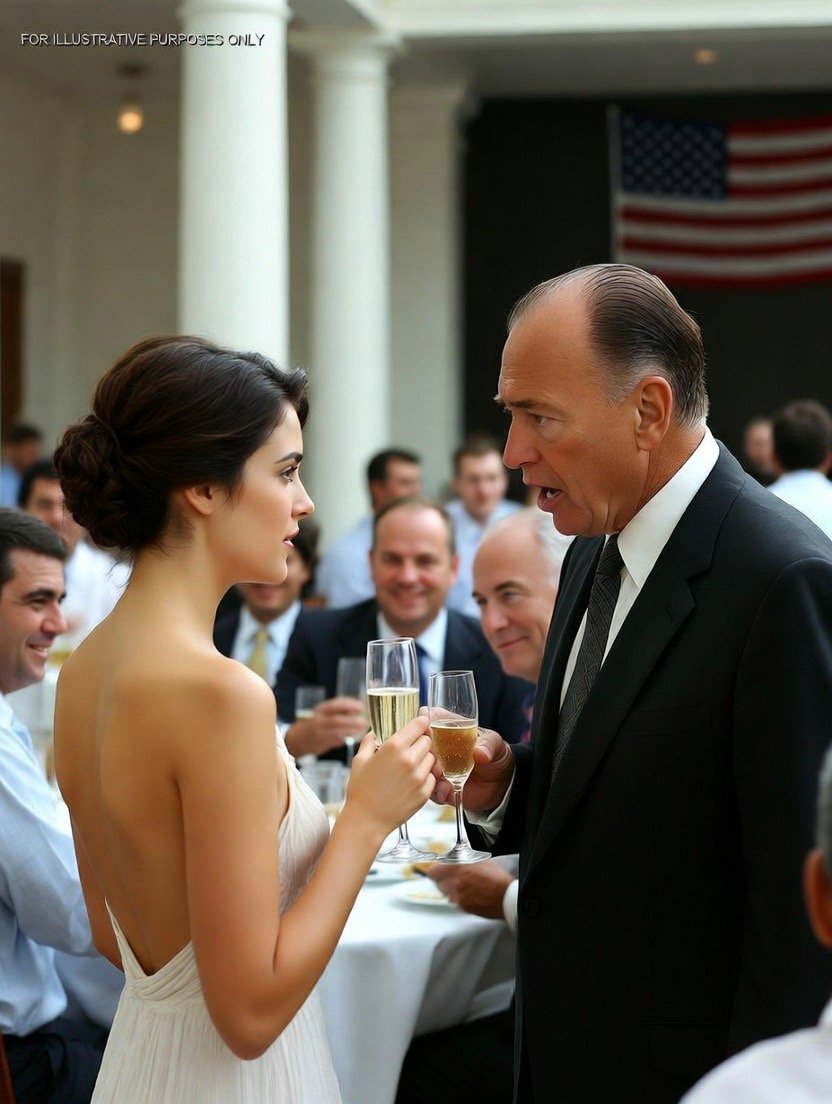
Then the glasses started clinking. My father stood. He held up a flute of Dom Pérignon, and the room fell into a hush that felt like a held knife.
“A toast,” he said, his voice carrying easily. “To my daughter and her…husband.”
The pause before husband was a slap. “I built everything I have from nothing,” he began, pacing slowly.
“Every dollar. Every deal. Every opportunity earned through blood and sacrifice.
And I dreamed that one day my daughter would marry someone worthy of that legacy.”
He stopped in front of our table and looked at James like he was something unpleasant stuck to his shoe. “Instead, she chose this. A grease monkey from Queens.
A parasite with nothing to offer but calloused hands and empty pockets.”
Gasps rippled through the crowd. I saw phones rise, screens glowing as people started recording. “So I’m here to make an announcement,” my father continued, voice hardening.
“From this moment forward, Fiona Ashford is no longer my daughter. She is removed from my will, cut off from her trust fund, and stripped of any claim to Ashford Properties.”
He turned to the crowd, arms open. “Let this be a lesson.
When you choose poverty over family, you get exactly what you deserve.”
He drained his glass, set it on our table, and smiled at me. “Congratulations, sweetheart. You’re finally getting everything you asked for.”
The silence that followed roared in my ears.
James rose slowly. He straightened his simple navy tie, turned to my father, and smiled—a small, measured smile I’d never seen before. “Thank you for coming, Mr.
Ashford,” he said, voice steady. “And thank you for your blessing.”
My father snorted. “Blessing?
I just told you you’re getting nothing.”
“I heard you.” James stepped closer until they were almost nose‑to‑nose. “And I want you to know…we don’t need it.”
“You don’t need it,” my father repeated, laughing harshly. “You own a garage worth less than my watch.
You live in a shoebox apartment. What exactly do you think you have to offer my daughter?”
James’s smile deepened. “Something more important than money, Mr.
Ashford,” he said quietly. “I have her.”
In the back of the room, a silver‑haired man in a perfectly cut, unshowy suit watched the exchange with interest. I’d noticed him among James’s guests earlier, but he hadn’t introduced himself.
When my father’s gaze flicked briefly to the man and back, something like unease slid across his face. He didn’t understand why that stranger was there. He didn’t know he was already losing the most important deal of his life.
Yet. “Enjoy your poverty,” my father spat. “When she’s tired of struggling, when she realizes what she’s thrown away—and she will—don’t say I didn’t warn you.”
“Real wealth isn’t measured in bank accounts,” James murmured.
My father laughed again, but it sounded thinner this time. He’d had his performance. Now it was my turn.
I stood, heart pounding, and turned to face three hundred people who had come to witness my humiliation. “My father believes money is everything,” I said, my voice surprisingly clear. “He believes love is a transaction, family is a business arrangement, and people are either useful or worthless.”
I looked at my mother, who refused to meet my eyes.
At Derek, still scrolling. At the cluster of society reporters pretending they weren’t streaming this live. “I used to believe it too,” I went on.
“I spent twenty‑eight years trying to be valuable in his eyes. The right school, the right degree, the right clothes, the right smile. And you know what it got me?”
I let the question hang.
“Adequate,” I said. “Acceptable. Never enough.”
My father’s jaw ticked.
“Today,” I said, squeezing James’s hand, “I chose something different. I chose to be loved for who I am, not what I’m worth. If that costs me the inheritance I was supposed to get—the twenty percent of Ashford Holdings everyone assumed would be mine—then maybe it was never actually mine.”
I turned to the crowd.
“If you came to watch a tragedy, I’m sorry to disappoint you. This is a celebration. If you want to leave, the door is there.
If you want to stay and actually celebrate our marriage…welcome to our wedding.”
For a heartbeat, no one moved. Then about thirty people gathered their things and left. The rest stayed.
Including some of my father’s guests. He hadn’t planned on that. He stormed out with my mother and Derek trailing behind, anger rolling off him like heat.
The door hadn’t even closed before the entire atmosphere of the room shifted. The air felt lighter. Someone started clapping.
It spread. The DJ, who’d been frozen in horror, finally started the music. Our wedding became ours again.
If you’re still with me, type “same” in the comments if your family has ever made you feel like a line item on a spreadsheet instead of a person. I read every single one. Now, back to the story.
Because trust me, the twist? You did not see it coming. The honeymoon period lasted six weeks.
Not our marriage. That part was perfect. James and I built routines in our Brooklyn apartment—pancakes on Sundays, cheap wine on the balcony on Fridays, Netflix and takeout on the nights when the world felt too heavy.
The part of my life that stopped being sweet was the fantasy that I could quietly rebuild my career and slide into a new normal. Three months after the wedding, my mother called. “Darling,” she said, her voice syrupy.
“How are you? We’ve been so worried.”
“Have you?” I asked. “Of course.
You’re still my daughter, no matter what your father says.”
There was a strategic pause. “You know,” she added lightly, “he hasn’t formally changed the will yet. There’s still time, if you wanted to…reconsider.”
“Reconsider my marriage?” I asked.
“Reconsider your choices,” she said. “You’ve made your point. We understand you wanted independence.
But surely by now you see that man can’t give you the life you deserve.”
I thought about James making coffee exactly the way I liked it. About the way he stood beside me when my father tried to tear my identity apart in front of three hundred people. About his steady faith when I had none left for myself.
“I think he already has,” I said. “You’re killing me, Fiona,” she whispered. “Every day you stay with him is another day you throw away your future.”
Click.
Two days later, Derek posted a rooftop party shot. The Manhattan skyline behind him, champagne in hand, surrounded by the friends who had ghosted me. Caption: Some people choose love over luxury.
Hope they’re enjoying their freedom. #povertyisromantic. My mother liked the post.
It took everything in me not to throw my phone across the room. James came home to find me staring at the screen, tears blurring the image. He read the post, jaw tightening.
“They’ll rewrite this story,” he said quietly. “Soon.”
“How can you be so sure?” I asked. He just kissed my forehead.
“Because I know how this ends,” he said. Four months after the wedding, the official letter arrived. Heavy cream paper.
Ashford Properties letterhead. A law firm’s seal. Dear Ms.
Ashford Carter, it began. This letter serves as formal notification that Richard Ashford has executed amendments to his last will and testament. Per these amendments, you have been permanently removed as a beneficiary.
Your previous designation to receive twenty percent of Ashford Properties holdings—estimated current value two hundred million dollars—has been reallocated. Additionally, trust account number 47891, established in your name, has been dissolved per trustee authority. These changes are final and irrevocable.
Two hundred million dollars erased with a signature. I sat on our balcony until the sun sank behind the brick and the sky went from gold to purple to black. I’d always told myself I didn’t care about the money.
Maybe that was true. But realizing my father could erase me from his life and his legacy with a ten‑second pen stroke hurt in a way I didn’t have words for. James found me there, the letter crumpled in my fist.
“I saw the envelope,” he said, sitting beside me. “I’m sorry.”
“I don’t care about the money,” I said, laughing in that ugly, wet way that doesn’t sound like laughter at all. “That’s the sick joke.
I never cared. But knowing he can just…delete me? Like I never existed?”
James was quiet for a long time.
“I have something to tell you,” he said finally. “Something I’ve been waiting for the right time to share.”
My heart stuttered. “But not yet,” he added.
“Not yet?”
“In three months, there’s an event,” he said. “I need you to trust me until then.”
“What kind of event?”
“The kind that will change everything,” he said. He met my eyes.
“Can you wait that long?”
I didn’t understand. But I trusted him. “Yes,” I said.
The next day, I finally called Margaret Smith back. Her office was in a brownstone on the Upper West Side, all mahogany shelves and worn leather chairs. “Thank you for coming, Mrs.
Carter,” she said, emphasizing my married name in a way that felt deliberate. “Your grandmother would be very proud of you.”
Just hearing Grandma Maggie’s name made my throat tighten. “You said there was something about her estate,” I managed.
Margaret slid a folder across the desk. “Before she passed,” Margaret said, “your grandmother established a separate trust. Independent of anything your father controls.
She instructed me to inform you of it only after you married someone of your own choosing, without your father’s approval.”
I stared. “She knew,” Margaret said gently. “Exactly what kind of man her son‑in‑law was.”
She opened the folder.
“The trust contains five hundred thousand dollars in diversified assets,” she said. “It became yours the day you married James Carter.”
Half a million dollars. Freedom, in a neat stack of bank statements.
Margaret handed me an envelope. Inside was a letter in my grandmother’s looping handwriting. My darling Fiona,
If you’re reading this, it means you finally chose your own path.
I am so proud of you. Your grandfather and I started our life with nothing but a rented walk‑up and a secondhand sofa. We ended it with everything we needed, because we had each other.
This money is not a fortune, but it is freedom. Use it to build the life you want. Never let anyone—especially family—tell you what you are worth.
All my love,
Grandma Maggie
I cried in that office for twenty minutes. For the first time in months, the tears tasted like hope. Five months after my wedding, I launched Thornton Creative.
I used my grandmother’s maiden name deliberately. I rented a tiny office in a co‑working space in SoHo. Designed my own logo.
Bought a secondhand Mac and a whiteboard and a plant I swore I wouldn’t kill. My first client was the coffee shop where I’d met James. They needed help with social media.
I charged half what I should have and did triple the work. The campaign worked. Their foot traffic doubled.
The second client was a vintage bookstore in the Village. Then a family‑owned restaurant in Queens. Then a tech startup in Jersey City.
Word spread—not through charity galas and country clubs, but through neighborhood grapevines and group chats. People who judged you on results, not your last name. Within two months, I had more clients than I could handle alone.
“I’m proud of you,” James said one night, watching me build out a campaign deck at our kitchen table. “I couldn’t have done it without Grandma’s trust,” I said. “Or without you believing in me when I didn’t believe in myself.”
“You would have found a way,” he said.
That week, an email popped into my inbox that made my breath catch. Subject: Partnership Inquiry.