

I knew which vendors cut corners and which truck routes always seemed to get delayed; I knew the way a missing shipment of IV bags could turn a calm night into a crisis. And I knew something about my children. They were brilliant, driven, and utterly convinced of their own exceptionalism.
What they didn’t know was that mothers see through the facades their children construct.
I saw Lucas’s desperation beneath his polished confidence. Rebecca’s insecurity beneath her sharp tongue.
“Mom, this is our one shot,” Lucas had said six years ago, sitting at this very table where the invitation now lay. He’d pushed his laptop toward me, spreadsheets and pitch decks glowing on the screen.
“Everyone who gets in early is going to make a fortune.”
Rebecca had nodded eagerly, her dark hair swinging over the collar of a blazer that probably cost more than my monthly mortgage payment.
“We just need enough to get through the first year of development. We have investors lined up, but they want to see some skin in the game from us.”
I’d looked at their eager faces, so like Raymond’s when he’d get excited about some new project around the house, and felt that familiar tug of maternal sacrifice. “How much do you need?” I’d asked.
The number they named would have emptied my retirement account.
Not the paltry 401(k) from the hospital, but the life insurance payout from Raymond’s death that Caleb Peterson had helped me place into safe, steady investments after the funeral. Money I’d been carefully growing for over a decade.
My safety net. My future.
“You’ll be a silent partner,” Rebecca had promised, her eyes shining.
“When we go public, you’ll get it all back tenfold.”
They hadn’t visited in the two years before that day. They hadn’t called on my birthday. They hadn’t asked about my health, or whether I was lonely in this little house at the edge of the city, or if I needed anything.
But they’d shown up with business plans and projections, wearing clothes that cost more than the old Honda in my driveway.
I should have seen it then. I gave them the money.
All of it. They promised they’d bring paperwork to formalize my investment.
It never came.
The first year, I got occasional updates. Breathless calls about beta tests and pilot programs, links to articles I barely understood about AI and logistics optimization. The second year, there were just glossy Christmas cards with no personal messages, their signatures printed in silver ink under the company logo.
By year three, my calls went to voicemail.
My texts received one-word replies, if they were answered at all. I saw their company in the Atlanta Business Chronicle one morning in the hospital break room.
Rising Stars Under 40. There they were, my twins, polished and prosperous in designer clothes, standing in a sleek open-plan office I had never been invited to visit.
The article mentioned angel investors and venture capital firms.
It quoted their former professor. It praised their “self-made” story. Not a word about their mother — the nurse who’d emptied her future to give them their start.
I didn’t confront them.
What would be the point? I picked up extra shifts instead.
Ignored the arthritis in my hands. Adjusted to the idea that I would be working until I physically couldn’t stand at a bedside anymore.
And now this invitation.
I picked up my phone and called Sarah, my one real friend — a fellow nurse who’d stood by me through workplace reorganizations, late-night emergencies, funerals, and the kind of ordinary Tuesdays that can feel heavier than any tragedy. She answered on the third ring, her warm Georgia drawl wrapping around my name. “Kora?
Everything okay?”
“They invited me,” I said, staring at the gold letters.
“Who?” she asked, though I could hear in her voice she already knew. “Lucas and Rebecca.
Horizon Innovations. Five-year anniversary at the Ritz.” I read the wording aloud.
“To rub my nose in it, I think.
To show me what they’ve accomplished without me.”
Sarah’s sigh carried years of witnessed hurts. “Are you going to go?”
Was I? Part of me wanted to tear the invitation into confetti and dump it in the kitchen trash.
Another part — the mother who remembered two dark-haired toddlers running across worn carpet to throw themselves into my arms — wanted one more chance to see them in their world, to witness what they’d become, even if they’d built it by stepping on my back.
“I think I will,” I said finally. “Kora.” Sarah’s voice turned serious, the way it did when we were about to push a high-risk medication.
“Don’t let them hurt you again.”
“I won’t,” I promised, though I wasn’t sure how I would prevent it. After we hung up, I sat with the invitation for a long time.
Five years of their company.
Five years since they’d effectively disappeared from my life. Five years of me working doubles while they built an empire on my investment. I opened my old, sluggish laptop — the one that made an angry little whirring sound every time I asked it to do too much — and typed Horizon Innovations into the search bar.
Their website was slick and impressive: deep-blue color palette, clean fonts, smiling stock photos of lab coats and server rooms.
“Revolutionizing healthcare logistics through proprietary AI solutions,” the tagline boasted over a looping video of trucks pulling up to hospital loading docks somewhere in the Midwest. There were photos of gleaming offices with glass walls and standing desks.
A team page where Lucas and Rebecca smiled confidently at the camera in tasteful business attire. And there, buried halfway down the “About Us” section, was a list of their major partnerships and investors.
Fourth from the top: Peterson Capital.
My heart stuttered. Peterson Capital was the investment firm that Caleb Peterson had started after leaving Henderson Financial. Caleb — who had been Raymond’s best friend since their days doing ROTC drills together at Georgia State.
Caleb, who had sat at my dining room table after the funeral, talking me through mutual funds and bond ladders when I could barely remember to eat.
Caleb, who still called every month to check in, who brought me homemade chicken soup when I had pneumonia last winter, who had become my financial adviser and, though neither of us had ever said the words aloud, perhaps something more. Caleb had never mentioned investing in my children’s company.
Then again, I had never told him about giving them my retirement money. Some misplaced sense of maternal pride, perhaps, or shame at being so thoroughly discarded afterward.
I picked up my phone again and dialed a different number.
“Kora,” Caleb answered warmly on the second ring. I could hear traffic in the background, the soft ding of an elevator. “I was just thinking about you.
How are you?”
“I’m fine,” I said automatically, though we both knew “fine” to be one of the world’s least honest words.
“Caleb, do you have a few minutes to talk? In person?”
There was a pause.
“Of course. Is everything all right?”
“I’m not sure,” I said honestly.
“But I need your advice.”
We arranged to meet at a small café near his Buckhead office the next day — the kind of place with chalkboard menus, exposed brick, and college students hunched over laptops, nursing single cups of coffee for hours.
After hanging up, I looked again at the invitation on my counter. “What real accomplishment looks like,” I repeated Lucas’s words aloud to my empty kitchen. I thought of my aching hands after twelve-hour shifts changing bedpans and administering medications.
I thought of the patients whose hands I’d held as they took their last breaths because their families couldn’t be bothered to show up.
I thought of raising two children alone after their father died, working two jobs and clipping coupons so they could have new backpacks and soccer cleats and SAT prep books. For the first time in years, I felt something other than resignation or quiet disappointment when thinking about my children.
I felt anger. Cold, clarifying anger that straightened my spine and lifted my chin.
I picked up the RSVP card and wrote a single word.
Yes. Then I opened my closet and pushed aside the practical scrubs and comfortable shoes that had become my uniform. In the very back, wrapped in plastic from a dry cleaner long since closed, hung the black dress I’d worn to Raymond’s funeral — a simple, classic sheath, elegant and severe.
I hadn’t had occasion to wear it since.
It would do nicely for a different kind of ending. Caleb was already waiting when I arrived at the café the next afternoon.
His silver hair was neatly combed, his navy suit impeccable as always. He stood when he saw me — that old-fashioned courtesy Raymond had shared.
For a moment, I saw concern slide across his face before he covered it with a warm smile.
Perhaps I looked more tired than usual. “Kora,” he said, pulling out my chair. “It’s good to see you.”
We ordered — tea for me, black coffee for him — and exchanged pleasantries about his daughter’s new baby in Nashville, the volunteer tomatoes that had popped up unexpectedly in my garden bed this year.
Then I reached into my bag, took out the cream-and-gold invitation, and placed it on the table between us.
“My children’s company,” I said simply. “I understand Peterson Capital is one of their investors.”
Caleb picked up the invitation, his expression growing carefully neutral.
“Yes. We invested in their Series B round about three years ago.
It’s been quite successful.” He looked up at me.
“I didn’t realize you were… estranged.”
“That’s one word for it,” I replied, taking a sip of tea to steady my hands. “What do you know about their funding history?”
He hesitated — the cautious pause of a man tied up in NDAs and fiduciary responsibilities. “I’m not sure how much I can—”
“Caleb,” I interrupted quietly.
“They took everything I had to start that company.
Every penny of Raymond’s life insurance money. They promised me partnership paperwork.
It never came.”
The color drained from his face. “Kora, I had no idea.”
“Of course you didn’t,” I said.
“I never told anyone.
Maternal pride, I suppose. Or foolishness.” I kept my voice steady. “What I need to know is whether they’ve listed me as an investor in any of their documents.
Anywhere at all.”
Caleb set his coffee cup down very carefully.
“Not that I’ve ever seen,” he said at last. “We conducted thorough due diligence before investing.
Their seed round was attributed to personal funds and a small group of angel investors. None named Green.”
I nodded, having expected as much, but the confirmation still landed like a blow.
“And their company valuation now?” I asked.
He exhaled slowly. “Conservative estimates put it around seventy-five million. They’re positioning for an IPO next year that could easily triple that, especially if the MedTech rumors pan out.”
Seventy-five million.
The three hundred fifty thousand dollars I’d given them — my entire future — would be worth several million now if they’d honored their promise.
“Do you have any documentation of your investment?” Caleb asked gently. “Just bank transfers from my account to theirs,” I said.
“And a letter Lucas wrote, promising me founder-level equity in the company they were forming. For whatever that’s worth.” I tried for a smile and failed.
“Not much in a courtroom, I imagine.”
Caleb leaned forward, his voice low.
“Kora, if what you’re telling me is true, this is serious. It’s securities fraud, for one thing. Misrepresentation to investors.
If they deliberately concealed your seed funding from subsequent rounds—”
“I’m not interested in legal battles,” I said, cutting him off.
“I’m too old and too tired for that, and they’re still my children, however much they’ve disappointed me.”
“Then what do you want?” he asked quietly. What did I want?
Acknowledgment. An apology.
My money back with interest.
None of those seemed adequate for the depth of the betrayal. “I want to attend this party,” I said finally. “And I want you to be my escort.”
Caleb looked surprised, then thoughtful.
“As your financial adviser?”
“As my friend,” I corrected.
“A friend who happens to be one of their major investors.”
Understanding dawned in his eyes. “Kora…” he began.
“Just be there,” I said. “That’s all I’m asking.”
He studied me for a long moment, as if seeing me — not as a client, not as his best friend’s widow, but as a woman drawing a line after too many years of swallowing hurt.
At last, he nodded slowly.
“Of course. I’ll pick you up at seven.”
The week before the party crawled by. I worked my shifts at the hospital, tended my garden in the early mornings, and prepared with the methodical patience that had served me well through decades of nursing.
I took my old black dress to a tailor in a strip mall near the interstate, where a woman named Mrs.
Patel pinned and tucked until it fit my still-slender frame perfectly. I visited a salon for the first time in years, letting a young stylist with purple streaks in her hair shape my silver bob into something elegant rather than merely practical.
When she finished, she spun my chair around and I barely recognized the woman in the mirror — tired around the eyes, yes, but with a certain steel in her posture that hadn’t been there before. I withdrew a significant portion of my remaining savings for what I needed to do next.
Three days before the event, I visited Anthony Morgan, an old family attorney whose office sat above a pawnshop and a nail salon on a busy street just off Peachtree.
Anthony had handled Raymond’s will and the transfer of the house title after his death. He’d always reminded me of a slightly rumpled owl — wise eyes behind smudged glasses, suits that never quite fit at the shoulders. He listened without interruption as I laid out what I needed, his fingers steepled under his chin.
His expression gave nothing away.
“It’s unorthodox,” he said when I finished. “But legal, provided we have the documentation in order.”
“We will,” I assured him.
“Can you have it ready by Saturday for Raymond’s wife?”
He smiled faintly at the familiar line Raymond had once used when confronting bureaucrats who tried to push me around. “Of course.” He paused.
“Mrs.
Green, are you certain this is what you want to do? Family disputes can—”
“This isn’t a dispute, Anthony,” I corrected him gently. “This is a correction.
Sometimes the books need balancing, that’s all.”
He nodded, not entirely convinced, but professional enough not to argue.
“I’ll have everything prepared. Will you be attending alone?”
“No,” I said.
“Caleb Peterson will be accompanying me.”
Anthony’s eyebrows rose, but he said nothing more. The night of the party arrived with unseasonable warmth for September.
Cicadas still hummed in the trees as the sun slid down behind the Atlanta skyline.
Caleb pulled up in front of my house in his charcoal Audi, looking distinguished in a tuxedo that fit him as if it had been tailored yesterday. When I stepped onto the porch in my altered black dress, his eyes widened in unmistakable appreciation. “Kora,” he said softly.
“You look… beautiful.”
“Thank you,” I replied, accepting his outstretched arm.
“Let’s not be late.”
The drive downtown was quiet, both of us lost in our thoughts as we passed familiar landmarks — the Kroger where I bought discount produce on Tuesdays, the MARTA station where I’d waited for late trains after night shifts, the hospital complex where I’d spent more of my adult life than in my own living room. As the Ritz-Carlton came into view, its stone facade lit up against the darkening sky, Caleb finally broke the silence.
“You never told me what happened between you and your children,” he said. “Beyond the investment issue.”
I watched the city lights blur past my window.
“There’s not much to tell,” I said.
“They grew up. They moved on. They decided I wasn’t useful anymore… except for my money.” I turned to face him.
“It’s a common enough story.”
“Not in my experience,” Caleb said quietly.
“Not with a mother like you.”
We pulled up to the valet stand before I could respond. Young men in black vests opened doors, a doorman in a crisp uniform greeted us with practiced warmth.
Caleb came around to open my door himself, offering his arm again as we walked into the cool, perfumed air of the hotel lobby. I felt strangely calm — like the moments before administering a difficult but necessary treatment to a patient.
The pain would come, but it would be healing pain.
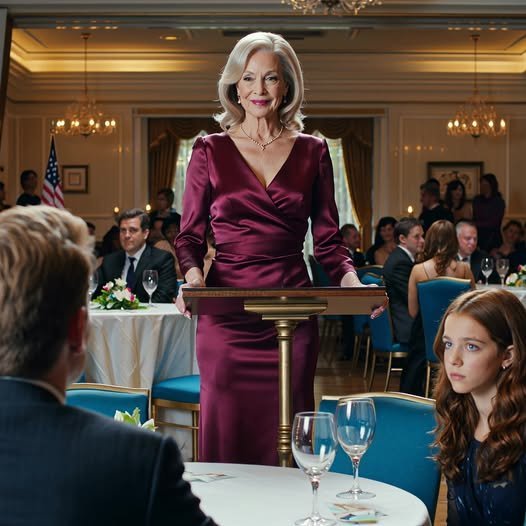
The ballroom was already crowded when we arrived, filled with men in dark suits and women in cocktail dresses, the air heavy with expensive perfume and the particular laughter of people who believe themselves successful. White tablecloths, glittering glassware, tiny candles floating in bowls of water. A banner bearing the Horizon Innovations logo hung above a small stage at the far end, flanked by two large projection screens.
“Kora.”
Rebecca’s voice, startled and slightly strained, cut through the buzz of conversation.
She approached us, resplendent in a red designer dress that showed off the gym-toned arms she’d once complained she never had time to earn. Her dark hair was swept up in an elegant twist.
She air-kissed my cheek, careful not to smudge her gloss, her eyes already sliding past me to Caleb. “Mr.
Peterson,” she said, her voice turning honeyed with ambition.
“We didn’t know you were coming with my mother. What a lovely surprise.”
“The pleasure is mine,” Caleb replied smoothly. “Your mother and I have been friends for many years.”
Rebecca’s smile faltered slightly at the emphasis on friends, but she recovered quickly.
“Well, we’re so glad you could both make it,” she said.
“Lucas will be thrilled.”
As if summoned, my son appeared at his sister’s side, handsome in his tuxedo, his father’s gray eyes assessing me coolly. “Mom,” he said, giving me a brief nod.
“You clean up nice.”
He turned at once to Caleb, extending his hand. “Mr.
Peterson.
Always good to see our most valued investor.”
I watched my children fawn over Caleb, barely acknowledging my presence except to cast the occasional wary glance my way. They were wondering why I had come, why their mother — the nurse from the small house on the edge of the city — was standing in their gleaming world of success. Why I had brought one of their major investors as my date.
“The program will be starting soon,” Rebecca said finally.
“We’ve reserved seats for you both near the front.” Her eyes flicked to mine, a faint smirk at the corner of her mouth. “We thought you’d enjoy seeing what real accomplishment looks like.”
There it was again — the phrase from the invitation.
My son’s smirk confirmed he’d been the author. “I’m looking forward to it,” I replied, my voice even.
Caleb offered me his arm again, and we followed my children through the crowd to a table near the front of the room, with a perfect view of the stage.
We were seated with three other couples, all investors, I gathered from their conversation. I recognized a few faces from business journals — tech executives, venture capitalists, people who moved money around the country with a few keystrokes. “Kora Green,” Caleb introduced me simply, without explaining my connection to Horizon’s founders.
I watched the assumptions flash behind their eyes.
A girlfriend, perhaps. A longtime family friend.
No one imagined I could be the twins’ mother. I had none of their polish, none of their calculated charm.
A server appeared with champagne flutes on a silver tray.
I accepted one and sipped slowly as I observed the room. At least three hundred people filled the ballroom, all there to celebrate my children’s success — success built on my sacrifice, my investment, and my erasure. “Are you familiar with Horizon’s work?” asked the woman beside me — a sleek blonde in her forties with diamond studs that caught the light every time she moved.
“Very,” I replied with a small smile.
“I’ve followed their progress from the beginning.”
“Cynthia’s fund was part of the Series C round,” her husband explained proudly. “Such a brilliant concept,” Cynthia gushed.
“Disrupting medical supply chains with AI. Who would have thought?
And they really did build it from nothing.
Truly self-made success stories.”
Under the table, Caleb’s hand found mine — a gentle pressure of reassurance, or perhaps restraint. “Self-made?” I repeated lightly. “Yes, that’s what they call themselves.”
The lights dimmed then, saving me from having to reply.
A spotlight illuminated the stage where a man in an expensive suit introduced himself as the evening’s MC.
He welcomed everyone to Horizon Innovations’ fifth anniversary celebration, speaking of visionaries and game changers and paradigm shifts in the healthcare industry. The crowd applauded on cue as Lucas and Rebecca took the stage, looking every inch the successful entrepreneurs.
My son adjusted the microphone, his smile practiced and confident. “Five years ago, my sister and I had an idea,” he began.
“A simple idea, really.
What if we could bring cutting-edge technology to the outdated world of medical supply logistics? What if we could ensure that every hospital, every clinic, every patient received exactly what they needed, when they needed it?”
Rebecca stepped forward, her voice warm and carefully modulated. “We knew it wouldn’t be easy,” she said.
“Everyone told us it couldn’t be done — that the system was too entrenched, too resistant to change.
But we believed.”
Lucas nodded. “We believed so strongly that we put everything on the line.
We invested every penny we had into making this dream a reality.”
Every penny they had. I felt something cold crystallize in my chest.
“The early days were tough,” Rebecca continued, her voice catching in practiced emotion.
“We worked out of my tiny apartment, eating ramen, coding until three in the morning, wondering if we’d made the biggest mistake of our lives.”
I thought of my own “early days” of Horizon Innovations — double shifts at the hospital, my arthritic hands aching as I counted out medications, my worry about making the mortgage after emptying my retirement account for them. I thought of falling into bed at midnight and getting up at five to do it all over again. They continued their carefully choreographed story, taking turns describing their journey from scrappy startup to industry disruptor.
They thanked their early believers, angel investors who had “seen their potential when no one else did.” They thanked mentors, professors, incubator directors.
Not once did they mention their mother — the nurse who had given them everything to start. “And now,” Lucas said, his voice swelling with pride, “we want to recognize the key partners who helped us reach this milestone.”
They began calling companies and investors to the stage, presenting each with a small crystal award engraved with the Horizon logo.
Peterson Capital was third on their list. “Caleb Peterson,” Rebecca announced warmly.
“One of our earliest major backers and a tremendous mentor to us personally.”
Caleb squeezed my hand once more before rising to accept the award.
He mounted the steps, shook my children’s hands, and turned to the microphone. “Thank you,” he said simply. “Horizon Innovations represents the kind of visionary thinking we at Peterson Capital are always seeking to support.
But true success isn’t just about good ideas or even good execution.”
He paused, his eyes finding mine in the audience.
“It’s about integrity,” he continued. “About honoring those who helped you along the way.
All of those who helped you.”
Lucas’s smile flickered, almost imperceptibly. Rebecca glanced at her brother, a momentary uncertainty passing between them.
Caleb nodded politely and left the stage, returning to his seat beside me as the presentations continued.
Several more investors were recognized, each receiving polite applause. The awards portion was clearly building to something — my children’s ultimate moment of self-congratulation, no doubt. “And finally,” Lucas said after the last investor had returned to their seat, “we have a special announcement to share with all of you tonight.”
Rebecca stepped forward, her smile radiant under the spotlight.
“As many of you know,” she said, “we’ve been preparing for the next phase of Horizon’s growth.
Today, we’re thrilled to announce that we’ve accepted an acquisition offer from MedTech Global for two hundred and fifty million dollars.”
Excited murmurs rippled through the crowd. The blonde woman beside me gasped in delight, gripping her husband’s arm.
“This partnership will allow Horizon’s technology to scale globally,” Lucas continued, “while providing an exceptional return to our loyal investors who believed in us from the start.”
My stomach tightened. They were selling the company — the company I had helped fund.
My investment, the one they had never acknowledged, would disappear into the structure of a multinational corporation, buried forever under layers of legal paperwork.
“But before we close this chapter,” Rebecca said, “we want to invite someone very special to join us on stage. Someone whose support has meant everything to us.”
For one irrational moment, I thought they were going to call my name — that some shred of decency had survived in them, that they were going to publicly acknowledge their debt to me at last. Instead, they called their former professor, the man who had introduced them to their first angel investor.
He joined them onstage to thunderous applause, beaming as they presented him with an oversized crystal award.
“Dr. Winters saw our potential before anyone else,” Lucas declared.
“He believed in us when we had nothing but an idea and determination.”
I felt Caleb tense beside me. He leaned close to my ear.
“Are you ready?” he murmured.
I nodded, my hand tightening around my small evening bag. The professor was making a speech now, praising my children’s extraordinary talent and uncompromising work ethic. He spoke of their “bootstrapped beginnings” and remarkable self-reliance.
I rose from my seat, smoothing my dress with steady hands.
Caleb stood as well, offering his arm once more. We walked together toward the stage, unhurried but purposeful.
I could feel eyes turning to watch us, whispers following in our wake. The professor faltered as he noticed the movement in the crowd, but he finished his remarks and stepped back, clearly unsure of what was happening.
My children saw us approaching.
I watched confusion bloom on their faces, followed quickly by alarm. Rebecca whispered something to Lucas, who gave a sharp, barely perceptible shake of his head. We reached the steps to the stage as the applause for Dr.
Winters died down.
The ballroom fell into an expectant hush. “Lucas.
Rebecca,” Caleb called pleasantly, his voice carrying easily in the sudden quiet. “I believe there’s one more person who should be recognized tonight.
Someone without whom Horizon Innovations would never have existed at all.”
Lucas stepped forward, his expression a careful mask of professional courtesy overlaying panic.
“Mr. Peterson,” he began, “we’re actually just wrapping up the formal program. Perhaps—”
“This will only take a moment,” Caleb interrupted, still smiling.
“And I think your investors will be particularly interested.”
Rebecca moved to her brother’s side, a united front against the unexpected disruption.
“Perhaps we could discuss this privately after the ceremony,” she suggested, her tone smooth but her eyes hard. “I’m afraid it can’t wait,” I said, speaking for the first time.
“Not with the acquisition announcement.”
They stared at me — their mother — as if I were a stranger who had crashed their party. In that moment, they were strangers to me as well.
Not the children I had raised, but cold-eyed adults who had calculated my worth and found it wanting.
I took the final steps onto the stage. The spotlight felt hot on my skin as I turned to face the room. Three hundred faces looked up at me, curious, confused, waiting.
Lucas’s face had gone rigid, a pulse visibly throbbing at his temple.
Rebecca maintained her professional smile, but her eyes were glacial. Caleb took the microphone from its stand and spoke with the easy authority of a man accustomed to commanding rooms full of money.
“For those of you who haven’t had the pleasure of meeting her,” he said, “this is Kora Green.” He paused, allowing the name to register. “Mother of Lucas and Rebecca Green — and the original seed investor in Horizon Innovations.”
A murmur rippled through the crowd.
I watched recognition dawn on some faces, confusion on others.
My children’s expressions remained frozen, calculating. Lucas recovered first, stepping forward to reclaim the microphone with a forced laugh. “There seems to be some confusion,” he said.
“Our mother has always been supportive, of course, but the company’s funding history is well documented in our SEC filings.”
“Indeed it is,” Caleb agreed pleasantly.
“Which makes its inaccuracy all the more troubling.”
Rebecca moved closer to her brother. “Mr.
Peterson, while we appreciate your concern,” she said, her voice tight, “this hardly seems the appropriate venue.”
“I gave you three hundred fifty thousand dollars to start this company,” I said, not loudly, but my voice carried in the tense silence. “Every penny of your father’s life insurance money.
My entire retirement.”
The buzz in the room grew louder.
I saw several investors leaning together, whispering urgently. A woman near the front raised her phone, already filming. “Mom,” Lucas said sharply, his voice tight.
“You made a personal loan.
It was repaid, with interest. We have the records.”
“You have forgeries,” I corrected calmly.
“The only money you ever returned to me was five thousand dollars for my sixty-fifth birthday. You called it a gift.”
Rebecca’s professional composure cracked slightly.
“This is ridiculous,” she snapped.
“We built this company from nothing. Sixteen-hour days, seven days a week.”
“While I worked double shifts at the hospital,” I finished for her. “At seventy-three.
With arthritis in both hands.”
The silence in the ballroom had taken on a different quality now — charged, uncomfortable.
I could feel the audience shifting from curiosity to something else. To judgment.
Lucas stepped closer, lowering his voice so only I could hear. “What do you want?” he hissed.
“Money?
Is that it? You could have asked privately instead of creating this… spectacle.”
I looked at my son — really looked at him. The boy who had once climbed into my lap after scraping his knee on the sidewalk, who had sobbed against my shoulder when his father died.
I searched for some remnant of that child in the man standing before me and found nothing.
“What I want,” I said clearly, so the microphone caught every word, “is acknowledgment. Recognition for what I sacrificed to give you your start.”
Rebecca made a dismissive sound.
“So that’s what this is about?” she demanded. “Your name on a plaque?
Your photo on our website?
After everything we’ve accomplished, you’re upset about not getting enough credit?”
I turned to Caleb, who nodded encouragingly. I reached into my evening bag and withdrew the envelope Anthony Morgan had prepared. From it, I removed several documents and handed them to Caleb, who stepped forward to the microphone once more.
“Ladies and gentlemen,” he said, “I have here notarized copies of bank transfers from Mrs.
Green’s personal account to her children, in the amount of three hundred fifty thousand dollars, dated six years ago.” He lifted the pages slightly. “There is also a letter, written in Lucas Green’s hand, promising his mother founder-level equity in the company they were forming.”
He held up the papers so those in the front rows could see them.
“What Mrs. Green has not yet shared,” he continued, “is that these documents were submitted three days ago to the Securities and Exchange Commission, along with a formal complaint alleging securities fraud.”
The room erupted.
Several people stood, phones in hand.
I saw a man I recognized from business articles as MedTech Global’s CEO signaling urgently to an assistant near the side doors. My children’s faces had gone nearly bloodless with shock. “You wouldn’t,” Lucas whispered hoarsely.
“I already have,” I replied.
Rebecca lunged forward, reaching for the documents, but Caleb smoothly handed them off the side of the stage to Anthony Morgan, who had appeared like a quiet shadow at the edge of the lights. The attorney nodded to me before disappearing back into the crowd with the evidence safely in hand.
“The SEC takes a dim view of undisclosed seed investors,” Caleb said over the rising commotion, “particularly when a company is in acquisition talks. Such omissions could be viewed as material misrepresentation, potentially invalidating all subsequent funding rounds.”
“You’re destroying everything,” Rebecca hissed at me now, no longer bothering to hide her fury.
“Years of work, all because you need to feel important.”
“I’m simply balancing the books.”
Lucas grabbed my arm, his fingers digging into my skin. “Do you have any idea what you’ve done?” he demanded, his voice shaking with rage. “The MedTech deal will collapse.
Our investors could sue us.
We could face criminal charges.”
I looked down at his hand on my arm, then back up at his face. “Let go of me, Lucas.”
Something in my tone made him release me instantly, taking a step back.
For the first time, I saw fear in his eyes. Not fear of legal consequences.
Fear of me.
“Mrs. Green.”
A clear voice rose from the back of the room. A woman in a severe navy suit had stood from a table near the rear.
“Christina Xiao, SEC regional office.
We’d be very interested in speaking with you further about this matter.”
So Anthony had made the calls he’d promised. “Of course,” I replied calmly.
More people were on their feet now. The MedTech CEO was striding toward the exit, his face thunderous.
Several investors were demanding answers from anyone who looked even vaguely official.
The carefully orchestrated evening was unraveling into chaos. Through it all, my children stood frozen, watching their empire crumble in real time. The triumph of the acquisition announcement had curdled into public disaster in a matter of minutes.
The MC rushed back onto the stage, trying desperately to regain control.
“Ladies and gentlemen, if we could please—”
His words were swallowed by the rising din. Lucas turned to me, his expression haunted.
“Why now?” he asked, his voice barely audible over the noise. “After all this time, why would you do this tonight?”
I stepped closer, close enough to see the tiny scar above his eyebrow from when he’d fallen off his bike at seven.
Close enough that only he could hear my answer.
“You invited me to see what real accomplishment looks like,” I told him, meeting his gaze. “So I thought I’d show you.”
His face contorted — rage, realization, perhaps even a flicker of shame — but I was already turning away, taking Caleb’s offered arm as we descended the steps. We walked through the pandemonium, past shocked faces and urgent conversations, past security personnel moving in and PR representatives trying to contain the damage.
No one stopped us.
No one even seemed to notice the elderly nurse and her distinguished escort making their quiet exit from the chaos they had unleashed. In the relative quiet of the hotel lobby, Caleb looked down at me.
“Are you all right?” he asked softly. I considered the question as we walked toward the doors.
Behind us, raised voices echoed from the ballroom.
Ahead, the Atlanta night waited — warm and humming, neon reflected in rain-slick sidewalks. “I will be,” I said finally. Outside, the valet brought Caleb’s car around.
As he held the door for me, I paused, looking back at the gleaming facade of the hotel where my children’s carefully constructed narrative was unraveling thread by thread.
“What happens now?” Caleb asked as we pulled away from the curb. I watched the hotel recede in the side mirror.
“They’ll attempt damage control,” I said. “They’ll claim I’m confused, vindictive, mentally unstable.
They’ll offer me money to retract my statement.”
“And will you?” he asked quietly.
I turned to look at him — this man who had helped me deliver justice without once trying to steer me away from it. “No,” I said simply. “Some debts can’t be repaid with money.”
The city lights blurred as we drove, the downtown towers rising around us like silent witnesses.
I felt neither triumph nor sorrow — just a curious lightness, as if something long carried had finally been set down.
The media coverage began the next morning. “Tech Startup Scandal: Founders Accused of Defrauding Their Own Mother” blared the headline in the local business section.
By noon, it had spread to national outlets. By evening, it had become a segment on cable news, a symbol of everything people said was wrong with startup culture — the hubris, the mythmaking, the casual cruelty hidden beneath inspirational success stories.
I watched it unfold from the worn recliner in my living room, a blanket over my knees, my small house suddenly feeling like the safest place in the world.
I fielded calls from Anthony Morgan about the SEC investigation and declined interview requests from journalists who wanted the “human angle.”
I had said what needed to be said on that stage. The rest would follow its natural course. Three days after the party, as I was deadheading roses in my backyard — a narrow strip of soil between my chain-link fence and the alley — a black SUV pulled up outside my house.
The engine idled for a moment before the passenger door opened.
Rebecca emerged, wearing sunglasses despite the overcast sky. She stood at the edge of my yard, seeming uncertain about crossing that invisible boundary between the street and my world.
“Mom,” she called. Not “Kora” this time.
I continued snipping dead blooms, dropping them into my basket.
“Rebecca.”
She came closer, stopping a few feet away, careful not to brush against the rosebushes. “You need to retract your statement to the SEC,” she said. I looked up at her.
Gone was the polished executive from the party, replaced by a woman who appeared not to have slept in days.
Her hair was pulled back carelessly. Her face was bare of makeup, her cheeks hollow.
“I won’t be doing that,” I said, turning back to my roses. “Do you have any idea what you’ve done?” Her voice cracked on the last word.
“The MedTech deal is suspended pending investigation.
Our Series C investors are threatening to sue for misrepresentation. Our stock options are worthless.”
I nodded, unsurprised. “Actions have consequences,” I said.
“This isn’t just about the money,” she exclaimed.
“Our reputations are ruined. No one will work with us again.
Lucas’s wife is talking about taking the kids and going to her parents in Texas.”
I met her gaze steadily. “That sounds difficult,” I said.
Rebecca stared at me, seemingly bewildered by my lack of reaction.
“Good grief, Mom,” she burst out. “I know we hurt you. I know we should have been more appreciative.
But this — destroying everything we’ve built, destroying our lives—”
“I didn’t destroy anything,” I corrected gently.
“I simply told the truth about how it was built.”
She paced in a small circle on the patchy grass, agitated. “We can make this right,” she insisted.
“We’ll pay you back the full amount, plus interest. We’ll give you shares in the company.
Ten percent.
That’s worth—” She stopped, realizing. “Well, it was worth millions before you torpedoed us.”
I set down my garden shears and removed my gloves, giving her my full attention. “Tell me something, Rebecca,” I said.
“In all these years, why did you never acknowledge my investment?
Not in your company records. Not to your other investors.
Not even in your speeches about your ‘bootstrapped beginnings.’”
She looked away, her mouth tightening. “It would have complicated things,” she muttered.
“How?” I asked.
“By giving me credit? By admitting you didn’t do it all yourselves? By linking the company to a seventy-something nurse with no tech background?”
She exploded.
“Do you have any idea how image-conscious this industry is?” she demanded.
“How investors shy away from anything that doesn’t fit the wunderkind narrative? Two smart young founders grinding it out in a tiny apartment — that sells.
A story about a grieving widow cashing out her husband’s life insurance to bankroll them? That just raises questions.”
I absorbed this, feeling neither surprise nor fresh hurt.
It was merely confirmation of what I had always suspected.
I had been edited out of their story because I didn’t fit the image they wanted to project. “So you lied,” I said simply. “We omitted,” she corrected, as if the distinction mattered.
“And then it was too late to fix the record without raising questions about our credibility.”
I picked up a weed that had sprung up between my prized tea roses and tugged it free, shaking the dirt from its roots.
“Your credibility,” I observed, “seems to be in question regardless.”
Rebecca made a frustrated sound. “What do you want, Mom?” she pleaded.
“Just tell me what you want and we’ll make it happen. Money?
Recognition?
We’ll put your name on the company website, issue a public statement about your contribution — whatever it takes.”
I straightened, feeling the familiar ache in my lower back, and ignored it as I always did. “What I want,” I said, “is not something you can give me now.”
“Then why?” she demanded, yanking off her sunglasses. Her eyes were reddened.
“Why did you do this if not to get something?
What was the point?”
I considered my daughter — this stranger who shared my blood but none of my values. I thought of all the ways I might answer her.
I could speak of justice, of consequences, of the bitter lesson that integrity matters. I could remind her of the little girl who had once broken her piggy bank to buy canned soup when I was sick.
I could ask when that child had been replaced by the woman who would discard her mother when it became convenient.
Instead, I said, “Some debts can’t be repaid.”
She flinched as if I’d struck her. “So that’s it?” she asked hoarsely. “You’ve had your revenge, and now we just… what?
Lose everything while you go back to gardening?”
“I imagine you’ll land on your feet,” I said calmly.
“You and Lucas are nothing if not resourceful.”
Rebecca stared at me for a long moment. I saw a series of emotions cross her face — anger, disbelief, calculation, and finally a cold acceptance that mirrored my own.
“You know,” she said quietly, “Dad would be ashamed of what you’ve done.”
If she had hoped to wound me with Raymond’s memory, she failed. I knew my husband better than she ever had.
“Your father,” I replied, “taught you both that family comes before business.
It seems that lesson didn’t take.”
Something shifted in her expression then. Not remorse — not yet — but perhaps the first glimmer of understanding that what had happened was not merely a transaction gone wrong, but a profound moral failure. Without another word, she turned and walked back to the waiting SUV.
I watched her go, feeling nothing but the cool autumn breeze on my face and the distant satisfaction of accounts finally settled.
The legal proceedings took nearly a year. The SEC investigation led to fines, settlements with investors, and the complete dissolution of the MedTech acquisition deal.
Horizon Innovations survived, but only barely, and under new management. My children were forced out by their own board, their golden future replaced by cautionary-tale status in the tech world.
I received what was legally mine, though the amount was far less than what my initial investment would have been worth had they honored their promise.
The money wasn’t the point. It never had been. Caleb remained steadfastly by my side throughout, his friendship deepening into something more as the months passed.
We never spoke of marriage — we were both too old for such ceremonies — but he moved into my small house, bringing his books, his quiet wisdom, and his way of making coffee exactly the way I liked it.
My children did not contact me again after that day in the garden. I heard about them occasionally through mutual acquaintances or the stray news article.
Lucas’s marriage ended, as Rebecca had predicted in my yard. He moved to Seattle to work for a former competitor at a fraction of his previous salary.
Rebecca started a consulting firm out of a co-working space, one of those glass-walled places downtown where people drink cold brew and pretend they aren’t lonely.
She struggled to find clients willing to overlook her history. Sometimes, in the quiet evenings, as Caleb and I sat on the porch watching the sun dip behind the line of modest rooftops, I thought about what might have been. Not with regret — I had none — but with a certain wondering about the paths not taken.
If they had acknowledged me from the beginning.
If they had shown even a modicum of gratitude or respect. If they had remembered even once that I was more than a convenient source of capital.
But they hadn’t. And in their failure, they had taught me my final lesson as a mother:
Love without justice is merely sacrifice.
And sacrifice without recognition becomes erasure.
I refuse to be erased. So that’s my story. Not one with a conventionally happy ending, perhaps, but a necessary one.
When people ask me if I ever regret what I did, I tell them the truth.
The only thing I regret is waiting so long to demand what was rightfully mine — not just the money, but the acknowledgment of my contribution. Some call it revenge.
I call it correction.