
Cops too. Always some excuse.”
Trouble. Tenants.
Cops. Words that tangle together. Later, I found Ronan at the station, polishing the truck like he always did when he wanted to keep his hands busy.
I asked him straight: Did anyone find the owner? He hesitated just a beat too long before shaking his head. “Place was cleared out.
Just junk inside.”
“Junk doesn’t cry,” I said, thinking of the kittens’ mews. His jaw tightened. “Drop it, alright?
Fires happen. You saved them. That’s enough.”
But it wasn’t.
Over the next week, I pieced together scraps. A delivery guy said the house used to get weekly shipments of animal feed. A woman at the corner store whispered she’d seen men carrying boxes inside at night.
And an old man on the block muttered that people who asked too many questions about that house tended to regret it. I could have walked away. I should have.
But every time I looked at the kittens, now playing clumsily on my living room floor, I felt a responsibility. They hadn’t asked to be left in the middle of a fire. Someone had used them, abandoned them, maybe worse.
I had to know. So one evening, I slipped past the tape again. The place was mostly gutted, but in the basement, beneath the stink of smoke, I found a locked trunk.
The fire hadn’t touched it much. I pried it open with a crowbar I’d borrowed from a friend, heart pounding like I was breaking into something sacred. Inside were papers.
Ledgers, receipts, lists. Not of furniture or clothes—but of animals. Dogs, cats, even birds.
Each one with a number next to it, crossed out with red ink. And at the bottom of one page, scribbled quick and careless, the word “shipment.”
My stomach turned cold. I stumbled back upstairs, the papers stuffed in my jacket.
The air outside felt too clean, too sharp. I thought about calling the cops, but then I remembered the old man’s warning, and Ronan’s tight jaw. What if some of them were involved?
For a few days, I sat with the knowledge like a stone in my chest. The kittens grew stronger, chasing each other across the couch, innocent of the ugliness they’d escaped. I couldn’t sit still anymore.
I had to do something. So I brought the papers to a reporter I trusted, a woman named Maeve who had once exposed a crooked developer in town. Her eyes widened as she flipped through the ledgers.
“This… this is big. You sure you want to be tied to it?”
“I pulled them out of the fire,” I said. “I’m already tied.”
She promised to dig, to be careful.
And she did. Weeks later, her article hit the front page. “Animal Trafficking Ring Hidden In Plain Sight.” The house was one of several.
The landlord was a front. Shipments had been moving through for years. And the fire?
Set deliberately, to erase evidence. People were furious. Donations poured in to rescue groups.
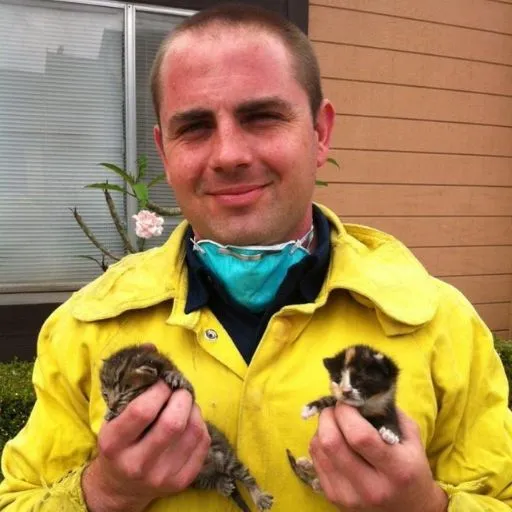
Arrests were made. The landlord’s name was plastered everywhere. And in the middle of it all, a picture ran again—me with soot on my face, kittens in my arms.
Only this time, it wasn’t just a feel-good miracle. It was proof. Proof that asking the hard questions mattered.
But there was one more twist I didn’t expect. A week after the article, Maeve called me, her voice low. “There’s something you should see.”
She slid a photo across the diner table when we met.
It was grainy, from a surveillance camera, but clear enough. A man leaving the burned house the night before the fire. And on his arm, a patch from Engine Five.
Ronan. My chest went tight. He’d been there before the fire.
He’d told me the house was empty, told me to drop it. My friend, the one who laughed as he wrapped the kittens in his jacket. I wanted to deny it.
To believe there was some explanation. But Maeve shook her head. “They think he was paid off.
Maybe to look the other way. Maybe more.”
I confronted him. I had to.
In the locker room of the station, where the smell of soap and smoke never quite faded, I asked him straight: “Were you part of it?”
He didn’t answer right away. He just sat on the bench, staring at his boots, shoulders heavy. Then finally, he said, “I didn’t know what they were doing at first.
By the time I did, I was in too deep. Money talks, and I thought no one would ever find out. But then the fire—”
“You let them burn,” I whispered.
I walked away, heart torn. He was my friend, but he had chosen wrong. And now he would face the consequences.
In the end, he turned himself in. Said he couldn’t live with the guilt anymore. It didn’t erase what he’d done, but it mattered.
It mattered that he admitted it. As for me, I kept the kittens. They grew into sleek, mischievous cats, filling my apartment with noise and warmth.
Every time they curled against me, I thought about how close they’d come to being nothing more than ash. And I thought about choices. How easy it is to look away, to take the money, to keep silent.
How much harder it is to ask questions, to push back, to risk being the one who won’t let it go. The fire haunted me, yes. The cries in the smoke, the papers in the trunk, Ronan’s broken voice in the locker room.
But so did the lesson: that being a hero isn’t about one perfect second in front of cameras. It’s about what you do when the cameras are gone, when the questions get heavy, when the answers hurt. So here’s what I know now.
Sometimes saving two kittens can unravel something bigger than you ever imagined. Sometimes the smallest cries lead you straight to the truth. And sometimes, the people you trust most will break your heart—but also remind you that redemption is still possible, even when it comes late.
I risked everything to save them. And in the end, maybe they saved me too—reminding me that silence is dangerous, and truth, no matter how hard, is always worth chasing. If this story touched you, share it.
Let it remind others that courage isn’t loud, and justice often begins with something small. And if you believe in second chances, in speaking up, in fighting for what matters—don’t just like this. Live it.