
A routine will help, trust me.”
I did trust her. I’d trusted her with everything I had.
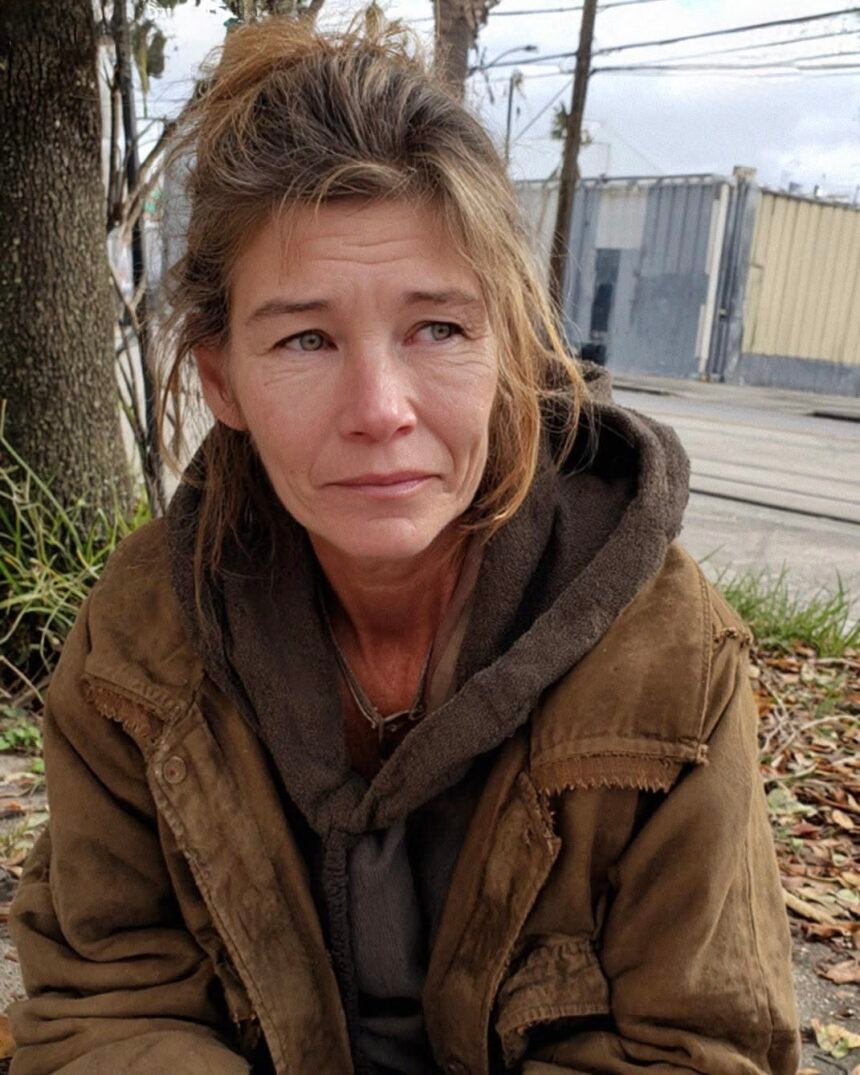
After a few minutes, I set it down, grabbed my keys, and reached for the jacket hanging by the door. It was the brown one Sarah had given me for Father’s Day years ago.
It was thick and warm and reminded me that I was loved, even when I felt terribly alone.
The jacket was too nice for the grocery store, but I didn’t care. I just needed to move. I needed to be outside.
I needed to feel the cold and fresh air on my face.
I walked to the store, slower than usual.
I picked up a rotisserie chicken, fresh dinner rolls, cranberry sauce, and a pumpkin pie. I didn’t need any of it.
I told myself it was for later, maybe for a proper dinner. But I knew I’d probably just pick at the pie and leave the rest untouched.
As I left the store, my arms full of bags, I spotted her.
She was sitting alone beneath a bare maple tree, not far from the cart return. Her hands were trembling in her lap, and she didn’t have a coat on.
Her eyes stared at the ground like she wanted the concrete to swallow her whole.
People walked past her. Some avoided eye contact; others stared ahead like she didn’t exist. But something tugged at me.
I hesitated.
I almost kept walking. But then I heard my wife’s voice in my head again.
“Do something, Eric. Do something good.”
I approached the woman slowly, unsure of what I was even going to say.
She tensed up when she saw me.
“I’m not going to bother you,” I said quietly. “I’m not going to ask you any questions. You just…
look cold.”
She didn’t respond. She just blinked, wary and tired — like the entire world had dropped its burdens on her small shoulders.
I unzipped my jacket and offered it to her with both hands.
“Here, you need this more than I do,” I said.
She looked up, blinking at me like I’d spoken a foreign language. Her mouth parted slightly, as if she wanted to say something but couldn’t quite remember how.
Her fingers, red and cracked, hovered near mine before she finally took the coat from my hands.
She didn’t say thank you right away; she just clutched the fabric like it might vanish.
I handed her the grocery bag as well and reached into my pocket for the pen I always carried with me. It was half-dried, but I managed to scrawl my address across the top of the pie box.
I hesitated, then held it out to her.
“If you really need help,” I said. My voice caught on the word help.
I cleared my throat, trying to hide the way it made me feel. “My name is Eric.”
She nodded once, almost imperceptibly, and whispered “thank you” so softly I might’ve imagined it.
That night, Sarah and I talked over video. She was sitting near the fireplace at her place in Scotland, wearing that oversized hoodie she’d stolen from me when she was back in high school.
“Did you eat something, Dad?” she asked.
“Of course I did!” I lied, trying to sound casual.
“I had a bit of pumpkin pie. But it was too sweet, so I only had a bite, really.”
“It’s not Thanksgiving without the pie,” Sarah said, smiling. “Remember that one year when Mom made three different pies?
My goodness. I loved every moment of it.”
I asked my daughter about the weather. She asked about our neighbors.
We talked about everything except the ache of grief that we both felt deeply in our bones. After the call, I sat in the living room with the lights off and stared at the empty kitchen chair across from me.
I wondered if the woman had eaten. If she’d found a place to stay for the night.
And if she’d worn the jacket or left it behind on a bench somewhere. Eventually, I told myself it had to be enough. And that I’d done what I could.
Still, I thought about her more than I admitted.
“You did exactly what Marla would have wanted you to do, Eric,” I mumbled to myself as I brushed my teeth. “And she’d be proud of you.”
Two years passed quickly.
I didn’t forget, not exactly, but I just learned how to file it away — like so many things I didn’t know how to carry, I stored it somewhere deep and quiet.
Then, on Thanksgiving, just after noon, my doorbell rang.
Sarah and her husband, Jake — home visiting me for a while — were already arguing over board game pieces and cups of hot cocoa at the dining table.
“Who on earth could that be?” I muttered as I slipped my feet into my slippers.
When I opened the door, I felt the breath leave my body.
It was her.
She looked different — much healthier and smiling. Her hair was clean and brushed, tucked gently behind her ears.
She wore a proper winter coat, and her cheeks were pink from the cold.
Her hands clutched a small black backpack to her chest like it was something sacred.
“Thank goodness,” she said, smiling softly. “I hoped you still lived here.”
Her smile wasn’t haunted this time. It was warm and whole — like someone who knew better than to speak too loudly in a moment like this.
I opened my mouth, but no words came out at first. All I could do was look at her.
After a moment, I caught my breath.
“What do you need? Are you okay?” I asked.
She glanced down at her backpack and then back at me.
“Yes. But I think it’s time I return something that belongs to you.”
I hesitated again.
My brain couldn’t keep up with what was happening. But I stepped back and opened the door wider. She pushed the backpack into my hand.
“Come in,” I said.
“Please.”
Sarah and Jake looked up from the table, both of them frozen mid-game. Sarah’s eyes flicked to me, silently asking who this woman was. I gave her a small shake of my head.
Just wait.
I placed the backpack gently on the counter and opened it.
My hands shook more than I expected, and I had no idea why.
Inside was my brown jacket — folded with care, like it had truly been treasured all this time.
Resting on top of it was a small wooden box.
I opened it slowly, uncertain what I’d find inside.
Inside was a gold-faced wristwatch with a worn leather strap. Underneath it, tucked carefully, was a folded check.
It was made out to me — for $20,000. I stared at it, unsure whether to speak or laugh…
or cry.
“What… what is this?” I asked, the words catching in my throat. “I don’t understand.
I can’t take this from you. I don’t… know you.”
She offered a small smile and nodded, almost as if she had expected that reaction.
“My name is Charlotte,” she said.
“And I can explain everything. I promise.”
I pulled out a chair and gestured for her to sit at the kitchen counter. Sarah and Jake joined us, their eyes wide with quiet curiosity.
Charlotte sat down, pulling the empty backpack toward her — holding it in her lap like a shield.
Her fingers stayed curled around the straps. She looked down at the counter and then exhaled slowly.
“You saved my life, Eric,” she said. “And now I want to tell you how you did that.”
The silence in the room waited with her, as if it understood how much this story cost to tell.
“Two years ago, when you found me,” she said, “I didn’t want to keep living.”
The words hovered in the air, heavy and bare.
And then she told us everything.
How her husband, Levi — once charming, now horrible and calculated — had been cheating on her for years.
How he and the other woman slowly manipulated her into signing away her parents’ inheritance. And how he’d pretended to be happy about her pregnancy.
“It was a carefully laid financial trap,” Charlotte said, her eyes dark. “It was a trap disguised as love, and I couldn’t see it until it was way too late.”
When Charlotte tried to fight back with everything she had, Levi planted fake documents and fabricated theft accusations at her workplace.
She was fired in disgrace and blacklisted from the company and all their associations.
And then, only two months before I found her, Charlotte had miscarried.
“I was 42,” she said quietly.
“It was a miracle pregnancy, given my age and pre-existing conditions. I hadn’t even started buying things yet — I was just too afraid that if I got my hopes up, I’d be jinxing everything. And then one morning, I woke up bleeding.
And that was the end of my beginning.”
I watched as Sarah reached for Jake’s hand. My chest ached with the weight of the devastation. Charlotte wiped her eyes and kept going.
“That day, Eric, when you saw me…
I’d already decided that I wasn’t going to see the next day. I was just sitting there, planning on the best way to carry out my final… act.
I was sitting there in the cold, trying to figure out which way would be final and less… messy.”
She paused, letting the words sink in.
“But you showed up,” she said. “You, a complete stranger, who didn’t know me from a bar of soap, gave me something I hadn’t had in months.
Eric, you gave me kindness. A jacket. Food.
And an address, if I ever needed it.”
“Oh, my darling,” I said, unable to find any other words.
“That kindness gave me hope again. And I realized that I didn’t want to die. I just wanted to see the light again and know that I wasn’t alone,” Charlotte said, tears streaming down her face.
That day, she’d put on the jacket, eaten the rolls, and felt just warm enough to think clearly.
It wasn’t much, she said, but it was enough to keep her from disappearing. That clarity gave her the courage to walk — miles, she told us — to the home of a retired attorney.