

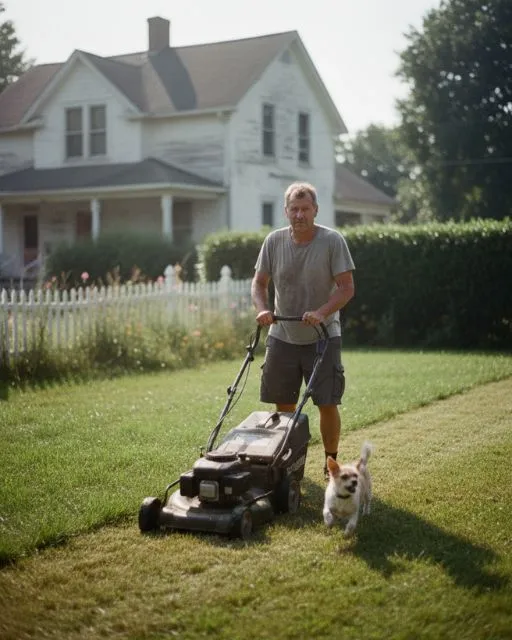
My mom decided she needed to see him. She crossed the street, pushed open the gate, and knocked. The front door opened before she could say a word.
There he stood—thinner, older, his face worn but unmistakable. They stared at each other in silence until he finally stepped back and let her in. Hours later, she returned, her eyes wet, her hands trembling.
She explained that he had been homeless for years, caught up with the wrong people, too ashamed to come back. He had been living secretly in the condemned house across the street. “He said mowing our lawn gave him peace,” she told us quietly.
“It was his way of being close without facing us.”
Then she added the words that made my heart sink: “He’s dying. Liver failure. He doesn’t have much time.”
He asked if he could stay with us for a while.
My parents agreed. We cleared out the guest room, and he moved in with only a small duffel bag. At first, it was awkward.
He spoke little, smiled rarely. But over time, the silence softened. He fixed the broken fence, rewired the porch light, and replanted my mom’s neglected herb garden.
Slowly, our house began to feel warmer—not just physically, but emotionally. One evening, my mom pulled out a box of old photos. For the first time in years, they laughed together, remembering childhood adventures—the treehouse that collapsed the same day they built it, the nights sneaking into the local drive-in.
For her, it was like getting a piece of her childhood back. For him, it was a second chance. But his health was fading.
His eyes turned yellow, his body weaker each day. Eventually, we convinced him to go to the hospital. The doctors confirmed what he already knew: cirrhosis, advanced and irreversible.
Months left, maybe less. We brought him home, setting up a hospital bed in the living room so he could watch squirrels from the window. Neighbors began stopping by.
Some remembered him from decades earlier. One woman brought a photo of him as a teenager, recalling how he once carried her groceries when her son was sick. It turned out that even in his hidden life, he had quietly helped many people—fixing mailboxes, clearing storm drains, shoveling snow.
Always in silence. Always without recognition. He passed peacefully one night, surrounded by family who had once believed he was lost forever.
The following Tuesday, I woke to the sound of a mower. Heart pounding, I rushed outside. The lawn was freshly cut—same path, same care, the rose bush carefully circled, the back corner untouched.
But the man was gone. Instead, the mower sat neatly by the porch with a note taped to it: “He taught me how.” It was signed by Marcus, a neighborhood teen my uncle had quietly mentored. We gave Marcus the mower and told him he could keep coming.
And he does. Every Tuesday, at seven sharp, we hear that familiar hum. What began as a mystery—a stranger mowing our lawn—ended as a story of forgiveness, redemption, and legacy.
My uncle, who had once run away and lost everything, found a way to reconnect with his family and community through simple, consistent acts of service. His silence spoke volumes. His mowing was more than yard work; it was an apology, a prayer, and a promise.
And even after his death, his legacy continues, passed down to the next generation. Sometimes, people carry guilt so heavy they can’t find the words to say “I’m sorry.” Sometimes, healing comes not through conversations but through quiet acts of kindness repeated over years. If you ever see someone doing something good without explanation, don’t dismiss it.
Maybe it’s their way of reaching out. Maybe it’s the only way they know to make peace. For us, forgiveness looked like a freshly mowed lawn.
For him, redemption was found in every blade of grass he trimmed, every Tuesday morning he showed up, and every quiet gesture that spoke louder than words ever could. Because a legacy doesn’t need to be grand to matter. Sometimes, it’s simple, steady, and silent—just like the hum of a push mower cutting grass in the early morning fog.