

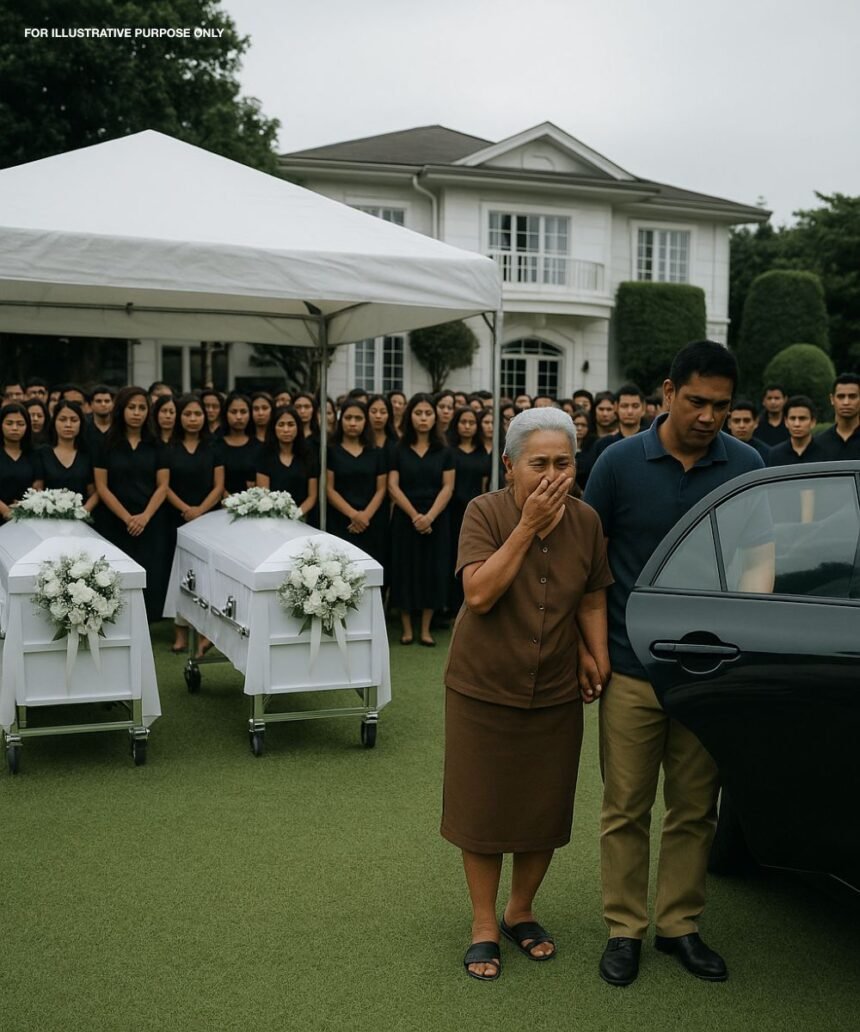
By the time they realized it was serious, it was too late.”
My body went cold. My daughter had begged for help, and tradition—twisted and rigid—had been placed above her life. As the horns blared and relatives prepared for cremation, I stumbled to my feet and blocked the bier.
“No one will touch my daughter or the baby! Stop this now!”
Her mother-in-law tried to push me aside. “The custom is to take them to the river immediately,” she snapped.
“Custom?” I cried. “What custom forbids a mother from taking her daughter to the hospital? What custom allows a woman to bleed to death while her child cries for help?”
My hands shook as I dialed 112, the emergency line.
Then 181, the women’s helpline. Within minutes, a police vehicle pulled into the yard. Officers stepped out and halted the rites.
Sub-Inspector Verma demanded records: birth certificates, medical files, any proof of treatment. The officers ordered the coffins sealed and sent to the district hospital for postmortem. Since Kavya had been married less than seven years, and there were clear signs of neglect, the law demanded investigation.
At the hospital, the Chief Medical Superintendent confirmed what I already feared: postpartum hemorrhage. A condition dangerous but treatable—with the right medicines, fluids, and timely transfer to a proper facility. “She could have been saved,” the doctor said quietly.
“Both of them could have been saved.”
At the police station, the midwife arrived carrying a worn cloth bag of leaves and powders. “I treated her as best I knew how,” she insisted. The officer’s voice was stern.
“You know this condition requires proper drugs, IV fluids, and blood transfusion. Herbal leaves do not stop postpartum hemorrhage.”
The midwife faltered, eyes dropping. My fury had burned to ashes by then; all that remained was exhaustion.
“Tradition should protect life,” I whispered. “Not take it away.”
Her husband Rohit sat silent, his head bowed. “I thought people would laugh at me for breaking custom,” he admitted.
“I was afraid of shame.”
But shame had already arrived—shame far heavier than what the neighbors could ever say. The investigation barred the cremation until legal steps were complete. When the coffins were released, I took my daughter and grandchild home with me to Lucknow.
Neighbors lined the lane, some weeping silently, others bowing their heads in respect. I slipped Kavya’s phone into her hand, the final missed call still glowing on the screen. It was proof—proof that she had asked for help, and proof that I had not come soon enough.
During the prayers, the priest urged us not to let her suffering vanish unheard. “This must become a lesson,” he said. “Postpartum care is not optional.
No tradition is worth more than a mother’s life.”
As the days unfolded, the case moved forward. Charges of negligence and cruelty were filed. Officials recommended a judicial inquiry into maternal deaths caused by denial of care.
But for me, justice was more than papers or courtrooms. Justice meant making sure no other mother cried into the night while help stood locked outside the door. Justice meant turning my grief into a movement.
When I lit the evening lamp by Kavya’s photo, I whispered a promise: “Your cries will not vanish into silence. They will become a path for others to find help.”
My daughter’s story is not only about loss—it is about the cost of silence, the weight of customs misused, and the need for change. Maternal health is not a luxury.
Postpartum care, emergency access, and community health programs are what stand between life and tragedy. No family should ever lose a daughter, or a newborn, because help was delayed by fear of what neighbors might say. Every time I hear the echo of her late-night calls in my memory, I answer: “Rest, child.
I’m here now. And I will not let your voice go unheard.”