
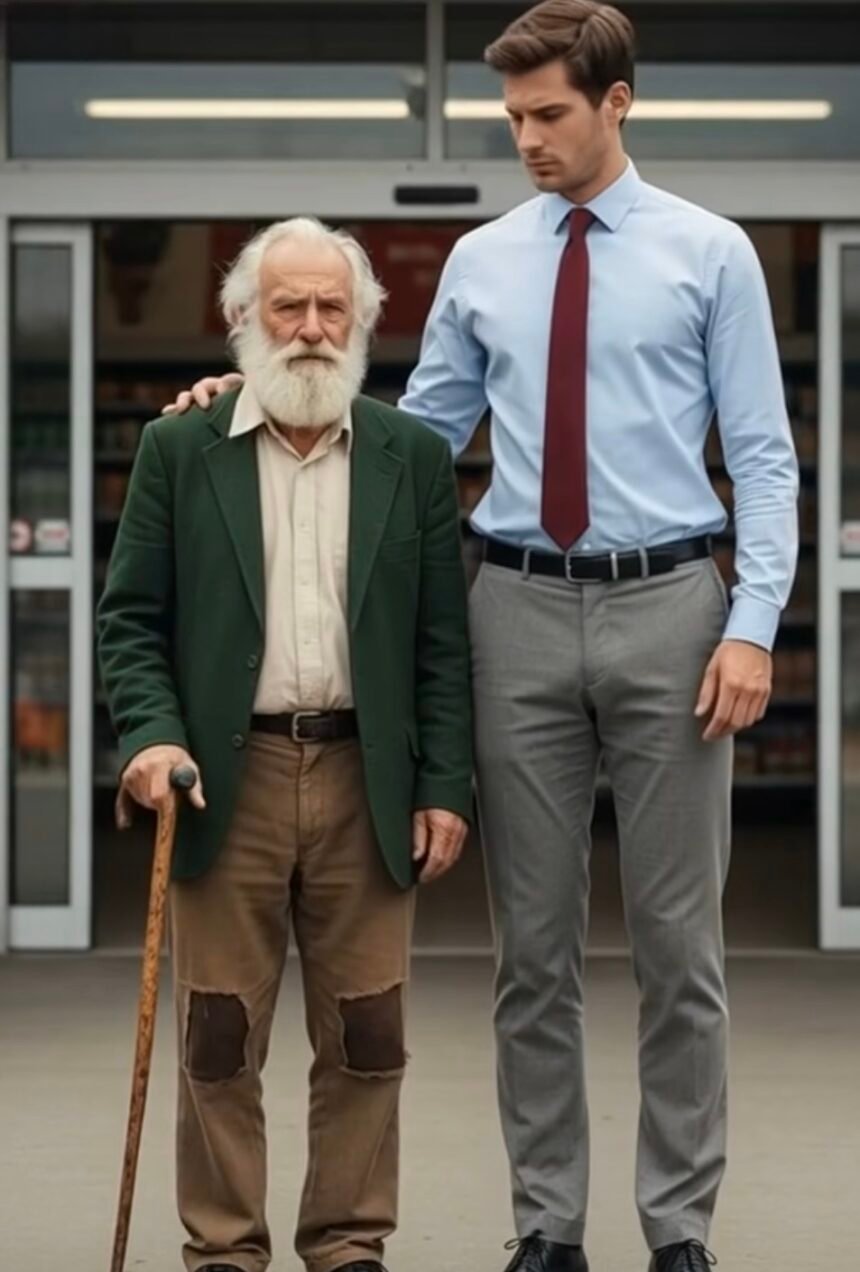
In the break room, he poured me coffee, handed me a sandwich, and sat across from me.
“You remind me of my dad,” he said softly. “He passed last year.
He had that same look… like life had shown him too much.”
He hesitated.
“I don’t know your story, sir, but you matter. Don’t let anyone tell you otherwise.”
Tears burned behind my eyes.
That sandwich felt like gold. I wanted to tell him who I was — but it wasn’t time yet.
That night, back in my office, I rewrote my will.
Every dollar, every acre, every store — left to Lewis.
A week later, I walked into the same supermarket, this time in a charcoal-gray suit, cane polished, shoes shining.
The same doors opened — and the same people bowed.
“Mr. Hutchins! Welcome, sir!”
“Can we get you a cart?”
Even Kyle stumbled toward me, pale as chalk.
“M–Mr.
Hutchins! I had no idea—”
“No,” I said, “you didn’t.”
Across the room, Lewis met my gaze.
He gave a small nod — no smile, just understanding.
That evening, he called.
“I knew it was you,” he said. “But kindness shouldn’t depend on who someone is.
You looked hungry.
That was all I needed to know.”
He had passed the test.
The next morning, I arrived with my lawyers. Kyle and the cashier were dismissed. And before the entire staff, I announced, “This man,” I said, pointing to Lewis, “is your new boss — and the future owner of this chain.”
But then came an anonymous letter:
Don’t trust Lewis.
Check Huntsville prison, 2012.
We investigated.
At nineteen, he’d stolen a car, served eighteen months.
He didn’t deny it.
“I was young and foolish,” he said. “Prison taught me what it means to lose dignity — and why no one should be denied it.”
I believed him.
His eyes held truth carved by pain.
My relatives didn’t agree. They appeared out of nowhere — furious, shouting that I’d lost my mind.
I told them, “Blood doesn’t make family.
Compassion does.”
When I told Lewis everything — the disguise, the will, the threats — he simply said,
“I don’t want your money, sir.
Use it to help others. Start something that lasts.”
And so I did.
I gave it all to the Hutchins Foundation for Human Dignity — to feed the hungry, educate the young, and give second chances to the forgotten.
When I handed Lewis the papers naming him director for life, he whispered,
“My father used to say, ‘Character is what you show when no one’s watching.’ You’ve lived by that.”
Now, at ninety, I wait peacefully for my final day — knowing my true heir isn’t bound by blood or greed, but by kindness freely given to a stranger.
If you ever doubt that goodness still exists, remember Lewis’s words:
“You don’t need money to be treated with respect.”