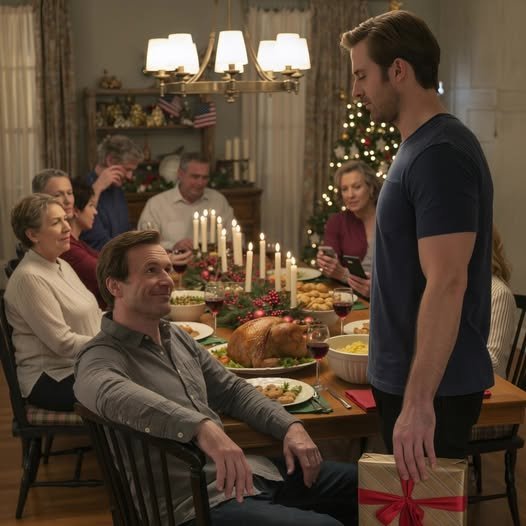
They had told me I could eat in the car.
Fine. I was finally willing to see who I really was to them. That was the moment I realized I was done being the quiet one at that table.
I didn’t drive away right away.
The neighborhood was lit up the way it always was the week of Christmas—plastic reindeer on lawns, strings of lights hung half‑crooked along gutters, inflatable Santas listing to one side in the cold. In the rearview mirror, I could see the warm glow of my parents’ dining room window.
For thirty‑three Christmases, that room had meant family. This year, it meant something else.
My hands rested on the steering wheel, knuckles white.
In the passenger seat, another gift bag waited, this one not wrapped in shiny paper. A leather folder. More copies of what was in the envelope.
Numbers, dates, screenshots, and one simple demand.
Forty‑two thousand five hundred dollars. That was the price of my silence, the price of pretending I was still just the “good brother” and not the guy who finally added everything up.
“Once,” I said out loud, breath fogging the windshield, “I pay the bill and shut up. Just once more.”
I stared at my reflection in the glass, the faint outline of a guy who had spent years twisting himself into whatever shape his family needed.
“After that,” I promised myself, “I don’t pay for them again.
Not with money. Not with time. Not with my own life.”
In a family where everything had always been unspoken, that was my first real bet with myself.
My name is Ethan Miller, and for as long as I can remember, I’ve been the responsible one.
When Jacob and Kelly had their first kid, I was there with gifts and a stroller they couldn’t afford. The saleswoman at Target had looked between us and asked who was the dad, and Jacob laughed and pointed at me.
“The rich uncle,” he said. “He likes to spoil us.”
When their second came along, I covered daycare because Kelly’s part‑time job barely covered groceries and Jacob’s latest “business opportunity” had somehow gone sideways.
Every August, I bought the kids’ school supplies, the backpacks with the right characters, the sneakers with the good brand logo.
I pitched in for summer camps so they wouldn’t be stuck at home watching cartoons until their eyes glazed over. When Jacob was “between jobs” for three months, I covered their mortgage so the kids wouldn’t have to move schools. Each time, Mom would call me her rock.
Dad would clap a hand on my shoulder and say I was “doing what family does.” Jacob would hug me, smelling like cheap beer and barbecue smoke, and say he’d pay me back “once things turned around.”
Things never turned around.
Year after year, I was the one who showed up. I fixed the leaky faucet in Mom’s kitchen.
I drove Dad to his cardiologist appointments when he didn’t want Mom to worry. I spent my vacation time doing yard work at their house because Dad’s back couldn’t handle it anymore and Jacob was always “too slammed” to help.
I gave and gave and gave, and when I couldn’t keep up, when I said no to something or hesitated for half a second, the looks came.
Must be nice, Ethan, someone would say. Not having kids. All that money just for you.
Or: Come on, you know Jacob’s under stress.
You’re better with money. You’ll figure it out.
No one asked how many nights I spent at my own kitchen table, bills spread out, calculator app open, trying to figure out how to help them without wrecking myself. No one saw the vacations I never booked, the car I didn’t upgrade, the repairs I put off, the way I told coworkers I “just wasn’t into travel” so I didn’t have to admit I was busy funding someone else’s life.
To them, I wasn’t a person.
I was a wallet that showed up with a smile and a credit score. And still, I kept coming back to that house. Kept showing up for Christmas, for birthdays, for every “small favor” that somehow never stayed small.
Because that’s what you do for family, right?
That illusion cracked the night my own mother told me I could eat in the car. My phone wouldn’t stop buzzing.
Mom. Dad.
Mom again.
A couple of texts from Jacob lighting up the screen, each more impatient than the last. I watched the notifications stack up—ten, fifteen, nineteen—until finally, more out of habit than desire, I tapped to answer. “Now you call,” I said, my voice coming out rougher than I expected.
“Sweetheart, please come back,” Mom rushed out.
Behind her I could hear the clatter of dishes, the murmur of voices, someone—probably Jacob—cursing under his breath. “We didn’t mean it.
Jacob was just upset.”
“Upset?” I laughed, the sound brittle in the small car. “You didn’t look very upset when you told me I could eat in the car.”
“It was just a joke,” she said quickly.
“You know how your brother is.”
“No, Mom,” I said.
“It’s never just a joke. Not when it’s always me.”
There was a pause, and in that pause I could hear Dad’s voice in the background, low and gruff. “Tell him to stop being dramatic,” he muttered.
“He’s ruining Christmas.”
“You and Dad just sat there,” I said quietly.
“You didn’t say a word. Not one.
You let him say that to me in your house.”
“Please,” Mom whispered, and suddenly she sounded tired, older than I remembered. “Just come home.
We can talk about this here.”
“That’s not my home,” I snapped.
“It’s a place I visit to be humiliated.”
The words hung between us, heavier than any silence we’d ever shared. “Please don’t do this,” she said again, but I was already ending the call. For thirty‑three years, I’d been the one who swallowed my pride, smoothed things over, made excuses for Jacob, for all of them.
For the first time, I let the hurt sit where it belonged.
That was my second pivot: choosing my own dignity over their comfort. I pulled out of the driveway, tires crunching over the frozen slush at the curb.
The whole street was strung in twinkling white and red, candy‑cane arches bending over sidewalks, inflatable snowmen grinning at nobody. It should’ve felt festive.
Instead, the lights blurred at the edges as I blinked hard, jaw clenched.
I drove aimlessly past houses with wreaths on every door, past the elementary school with its empty playground, past the strip mall with the flag whipping in the wind above the diner where Dad liked to get his Sunday pancakes. My phone buzzed over and over on the passenger seat. Mom.
Dad.
Even Jacob. I ignored them.
It wasn’t just about Christmas. It had never been just about Christmas.
This had been coming for years, building slowly like snow piling against a door you keep telling yourself you’ll shovel “later.” I had been too busy, too tired, too desperate to believe that if I just gave a little more, if I just proved I was good enough, they’d finally see me as something other than a resource.
Somewhere between one stoplight and the next, the anger crystallized into something sharper. I turned the car around. I wasn’t going home.
Not the apartment where the thermostat was set low to keep the bill down and the fridge held leftovers in plastic containers.
Not yet. I was going back.
The drive to my parents’ cul‑de‑sac felt shorter the second time, like my body already knew the roads by muscle memory. I pulled up behind Jacob’s SUV, the one I’d helped him keep when he’d fallen behind on payments three winters ago.
The front window glowed with warm yellow light.
Through the glass I could see movement—figures standing, someone gesturing wildly. On the dining table, Jacob’s chair was empty. The envelope that had been under his plate now sat open in the center, its contents fanned out like a little white explosion.
I killed the engine, stepped out into the cold, and walked up the front path, the candy‑cane lights casting red stripes across the snow.
My heart hammered, but underneath the fear there was something else. A strange, fierce calm.
I knocked once. Hard.
The door flew open almost immediately.
Mom stood there, eyes red, mascara smudged, a dish towel still crumpled in one hand. Behind her, Dad hovered near the dining room, arms folded tight across his chest. Jacob leaned against the wall, jaw tight, the envelope clutched in his fist.
“Back for another lecture?” he sneered, but there was a crack in his voice.
“No,” I said, stepping inside, past the threshold I usually felt grateful to cross. “I’m back for answers.”
The air in the hallway was thick with the smell of ham and tension.
“Explain it to me,” I said, turning to Mom and Dad. “How did I become the joke of this family?
How did I become the loser?”
“Don’t be dramatic,” Dad said, his go‑to line when things got uncomfortable.
“Jacob was just kidding. You know how he is.”
“Yeah,” Jacob chimed in, finding some of his swagger. “Can’t you take a joke, Ethan?
We’ve always messed around like this.”
I felt heat rise in my chest.
“This isn’t just about tonight,” I said. “It’s about everything.”
I took a step closer to Jacob, and his fingers tightened around the envelope.
“I’ve spent years—years—paying your bills, covering your mistakes, taking care of your family because you couldn’t or wouldn’t. I paid for your kids’ strollers, their daycare, their school supplies.
I covered your mortgage when you ‘lost’ another job.
I’ve fixed the things you break and filled in the gaps you leave.”
Jacob rolled his eyes. “I didn’t ask you to.”
“No,” I said, laughing once, harsh. “You didn’t ask.
You just expected.
And Mom and Dad backed you up every single time. ‘You’re the responsible one, Ethan.’ ‘You’re good with money, Ethan.’ But when I needed some basic respect at your table tonight, I got told I could eat in the car.”
Mom flinched.
Dad looked away. “If you’re going to cry about a few bucks—” Jacob started.
“A few bucks?” I cut in, my voice rising.
“How much do you think I’ve given you, Jacob? Thousands. Tens of thousands.
While you sat back and called me a loser whenever I couldn’t show up with even more.”
My vision tunneled for a second.
I could feel the weight of every receipt, every transfer, every quiet compromise. Behind me, the front door was still open, cold air seeping in.
This was the first time I’d ever said any of it out loud. “Stop yelling,” Dad muttered.
“You’re making a scene.”
“Oh, I’m making a scene?” I said.
“You haven’t seen anything yet.”
I turned on my heel and walked back out to my car. I could feel all of them watching from the doorway, like I was about to do something outrageous instead of something ten years overdue. In the back seat, the gift bags waited—carefully wrapped presents I’d chosen during my lunch breaks, standing under fluorescent lights while a holiday playlist looped overhead.
Books for the kids, a kitchen gadget Mom had mentioned liking, a tool set Dad had circled in a catalog but never bought.
I grabbed the bags, all of them, and carried them back up the stone path. The wind cut through my coat, but my hands barely felt it.
“You know what?” I said, stopping in the entryway. “Here.”
I dropped the bags at Jacob’s feet.
One tipped, spilling toys and books across the hardwood floor.
“Take them. The presents you didn’t think I brought because you wrote me off the second I walked in.”
Kelly appeared in the hallway, hovering just behind Jacob’s shoulder, his face pale. Mark peeked in from the dining room, eyes wide, like this was better than anything on Netflix.
“You didn’t even look in the car, did you?” I asked.
“You just assumed I was worthless. That I’d show up with nothing, that I’d sit quietly in the corner and take whatever scraps you tossed me.”
Mom’s voice wobbled.
“Enough. This is Christmas.
Please, just calm down.
We can talk about it like adults.”
“Calm down,” I repeated, tasting the words. I let out a breath that felt like it had been trapped in my lungs for a decade. “Fine.
I’m calm.”
I straightened, meeting each of their eyes in turn.
“But I’m also done. Done being your bank.
Done being your punching bag. Done pretending this is a family.”
For a moment, no one said anything.
Even the Sinatra playlist had stopped, leaving only the hum of the heater and the ticking of the clock over the mantle.
“Yeah, walk away,” Jacob finally muttered, trying to scrape his pride back together. “You always do.”
“I never walked away,” I said quietly. “I just never realized how little I mattered here.”
I turned and left, this time pulling the door shut behind me hard enough that the wreath shuddered on its hook.
As I walked back to my car, the cold air felt cleaner than the warmth inside ever had.
That was the night I stopped confusing access to their house with belonging. The next two days were quiet in a way my life had never been where my family was concerned.
No calls. No texts.
No guilt‑laced voice mails from Mom, no annoyed check‑ins from Dad, no half‑baked apologies from Jacob.
The notifications that usually cluttered my phone were gone, replaced by work emails and a spam text about car insurance. For a few hours, I let myself believe maybe they’d heard me. Really heard me.
Maybe they’d finally sat at that table and read every word in that envelope, looked at each other, and realized what they’d turned me into.
Maybe they were ashamed. That fantasy lasted until the morning of the third day when my doorbell rang hard enough to rattle the picture frames on my wall.
I didn’t have to check the peephole. The angry silhouette on the other side of my apartment door was familiar.
“Open up, Ethan,” Jacob’s voice came through the wood, muffled but furious.
“You can’t hide in there forever.”
I opened the door and leaned casually against the frame, even though my pulse was thudding in my ears. “Make it quick,” I said. “I’m busy.”
He shoved his way inside without waiting for an invitation, his winter jacket half‑zipped, hair a mess, eyes bloodshot like he hadn’t slept.
“You need to stop this,” he snapped.
“You can’t just cut us off like this. You can’t—” he waved a hand vaguely—”do whatever it is you think you’re doing.”
“Excuse me?” I crossed my arms, shifting my weight against the kitchen counter.
“Pay you off? You mean finally saying no to being your personal ATM?”
“Don’t be dramatic,” he said, echoing Dad word for word.
“You’ve always helped us.
Always. You can’t just stop.”
“Oh, but I can,” I said. “You told me I could eat in the car, remember?
You made it pretty clear where I stand.”
He scoffed.
“You’re really going to throw a tantrum over a joke?”
My laugh came out sharp. “This isn’t about a joke.
It’s about the fact that the only time my phone lights up with your name is when you need money. It’s about the fact that the minute I set a boundary, you turn into a victim.”
His voice jumped an octave.
“Do you know what you’re doing to us?
Kelly’s panicking. The kids don’t understand why there aren’t as many presents. Mom and Dad are losing it.
You think this is easy on anyone?”
“The only thing they’ve lost,” I said, “is their free ticket to bleed me dry.”
“You only think about yourself,” Jacob exploded, face turning red.
“We’re a family. Families help each other.”
“You want to talk about help?” I stepped forward, matching his volume.
“I’ve paid for your kids’ school supplies, covered your rent, even paid your mortgage at one point. I’ve been more of a father to your kids than you’ve ever bothered to be.”
His hands curled into fists at his sides.
“You think you’re so much better than me, don’t you?”
“I don’t think I’m better,” I said.
“I just know I’m done being used.”
“Used?” His laugh was ugly, cracked. “You act like a victim. Poor you, right?
The brother who always had more.
Who always thought he was too good for the rest of us.”
“More?” I almost laughed again. “You mean more debt?
More sleepless nights wondering how I could cover your bills and still pay my own? More guilt every time I thought about saying no?”
“I have kids!” he shouted.
“They’re suffering because of you.”
“No,” I said, leaning closer, my voice low.
“They’re suffering because of you.”
He blinked. “What are you talking about?”
“Because you gambled away everything I gave you.”
The color drained from his face so fast it was almost fascinating. He swallowed, his throat working like someone had just tightened a tie around his neck.
‘You don’t know what you’re talking about,’ he said.
‘You have no idea how hard it is. The bills, the stress, the kids—’
‘Kelly does,’ I cut in.
‘She knows exactly how hard it is. Hard enough that she went through your emails one night while you were snoring on the couch.
Hard enough that she took screenshots of the bank statements from that little side account you thought she didn’t know about.
Hard enough that she walked into a lawyer’s office with those screenshots and cried until someone promised to help her get out.’
He stared at me like I’d slapped him. ‘Kelly wouldn’t,’ he whispered. ‘Kelly did,’ I said.
‘Your wife sat in a conference room across from a guy in a navy suit and a flag pin on his lapel and asked how to protect your kids from you.’
He lunged for my phone when I pulled it from my pocket.
I stepped back and held it just out of reach, thumb tapping the screen. The same folder I’d stared at a dozen times bloomed to life: transaction after transaction, all neatly highlighted.
Gambling sites. Online betting apps.
Hotel charges on nights he swore he was working late.
Restaurant tabs that added up to more than the groceries I’d bought for them that week. ‘You want to see what hard looks like?’ I asked. ‘Hard is watching thousands of dollars leave your account while you tell yourself it’s worth it because there are kids involved.
Hard is realizing you weren’t paying for food or shelter or anything that mattered.
You were paying for the privilege of being lied to.’
He reached again, fingers clawing for the phone, but I held my ground. The old version of me would have backed up, lowered my voice, said we could sort it out.
That version was sitting alone in a parked car on Christmas Eve, waiting for permission to exist. ‘Give it to me,’ he snarled.
‘You can’t just go through my stuff.
This is private.’
‘Kelly went through it,’ I said. ‘Her name is on those accounts. She gave it to her lawyer.
He gave it to me.
If you want someone to be mad at, get in line.’
For a second, his fists clenched like he was actually weighing whether hitting me was worth whatever came next. I saw the calculation flicker across his face, the same way I’d seen it at that dinner table when he decided I didn’t deserve a chair.
He didn’t swing. Instead, he sagged against the back of a chair, shoulders collapsing.
‘I was trying to fix it,’ he said.
‘You think I wanted things like this? I thought if I won big one time, just once, I could pay you back and get ahead and nobody would have to know.’
‘Except you kept losing,’ I said. ‘And every time you did, you called me.
Or Mom called me.
Or Dad did. And I paid.
I paid because I trusted you. That envelope under your plate?
That was the last time.’
His gaze flicked to the leather folder on my kitchen table, the one I’d dropped there when I came home from work three days earlier and hadn’t had the courage to open again until tonight.
The envelope inside was the twin of the one I’d taped under his plate, same crisp paper, same typed list, same number sitting at the bottom like a verdict. 42,500. Forty-two thousand five hundred dollars.
Forty-two thousand five hundred tiny ways I had taught my family I didn’t mind disappearing as long as their lights stayed on.
‘You put everything in there?’ he asked, nodding toward the folder. ‘Every transfer.
Every check. Every cash withdrawal I made because you said you were too embarrassed to have it show up in your account.
All the times Mom called me crying, saying the bank had left a message, saying she was scared the house would be taken.
Every time I stepped in so you didn’t have to feel that fear.’
I picked up the folder and flipped it open. Spreadsheets. Bank statements.
Printouts of texts.
At the very front, the top sheet was a letter on my lawyer’s letterhead. It wasn’t long.
Demand letters never are. ‘You talked to a lawyer?’ The words came out strangled.
‘Yeah,’ I said.
‘I did. I wanted to make sure I wasn’t crazy. I wanted someone who didn’t share our blood or our history or our guilt to look at this and tell me what it was.’
‘What did he say?’ Jacob whispered.
‘He said that if someone takes money while lying about what it’s for, if they keep taking it while they tell you stories about bills and rent and kids and then pour it into bets and hotel rooms instead, there is a word for that.’ I slid the top page out and held it up.
‘Fraud.’
Jacob flinched like the word itself had weight. ‘You going to send that?’ he asked.
‘Already did,’ I said. ‘The one you opened at dinner?
That’s your copy.
This one is mine.’
His eyes went wild. ‘You can’t do that. You can’t sue me.
We’re family.’
‘Family doesn’t tell you to eat in the car,’ I said.
‘Family doesn’t gamble with money you bled for. Family doesn’t call you a loser because you can’t keep up with their bad decisions.’
His breathing turned shallow, fast.
‘I don’t have that kind of money.’
‘I know,’ I said. ‘That’s why you’ve got a choice.
You have two weeks to start paying it back.
All of it. Forty-two thousand five hundred dollars. My lawyer agreed that if you make regular payments, I don’t take it to court.
You default, we file.’
He laughed, but it came out more like a bark.
‘You’re bluffing.’
I walked to the counter, picked up a second sheet, and tossed it onto the coffee table between us. A repayment schedule, neat rows of numbers marching toward zero.
‘Am I?’ I asked. ‘It’s all there.
Due dates, amounts, my lawyer’s information.
This isn’t a bluff, Jacob. This is me finally acting like the responsible one you all called me.’
He stared at the paper, at the total at the bottom. 42,500.
It might as well have been written in blood.
He sank onto the couch like his knees had given out. ‘You can’t do this,’ he said again, softer now.
‘Please. Ethan, please.
Think about the kids.
They’re going to lose everything.’
The kids’ faces flashed through my mind. Sticky hands tugging at my sleeve. Laughter when I showed up with a new basketball or the Lego set they wanted.
The way they’d ask if Uncle Ethan was coming over before holidays.
‘I am thinking about them,’ I said. ‘I’m thinking about what happens if they grow up believing this is normal.
That someone will always bail them out. That they can treat people like trash and still expect grace.
I won’t be that lesson for them anymore.’
He scrubbed his hands over his face, breathing hard.
‘I’ll tell Mom and Dad,’ he said suddenly. ‘I’ll tell them what you’re doing. They’ll know you tore this family apart.’
‘Go ahead,’ I said.
‘Tell them everything.
And then I’ll show them this.’ I tapped the folder. ‘We can all look at the numbers together.’
For the first time since he’d barged in, he looked afraid in a way that had nothing to do with me.
‘Get out,’ I said quietly. ‘Last chance.
Two weeks.
Forty-two thousand five hundred dollars. Or we let a judge decide.’
He stood, swaying, his face chalky. ‘You think you’re better than us now,’ he muttered.
‘I think I’m done pretending this is fine,’ I said.
He stomped toward the door, yanked it open, and nearly collided with the two figures standing on the other side. Mom and Dad.
Of course. Mom gasped, clutching her purse to her chest.
Dad’s jaw was tight, shoulders squared like he was walking into a boardroom showdown instead of his younger son’s apartment.
‘We heard yelling,’ Mom said, eyes darting between us. ‘What is going on? Jacob called us, said you were threatening him.’
Jacob seized the opportunity, slipping past them into the hallway.
‘He’s lost it,’ he said.
‘You need to talk some sense into him. He thinks he can sue me.
On Christmas.’
Dad’s gaze pinned me. ‘Is that true?’ he demanded.
I stepped back, letting them in.
The heater hummed quietly. The coffee I’d made that morning sat cold on the counter next to the leather folder. ‘Ask him where the money went,’ I said.
‘Ask your oldest son what he did with forty-two thousand five hundred dollars.’
Mom’s face twitched.
‘Forty-two thousand—’ she echoed. ‘That can’t be right.’
I walked to the table and picked up the folder again, but this time I didn’t clutch it like a shield.
I opened it and laid the documents out in a row on the kitchen island, the way my lawyer had done on his conference room table under a row of framed diplomas and another little American flag sitting in a brass stand. Receipts.
Transfers.
Screenshots. At the end, the demand letter. At the top of the page, just below my lawyer’s logo, the number 42,500 sat alone on a line.
That number had been my life for the last few years.
Tonight, it was finally speaking for me. Mom stepped closer, her hand shaking as she picked up the first page.
‘Ethan, what is all this?’ she whispered. ‘It’s every time I helped,’ I said.
‘Every time you called.
Every time Jacob said the kids needed something or the bank had called or they were going to lose the house. He kept saying it would get better. That he just needed a little more time.
So I stretched myself thinner and thinner because I thought that was what a good son did.’
Dad snatched one of the statements from the counter.
His eyes darted over the lines, the merchants, the dates. ‘These are casinos,’ he said slowly.
‘Sports betting sites. Hotels.’
He turned on Jacob.
‘You told us Ethan was exaggerating.’
‘I was trying to fix it,’ Jacob said again, voice rising.
‘I just needed one win. One big win and I could have made it right.’
‘You used his money,’ Mom said, voice cracking. ‘All of this?
All this time?’ Her eyes filled with tears.
‘We asked him to help you. We pushed him to help you.’
‘And when I finally said no,’ I added, ‘you told me I could eat in the car.’
Silence fell heavy over the little apartment.
Mom covered her mouth. Tears slipped down her cheeks, leaving dark tracks in her makeup.
Dad looked between us like he didn’t recognize either of his sons.
‘You’re really going to drag your brother into court?’ he asked me eventually. His voice was gravelly, tired, stripped of all the fake cheer he’d used at the dinner table. ‘I gave him a choice,’ I said.
‘He pays back what he took, or a judge decides what happens.
I am not carrying this in secret anymore.’
Mom turned fully toward me. ‘Please,’ she said.
‘He’s your brother. You can’t destroy him.
We can work something out.
We’ll help.’
A few years ago, those words would have softened me. I would have felt the old reflex kick in, the need to make everything easier for everyone else. Now, looking at the documents spread across my counter, the same way they’d been spread across my lawyer’s table, I felt something different.
Clarity.
‘I’m not destroying him,’ I said quietly. ‘He did that himself.
He lied. He gambled.
He took every kindness and turned it into a bet.
I’m just done paying the price.’
Dad’s gaze hardened. ‘You think this makes you a hero?’ he asked. ‘All I see is a son willing to drag his own brother through the mud for a few dollars.’
‘A few dollars?’ The laugh burst out of me before I could stop it.
‘Forty-two thousand five hundred isn’t a few dollars.
It’s the down payment I never made on a house because I paid yours instead. It’s the vacations I never took.
It’s the nights I spent staring at my checking account wondering how I was going to cover my own rent after covering his.’
My hands shook, but my voice didn’t. ‘It’s my life,’ I said.
‘And I’m taking it back.’
That was the night I stopped speaking the language of guilt they all understood so well.
Jacob stormed out first, shoving past Dad, muttering under his breath. The door slammed hard enough to rattle the frames on the wall. Mom tried one more time, her hand closing around my wrist, nails digging in.
‘Please, Ethan,’ she whispered.
‘Don’t do this. We can figure it out as a family.’
I gently pried her fingers loose.
‘We had years to figure it out as a family,’ I said. ‘You chose not to.
Now I’m choosing me.’
She left sobbing quietly, Dad’s arm stiff around her shoulders.
He didn’t look back at me when he pulled the door shut. The apartment felt cavernous in their absence, every tick of the wall clock suddenly louder. I gathered the papers back into the folder, sliding the demand letter on top.
The crisp white edge of the envelope peeked out when I closed it, the same kind of envelope that had sat under Jacob’s dinner plate.
Same paper. Different message.
I set it in the middle of my kitchen table like a centerpiece. That was my midpoint: not the threat, not the shouting, but the quiet afterward when I realized there was no going back to the version of myself who would have apologized for making a scene.
The next two weeks were a master class in pressure.
Jacob texted, called, left voice mails that swung wildly between rage and begging. Two days after our confrontation, Mom called sobbing, saying I was tearing the family apart. Dad left a single, terse message: ‘Call me.
This has gone far enough.’
I didn’t budge.
I went to work. I answered emails.
I met deadlines. I made small talk in the break room while a tiny part of my brain counted down days on an invisible calendar.
On day thirteen, an alert pinged on my banking app while I was standing in line at the coffee cart downstairs from my office.
Incoming wire: 10,000.00 USD. For a second, I thought I was reading it wrong. Then I saw the note: Repayment 1.
The number sat there on the screen, as unreal as the 42,500 had been the first time I’d added it up.
My phone buzzed almost immediately with Dad’s name. I stepped out of line and answered.
‘You got it,’ he said, not bothering with hello. ‘Ten thousand.
Jacob sold his car.
You’re satisfied?’ His voice was sharp, brittle with anger. ‘It’s a start,’ I said. ‘You’re bleeding him dry,’ Dad snapped.
‘He has kids.
A mortgage. You’re leaving him nothing.’
‘I left him plenty,’ I said.
‘I left him a path that doesn’t end with a judge and a court date. He chose this.’
There was a beat of silence, then a low growl.
‘You’re tearing this family apart.’
‘No,’ I said, surprised by how calm I sounded.
‘I’m fixing what I can. The rest was broken long before I sent that letter.’
I hung up before he could fire back. That night, I sat at my kitchen table with the leather folder open, added a new line to the spreadsheet, and watched the total owed drop from 42,500 to 32,500.
Ten thousand dollars closer to zero.
Ten thousand dollars closer to breathing. Payment after payment followed.
Jacob sold his SUV and bought a beater sedan with a mismatched door. He pawned his gadgets.
He took on extra shifts at a warehouse across town.
Once, I drove past my parents’ house and saw his old grill sitting at the curb with a handwritten ‘For Sale’ sign taped to it. Mom called less, but when she did, it was always the same script. ‘He is trying, Ethan,’ she would say.
‘Can’t you forgive the rest?
You have such a good job. This money doesn’t mean to you what it means to him.’
‘It means my life to me,’ I would answer.
‘And I’m not returning it to the lending library.’
Each time a payment came through, I updated the spreadsheet. 25,000.
18,000.
11,500. Watching the total shrink felt less like revenge and more like watching a cast being cut off a limb, inch by inch. Kelly texted once the second payment posting.
Thank you.
I didn’t know how to face him alone. Another time: The kids are adjusting.
We’re okay. Better than okay, actually.
I met her for coffee at a diner near her new apartment one Saturday morning.
The place smelled like bacon and burnt toast, the kind of place with laminated menus and a little flag stuck in a jar of sugar packets by the register. Sinatra played quietly on the overhead speakers. ‘You didn’t have to come,’ she said as I slid into the booth across from her.
‘I wanted to,’ I said.
‘You shouldn’t have had to go through this by yourself.’
She looked tired in a way I hadn’t noticed before, lines around her eyes deeper than they should have been at her age. But there was something lighter about her too, a looseness in her shoulders I’d never seen at family dinners.
‘I kept thinking it was my fault,’ she admitted, stirring her coffee with unnecessary force. ‘That if I’d just budgeted better or cut more coupons or picked up another shift, he wouldn’t need to ask you for so much.’
‘It was never about you,’ I said.
‘Or the kids.
He was chasing something he was never going to catch.’
Tears filled her eyes, but she blinked them away. ‘When I saw the statements,’ she said, ‘I thought I’d throw up. All that money.
All those nights he told me he was at work or with your dad talking about new business.
I wanted to smash his phone.’
‘You did something better,’ I said. ‘You walked away.’
She smiled weakly.
‘Only because you gave me the proof. The lawyer said without your records it would just be my word against his.
This way, I can keep the apartment.
The kids keep their daycare spot. I actually sleep.’
The waitress dropped off a plate of pancakes for her youngest, who sat beside her coloring on the kids’ menu. He looked up at me shyly.
‘Uncle Ethan,’ he said.
‘Did you know Grandma cried on Christmas?’ He said it like a weather report. I swallowed.
‘Yeah, buddy,’ I said. ‘I know.’
He went back to his crayons.
Kelly reached across the table and squeezed my hand.
‘You did the right thing,’ she said. ‘Even if it doesn’t feel like it yet.’
For the first time, someone from my family wasn’t asking me to cave. They were thanking me for standing up.
That was another hinge in my story: the moment I realized I wasn’t crazy for wanting something different.
A month after Christmas, the final payment hit my account. Incoming wire: 4,250.00 USD.
The memo line read Last one. I stared at the number, then at the new total on my spreadsheet.
0.00.
Forty-two thousand five hundred dollars had left me, dollar by dollar, over years. Now it had all come back, wired in desperate chunks, each one a little piece of Jacob’s old life being sold off. I didn’t feel victorious.
I felt free.
My phone buzzed almost immediately. Dad: This is enough.
Call your brother. We need to move past this.
Mom: Please just talk to us.
We miss you. Jacob: Hope you’re happy. I set the phone face down on the table and walked to the sliding door that led to my tiny balcony.
The city was waking up outside, pale winter light spilling over brick and glass, little curls of steam rising from vents on the rooftops.
I stepped out into the cold with a mug of coffee and breathed. The silence didn’t feel empty anymore.
It felt earned. Mom kept texting.
Sometimes it was the same plea copied and pasted.
Please just talk to us. We miss you. Other times it was smaller things.
Saw your favorite candy at the store.
Remember when you used to sneak it into the cart? Your dad’s cholesterol numbers are better.
You’d be proud. Jacob is trying.
He got a new job.
I read them all. I didn’t respond. Not because I hated them.
Not because I wanted them to hurt.
Because for the first time in my life, I loved myself enough not to go running back the second they felt uncomfortable. I had thought loving my family meant sacrificing until there was nothing left.
That good sons gave and gave, that good brothers saved people from their own bad decisions, that good kids laughed off insults at the dinner table because making a scene would ruin the holiday. Maybe that was love, in some houses.
In mine, it had become self-destruction.
On a gray Saturday morning in late January, my doorbell rang again. This time, the knock was gentle. I checked the peephole out of habit.
It wasn’t Jacob.
It wasn’t my parents. ‘Uncle Rob?’ I said when I opened the door.
He stood there with his familiar half-smile, a knit beanie pulled low over his ears, a small, neatly wrapped box in his hands. He smelled like cold air and motor oil.
‘Hey, kid,’ he said.
‘You got a minute?’
I stepped aside automatically. Rob was my mom’s younger brother, the one who’d moved three states away when I was in middle school and only came back for the big holidays. Growing up, I’d heard fragments of stories about him.
How he’d disappointed my grandparents.
How he’d refused to bail out one of his cousins when a business deal went bad. How he’d been ‘selfish’ and ‘stubborn’ and ‘impossible.’
I used to believe all of that.
Now, I wasn’t so sure. He set the box on my kitchen table, eyes flicking briefly to the leather folder still sitting there like a permanent placemat.
‘Been a busy season for you, huh?’ he said.
‘Word travels,’ I said wryly. ‘In this family? Faster than a text chain,’ he said.
‘Your mom called me.
Not to complain, surprisingly. More like she didn’t know what to do.’ He paused.
‘I figured I should hear your side. Not that I didn’t already guess.’
I poured two mugs of coffee and slid one toward him.
He took it, warming his hands around the ceramic.
We sat at the table, the folder between us like a third person. I told him everything. The insults disguised as jokes.
The years of transfers and ‘Can you help just this once?’ calls.
The envelope under Jacob’s plate. The demand letter.
The accusations. The payments.
He listened without interrupting, nodding occasionally, brows knitting at certain points like none of it surprised him and all of it still hurt.
When I finally ran out of words, he blew out a breath. ‘Yeah,’ he said. ‘Thought so.’
‘Thought what?’ I asked.
‘That you were the new me,’ he said with a crooked smile.
‘Every generation gets one.’
I frowned. ‘What is that supposed to mean?’
‘One kid who learns how to say no,’ he said.
‘One kid who stops writing checks with his sanity so everyone else can feel comfortable.’ He tapped the folder. ‘My version of that looked different, but the script was the same.
‘You’re the responsible one, Rob.’ ‘Your brother just needs a little help.’ ‘You’re tearing this family apart.’ I heard all of it.
Still do sometimes.’
I stared at him. ‘What did you do?’
He shrugged. ‘Said no.
Packed a U-Haul.
Moved out of state. Built a life that didn’t require me to be the mascot of self-sacrifice.
Spent a lot of holidays alone at first. Then with people who actually liked me, not what I could do for them.’
‘And it got better?’ I asked.
He smiled.
‘It got real. Better came later.’
He nudged the wrapped box toward me. ‘What’s this?’ I asked.
‘Open it,’ he said.
The paper crinkled under my fingers. Inside was a small wooden box, smooth and warm, about the size of my palm.
I lifted the lid. Inside, on a bed of dark felt, sat a single crisp white envelope.
Blank.
Empty. I huffed out a laugh. ‘Very funny.’
‘It’s not a joke,’ he said.
‘I had one like that when I left home.
Every time someone tried to guilt me into doing something that would wreck me, I wrote it down on a piece of paper and put it in the envelope. When the envelope got too full to close, I knew it wasn’t me who was the problem.’
I turned the envelope over in my hands.
It felt exactly like the ones I’d used for the demand letter. Same weight.
Same texture.
Same reminder. ‘You don’t owe them your life just because you share a last name,’ Rob said softly. ‘You get to decide what family looks like for you.’
For a long moment, we just sat there.
The city sounds filtered in from outside.
Sinatra’s voice drifted faintly from the neighbor’s TV through the wall, some old Christmas standard that made my chest ache less than it had a month ago. Finally, I tucked the empty envelope into the leather folder, right on top of the paid-in-full spreadsheet.
I closed the folder and rested my hand on it. ‘Next Christmas,’ Rob said, standing, ‘if you don’t feel like going over there, you can come to my place.
I make terrible ham and great mashed potatoes.
We can eat at the table. Or on the couch. Or on the floor if we feel like it.
But you’ll have a chair if you want one.
No one will tell you different.’
The image hit me so hard I had to look away for a second. A table where my presence wasn’t a favor.
A chair that was mine because I chose to be there, not because I paid for the lights to be on. ‘I might take you up on that,’ I said.
‘Good,’ he said.
‘You deserve people who don’t need an invoice to treat you like you matter.’
After he left, I stood on the balcony again, the wooden box warm in my hand. The city stretched out in front of me, a patchwork of brick and glass and tiny lives unfolding behind lit windows. Somewhere out there, my parents were probably sitting at their kitchen table, arguing in low voices.
Jacob was likely staring at his empty driveway where his SUV used to be, telling himself he was the real victim.
For the first time, I didn’t feel responsible for any of it. Inside, my phone buzzed with another text from Mom.
Please just talk to us. We miss you.
I picked it up, stared at the words for a long moment.
Then, slowly, I typed back. I’m okay. I just need space.
Three dots appeared.
Disappeared. Appeared again.
Okay, sweetheart. We love you.
When you’re ready.
I didn’t know what ‘ready’ would look like yet. I didn’t know if there would be apologies or just another round of pretending. What I did know was this: I had forty-two thousand five hundred reasons not to go back to the version of myself who thought love meant earning a seat at the table.
I set the phone down, went to the fridge, and grabbed a magnet from the side of it.
A chipped little American flag, colors fading from years of sun. I stuck a copy of the paid-in-full statement to the door with it.
Not as a trophy. As a reminder.
A reminder that I was allowed to draw lines.
That I was allowed to say no. That I was allowed to build a life that didn’t require me to eat in the car while everyone else laughed around a table I had helped pay for. The dawn light caught on the edge of the paper, on the tiny printed number 42,500 in the corner, and for once it didn’t look like a weight.
It looked like a door.
For the first time in my life, I wasn’t just free of their expectations. I was finally free to decide who got a seat at my table.