

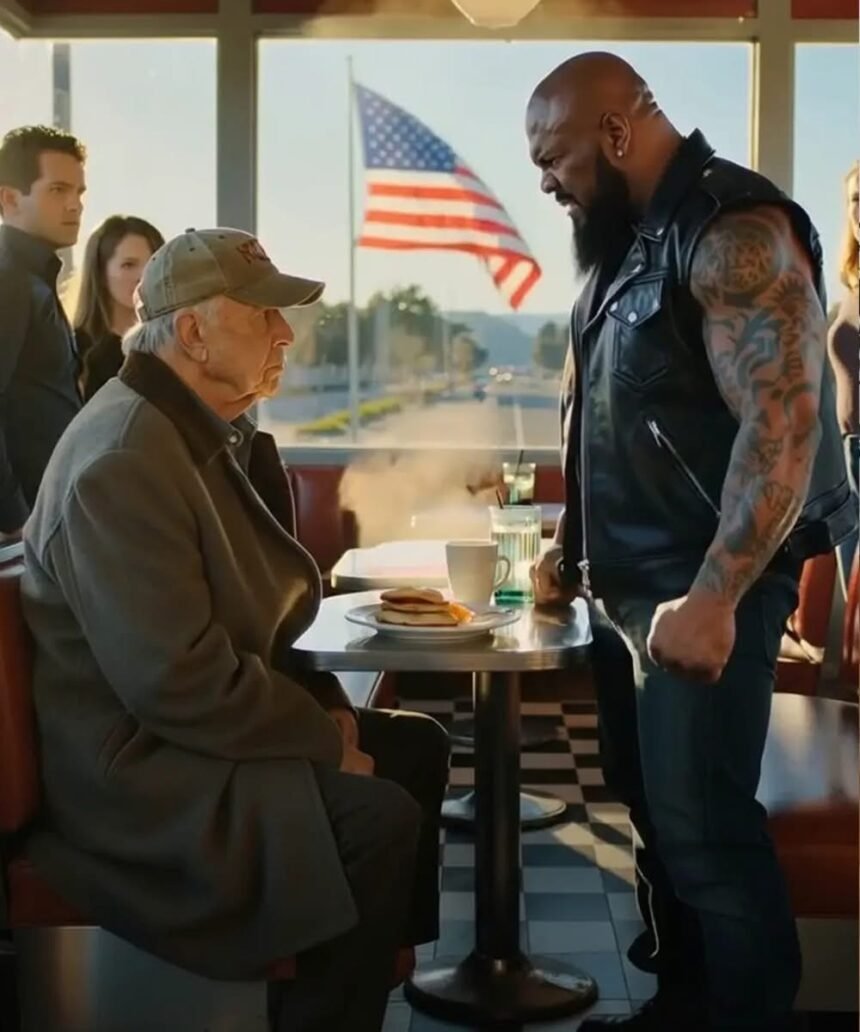
Harold did not raise his voice.
He picked up his cap, brushed it against his sleeve with the same care he had once used for a uniform, reset it on his head, then turned to Darlene. “May I use your phone, dear?”
She slid it across, fingers trembling. He dialed, spoke a few quiet words, returned to his seat, and fixed his gaze on the horizon where the light thinned into evening.
Minutes lengthened.
The jukebox quit pretending to play. Cole shifted, the rush of adrenaline curdling into awareness.
He scanned the room for approval and found only averted eyes and a hard kind of quiet. Then came the sound—low, measured, not a motorcycle.
An engine that belonged to work, not display.
It cut outside the door. A tall man stepped in. Dark coat.
Straight posture.
Not loud, not showy, but centered in a way that made the room re-measure itself. He glanced at Darlene (one nod), at Harold (one softer nod), and finally at Cole with the level look you give a mess you intend to clean up.
He crossed to the window seat. “Dad.”
The word changed the air.
The room understood.
Cole blinked. “Wait… your—?”
The man opened a leather wallet. A badge caught the light—polished, official, earned.
“Sergeant Major Michael Mitchell,” he said evenly.
Color drained from Cole’s face. Michael didn’t crowd.
He didn’t posture. He let stillness do its work.
“You think strength is the loudest thing in the room,” he said, voice calm, shaped for clarity.
“This man taught soldiers what strength is. It isn’t noise. It isn’t a hand that moves faster than thought.”
Cole tried to speak.
Nothing came.
Michael took one step closer—enough to cast a shadow across boots that had wanted to be bigger than they were. “You looked at him and saw age.
I look at him and see the man who raised me.”
He held the pause just long enough. “You can leave now.
Walk—while it’s still your choice.”
Cole turned.
The chain that had clattered earlier sounded thin now. The door closed behind him, and the diner exhaled. A clap started, small and unsure, and died the right way—because this wasn’t a scene for applause.
It was a lesson.
Michael faced his father. Harold’s smile was barely there, understated pride disguised as gratitude.
“I told you not to rush,” Harold teased, gentle as dust. “You think I’d be anywhere else?” Michael answered.
Life resumed—but altered.
The grill hissed again, the trucker sat, the child stopped worrying his straw. Yet every person present carried a new measurement inside them: how a person can be firm without being cruel; how a room can choose to witness rightly. Darlene set a fresh cup of coffee in front of Harold.
“On the house,” she said.
“Thank you,” he told her, and meant for more than the mug. Cole’s bike didn’t move for three days.
Neither did the echo. He replayed the moment—his own hand, the quiet look after, the way a badge had rearranged his idea of consequence.
The mirror didn’t offer the man he liked to be.
It offered the man he had been in front of witnesses. On the third morning he started the engine. It didn’t sound triumphant.
It sounded like a decision.
He followed a flag to a low brick building: the veterans’ center. He stood in the doorway longer than he’d stood anywhere on purpose.
Inside, the lobby smelled like coffee and old paper. Photos lined the walls—faces young then, never young again.
“I’m looking for Harold Mitchell,” he told the woman at the desk.
She smiled like she had been waiting for this day. “Garden, under the pecan.”
Harold sat on a wooden bench, cane across his knees, sunlight netted by leaves in a pattern on his hands. He looked up when Cole approached, not wary, not welcoming—available.
“Mr.
Mitchell,” Cole said, voice smaller but truer. “I was wrong.”
Harold tilted his head, inviting more.
“I thought being feared meant being strong,” Cole continued. “That day showed me otherwise.
I’ve seen your look every night since.
I don’t want to see it that way again.”
“It takes a man to say it,” Harold said. “Takes a better one to change what he does next.”
Cole swallowed. “How do I make it right?”
“Stay,” Harold answered simply.
“We’ve got food boxes to load, porches to fix, visits to make.
Plenty of work for hands that want to learn.”
Cole nodded. “I’ll be here.”
He came back the next morning.
And the next. He carried crates.
He swept floors.
He learned names. He listened—to stories that didn’t need his opinion, to silences that didn’t need his noise. No one asked for a speech.
Everyone noticed consistency.
Around town, the story softened into a tale people told at the end of the day: a hand that moved too fast, a call that moved faster, a room that chose respect, a man who chose to let the lesson land. Darlene pinned a photo behind the register: Harold and Michael out front in the evening light, both smiling the quiet smiles of men who prefer deeds to headlines.
New customers would ask, and she’d say, “That’s the day we were reminded what respect looks like.”
A month later, the center hosted a community day—lawn chairs, paper plates, kids racing in crooked circles. Cole stood at the grill wearing a plain T-shirt with a small flag patch someone had sewn on for him.
He served with a patience that once would have felt foreign.
“You didn’t burn these,” Harold observed from the bench under the pecan. “I’m trainable,” Cole grinned. They listened to an old radio song trying to find its station.
Ordinary peace filled the yard.
Michael arrived near sunset, weary from the city and braced for complicated. He found his father and the man from the diner standing side by side over a cooler full of ice and water bottles.
“Sergeant Major,” Cole said, voice even. “I owe you an apology.”
Michael looked at his father, then at the man in front of him—the posture, the steadier eyes, the absence of performance—and offered his hand.
“You’re paying it forward the right way.”
They shook hands like men who understood that apologies are verbs.
At 4:30 the next morning, Harold returned to his window seat. Darlene poured coffee without asking. Outside, a motorcycle rolled up and idled—no rev, no show.
Cole stepped in, removed his cap, and nodded.
“Morning, sir.”
“Morning, son,” Harold answered, welcoming him into the chair across from the one that had caused all the trouble. The same diner.
The same light. A different story.
People distilled the day into truths worth keeping:
- Honor doesn’t retire. Harold’s steadiness at eighty-one carried the same weight as any uniform he had ever worn.
- Respect isn’t demanded; it’s demonstrated. He never raised his voice.
He didn’t need to.
- Authority doesn’t have to shout. Michael’s presence, and the badge that symbolized duty, recalibrated a room without spectacle.
- Redemption is repetition. Cole’s change wasn’t a speech; it was showing up, again and again, to serve.
- Community witnesses and welcomes change. The diner, the center, the neighbors—they made space for a better version to take root.
- A raised hand reveals more about the raiser than the target. Noise isn’t strength. Restraint is.
People kept asking what Harold had said on that phone. He always smiled.
“I asked my son if he had time for coffee,” he’d answer.
It wasn’t a threat. It was a reminder: real strength doesn’t need to announce itself.
It arrives, steady, when called by a voice it trusts. At night, the diner’s neon buzzed in pink and blue, throwing a small glow on the window seat.
Inside, a cap with a faded patch tipped politely to the world, a coffee cooled, and a story traveled—about a moment when a room learned the difference between intimidation and strength, and a life began to change not because it was forced to, but because it was invited to do better.
Before he left one evening, Harold pressed two quarters into Darlene’s palm out of habit. She tried to give them back. He shook his head.
“Let me keep doing the small things right.”
On the corkboard at the veterans’ center, someone taped a handwritten note:
Respect isn’t what you ask for.
It’s what you leave behind.
No signatures. It didn’t need one.
Everyone already knew whose life had written it.