

The first hint that something was terribly wrong arrived on a morning that should have been flawless.
Golden sunlight flooded the Hawthorne estate, streaming through towering glass windows and spilling across lawns trimmed with obsessive care. Autumn had settled in gently, brushing the trees with shades of amber and honey. The air was cool and promising, the kind that made the day feel full of possibility. Birds darted freely between branches, unaware of anything amiss.
The house felt alive.
All except one room.
At the end of the east corridor, behind a white door carved with delicate vines, lay the bedroom of six-year-old Elara Hawthorne. While the rest of the mansion hummed with quiet elegance, her room felt unnervingly still. The silence there wasn’t peaceful—it was heavy, tense, like a breath held too long.
Elara lay unmoving on an oversized white bed, her small frame nearly lost in the expensive sheets. Her skin looked pale beneath the softened light. Dark curls clung damply to her forehead. Her breaths were shallow and irregular, each one seeming like an effort her body struggled to make.
She was far too young for this.
Once, she had been vibrant—laughing as she raced through the halls barefoot, calling for her father, her joy echoing off marble walls. That version of her now felt distant, replaced by a fragile child who seemed to fade more with each passing day.
Her father, Julian Hawthorne, stood beside the bed, shoulders stiff, jaw clenched as he watched his daughter fight for air.
Julian Hawthorne was not a man used to feeling powerless.
He was a titan in the business world, a strategist whose decisions reshaped entire industries. He ruled boardrooms with quiet authority, intimidated rivals with a single look, and built his fortune through relentless precision and control.
Yet none of that mattered here.
He had spared no expense. Elite pediatric specialists. Private doctors flown in from abroad. Cutting-edge equipment. Experimental treatments. Teams of nurses rotating day and night.
Nothing worked.
Elara remained ill.
Doctors spoke in careful language—unexplained, chronic, idiopathic. They offered possibilities but no certainty. Treatments without solutions. It was as if something unseen was draining the life from her, leaving no evidence behind.
Julian’s hands curled into fists.
Years ago, grief had hardened him. Losing his wife during childbirth had broken something deep within him. He had loved her fiercely, and her death split his world in two. Watching Elara suffer reopened wounds he thought time had buried.
So Julian did what he had always done.
He worked.
He vanished into meetings, deals, late-night calls. He told himself that money could solve this—that somewhere, someone had the answer, if only he pushed harder.
Meanwhile, at home, Elara continued to fade.
Her room was spotless, maintained meticulously by staff. Curtains filtered the light just enough. The air smelled faintly of antiseptic and medicine. Machines beeped softly in the corners, tracking vitals that never quite stabilized.
Elara rarely smiled now. Rarely spoke. Mostly, she stared into space, eyes unfocused, as if listening to something no one else could hear. At night, she woke trembling, clutching the sheets, breath uneven. The nurses called it anxiety.
But it felt like more.
Something deeper.
Then came Mara Quinn.
She arrived quietly, carrying one worn suitcase and an air of calm that felt almost out of place within the mansion’s polished walls. Mara wasn’t flashy. Her résumé was thin. Her manner was gentle, observant.
Julian nearly turned her away.
But when Mara stepped into Elara’s room for the first time, something unexpected happened.
Elara reached out.
The child, withdrawn for weeks, lifted her hand and lightly brushed Mara’s fingers. The gesture was small—but it stopped Julian cold.
Elara hadn’t done that for anyone in a long time.
Mara was hired on the spot.
She moved into the estate and devoted herself fully to Elara’s care. She never rushed. Never overwhelmed. She sat quietly, read softly, brushed Elara’s hair, and observed.
And she noticed things no one else had.
Elara’s strength dipped whenever she spent too long in her bedroom but improved slightly outdoors. Her breathing shifted when she lay closer to the floor. She woke at night startled, eyes wide, as if something unseen lingered nearby.
The room felt wrong.
Not cold. Not warm.
Oppressive.
Mara couldn’t explain it, but every instinct warned her: the room itself was harming the child.
She cleaned obsessively. Changed linens. Removed flowers. Checked for allergens. Adjusted the lighting. Examined every visible corner.
Still, Elara worsened.
One afternoon, as sunlight flickered across the rug, Elara slipped into an uneasy sleep. Her fingers twitched. Her brow tightened. Her breathing thinned again.
Mara’s pulse raced.
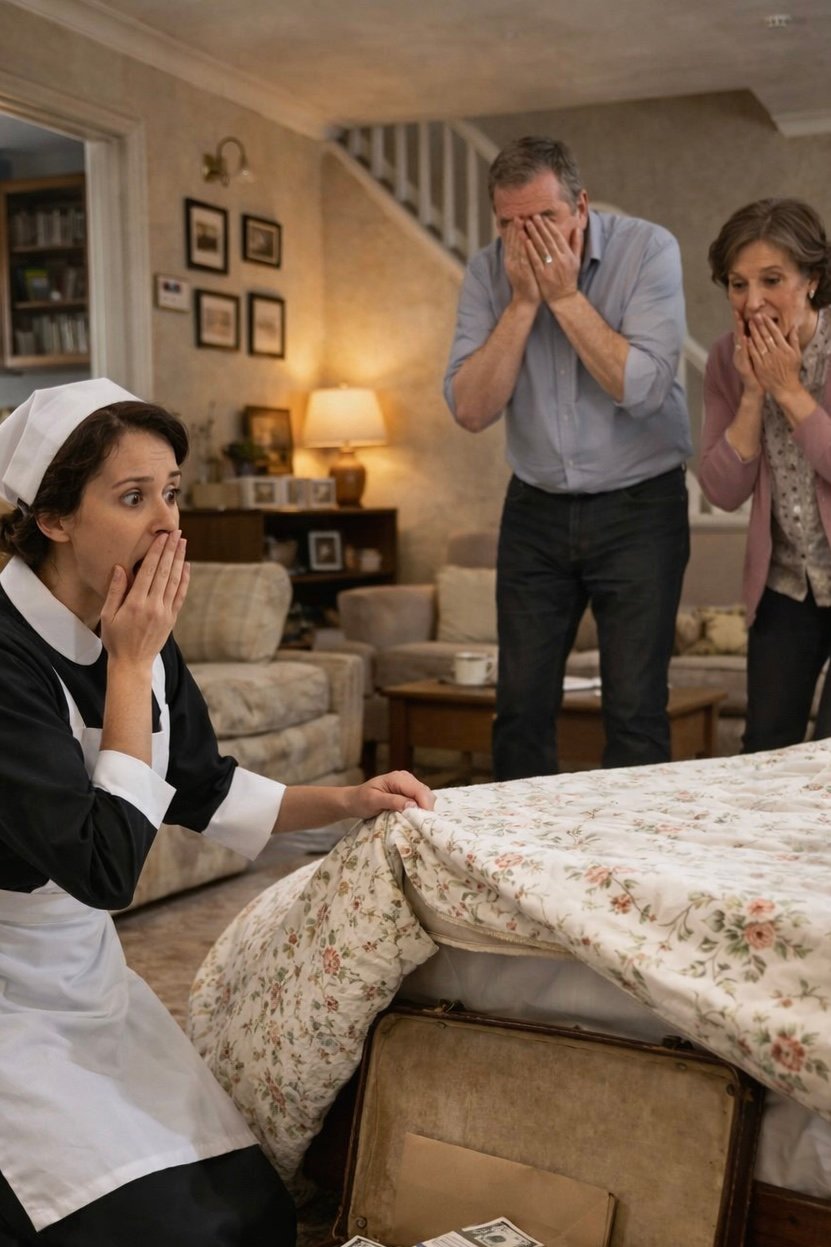
Drawn by an urge she couldn’t name, she slowly circled the bed, then knelt. With trembling hands, she lifted the bed skirt.
And froze.
Beneath the bed sat a wooden chest.
It didn’t belong.
The room was modern, carefully curated. Every detail intentional. Yet this chest looked ancient—its wood cracked and scarred, dulled by time. Dust coated its edges.
The air beneath the bed felt heavy. Pressurized.
Mara pulled the chest into the light. The hinges creaked softly.
Inside lay a faded black-and-white photograph of a stern woman with sharp eyes. Beneath it rested a rusted locket, dried herbs bound with twine, an old rosary, and handwritten pages marked with unfamiliar symbols.
These weren’t keepsakes.
They were intentional.
Footsteps stopped behind her.
Julian stood in the doorway, color draining from his face as he saw the contents.
“That’s my wife’s mother,” he whispered.
The woman who had hated him. Blamed him. Promised he would pay.
She had died before Elara was born.
Julian dropped beside Mara and explained in a shaking voice how, after his wife’s death, her mother had become obsessed with protection rituals—charms, wards, symbols meant to guard against unseen dangers. Julian had ordered everything removed.
But someone had put this back.
And not to protect.
Mara didn’t hesitate.
She carefully removed each item, wrapping them in cloth. As the last piece left the space beneath the bed, Elara stirred.
Her breathing deepened.
Color returned to her cheeks.
The room felt lighter—like it had finally exhaled.
That night, Elara slept in a guest room beside Mara.
For the first time in months, she slept peacefully.
No trembling. No shallow breaths.
Days passed.
Then weeks.
Elara smiled again. Asked to go outside. Walked in the garden. Painted with bright colors. Laughed softly as Mara braided her hair.
Doctors were stunned.
Julian watched, guilt and relief twisting together. He realized how grief had blinded him, how control had replaced presence.
One afternoon, he saw Mara reading by the window, Elara leaning comfortably against her.
Something inside him loosened.
Mara stayed.
Not just as a caretaker—but as the one who saved a child by noticing what others overlooked.
The chest was removed and sealed away. No one ever discovered who placed it there.
Julian stopped searching for that answer.
Because his daughter was healing.
And sometimes, healing begins when someone dares to look beneath the surface.