
They called me delusional. They said I was walking into a slaughterhouse without a weapon.
In the cutthroat world of high-stakes divorce litigation, you simply do not represent yourself against a shark like Jameson Brooks. It is unheard of—especially when he has hired the deadliest lawyer in the city to gut you. Everyone in Department 42 expected a massacre that morning. They expected Kiana Bell to cry, put her name on the agreement with a trembling hand, and disappear back into the poverty she came from.
Jameson certainly did. He even laughed out loud when I stood up.
But my husband forgot one crucial thing: the person who helps build the empire usually knows exactly where the bodies are buried.
What happened over the next three days didn’t just silence his laughter. It stunned the entire legal system and exposed a secret so dark the judge threatened to have everyone in the room arrested. This is the story of the wife who played the fool—only to checkmate the king.
The laughter was not subtle. It was a rich, throaty sound that bounced off the mahogany walls of Superior Court, the kind of laugh that belonged to a man who had never lost a day in his life.
Jameson Brooks leaned back in his Italian leather chair, smoothing the lapel of his $3,000 charcoal suit. He turned to his attorney, Harrison Howard—a man known in legal circles as the Butcher, because he left nothing behind—and whispered loud enough for half the room to hear.
“Look at her, Harrison. She’s wearing that dress I bought her for a charity gala five years ago. It’s pathetic. She thinks she’s in a movie.”
Harrison Howard didn’t laugh. He was a man with silver hair and eyes like chipped flint. He only smirked, tapping his gold fountain pen against the heavy oak table.
“Let her play pretend, Jameson. It makes the kill easier. Judge Coleman hates time-wasters. She’ll be held in contempt before lunch.”
Across the aisle at the plaintiff’s table sat me.
I felt small. The courtroom air conditioning blasted cold air, and I shivered slightly, my skin prickling under the thin fabric of my dress. Unlike the defense table—which was cluttered with paralegals, expensive laptops, and thick stacks of neatly bound exhibits—my table was empty, save for a single yellow legal pad and a plastic cup of lukewarm water.
I kept my head down. My brown hair was pulled back into a severe, sensible bun. To the casual observer, I looked like a defeated woman. I looked like a housewife traded in for a newer model—specifically Jameson’s twenty-four-year-old personal assistant, Destiny Price.
“All rise,” the bailiff bellowed.
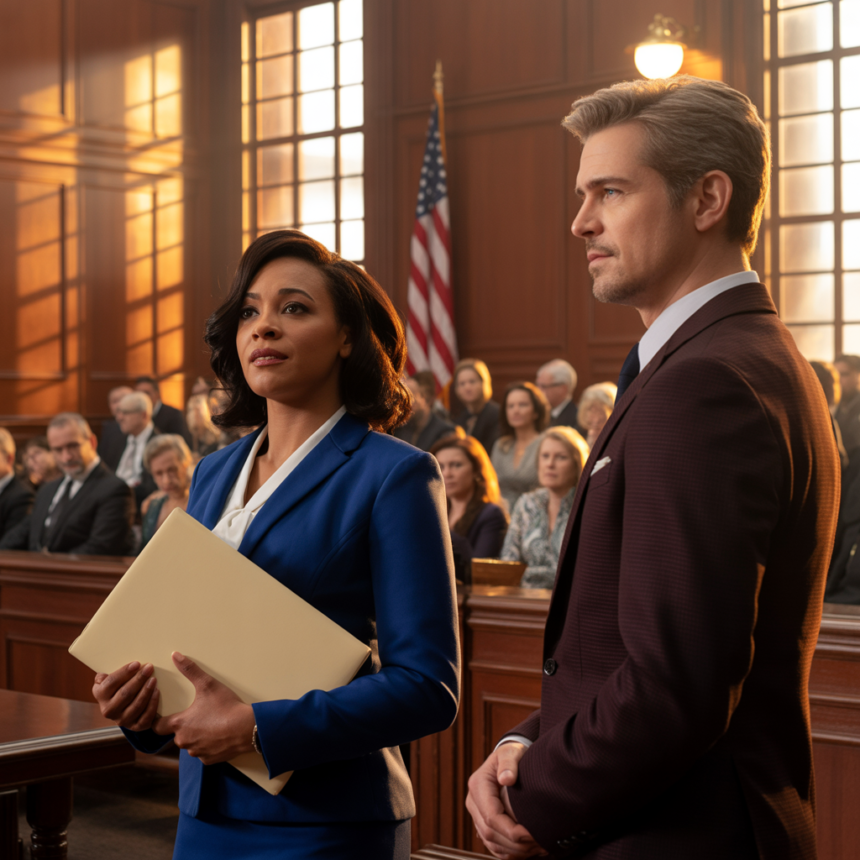
The heavy door behind the bench swung open, and the Honorable Judge Declan Coleman swept into the room. Coleman was an old-school jurist. He had zero patience for theatrics and even less for incompetence. He adjusted his glasses and looked down at the docket with a frown.
“Case number 4920,” Judge Coleman grumbled. “Brooks versus Bell. We are here for the final hearing on asset division and spousal support. Appearances.”
Harrison Howard stood smoothly, buttoning his jacket as if he’d been born inside a courtroom.
“Harrison Howard representing the respondent, Mr. Jameson Brooks, Your Honor.”
The judge looked toward my table. “And for the petitioner?”
I stood. My chair scraped loudly against the floor, a harsh sound in the quiet room. Jameson chuckled again, covering his mouth with a well-manicured hand.
“Kiana Bell, Your Honor,” I said. My voice was soft and trembling slightly. “Representing myself.”
Judge Coleman peered over his spectacles and let out a long, weary exhale that said he was already dreading the day.
“Ms. Bell, I am going to ask you this once, and I want you to listen carefully. Your husband is the CEO of Brooks Dynamics. The marital assets in question are estimated in the tens of millions. Mr. Howard has been practicing law for thirty years. Are you absolutely certain you wish to proceed pro se?”
He leaned back, his expression flat, his tone almost pitying.
“You’re bringing a butter knife to a nuclear war, madam.”
“I cannot afford an attorney, Your Honor,” I said, looking down at my hands. “Jameson cut off my access to the joint accounts six months ago.”
Harrison Howard shot up as if propelled by springs. “Objection. Your Honor, Mr. Brooks merely secured the assets to prevent frivolous spending. We offered Ms. Bell a generous settlement of $50,000 to cover her transition. She refused it out of spite.”
“Fifty thousand,” the judge repeated, raising an eyebrow.
“For an estate of this size,” Harrison said smoothly, “it is more than she came into the marriage with. She was a waitress when they met, Your Honor. She has no financial literacy. We are trying to protect the estate.”
“I see,” Judge Coleman said.
His eyes returned to me. “Ms. Bell, I strongly advise you to reconsider the settlement. If you proceed, you will be held to the same standards as a practicing attorney. I will not hold your hand. If you fail to object, evidence comes in. If you fail to file the proper motions, you lose. Do you understand?”
I looked up.
For a split second, the fear in my eyes seemed to vanish, replaced by something colder and harder. It was gone so fast Jameson missed it.
“I understand, Your Honor,” I said. “I am ready.”
Jameson leaned toward Harrison, delight practically bubbling out of him. “Watch this. She’s going to cry in ten minutes.”
“Mr. Howard,” the judge ordered, “your opening statement.”
Harrison Howard walked to the center of the room. He didn’t use notes. He was a performer.
“Your Honor,” Harrison began, his voice baritone and trustworthy, “this case is simple. It is a tragedy, yes, but a simple one. Jameson Brooks is a visionary. He built Brooks Dynamics from a garage start-up into a global logistics empire. He worked eighteen-hour days. He missed holidays. He sacrificed everything for the success of the family.”
He gestured at me as if I were an exhibit.
“And what did his wife do? She stayed home. She attended luncheons. She spent his money. And now that the marriage has unfortunately broken down due to irreconcilable differences, she wants half. She wants to dismantle a company that employs thousands of people just to fund a lifestyle she did nothing to earn.”
He paused, letting the accusation hang.
“We will prove that a prenuptial agreement exists—one that she claims to have lost—and that her contributions to the marriage were negligible. We ask the court to limit support to the statutory minimum and grant Mr. Brooks full retention of the company shares.”
He sat down.
It was clean. Polished. Devastating. It painted Jameson as the tireless hero and me as the parasite.
“Ms. Bell,” Judge Coleman said, “your opening statement. Keep it brief.”
I stepped around the table. I didn’t go to the podium. I stood awkwardly in the aisle, holding my yellow legal pad against my chest like a shield.
“My husband—James—and I,” I started, my voice shaking. “He says I did nothing. He says I was just a waitress.”
I swallowed.
“That is true. I was a waitress at the Blue Diner on Fourth Street when we met.”
Jameson rolled his eyes, already bored, already amused. Here comes the sob story, he thought.
But I continued, drawing a steadying breath.
“The law in this state speaks of a partnership. It speaks of good faith. Jameson is asking you to believe that he built Brooks Dynamics alone. He is asking you to believe that the fifty million dollars in the Vanguard trust does not exist.”
The room went dead silent.
Harrison Howard’s head snapped up. Jameson froze, the smile turning to stone on his face.
“The what trust?” Judge Coleman asked, leaning forward.
“The Vanguard trust, Your Honor,” I said, and my voice stabilized as if someone had flipped a switch. “And the shell company in the Cayman Islands registered as Blue Ocean Holdings. And the three commercial properties in Seattle purchased under the name of his driver, Cooper Long.”
Jameson’s face went from smug to purple in the span of three seconds. He slammed his hand on the table.
“That is a lie. She is lying.”
“Mr. Brooks, sit down,” the judge barked.
Then his gaze returned to me. The pity was gone, replaced by sharp interest.
“Ms. Bell, those are serious allegations. Alleging hidden assets without proof is a quick way to get your case dismissed and to be ordered to pay the other side’s legal fees.”
“I know, Your Honor,” I said.
I walked back to my table and picked up a single page.
“I do not have a law degree, but I do have the invoices, and I have the transfer records.”
I handed the paper to the bailiff.
“Marked as Exhibit A,” I said softly.
Harrison Howard snatched the copy from the bailiff. His eyes scanned the page. It was a wire transfer record—four million dollars moved from Brooks Dynamics to a generic account in the Caymans.
Harrison looked at Jameson, his expression tightening. “You told me the accounts were clean,” he hissed.
“They are,” Jameson whispered frantically, sweat beading on his forehead. “That account is encrypted. There is no way she could have that. She doesn’t even know how to use a spreadsheet.”
I sat back down. I looked at Jameson, and for the first time, I smiled.
It was not a happy smile. It was the smile of a hunter who had just set the trap.
“Call your first witness, Mr. Howard,” the judge said, his voice dropping an octave. “And this better be good.”
The air in the courtroom shifted. It was no longer a slaughter.
It was a brawl.
Harrison Howard was a seasoned veteran, though. He knew how to recover. He shoved the paper into his briefcase, dismissing it as a forgery or a misunderstanding to be dealt with later.
“I call Mr. Bennett Sanders to the stand,” Harrison announced.
Bennett Sanders was Jameson’s CFO. He had a nervous twitch and a suit that cost more than my first car. He took the oath, sat, and tried to look unbothered.
“Mr. Sanders,” Harrison began, pacing with controlled confidence, “you manage the finances for Brooks Dynamics. Correct?”
“I do,” Sanders said.
“Are you familiar with the plaintiff’s claims regarding hidden assets in the Cayman Islands or a Vanguard trust?”
“I have never heard of such things,” Sanders lied smoothly. “Our books are audited annually. Everything is above board. Ms. Bell is likely confusing standard operating expenses with whatever fantasy she has cooked up.”
Harrison turned to the judge, palms open as if presenting reason itself.
“You see, Your Honor—a misunderstanding of complex corporate finance.”
Then he turned to me. “Your witness.”
I stood. I didn’t bring my notepad this time. I walked straight up to the witness stand and looked Bennett Sanders in the eye.
Sanders shifted in his seat.
He had known me for ten years. He used to come over for Christmas dinner. He knew I made a great lasagna.
He did not know I could read a balance sheet.
“Hello, Bennett,” I said.
“Ms. Bell,” he nodded stiffly.
“Bennett,” I said, “do you recall the corporate retreat in Aspen in 2021?”
“Ah… yes. I was there.”
“Do you remember giving me your laptop to hold while you went skiing because you were afraid to leave it in the hotel room safe?”
Sanders blinked. “I might have. I do not recall.”
“I recall it,” I said. “You were very drunk that night, Bennett. You told me the password was your daughter’s birthday. July 14th, 2012.”
“Objection,” Harrison shouted. “Relevance.”
“I am getting there, Your Honor,” I said calmly.
Judge Coleman’s gaze stayed on me. “Proceed.”
“Bennett,” I said, “is it true that Brooks Dynamics utilizes a software called Shadow Ledger for internal accounting?”
Sanders’s face drained of color.
“That is—that is an industry standard tool.”
“Is it?” I pulled a page from my stack. “Because I did some research. Shadow Ledger is a dual-entry bookkeeping system designed specifically to maintain two sets of books—one for the IRS and one for the owners. Is that correct?”
Sanders’s mouth opened and closed, panic flickering behind his eyes.
“I… I take the Fifth,” he stammered.
The courtroom gasped.
“You cannot take the Fifth Amendment in a civil divorce trial regarding corporate procedure unless you are admitting to a crime, Mr. Sanders,” Judge Coleman boomed. “Answer the question.”
Sanders’s shoulders sagged. “It has that capability,” he whispered.
I didn’t let him breathe.
“On the night of December 14th, 2023—just three days before Jameson filed for divorce—did you oversee a transfer of six million dollars labeled consulting fees to a company called Orion Group?”
Sanders’s eyes darted to Jameson.
“I—Jameson told me to,” Sanders blurted, his voice cracking. “He said it was for future expansion.”
“And who owns Orion Group, Bennett?”
“I… I don’t know,” Sanders lied.
I turned to the judge. “Your Honor, I would like to submit Exhibit B. It is the articles of incorporation for Orion Group registered in Nevada.”
I placed the page on the overhead projector. The name on the registration was clear for everyone to see.
Destiny Price.
The courtroom erupted.
Jameson buried his face in his hands. Destiny Price—the assistant—was the mistress.
“Order,” Judge Coleman snapped, slamming his gavel. “Order.”
He glared at Jameson Brooks.
“Mr. Howard, control your client and your witnesses, or I will start issuing sanctions that will make your head spin.”
Harrison Howard turned toward Jameson with pure venom. “You told me the girl was not involved in the financials,” he hissed.
“She’s not,” Jameson whispered back, terrified. “I just used her name. I didn’t think Kiana would find it. She’s a housewife, Harrison. She knits.”
I returned to my table and sat down. I took a sip of water. My hand was shaking violently now. The adrenaline was wearing off, leaving nausea in its place.
I looked at Jameson.
He wasn’t laughing anymore. He stared at me with a mixture of fear and confusion, like a man who had walked into his own house and found a stranger sitting in his chair.
But I knew this was just the beginning.
Exposing the money was the easy part. The hard part was proving why I deserved it—because Jameson had one card left to play, a card that could destroy my reputation and leave me with nothing regardless of the money.
Harrison stood up again. He adjusted his tie.
He looked dangerous now. The smirk was gone, replaced by the cold, calculating stare of a predator who had been wounded.
“Your Honor,” Harrison said, his voice icy, “we would like to move past the financials for a moment. We would like to address the issue of conduct.”
He turned his head toward me as if I were something unpleasant on his shoe.
“We call Ms. Kiana Bell to the stand.”
I froze.
This was it. The cross-examination.
I stood and walked to the witness box.
“Ms. Bell,” Harrison said, stepping close enough to invade my personal space, “you seem very knowledgeable about your husband’s business today. Surprisingly so.”
“I pay attention,” I said.
“Do you?” Harrison’s mouth twitched into something that wasn’t a smile. “Because according to a sworn affidavit from your former psychiatrist, Dr. Rowan Cox, you suffer from paranoid delusions.”
The room went silent again.
“Is it not true that you were institutionalized in 2018 for a mental breakdown?”
This was the dirty laundry.
“I sought help for depression,” I said quietly. “I lost a child.”
“Ah, yes,” Harrison said, voice dripping with performative sympathy. “A tragedy. But during that time, you accused your husband of spying on you. You accused him of gaslighting you. You were medicated, were you not?”
“Yes.”
“And isn’t it true,” Harrison leaned in, “that you have a history of fabricating stories to get attention—that you are, in medical terms, an unreliable narrator?”
I looked at the judge, then at Jameson.
Jameson was grinning again. This was his narrative. Crazy Kiana. Sad, crazy Kiana.
“I was medicated,” I said, and my voice gained a strength I hadn’t felt in years. “I was medicated because my husband was gaslighting me—and I can prove that, too.”
Harrison let out a short, derisive laugh and shook his head.
“How?” he asked, glancing at the judge with a smirk. “With more stolen—”
“No,” I said calmly. “With the recordings.”
Harrison stopped laughing instantly. His smile evaporated.
“What recordings?” he demanded.
“The state of New York is a one-party consent state for audio recording,” I said, citing the statute number perfectly from memory. “For the last two years of our marriage, I carried a digital voice recorder in my pocket. Every threat, every admission, every time Jameson told me he would destroy me if I ever tried to leave—I have it all.”
I reached into my tote bag. My fingers closed around the cool plastic of a small black USB drive. I pulled it out and held it up for the room to see.
“Exhibit C, Your Honor,” I said.
Jameson jumped to his feet so fast he knocked his heavy leather chair over with a crash.
“She can’t do that!” he screamed, face turning blotchy red. “That is private conversation, Harrison—stop her!”
“Sit down,” Judge Coleman roared.
His voice boomed off the mahogany walls. “Mr. Howard, if your client speaks one more time out of turn, I will have the bailiff gag him.”
Jameson froze, chest heaving, and slowly sank back into his chair.
Judge Coleman turned his gaze to me. “Mrs. Brooks—” he hesitated, then continued, “you are telling me you have audio evidence of the respondent admitting to what exactly?”
I looked straight at Jameson. Right into his terrified blue eyes.
“Admitting to the fraud, Your Honor,” I said, “and admitting that he paid Dr. Rowan Cox to falsify my diagnosis to keep me under control.”
The silence in the courtroom turned heavy and suffocating, as if the oxygen had been sucked out of the room. Even the court reporter stopped typing, hands hovering over the keys.
“Play it,” Judge Coleman ordered.
The bailiff walked over and took the USB drive from my trembling hand. He plugged it into the court’s AV system. A projection screen descended from the ceiling, displaying a simple media player interface.
Judge Coleman leaned back in his high-backed chair, face unreadable.
“Mr. Howard,” the judge said, “I am allowing this under the crime-fraud exception to marital privilege. If this recording contains evidence of a crime, your objection is overruled before you even make it.”
Harrison Howard didn’t object. He was too busy staring at his client with dawning horror.
Jameson gripped the edge of the defense table so hard his knuckles turned white. He looked like a man watching a bomb tick down.
“Play it,” the judge said again.
The courtroom speakers crackled with static. Then a voice filled the room.
It was unmistakably Jameson Brooks.
The audio was clear, recorded in a space with a slight echo—likely our master bathroom with high ceilings and marble floors.
“Stop crying, Kiana,” the recorded voice sneered. “It’s pathetic. You really think anyone is going to believe you? You’re a high school dropout who got lucky.”
“I know what you’re doing with the Cayman accounts, Jameson,” my voice on the recording said, small and frightened. “I saw the papers in your briefcase.”
Jameson’s laugh on the recording was cruel.
“You saw papers you don’t even know what you were looking at. But let’s say you do. Let’s say you tell someone. Who are they going to believe—the CEO of a Fortune 500 company or the hysterical housewife who spent a month in a psych ward?”
“You put me there,” I whispered on the tape. “You told Dr. Cox to say I was paranoid.”
“I didn’t tell him anything,” Jameson’s voice boasted. “I bought him. Fifty thousand dollars is a lot of money for a shrink with gambling debts. He’ll write whatever diagnosis I want—paranoia, schizophrenia, bipolar. Take your pick.”
The courtroom didn’t breathe.
“If you try to touch my money, Kiana, I won’t just divorce you. I will have you committed permanently. I will make sure you drool in a cup for the rest of your life while I enjoy my money with someone who appreciates it. Now get out of my face.”
The recording clicked off.
The silence that followed was louder than the audio itself. It pressed down on everyone like a weight.
Judge Coleman slowly removed his reading glasses. He cleaned them with a small microfiber cloth, his movements deliberate and terrifyingly calm. Then he put them back on and looked at the defense table.
“Mr. Howard,” the judge said, voice barely a whisper but sharp enough to cut, “did your client just admit to bribing a medical professional to falsify a mental health diagnosis for the purpose of discrediting a witness?”
Harrison Howard stood. He was pale, the blood drained from his face.
“Your Honor, I have not heard this recording before. I cannot verify its authenticity. It could be deepfake technology. It could be AI-generated.”
“It is not AI,” I said from my seat.
I stood, legs feeling stronger now. “Because I didn’t come alone, Your Honor. I have a witness.”
“Who?” Jameson snapped, voice cracking. “Who do you have? You have no friends. I isolated you from everyone.”
I turned toward the back of the courtroom.
The heavy oak doors opened.
A man walked in, disheveled. He wore a cheap suit two sizes too big, stained at the collar, and he looked like he hadn’t slept in a week. He shuffled forward, eyes darting nervously around the room.
It was Dr. Rowan Cox.
Jameson gasped, the sound echoing in the quiet room.
“No,” he whispered.
“I call Dr. Rowan Cox to the stand,” I announced.
Harrison Howard stared at Jameson with pure venom. “You said he was in Europe,” he hissed. “You said he was unreachable.”
“He was,” Jameson hissed back. “I paid for his plane ticket.”
Dr. Cox took the stand. He refused to look at Jameson. He stared at the floor, hands shaking violently as he placed one on the Bible to take the oath.
“Dr. Cox,” I said, approaching. “You treated me in 2018, correct?”
“Yes,” Cox mumbled.
“And you signed an affidavit submitted this morning stating that I suffer from severe paranoid delusions. Is that affidavit true?”
Cox looked up at the judge. Then he looked at the bailiff near the door, hand resting on his belt. Cox swallowed hard.
“Speak up,” Judge Coleman barked.
“No,” Cox shouted, tears filling his bloodshot eyes. “It is not true. She is sane. She has always been sane. I made it up.”
The gallery erupted. Reporters typed furiously, whispering to one another.
“Why did you lie, doctor?” I asked gently.
Cox pointed a shaking finger at Jameson.
“Because he told me to. He paid off my bookie. I owed forty grand to some bad people in Atlantic City. Jameson paid it. He told me to gaslight her. He told me to prescribe heavy sedatives to make her look confused in public. I needed the money.”
His voice broke.
“I am sorry, Kiana. I am so sorry.”
“Objection!” Harrison roared, desperate to stop the bleeding. “This witness is clearly under duress. He is unreliable—”
“The only duress I see, Mr. Howard,” Judge Coleman said, eyes narrowing into slits, “is the perjury your client just suborned. Sit down before I have you joined as a codefendant.”
Harrison sat, slowly. And he moved his chair six inches away from Jameson, putting physical distance between himself and the radioactive fallout.
I looked at my husband.
Jameson was no longer the arrogant tycoon. He was sweating, his perfectly styled hair beginning to droop over his forehead. He looked small.
“I have no further questions for this witness,” I said.
“Dr. Cox,” the judge said ominously, “you are not to leave this building. The bailiff will escort you to a holding room. The district attorney will be very interested in your testimony.”
As Dr. Cox was led away, sobbing into his hands, the courtroom felt like a pressure cooker nearing rupture.
I returned to my table.
I had won the battle of character. I had proven I wasn’t crazy. But I still had to prove where the money was and why it mattered—because Jameson wasn’t just hiding money from me.
He was hiding it from everyone.
“Mrs. Brooks,” Judge Coleman said, and his tone had changed, becoming respectful, “do you have further evidence regarding the assets?”
“I do, Your Honor,” I said. “But for this part one, I’m going to need a calculator, and I’m going to need the court to look at the pension fund for the employees of Sterling Dynamics.”
Jameson’s head snapped up.
If looks could kill, I would have been dead on the spot. The fear in his eyes wasn’t just about divorce anymore. It was the primal fear of prison.
“The pension fund,” Harrison whispered, turning toward Jameson. “What did you do, Jameson? Tell me right now. If you lie to me again, I walk.”
“It’s complicated,” Jameson stammered. “I borrowed against it—just temporarily—to cover the margin calls on the expansion.”
Harrison closed his eyes and pinched the bridge of his nose.
“You embezzled from your employees’ retirement to fund a shell company,” he said, voice low and sick. “Jameson, that is federal.”
“Mrs. Brooks,” the judge ordered, “proceed.”
I walked to the projector and placed a new page on the glass. It was a complex spreadsheet filled with rows of numbers and dates.
“Exhibit D,” I said. “This is a comparison of the employee contributions to the Sterling Dynamics 401(k) plan versus the actual deposits made into the custodial account at Chase Bank.”
I used a cheap red laser pointer—one I’d bought at a gas station—to circle a column from January 2022 to present.
“Every employee had five percent of their paycheck deducted for retirement,” I explained, voice steady. “That money was supposed to go to Chase Bank, but it didn’t.”
I placed another sheet on the projector.
“This is the ledger from Blue Ocean Holdings in the Cayman Islands. The dates match perfectly. January 15th: four hundred thousand deducted from payroll. January 16th: four hundred thousand deposited into Blue Ocean.”
The courtroom buzzed.
“He was skimming the retirement fund, laundering it through the Caymans to avoid taxes, and then using it to buy real estate under his mistress’s name.”
This wasn’t just a divorce anymore.
It was a corporate scandal of massive proportions.
“Mr. Howard,” Judge Coleman said, voice deadly calm, “does your client have an explanation for why the employee pension fund is empty?”
Harrison stood slowly. He looked tired. He looked like a man who realized his career might die today along with his client.
“Your Honor,” Harrison said, “we request a recess. I need to confer with my client regarding potential criminal liability.”
“Denied,” Judge Coleman said instantly. “We are in the middle of a hearing. If your client wishes to invoke his Fifth Amendment rights against self-incrimination regarding the embezzlement, he may do so. But that will allow me to draw an adverse inference regarding the marital assets.”
He leaned forward.
“In layman’s terms, Mr. Howard: if he stays silent to stay out of jail, he loses the divorce. If he speaks to win the divorce, he goes to jail. Choose.”
It was the ultimate checkmate.
Jameson stood, shoving Harrison aside.
“This is ridiculous!” he shouted. “I am the CEO. It’s my company. I can move capital wherever I want. I was going to pay it back. It was a bridge loan.”
“A bridge loan unauthorized by the board,” I said calmly, from my table. “Because I have the board meeting minutes here, Jameson. You never told them. In fact, you fired the internal auditor who asked about it last month, didn’t you?”
“Mr. Cole was incompetent!” Jameson yelled, face turning a deep shade of crimson. “Just like you. You think you are so smart, Kiana. You think you can take me down. I built this empire. I am Sterling Dynamics. Without me, you are nothing. You are just a waitress.”
“Mr. Brooks,” Judge Coleman snapped, slamming the gavel, “control yourself.”
But Jameson was unhinged now, the facade of the cool, collected billionaire shattered into a thousand pieces.
“She hacked my computer!” he screamed. “That’s illegal. This evidence is inadmissible. Arrest her!”
“I didn’t hack your computer, Jameson,” I said softly.
The room went quiet just to hear me.
“I didn’t have to,” I continued. “You linked your iPad to the family cloud account so you could upload photos of your trips with Destiny Price. You were so arrogant you didn’t even realize that every file you saved, every spreadsheet you edited, was automatically backing up to the family server in the basement—the server I paid to install to store our wedding photos.”
I looked at him with something that felt like pity.
“You took everything from me, Jameson—my dignity, my friends. You tried to take my sanity. But you forgot to change your cloud settings.”
A few people in the gallery laughed. It was nervous, shocked laughter, the kind that slipped out when your brain didn’t know what else to do.
Harrison Howard began packing his briefcase.
“Where are you going, Mr. Howard?” Judge Coleman asked.
“I am withdrawing as counsel, Your Honor,” Harrison said, not looking at Jameson. “My client has lied to me, implicated me in suborning perjury, and is currently confessing to federal wire fraud on the record. I am ethically bound to withdraw.”
“You sit your backside down,” Judge Coleman ruled. “You will remain until this hearing is concluded. But you are not required to suborn further perjury.”
Jameson grabbed his lawyer’s arm.
“I pay you a thousand dollars an hour. You don’t leave until I say so.”
“Get your hands off me,” Harrison snarled, shaking him off.
Judge Coleman’s eyes flicked between them like a metronome.
“Now, Mrs. Brooks,” the judge said, “you have proven the assets exist. You have proven abuse and fraud. What is your request for judgment?”
I took a deep breath and glanced down at the yellow legal pad where I had scribbled my closing argument.
I didn’t need it.
“I don’t want half, Your Honor,” I said.
Jameson froze. “What?”
“I don’t want half,” I repeated, firm now. “I want it all.”
Judge Coleman’s eyebrows lifted. “On what grounds?”
“On the grounds of dissipation of assets,” I said, citing the precedent. “When one spouse maliciously wastes or hides assets to defraud the other, the court has discretion to award one hundred percent of the remaining estate to the victim.”
I let the words settle, then kept going.
“Jameson emptied the pension fund. He spent millions on his mistress. He hid the rest in the Caymans. If you give him half, he will flee the country.”
I held up a printout.
“He has a flight booked to Brazil for tonight at ten p.m. Exhibit E.”
Jameson checked his pockets frantically for his phone. He had booked that flight two hours ago during the bathroom break.
How did she have it?
“My cloud,” he whispered, horrified.
“He is a flight risk, Your Honor,” I said. “I am asking for full control of the remaining liquid assets, the marital home, and the shares of Sterling Dynamics to be held in trust so that I can repay the employees he stole from.”
Judge Coleman looked at Jameson. He looked at the evidence. He looked at the empty witness stand where Dr. Cox had sat.
“I am inclined to agree,” the judge said.
He turned back to Jameson. “Mr. Brooks, surrender your passport to the bailiff immediately.”
“I left it at home,” Jameson lied.
“Bailiff, search him,” Judge Coleman ordered.
The bailiff stepped forward. Jameson backed away.
“Don’t touch me!” Jameson screamed, eyes darting to the exit, then to the windows. He was a trapped animal.
Then the heavy double doors at the back of the courtroom burst open with a loud bang that made everyone jump.
Everyone turned.
Six men and women in navy windbreakers with yellow lettering marched in, followed by two uniformed NYPD officers. The lettering on the jackets didn’t read FBI.
It read SEC—Securities and Exchange Commission—and behind them, DOJ—Department of Justice.
The lead agent, a tall woman with a stern face and hair pulled back in a tight bun, pointed at the defense table.
“Jameson Brooks,” she announced. “I am Special Agent Monique Ramirez. We have a warrant for your arrest for securities fraud, embezzlement, and money laundering.”
Jameson slumped into his chair. He looked at me.
I didn’t look away.
I didn’t smile.
I didn’t gloat.
I just watched.
I told you, James, I thought—and I whispered it, though he couldn’t hear me across the chaos. I told you I would survive. I told you I wasn’t crazy.
The words echoed in my mind like a quiet mantra of vindication, but the drama was far from over.
As the federal agents moved to cuff Jameson, Harrison Howard stood up from the defense table.
“Officer,” Harrison said, voice trembling as he pointed a manicured finger at his own client, “Mr. Brooks has just confessed to additional crimes on the court record. I suggest you get the transcript immediately.”
“You traitor!” Jameson roared.
He lunged at Harrison, face twisted into a mask of pure, unfiltered hate.
The chaos of Jameson Brooks’s arrest took twenty minutes to clear. The sight of a billionaire CEO being dragged out in cuffs, screaming at his lawyer and his wife, was the kind of spectacle that would dominate headlines from New York to Los Angeles for weeks.
When the heavy oak doors finally closed, leaving the courtroom in stunned, dusty silence, only a few people remained—me, Judge Coleman, the court reporter, and Harrison Howard, who was shoving papers into his briefcase like a rat sensing the ship had already snapped in half.
“Mr. Howard,” Judge Coleman said, his voice echoing in the empty room with the weight of a gavel strike.
Harrison froze, hand hovering over a stack of files.
“Your Honor,” he began.
“You are perilously close to being disbarred,” Judge Coleman cut in. “If you want to save your license, you will cooperate fully with the court-appointed receiver. Do I make myself clear?”
“Crystal, Your Honor,” Harrison said, wiping a bead of sweat from his brow.
He glanced at me. For a moment his eyes narrowed—not defeat, but calculation—before he hurried out through the side exit.
I stood alone at the plaintiff’s table.
Lightheaded.
The adrenaline crash was coming, and it was going to be brutal.
“Mrs. Brooks,” the judge said gently, “or should I say Ms. Bell.”
I looked up. “Yes, Your Honor.”
“In light of the federal indictment and the freezing of Mr. Brooks’s personal assets, the company—Sterling Dynamics—is effectively headless. The stock is going to freefall the moment the market opens tomorrow morning. Thousands of jobs are at risk.”
“I know,” I said, voice steady despite the trembling in my hands. “That is why I asked for control.”
Judge Coleman nodded slowly.
“I am granting you an emergency conservatorship over the voting shares held by the marital estate. Until the divorce is finalized or the criminal trial concludes, you are the majority shareholder. You are, for all intents and purposes, the owner of Sterling Dynamics.”
He leaned forward, expression grave.
“Be careful, Kiana. You just took down a wolf, but you are about to walk into a den of vipers. The board of directors will not welcome you with open arms. They will try to eat you alive.”
I picked up my yellow legal pad.
I didn’t feel like the trembling woman who had walked into that courtroom three hours earlier.
“Let them try,” I said.
Two hours later, a black town car pulled up to the gleaming glass skyscraper in Midtown Manhattan. The logo of Sterling Dynamics was etched in steel above the revolving doors.
I stepped out onto the sidewalk.
I hadn’t changed. I was still wearing the five-year-old dress Jameson had mocked, but as I walked through the lobby, the atmosphere was electric with fear. Employees huddled in corners, whispering behind cupped hands. They had seen the news alerts. They knew federal agents had raided the headquarters earlier that morning.
When I reached the executive floor, the reception area was empty. The receptionist had fled, likely fearing her own arrest. I walked straight to the double mahogany doors of the boardroom. Shouting leaked through the seams.
I pushed the doors open.
Around the massive oval table sat twelve men and one woman—the board of directors. They were arguing loudly, phones pressed to their ears, ties loosened, suit jackets tossed over chairs.
The room went silent as I entered.
“Who let you in?” barked Conrad Vance, the chairman of the board.
Vance was a seventy-year-old corporate raider with a reputation for stripping companies for parts.
“Security,” he snapped. “Get this woman out of here.”
“Sit down, Conrad,” I said.
My voice wasn’t loud, but it cut through the room like a blade.
Vance scoffed, face turning crimson. “Excuse me—do you know who I am? This is a restricted meeting. Go home and bake cookies, Kiana. Your husband is in jail and this company is under our control now.”
I walked to the head of the table, to Jameson’s empty chair. I didn’t sit yet. I stood behind it, hands resting on the leather back, feeling the cold texture under my palms.
“Actually,” I said, pulling the court order from my bag and sliding it down the polished table, “it is under mine.”
Vance snatched the page and read it. His face turned the color of ash.
“This is insane,” he sputtered. “Coleman gave you the voting rights. You have no experience. You’re a housewife.”
“I am the court-appointed conservator of the Sterling estate,” I corrected, “which owns fifty-one percent of the voting stock. That makes me the chairwoman.”
I let that settle, then continued.
“And as my first act, I am calling this meeting to order.”
“We won’t stand for this,” another board member said, a heavyset man named Baxter. “We are filing an emergency motion to remove you. The stock is down forty percent in two hours. We need to sell the logistics division to Amazon by the end of the day to save capital.”
“No,” I said.
Baxter blinked like he hadn’t heard me correctly. “What do you mean, no?”
He stood, slamming his hand on the table. “You don’t understand business. We have a liquidity crisis.”
“We have a corruption crisis,” I shot back. “And we are not selling the logistics division. That division employs four thousand people in Ohio and Michigan. If you sell it, they lose their pensions because of the way Jameson structured the debt.”
I looked directly at him.
“I read the contracts, Baxter.”
Silence.
They looked at me differently now—not respect, but caution, like I was a bomb that had started ticking.
“So what is your brilliant plan?” Vance sneered. “Hug the employees until the stock recovers?”
“No,” I said. “My plan is to cut the cancer out.”
I reached into my bag and pulled out a stack of manila folders. I tossed one in front of Vance, one in front of Baxter, and one in front of the lone woman on the board, Linda Gray.
“What is this?” Linda asked, opening the folder with shaking fingers.
“That,” I said, “is a record of the kickback you received from the construction of the new warehouse in Nevada. You approved a bid that was twenty percent higher than market rate, and coincidentally, the construction company is owned by your brother-in-law, Linda.”
Linda went pale.
I turned to Vance. “And you, Conrad—you have been short-selling Sterling stock for three months. You knew Jameson was cooking the books. You were betting against the company you were supposed to be protecting.”
Vance slammed the folder shut. “This is slander.”
“It’s in the emails,” I said. “Jameson kept everything. He didn’t trust you any more than you trusted him.”
I leaned forward, gripping the chair until my knuckles turned white.
“Here is how this is going to work. Vance. Baxter. Gray. You are resigning—effective immediately. You will cite personal health reasons.”
I let my gaze sweep the room.
“If you do, I won’t hand these folders to the SEC agents currently downstairs seizing the servers. If you fight me, you will share a cell with Jameson.”
Vance looked at the other board members.
They looked away—at their shoes, at the ceiling, anywhere but him.
He was alone.
“You’re a witch,” Vance hissed.
“I’m a wife who paid attention,” I replied. “Get out.”
Vance stood, grabbed his coat, and stormed out. Baxter and Gray followed, heads bowed.
I looked at the remaining nine board members.
They sat perfectly still, terrified.
“Now,” I said, finally sitting in the leather chair. It was too big for me, but I filled the room with my presence. “Let’s talk about how we are going to pay back the pension fund.”
The first week of my reign as interim CEO of Sterling Dynamics was a blur of adrenaline and caffeine. I purged the board, stabilized the stock, and won the hearts of the employees.
To the outside world, I was the victorious heroine.
But inside the silent glass-walled executive suite on the forty-second floor, I felt an uneasy gnawing that wouldn’t leave me alone. I was winning the war for the company, but I still didn’t understand why the war had started in the first place.
Why had Jameson—a billionaire tycoon—married the daughter of a community organizer from Queens ten years ago?
It was eleven at night on a Thursday. The cleaners had long since departed, leaving the office in a heavy, pressurized silence. I sat at Jameson’s massive mahogany desk, staring at a painting of a nineteenth-century schooner on the wall.
I remembered Jameson once bragging, half drunk on scotch, that he kept his real insurance behind that ship.
I stood, removed the painting, and found a wall safe.
I punched in the code. Jameson’s ego was so fragile he used his own birthday. The heavy steel door clicked open.
There was no cash inside—only a stack of old hard drives and a single weather-beaten notebook bound in red leather.
I carried the notebook to the desk, clicked on the brass reading lamp, and opened it.
It wasn’t a ledger.
It was a diary of sins.
Bribes. Illegal dumping. Blackmail schemes. Twenty years’ worth.
But when I flipped to the entries from 2014, my blood ran cold.
Entry: June 12th, 2014.
Target identified. Kiana Bell, daughter of Marcus Bell, the owner of the Brownstones on the waterfront. He won’t sell. He claims the land is sacred to his family. HH says we need a workaround.
My hands began to tremble uncontrollably.
Bell was my maiden name. My father—Marcus—had been stubborn and proud.
He died penniless.
Or so I thought.
I turned the page, heart hammering against my ribs like a trapped bird.
Entry: July 4th, 2014.
HH suggests the widower route. If Marcus dies intestate, the land goes to the daughter. If I marry the daughter, the land becomes a marital asset. We can bypass the historical preservation society. It is cleaner than a buyout.
I gasped, a ragged sound in the empty room.
The romance. The flowers. The way Jameson had “accidentally” bumped into me at the coffee shop.
It was never love.
It was a corporate acquisition.
I was nothing more than a deed with a heartbeat.
But the next entry shattered what was left of my soul.
Entry: August 15th, 2014.
Problem solved. The old man wouldn’t get out of the road. HH was driving. It was messy but effective. Police report filed as a hit and run. No witnesses. We own the girl now.
Tears blurred my vision.
My father hadn’t died of a heart attack or a random accident.
He had been killed—run down in the street like an animal—so Jameson could build a luxury high-rise.
And those initials.
HH.
Harrison Howard.
The buzz of the intercom jolted me so hard I nearly dropped the notebook.
“Mrs. Brooks,” the night security guard’s voice crackled, “Mr. Howard is here. He says he has urgent papers regarding the plea deal.”
I stared at the intercom, paralyzed.
The man who had helped take my father from me was in the lobby.
“Send him up,” I whispered, my voice sounding foreign even to my own ears.
I had seconds.
I slipped the red notebook into my purse. I slid my phone under a stack of files and hit record on the voice memo app. I grabbed a can of pepper spray—something I’d started carrying since the divorce began—and hid it in my palm beneath a file folder.
The elevator chimed.
The sound was deafening in the quiet office.
Harrison Howard walked in.
He wasn’t the polished lawyer tonight. He wore a dark trench coat. His eyes were rimmed with red, like a man who had stared into the abyss and blinked.
“Working late, Kiana,” he said, closing the heavy oak door behind him.
The lock clicked.
“You’re taking to the throne quite naturally.”
“What do you want, Harrison?” I asked.
I stayed behind the desk, fingers white-knuckled around the file folder.
“I’m here to save you,” Harrison lied, walking toward the wet bar. He poured himself a scotch, his hand steady. “Jameson is cracking. He’s going to trade everyone to the feds—me, the board, you.”
He took a slow sip.
“But I can protect you, Kiana. I can make sure your name stays out of the indictment.”
“I haven’t done anything wrong,” I said, watching him like a hawk.
“It doesn’t matter,” Harrison smiled—a cold, reptilian expression. He walked around the desk, invading my space. “I need leverage. I need the notebook, Kiana.”
My lungs forgot how to work.
“I don’t know what you mean,” I managed.
“Don’t play the fool anymore,” Harrison sighed, leaning against the edge of the desk. “I tracked the biometric log. You opened the safe. You know about the land. You know about the accident.”
“It wasn’t an accident,” I said, voice shaking with rage. “You killed him. You killed my father.”
The silence that followed felt heavy enough to crush bone.
Harrison didn’t deny it. He sipped his drink, almost bored.
“It was necessary,” he said simply. “Marcus was an obstacle. We removed him, and you got a life of luxury in exchange.”
“Was it really such a bad trade?”
“You’re a monster,” I whispered.
“I’m a pragmatist,” Harrison corrected, setting the glass down. “Now give me the book. If the DOJ gets that, it’s a murder charge. I won’t go down alone, Kiana. I will plant evidence that you were driving the car. Who will they believe—the grieving widow or the greedy ex-wife?”
He held out his hand.
“The book. Now.”
I glanced at the door. It was twenty feet away. I looked back at Harrison.
“Okay,” I said, reaching into my purse. “You win.”
I pulled out the red notebook.
Harrison’s eyes lit with greed. He reached for it.
I tossed the book high into the air over his head.
Harrison’s instincts took over. He spun, lunging to catch the evidence before it hit the floor.
In that split second, I dropped the file folder, raised the pepper spray, and unleashed a stream straight into his face.
Harrison screamed—a primal, terrifying sound. He clutched his eyes, stumbling back into the wet bar. Glass shattered as he crashed into the shelves.
I didn’t hesitate.
I snatched the notebook from the floor and bolted.
“You witch!” Harrison roared, swinging blindly. “You’re dead!”
I sprinted for the elevator, slamming my hand against the call button.
Come on. Come on.
Behind me, I could hear him stumbling down the hallway, cursing in a blind rage.
The doors opened.
I threw myself inside and hit the lobby button.
As the doors slid shut, I saw Harrison burst into the hallway, face swollen and red, a shard of broken glass clutched in his hand.
The doors closed, sealing me in.
But as the elevator descended, I knew the nightmare wasn’t over.
I was trapped in a building with a killer, and there was nowhere left to hide.
The elevator doors slid open with a cheerful ding that felt obscene in the dark lobby. I stumbled out into a cavern of marble and glass. It was usually bustling, but tonight it was a silent tomb.
I sprinted toward the revolving doors, heels clicking loudly on the polished floor. I pushed against the heavy glass.
It didn’t move.
Panic surged in my throat.
The night security protocol—the building automatically locked down at midnight.
I checked my pockets frantically, but Jameson’s access card was gone, dropped in the struggle upstairs.
I was trapped.
“Kiana!”
The scream echoed down the elevator shaft, followed by the heavy thud of footsteps at the emergency stairwell door.
Harrison hadn’t waited for the elevator.
He was coming down the stairs, and he was getting closer with every second—fueled by a terrifying rage that seemed to defy his physical limits.
I dove behind the massive granite security desk just as the heavy steel door to the stairwell burst open, slamming against the wall with a violence that echoed through the empty atrium.
Harrison Howard limped into the cavernous lobby, and he looked like something out of a nightmare. His eyes were bloodshot and streaming tears from the pepper spray. His skin was blotchy and swollen. In his right hand, he gripped a jagged shard of heavy crystal—likely a broken piece from an award in the hallway—now repurposed into something meant to hurt.
“I know you’re in here,” Harrison rasped, his voice grinding against the marble as it bounced off the cold walls. “The building is in total lockdown. The doors are magnetic. You cannot get out—and I assure you the police will not get here in time to save you.”
I crouched lower, pressing my back against the cool stone of the desk, clutching the red leather notebook to my chest like a shield. My other hand gripped my smartphone so tightly my knuckles turned white.
The screen glowed.
The call with Special Agent Monique Ramirez—silent, but very much connected.
“You really think you have one, don’t you?” Harrison taunted, moving slowly toward the center of the room. He hunted by sound, tilting his head, trying to listen past the rushing blood in his own ears. “You think just because you found a diary, you can take us down. Jameson is weak. He always was.”
He took another step, voice dropping into something almost conversational.
“But me? I solve problems. I fix things—just like I fixed the problem of your father all those years ago.”
He stopped moving.
In the silence of the lobby, the air conditioning hummed, but it wasn’t enough to mask the sound of my ragged breathing behind the desk.
“Found you,” Harrison whispered.
He lunged around the corner of the security station with surprising speed.
I screamed—a raw sound of survival—and scrambled backward on my hands and knees, putting distance between myself and the man who had destroyed my family. I backed toward the massive decorative fountain in the center of the lobby, water cascading down slate tiles.
Harrison closed the distance, raising the glass shard high, his face twisted into pure hate.
“Give me the book, Kiana,” he snarled. “Give it to me now, and I’ll make it quick.”
I looked up at the shard catching the lobby lights. I looked at the man who had orchestrated the worst chapters of my life.
Then I looked down at the phone in my hand.
Something in me shifted.
The fear drained away, replaced by cold resolve.
“No,” I said. My voice shook at first, then steadied with every syllable. “I’m not giving you the book, Harrison. But I will give you an audience.”
I held the phone up, the screen glowing bright in the dim lobby.
“Agent Ramirez,” I said, “did you hear that confession?”
A crisp, amplified voice cut through the silence, loud enough for Harrison to hear over the rushing water.
“We got it all, Mrs. Brooks. Stay down—and look at the main entrance.”
Harrison froze, arm still raised, confusion clouding his swollen eyes.
Then the world exploded.
The massive glass revolving doors shattered inward with a deafening crash as a swat-armored truck rammed the entrance, metal groaning against stone. Men in heavy tactical gear swarmed through the jagged opening, laser sights cutting through dust and debris like red needles.
“Federal agents! Drop the weapon! Get on the ground!”
The commands were barked with authority, bouncing off the high ceilings.
Harrison Howard stood blinking in the tactical lights, suddenly small and pathetic against a wall of law enforcement.
Realizing it was truly over—that his money and connections could not save him—he dropped the shard.
It shattered harmlessly on the marble floor.
He fell to his knees, hands raised in defeat.
As officers swarmed him, cuffing him and dragging him away, Special Agent Monique Ramirez walked calmly through the debris, her heels clicking on the floor. She approached me by the fountain, where I stood trembling as the adrenaline began to drain from my body.
“Mrs. Brooks,” Ramirez asked, her voice softening, “are you all right?”
I took a deep breath and handed her the red notebook.
“Here,” I whispered, voice barely audible. “The murder, the fraud, the land grab—it’s all in there. Every single page.”
Six months later, the fall of the empire Jameson Brooks and Harrison Howard had built was absolute and irreversible.
Harrison—stripped of any possibility of immunity due to the overwhelming evidence and his recorded confession—was charged with first-degree murder, racketeering, and fraud. He never made it to trial. He died in prison three months into his holding period, a lonely end for a man who thought he owned the world.
Jameson Brooks, facing a mountain of evidence, took a plea deal. He accepted twenty-five years in federal prison. The last time I saw him, he was crying as bailiffs led him away in cuffs, his expensive suit replaced by a jumpsuit that hung loose on his frame.
But the story ended exactly where it began—with the land.
On a crisp golden autumn morning, I stood at the head of the boardroom table in the skyscraper that used to intimidate me. The corporate raiders and slick lawyers were gone. In their seats sat truck drivers with calloused hands, shift managers in polo shirts, and secretaries who had kept the company running for decades.
“This company was built on the land my father died for,” I told them, my voice clear and strong. “He believed in honest work and community. Effective today, Sterling Dynamics is no longer a private corporation.”
I paused, letting the moment breathe.
“It is an employee-owned cooperative. You own the shares. You keep the profits.”
The room erupted in cheers, tears, and applause—a sound far sweeter than any shareholder meeting.
I walked out of the building, the autumn air cool against my face, and drove my modest sedan to a quiet cemetery just outside the city limits.
I crossed crunching leaves until I reached a simple, well-tended gravestone.
It read: Marcus Bell.
I knelt in the grass, not caring about stains on my jeans.
“I got it back, Daddy,” I whispered, placing a copy of the court order on the grass beside a bouquet of fresh lilies. “I got the land back, and I made them pay for what they did to you.”
I stood, wiping my eyes—but these were tears of relief, not sadness.
I wasn’t the waitress anymore.
I wasn’t the victim.
I was Kiana Bell, and I had never been stronger.
They always say that hell hath no fury like a woman scorned.
But Kiana proved that fury isn’t always loud, and it isn’t always chaotic.
Sometimes true fury is organized.
It is patient, and it is legal.
Jameson and Harrison thought they were untouchable because they had money, power, and the law on their payroll. They laughed at Kiana because she was just a wife, just a temporary inconvenience.
But they forgot the most important rule of survival.
You never, ever corner a woman who has nothing left to lose.
Kiana didn’t just win a divorce settlement. She dismantled a criminal empire brick by brick and exposed a decades-old murder.
If you enjoyed this story of justice served ice cold, please hit that like button. It really helps the channel grow and lets us know you want more stories like this. Don’t forget to subscribe and turn on notifications so you never miss the drama. Tell me in the comments—do you think 25 years was enough for Jameson, or did he deserve life like Harrison?