

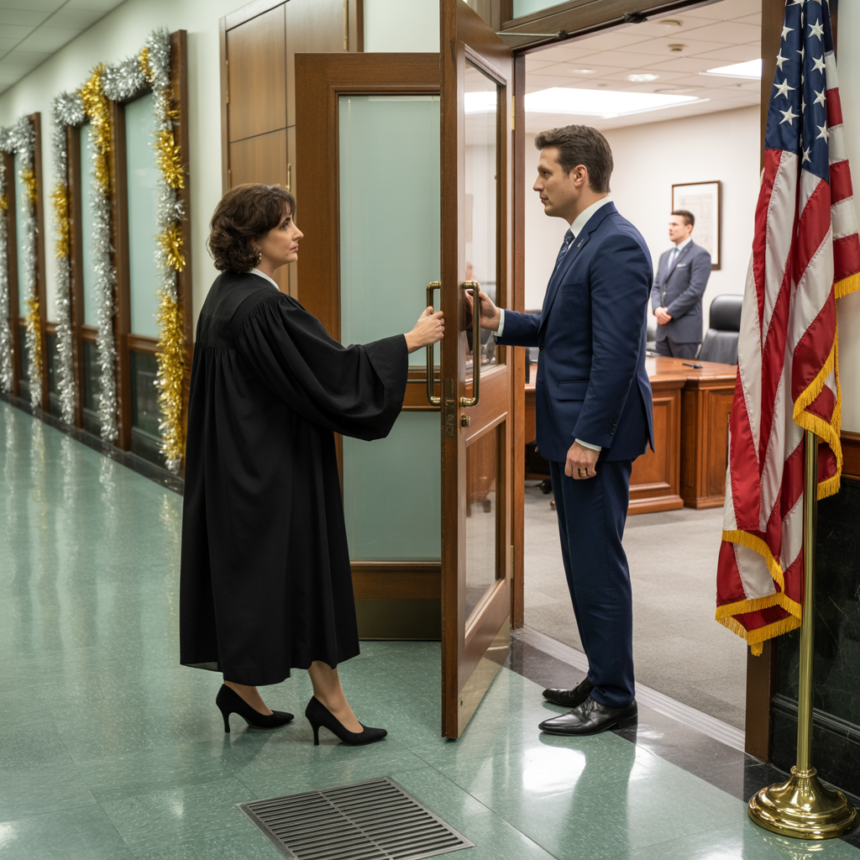
Dad Said “Skip My Party — Your Sister’s Boyfriend Is A Federal Judge” — Until He Saw…
My name is Alexandra Martinez, and for the last six years, my family has treated my career like an embarrassing secret they’re forced to acknowledge at holidays.
It started when I graduated from Yale Law School at 25. My father had been so proud—his daughter, the lawyer. My older sister, Emma, had gone into marketing, which Dad tolerated but never really celebrated.
But law—law was prestigious. Law was respectable.
Then I told them where I’d be working.
The public defender’s office.
My father repeated it, his face falling.
“The Bronx.”
“Dad, it’s an incredible opportunity.”
“Alexandra, you graduated third in your class from Yale. You had offers from every major firm in Manhattan. Sullivan & Cromwell wanted you. Cravath wanted you. And you’re choosing to defend criminals for $63,000 a year.”
“I’m choosing to defend people who can’t afford representation. It’s constitutional work, Dad. It matters.”
My mother put her hand on his arm.
“Richard, maybe it’s just for a year or two. Like a fellowship.”
But it wasn’t just for a year or two.
I spent six years as a public defender, handling everything from misdemeanors to murder cases. I worked 100-hour weeks, fought against prosecutors with unlimited resources, and won more cases than I lost.
I became known in the Bronx as the firewall, because no matter how strong the prosecution’s case seemed, I’d find a way through.
My family never understood it.
Every holiday gathering was the same. My sister Emma would talk about her marketing campaigns for luxury brands, her salary increases, her corner office with a view of Central Park.
My parents would beam with pride. Then they’d turn to me.
“Still working with criminals, Alex?”
“They’re called defendants, Mom.”
“And yes.”
“When are you going to move to a real firm? Emma’s boyfriend knows some partners at—”
“I’m happy where I am.”
The disappointment was always palpable.
Sometimes I could feel it like a draft under a door—cold, constant, and impossible to ignore. My father would stare at my hands while I talked, like he expected to see dirt under my nails, like my work had made me permanently unclean.
That was the part no one outside our family understood. People in the Bronx respected me. Judges listened to me. Prosecutors learned to prepare when my name was on the docket.
But in my parents’ dining room, I was still the kid who chose the “wrong” kind of success.
I didn’t come from a family that hated public service. My father didn’t sneer at teachers or nurses. He could praise sacrifice in the abstract.
What he couldn’t tolerate was sacrifice when it belonged to me, because he’d been saving his pride for a different kind of story.
The story doesn’t end here – it continues on the next page.
TAP → NEXT PAGE → 👇